Yogaḥ Karmasu Kauśalam: Yoga Is Skill in Action
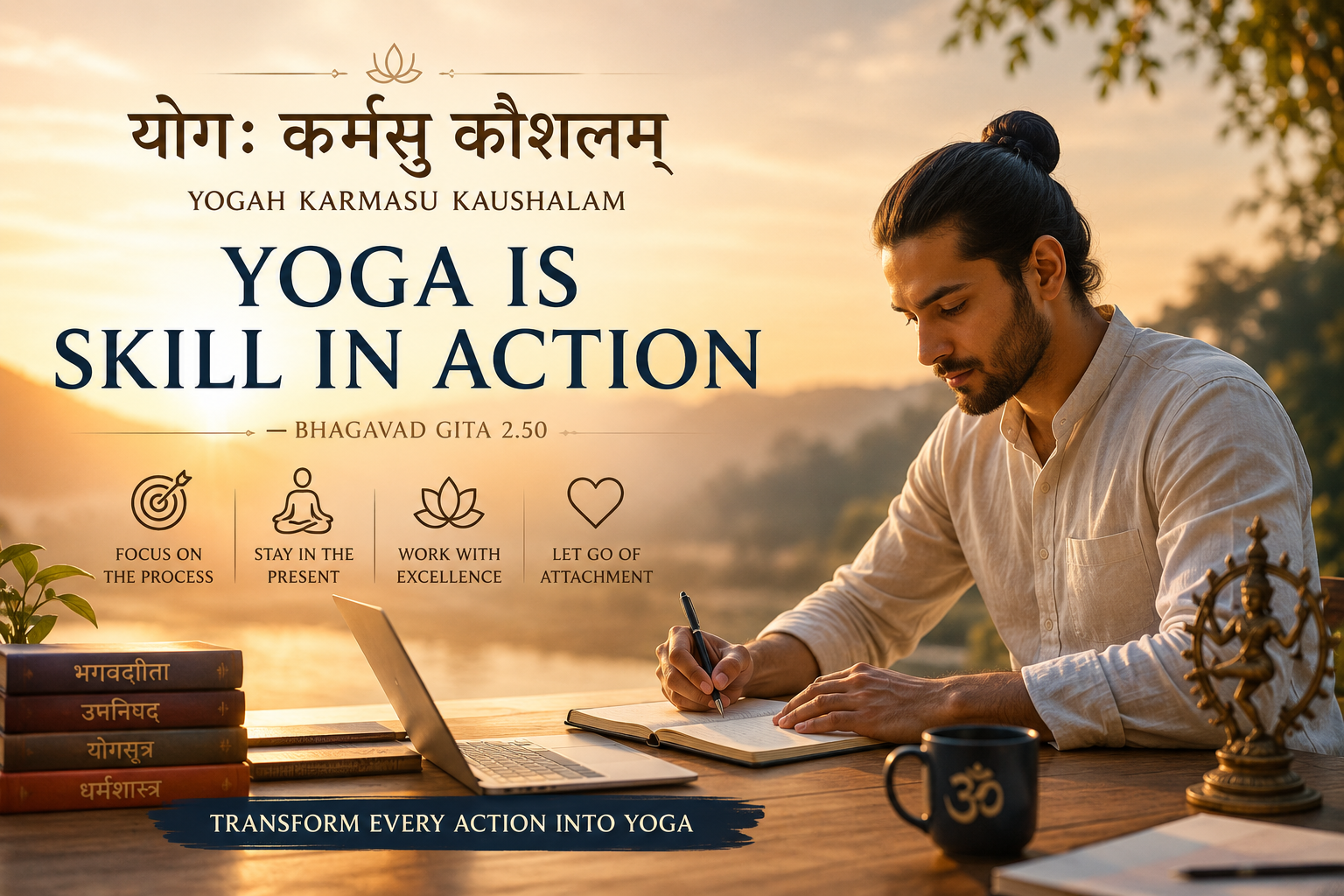
Yogaḥ Karmasu Kauśalam: Yoga Is Skill in Action
Introduction
“Yogaḥ Karmasu Kauśalam” is one of the most well-known descriptions of Yoga found in the Bhagavad Gita, Chapter 2, Verse 50.
It is commonly understood as “Yoga is skill in action.”
This teaching expands our understanding of Yoga beyond meditation and the physical practice of asanas. Yoga can also be expressed through the way we perform our actions—with skill, awareness, balance, and excellence.
When a person performs their duty with complete attention and dedication, without being excessively preoccupied with the fruits of the action, the very act of working can become a practice of Yoga.
The Teaching
योगः कर्मसु कौशलम्
Yogaḥ Karmasu Kauśalam
Word-by-Word Meaning
- Yoga (योग) – Union, integration, or a state of inner balance
- Karmasu (कर्मसु) – In actions or activities
- Kauśalam (कौशलम्) – Skillfulness, dexterity, competence, or excellence
Meaning
“Yoga is skillfulness in action.”
In practical terms, it teaches us to perform our actions with awareness, intelligence, balance, and excellence.
Yoga and Action
Yoga does not mean practising asanas alone.
Every activity in life can become a part of Yogic practice. Whether it is:
- Studying
- Teaching
- Running a business
- Serving others
- Performing daily responsibilities
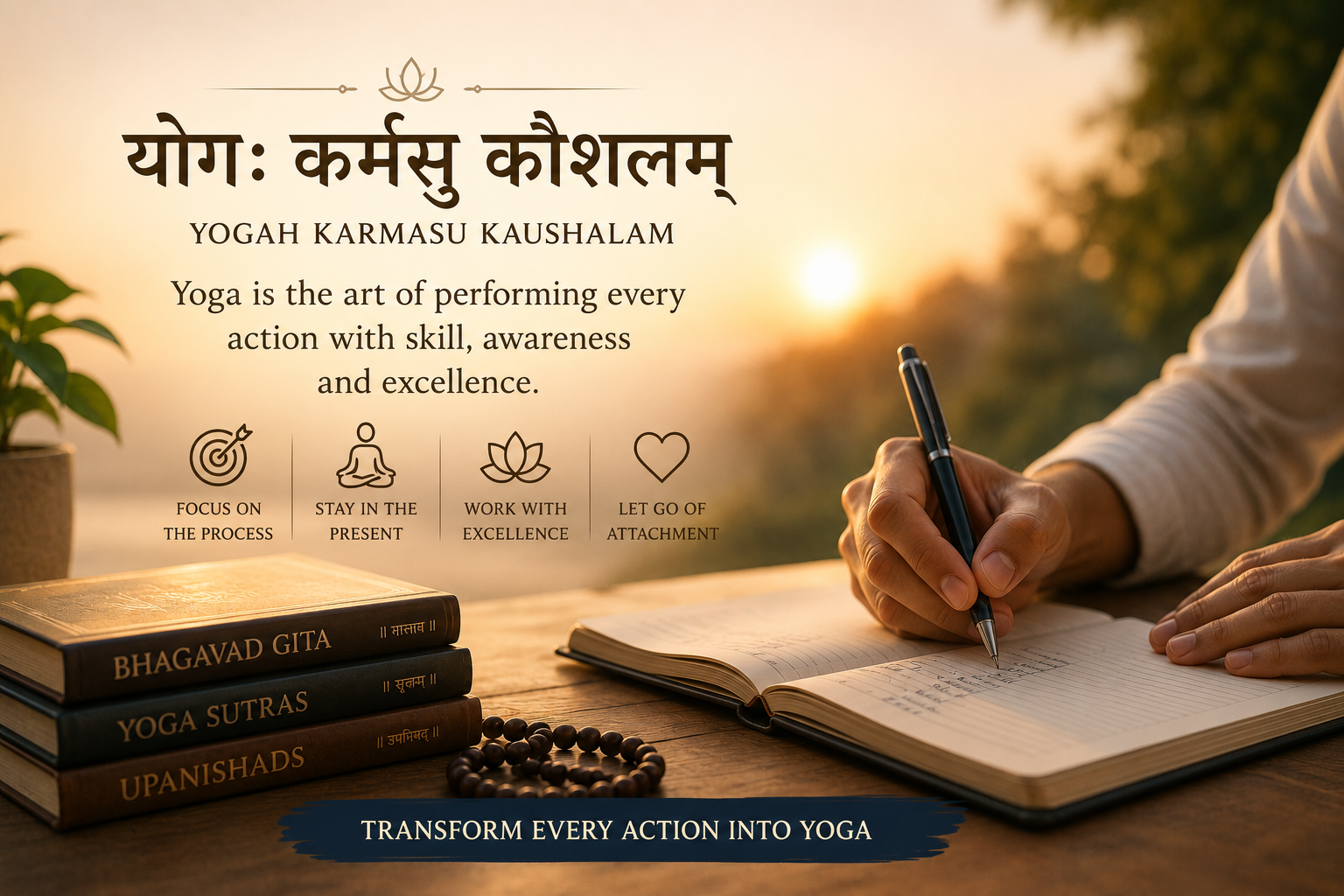
When an action is performed with complete awareness, dedication, and sincerity, the quality of that action changes.
The workplace can become a place of Yoga. A classroom can become a place of Yoga. Even ordinary household activities can become Yogic when they are performed with awareness and complete involvement.
Thus, Yoga is not necessarily separate from life. It can become the very way in which we live and act.
Focus on the Process, Not Only on the Result
One of the central messages associated with this teaching is the importance of focusing on the process rather than being constantly anxious about the result.
A person may repeatedly think:
- What will I get from this?
- When will I become successful?
- What will the result be?
When the mind remains excessively occupied with the future result, attention is divided. As a consequence, the quality of the present action may decline.
On the other hand, when a person gives complete attention to the work being performed in the present moment, the action becomes more focused, effective, and refined.
This does not mean that we should have no goals.
Goals provide direction. However, excessive attachment to the result can create anxiety, fear, and mental disturbance.
The Bhagavad Gita teaches us to act sincerely while developing a balanced relationship with the fruits of our actions.
What Does “Skill in Action” Mean?
Skill in action is not limited to technical expertise.
From a Yogic perspective, Kauśalam can also be understood as the intelligence and balance with which we respond to life.
It includes:
- Performing every action with complete attention
- Handling circumstances intelligently
- Using the body and mind in a balanced manner
- Responding to challenges with calmness and clarity
- Maintaining awareness while performing one's duties
Therefore, skillful action involves both external efficiency and internal balance.
A person may be highly productive, but if the mind is continuously disturbed, anxious, or overwhelmed, something is missing from the Yogic dimension of action.
Yoga encourages us to develop excellence in our actions without losing our inner equilibrium.
The Importance of Vairāgya
Vairāgya, or non-attachment, plays an important role in understanding this teaching.
A person should certainly set goals and work sincerely towards them. However, one should not become excessively attached to a particular result.
Attachment often creates mental pressure.
We begin to think:
“What if I fail?”
“What if the result is not what I expected?”
“What will others think?”
Such thoughts consume mental energy and reduce our ability to remain fully present in our actions.
When we perform our duties with dedication but reduce excessive attachment to the outcome, our attention naturally returns to the quality of the work itself.
This is the deeper practical spirit of Yogaḥ Karmasu Kauśalam.
The Practical Message of Yogaḥ Karmasu Kauśalam
The teaching can be applied to everyday life in a simple and practical way:
- Set clear goals.
- Perform your duties with complete dedication.
- Remain aware of the present moment.
- Focus on the quality of the process.
- Do not allow anxiety about the result to dominate your mind.
- Continuously improve the quality of your actions.
- Maintain inner balance while facing success and failure.
When these principles become part of our daily life, Yoga moves beyond the Yoga mat and becomes a way of living.
Key Points
- “Yogaḥ Karmasu Kauśalam” is an important description of Yoga found in the Bhagavad Gita.
- It is commonly translated as “Yoga is skill in action.”
- Yoga is not limited to asanas or meditation.
- Every action can become Yogic when performed with awareness and complete attention.
- We should focus more deeply on the quality of the process rather than constantly worrying about the result.
- Skill in action includes both external competence and internal balance.
- Goals are important, but excessive attachment to outcomes can disturb the mind.
- Non-attached and skillful action can support clarity, inner peace, and effectiveness.
- Yoga is not merely a physical practice; it is the art of bringing awareness, balance, and excellence into every action of life .
Conclusion
Yogaḥ Karmasu Kauśalam presents Yoga as a deeply practical philosophy of life.
Yoga is not confined to a particular posture, meditation room, or practice session. It can be present in the way we study, teach, work, serve, communicate, and perform our daily responsibilities.
The teaching is simple yet profound: give your full attention to the action before you, perform it with skill and awareness, and do not allow excessive attachment to the result to disturb your inner balance.
When awareness, excellence, and equanimity become part of our actions, everyday life itself begins to become a practice of Yoga.
Yoga is not only something we practise. Yoga can become the way we act, work, and live.