Yama: The First Limb of Ashtanga Yoga
Introduction
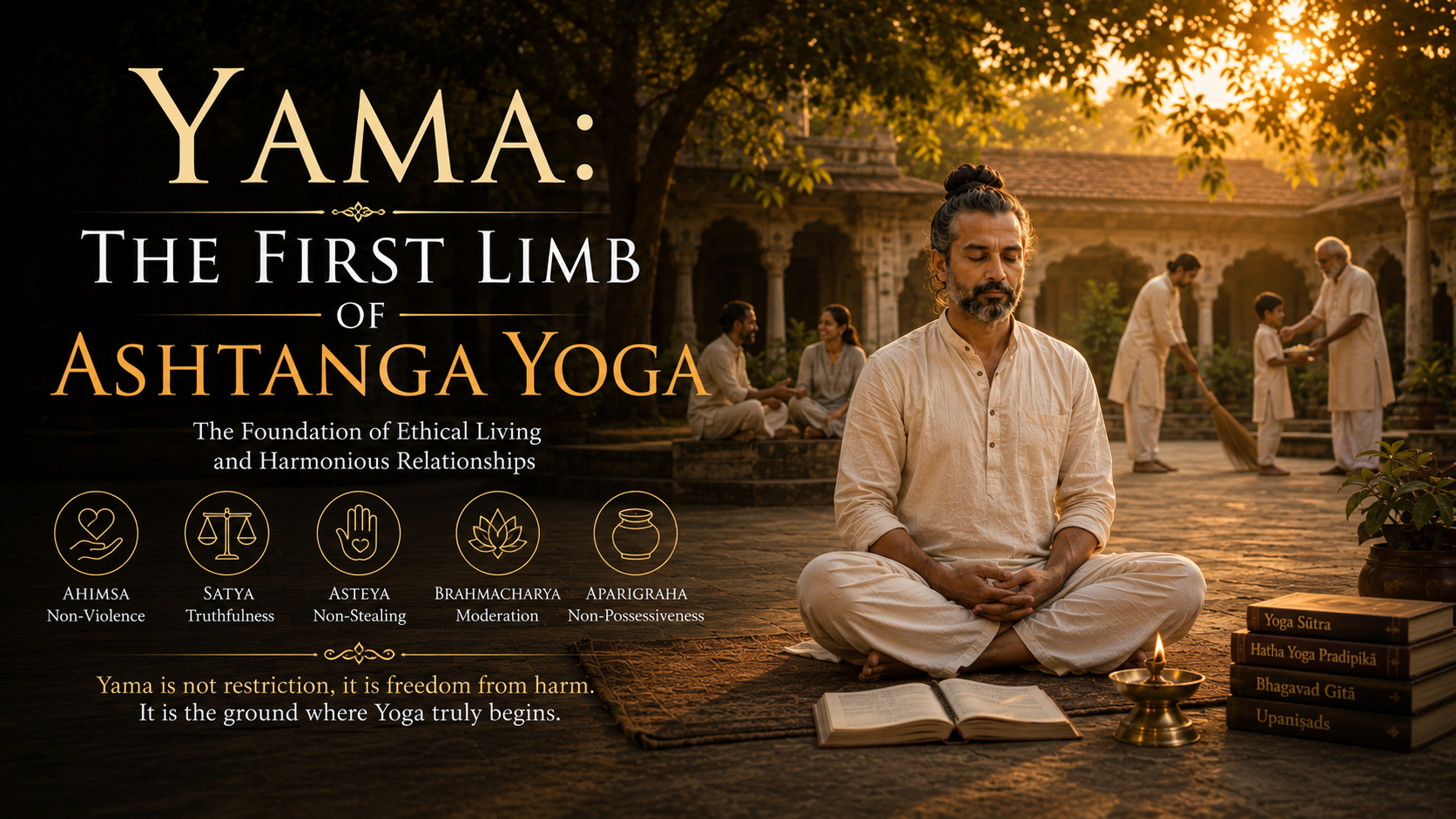
Yama is the first limb of Ashtanga Yoga. It is the principle of social ethics and social restraint — it teaches how our conduct toward society, family, and the outer world should be shaped. Although Yama concerns outward conduct, its practice actually begins with the purification of the mind, thought, and emotion.
Maharṣi Patañjali lists five principles of Yama (Yoga Sūtra 2.30):
- Ahiṃsā (non-violence)
- Satya (truthfulness)
- Asteya (non-stealing)
- Brahmacharya (traditionally, sexual restraint / right use of vital energy)
- Aparigraha (non-possessiveness)

1. Ahiṃsā — Non-Violence
Ahiṃsā is commonly understood simply as "not committing violence," but Maharṣi Patañjali did not confine its meaning to physical violence alone.
Ahiṃsā must be observed at three levels:
- Thought (Vichāra)
- Speech (Vāṇī)
- Action (Karma)
If the mind harbours malice, a desire for revenge, or the intention to harm someone, this too is a form of violence.
The Effect of Ahiṃsā
When a person practises complete Ahiṃsā:
- Their conduct becomes calm.
- The atmosphere around them tends to become calmer as well.
- Their very presence can generate a sense of peace and warmth in others.
2. Satya — Truthfulness
Satya means more than simply "speaking the truth." It means the alignment of:
- Truth in thought
- Truth in speech
- Truth in action
At its root, Satya rests on pure and sincere intention.
Action alone is not sufficient; it is when the feeling and intention behind an action are pure that a person's actions bear their finest fruit.
3. Asteya — Non-Stealing
Asteya, in its ordinary sense, means "not stealing."
But according to Patañjali's broader intent, this is not limited to the theft of objects.
Asteya must also be observed at these levels:
- Not appropriating others' ideas.
- Not improperly using others' plans or techniques.
- Avoiding envy and greed.
- Not harbouring an improper desire to acquire what one sees others have achieved.
Asteya cultivates contentment and honesty in a practitioner.

4. Brahmacharya — The Right Use of Energy
Brahmacharya is often reduced, in casual usage, to simply "celibacy" or "unmarried life" — but its meaning is both narrower and broader than that popular shorthand suggests, in different ways.
Brahmacharya = Brahma + Charya
- Brahma — most literally, Brahman, the Ultimate Reality (rather than "infinity" in the mathematical sense)
- Charya — conduct, or movement toward
So, more literally: "conduct that moves toward the Ultimate Reality."
In its primary classical sense — including in Patañjali's own Yoga Sūtra 2.38 — Brahmacharya is specifically tied to the conservation of sexual/vital energy (Vīrya): the sūtra states that when Brahmacharya is firmly established, great vigour and strength are gained. Classical commentary, including Vyāsa's, treats this principally as continence — for a celibate practitioner, complete sexual restraint; for a married householder, fidelity within marriage rather than total abstinence.
The broader teaching — that Brahmacharya means directing one's physical, mental, and spiritual energy wisely, and not squandering the energy of life — is a legitimate and widely taught extension of this principle, and it does not contradict the core teaching. But it is worth being clear that this wider reading is an extension of the classical meaning, not a replacement for it. Brahmacharya does not require rejecting marriage; a married person can absolutely practise Brahmacharya, understood as fidelity and disciplined, undissipated use of one's vital energy — including energy directed toward meditation, Sādhana, and self-development.

5. Aparigraha — Non-Possessiveness
Aparigraha means not accumulating beyond what is necessary.
It is not limited to the hoarding of wealth or possessions.
Aparigraha concerns the accumulation of:
- Physical objects
- Negative emotions
- Unnecessary thoughts
- Mental burden
A helpful modern teaching phrase for this last category is "emotional garbage" — a pedagogical expression, not classical Sanskrit terminology, but a useful way of conveying the idea.
Aparigraha teaches:
- Do not accumulate more than what is needed.
- Release old, negative emotions.
- Cultivate contentment and generosity.
As the teaching is often put: the secret of life lies not in accumulating, but in giving.
The Importance of Yama
Yama is the foundation of a person's character.
Observing these five principles:
- Improves social relationships.
- Purifies the mind.
- Brings positive change to one's personality.
- Builds a strong foundation for the further stages of Yoga Sādhana.
Key Points
- Yama is the first limb of Ashtanga Yoga.
- It is the foundation of social ethics and discipline.
- The five principles of Yama are: Ahiṃsā, Satya, Asteya, Brahmacharya, and Aparigraha.
- Ahiṃsā must be practised at the level of thought, speech, and action.
- Satya means truth in thought, speech, and action alike.
- Asteya extends beyond the theft of objects to envy, undue advantage, and encroaching on others' rights.
- Brahmacharya, in its primary classical sense, concerns the conservation of vital/sexual energy — celibacy for the unmarried, fidelity for the married — extended in modern teaching to the broader disciplined use of one's energy for self-development.
- Aparigraha means letting go of unnecessary physical and mental accumulation.
- The practice of Yama leads a person toward a balanced, ethical, and peaceful life.
Editorial Notes: Corrections and Clarifications
-
Brahmacharya's etymology and primary meaning needed correction. The original draft translated "Brahma" as "infinity" and framed Brahmacharya's meaning almost entirely around "energy used in the right direction," with celibacy mentioned only to be set aside. Scripturally, "Brahma" more accurately refers to Brahman, the Ultimate Reality, and Patañjali's own Yoga Sūtra 2.38 ties Brahmacharya specifically to the conservation of Vīrya (vital/sexual energy) — a meaning that classical commentators, including Vyāsa, treat as central, not incidental. The broader "right use of all one's energy" reading is a valid and widely taught extension of this principle, but this piece now presents both the primary classical meaning and its modern extension, rather than only the extension.
-
"Emotional garbage" has been marked as a modern teaching phrase, not classical Sanskrit terminology, to keep the distinction between traditional textual content and contemporary pedagogical language clear.
-
A note on scientific context (per your standing request to check facts against both scripture and science): several components of Yama have some correlation with findings in contemporary psychology — for instance, research on compassion and prosocial behaviour has associated practices resembling Ahiṃsā with lower stress and improved wellbeing, and research on gratitude and non-attachment has linked contentment (relevant to Aparigraha) with better mental health outcomes. These are worth knowing as supporting context, but they describe correlational psychological findings — they are not scientific "proof" of the Sūtras' further ethical or spiritual claims, which remain a different kind of claim entirely.
Conclusion
Yama is not a list of prohibitions — it is a description of the character a Yoga practitioner gradually cultivates: non-violent in thought and deed, truthful in word and intention, honest in what one takes and claims, disciplined and undissipated in the use of one's vital energy, and unburdened by unnecessary accumulation, whether material or emotional. Understood with this precision — including where classical scripture and later teaching extension diverge — Yama remains exactly what Patañjali intended it to be: the first and most essential foundation of the entire eightfold path.
Want to go deeper into authentic Yoga practice with Iti Iti Yogashram?
Get in Touch