Who Is a Guru? Understanding the True Meaning of Guru in Yogic Tradition
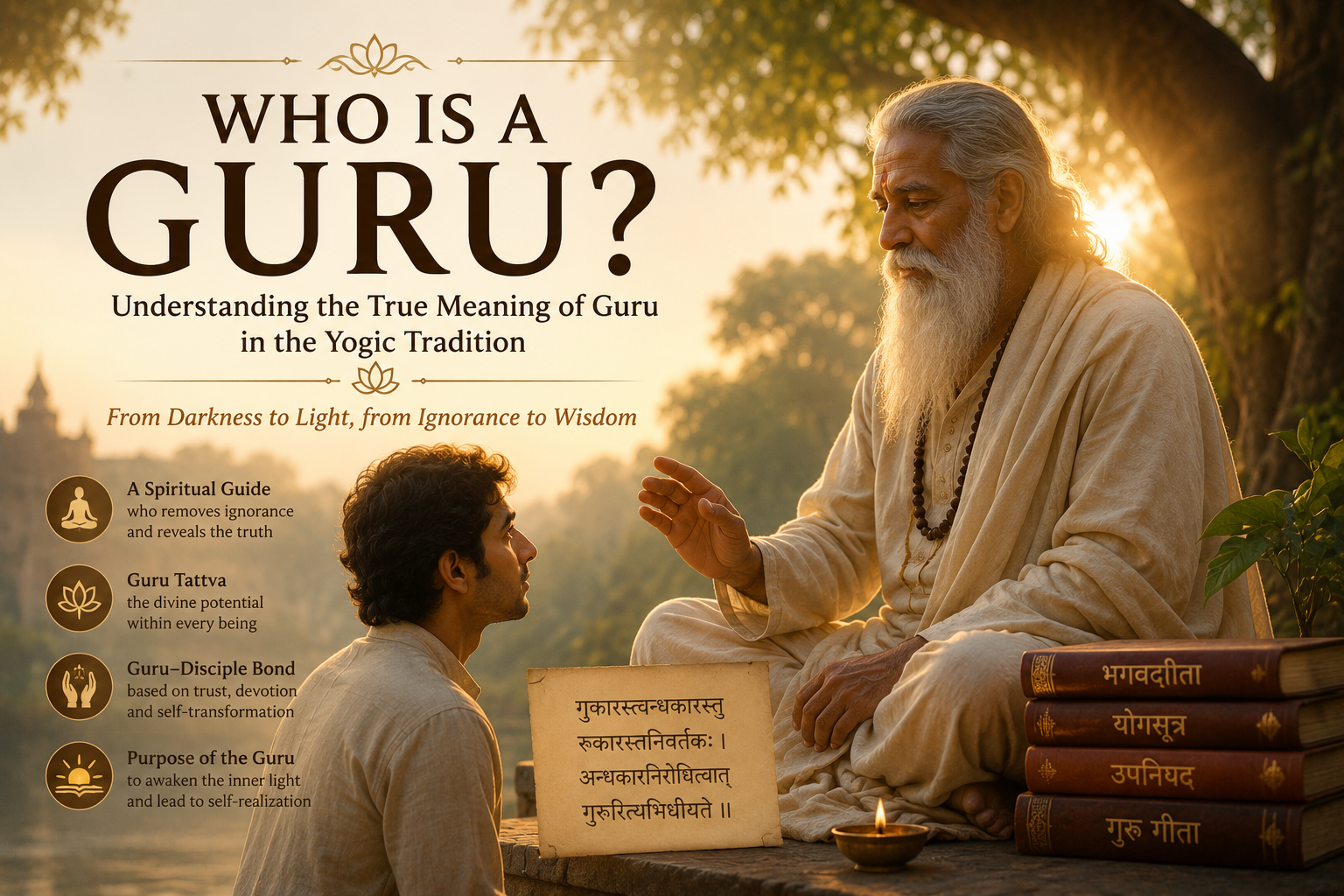
Who Is a Guru? Understanding the True Meaning of Guru in the Yogic Tradition
Introduction
In Indian culture and the Yogic tradition, the Guru holds a position of profound importance.
A Guru is not merely a teacher who provides information or intellectual knowledge. A true Guru is a spiritual guide who leads the seeker from ignorance to knowledge, confusion to truth, and limited awareness towards higher consciousness.
The concept of Guru is deeply connected with spiritual growth and inner transformation. The Guru does not simply tell us what to think. The Guru helps us see more clearly, understand our inner nature, and move towards a deeper experience of life.
Let us explore the true meaning of Guru, the Guru–disciple relationship, and the importance of a Guru in one's spiritual journey.
What Does the Word “Guru” Mean?
The word Guru is traditionally explained through two components:
“Gu” (गु) – Darkness, representing ignorance, confusion, and Avidyā.
“Ru” (रु) – The remover of darkness or the principle that dispels it.
Therefore, a Guru is understood as one who removes the darkness of ignorance through the light of knowledge.
This traditional explanation is expressed in the well-known verse:
गुकारस्त्वन्धकारस्तु रुकारस्तन्निवर्तकः।
अन्धकारनिरोधित्वात् गुरुरित्यभिधीयते॥Gukāras tv andhakāras tu rukāras tan nivartakaḥ
Andhakāra-nirodhitvāt gurur ity abhidhīyate
The Guru is thus associated with the removal of inner darkness and the awakening of knowledge.
The True Nature of a Guru
A Guru should not be understood merely as a physical body or personality.
In the spiritual tradition, the Guru represents a principle of awakening, wisdom, and guidance.
A true Guru does not only provide external knowledge. The Guru helps awaken the hidden potential, clarity, confidence, and deeper awareness already present within the disciple.
The purpose of a Guru is not simply to educate.
The deeper purpose is transformation.
A teacher may give us information. A Guru helps transform the way we see ourselves and life.
The Guru points towards that which the disciple may not yet be able to perceive independently.
What Does a Guru Do?
The Guru guides the seeker from:
- Ignorance towards knowledge
- Fear towards courage
- Confusion towards clarity
- Inner disturbance towards peace
- Suffering towards deeper understanding
- Limited awareness towards higher consciousness
Life inevitably presents difficulties, uncertainty, and periods of confusion.
During such times, the Guru acts as a guide.
The Guru does not necessarily remove every challenge from the disciple's life. Instead, the Guru develops the disciple's understanding and awareness so that challenges can be faced with greater clarity and inner strength.
The love of a true Guru is not based on personal gain.
It is directed towards the growth and welfare of the disciple.
The Guru leads the seeker from darkness towards light and helps the seeker move beyond the boundaries of what is already known.
When a sincere seeker comes into the presence of a true Guru, restless searching may gradually begin to settle.
Then, a different process begins.
Inner blossoming begins.
The Guru Tattva Within Every Person

One of the profound ideas in the Yogic tradition is the concept of Guru Tattva.
Tattva means principle, essence, or fundamental reality.
Guru Tattva refers to the principle of wisdom and awakening.
The potential for wisdom exists within every human being. However, this potential may remain hidden beneath ignorance, conditioning, fear, attachment, and confusion.
An awakened Guru helps awaken this inner possibility.
A simple analogy can help us understand this.
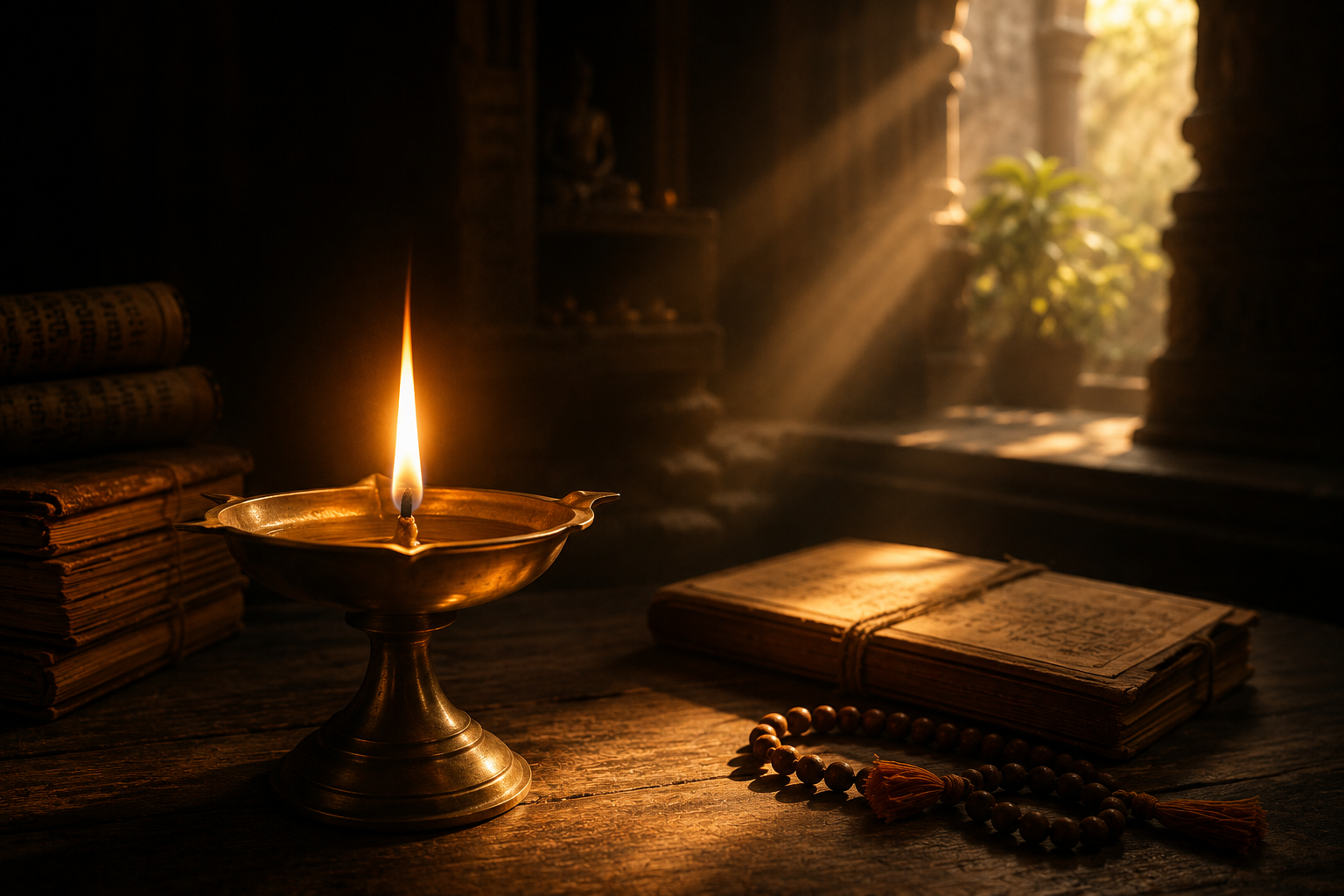
One illuminated lamp can light another lamp.
The first lamp does not lose its light by sharing its flame. Instead, another source of light is created.
Similarly, the Guru, established in greater awareness, helps ignite the light of knowledge within the disciple.
The ultimate purpose is not to make the disciple permanently dependent on the Guru's personality.
The deeper purpose is to awaken wisdom within the disciple.
Why Do We Need a Guru in Life?
If a person sincerely wishes to progress in any field, guidance is valuable.
This is especially true in Yoga and spirituality.
The spiritual path can involve subtle experiences, psychological patterns, philosophical questions, and misunderstandings. Without proper guidance, a seeker may mistake imagination for experience, ego for spiritual progress, or emotional excitement for inner transformation.
A competent Guru provides direction.
The Guru acts as a guide on the journey, helping the seeker recognise obstacles and move in the appropriate direction.
This does not mean that a disciple should abandon intelligence or critical thinking.
A genuine spiritual path requires Viveka—discernment.
The role of the Guru is not to destroy the disciple's intelligence but to refine understanding and help the disciple perceive more clearly.
Therefore, the relationship between Guru and disciple should be based on wisdom, sincerity, and genuine spiritual purpose.
The Significance of Guru Purnima
Guru Purnima is one of the most sacred occasions in the Indian spiritual tradition.
On this day, disciples express respect, gratitude, and devotion towards their Guru and the entire Guru Paramparā—the lineage of spiritual teachers.
Guru Purnima is not merely about honouring one living teacher.
It is an opportunity to remember the great masters, sages, and teachers who preserved and transmitted knowledge for the welfare of humanity.
The Yogic tradition that we study today did not appear suddenly.
Its teachings were observed, experienced, refined, preserved, and transmitted through generations.
Guru Purnima reminds us to recognise this lineage of knowledge with gratitude.
It is a day of remembrance, reflection, and renewed commitment to the path of learning and spiritual growth.
Mother as the First Guru
In life, the mother is often regarded as the first Guru.
After birth, the child begins learning through the mother.
Language, behaviour, emotional connection, basic values, and the first understanding of the world often develop through this relationship.
The mother introduces the child to life.
Later, different teachers guide us in education and practical knowledge.
Eventually, a spiritual Guru may guide the seeker towards self-knowledge and the deeper questions of existence.
Thus, different forms of guidance appear at different stages of life. Each has its own importance.
The Guru–Disciple Relationship
The relationship between Guru and disciple is not limited to the transfer of information.
Traditionally, the Guru–Shishya relationship is based on:
- Trust
- Śraddhā, or deep reverence and receptivity
- Sincerity
- Discipline
- Dedication
- Sattvic intention
- Commitment to inner growth
A genuine Guru–disciple relationship should not be based on selfish exploitation.
Its purpose is spiritual development and transformation.
However, surrender in the Yogic tradition should not be confused with intellectual blindness.
True receptivity requires sincerity, but genuine spiritual growth also requires discernment.
The disciple must practise, observe, reflect, and transform.
The Guru may show the path, but the disciple must walk upon it.
The depth of inner development depends greatly on the sincerity with which the disciple receives guidance and applies it in life.
The Ultimate Purpose of a Guru
The ultimate purpose of a Guru is not merely to make the disciple successful in the external world.
The Guru helps the disciple recognise a deeper dimension of existence.
Through guidance and spiritual practice, the seeker gradually begins to understand that peace, joy, and fulfilment cannot be permanently secured through external achievements alone.
The Guru directs the disciple inward.
The Guru helps the seeker investigate an essential question:
“Who am I beyond my changing body, thoughts, emotions, roles, and identities?”
The spiritual journey ultimately moves towards Ātma-jñāna—knowledge of the Self.
A true Guru helps the disciple recognise the deeper nature of consciousness and discover the source of peace and fulfilment within.
The Guru does not simply change the circumstances of life.
The Guru transforms the vision through which life is experienced.
Key Points
- A Guru removes the darkness of ignorance through the light of knowledge.
- The Guru is not merely a teacher of information but a guide towards inner transformation.
- Guru Tattva represents the principle of wisdom and awakening.
- The potential for wisdom exists within every human being.
- A competent Guru provides direction and clarity on the spiritual path.
- A true Guru helps the disciple develop awareness rather than permanent personal dependence.
- Guru Purnima is an occasion to express gratitude towards the Guru and the entire Guru Paramparā.
- The mother is often regarded as the first Guru in life.
- The Guru–disciple relationship is traditionally based on trust, Śraddhā, discipline, sincerity, and Sattvic intention.
- Genuine surrender should not be confused with blind belief.
- The ultimate purpose of the Guru is to guide the seeker towards self-knowledge and inner awakening.
- A true Guru does not merely give answers; the Guru transforms the seeker's vision.
Conclusion
The Guru occupies a unique place in Indian and Yogic philosophy.
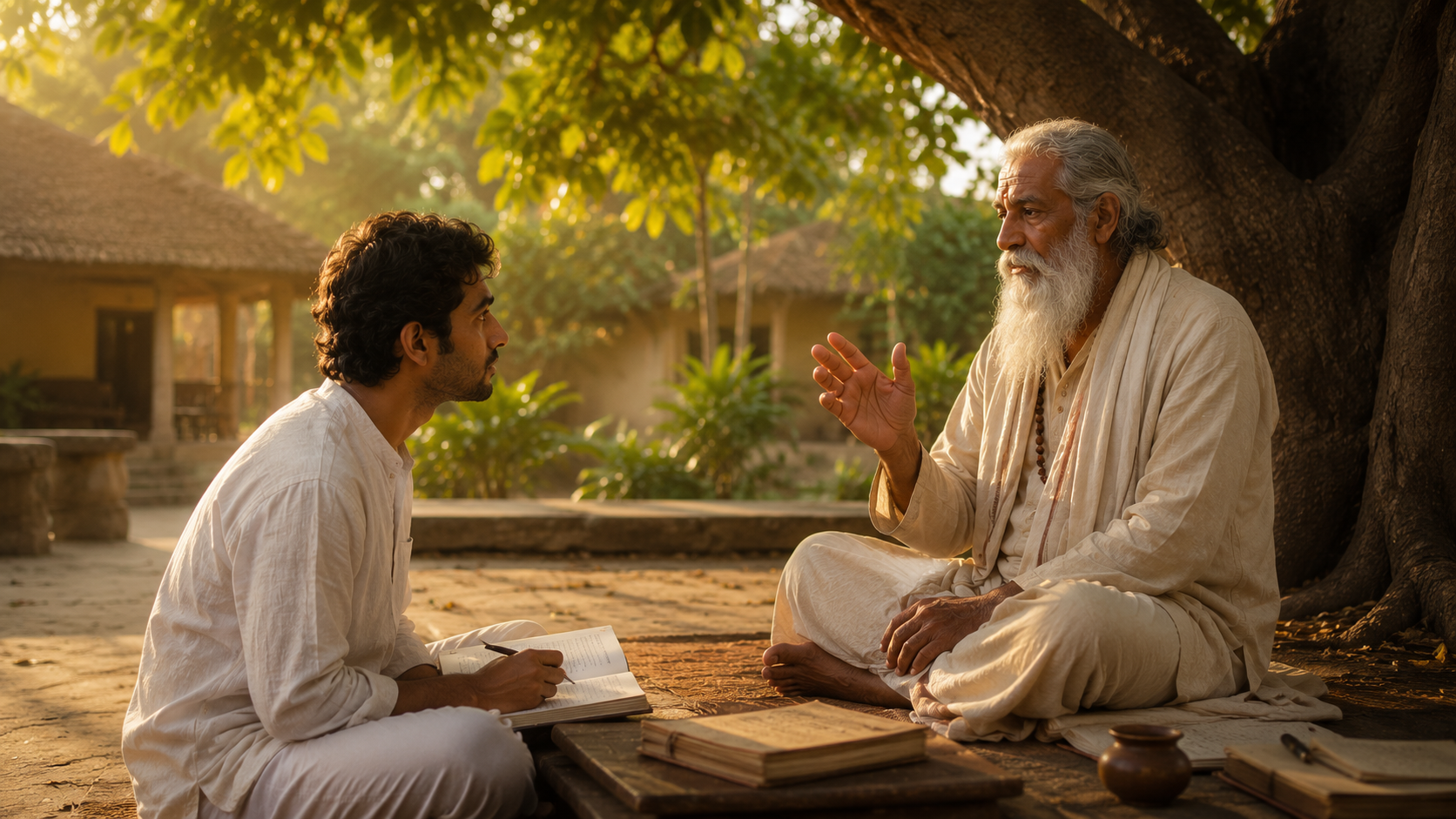
A Guru is not simply someone who possesses more information than the disciple. The true role of the Guru is to remove ignorance, refine understanding, awaken discernment, and guide the seeker towards deeper awareness.
The Guru illuminates the path, but the disciple must practise and walk upon it.
The Guru may light the lamp, but the light must ultimately awaken within the seeker.
This is the profound essence of the Guru tradition.
A true Guru does not merely tell us where to go. A true Guru helps us develop the vision to recognise the path and ultimately discover the light within ourselves.