Vṛkṣāsana (Tree Pose): Complete Anatomy, Alignment & Evidence-Based Guide
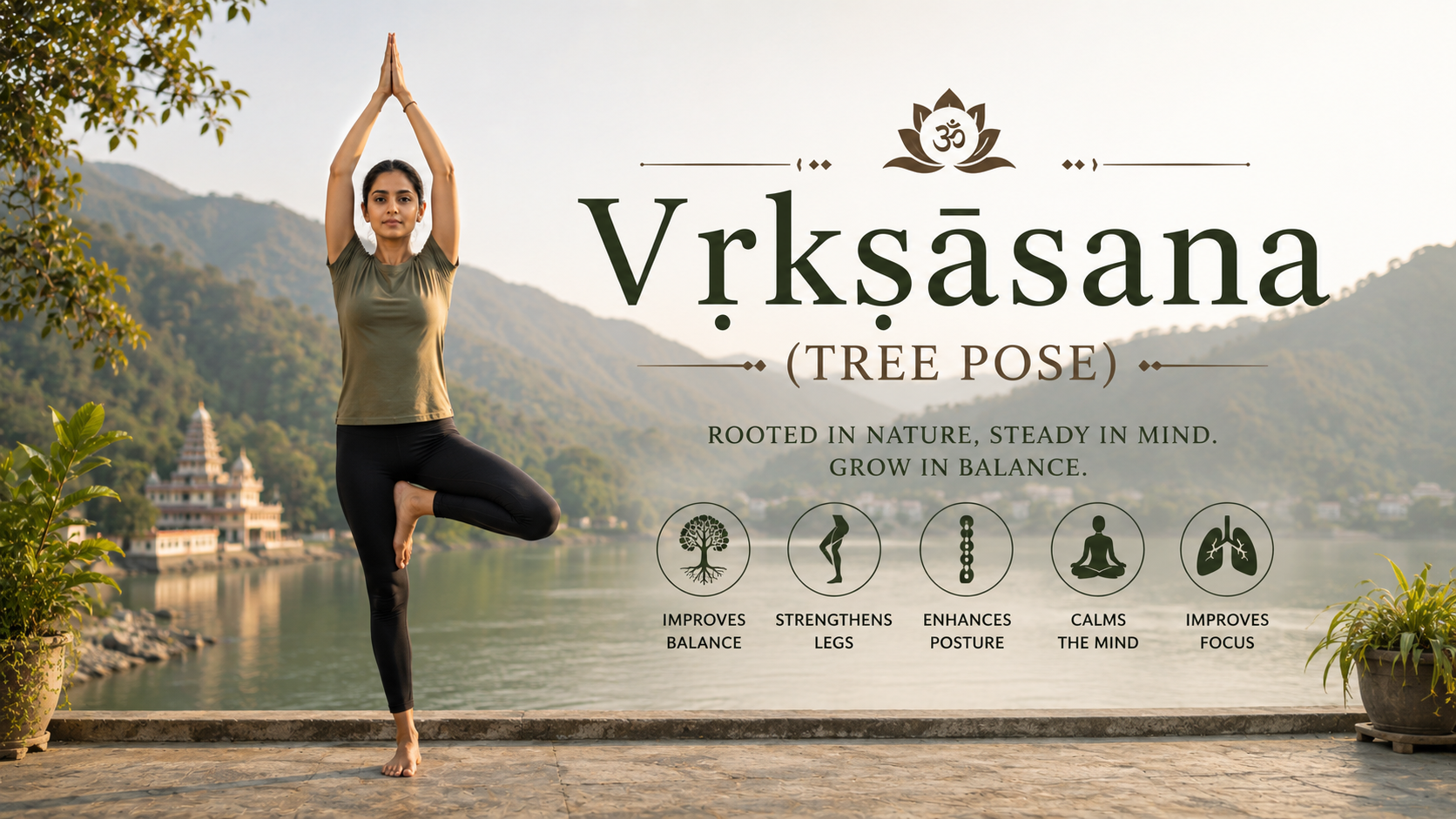
Vṛkṣāsana (Tree Pose): The Complete Reference Guide

Editorial note, stated once: throughout this article, traditional yogic and Āyurvedic claims (chakra, prāṇa, dosha associations) are presented as traditional belief, not scientific fact, unless a specific evidence source is cited alongside them.
Name & Meaning
- Sanskrit: वृक्षासन (Vṛkṣāsana)
- English: Tree Pose
- Etymology: Vṛkṣa (tree) + Āsana (posture)
Introduction
- Vṛkṣāsana is one of the very few standing balance poses with a genuine classical (medieval Hatha Yoga) textual source, unlike Tāḍāsana
- A single-leg standing balance with the bent-leg foot placed on the inner thigh or shin of the standing leg, arms typically extended overhead
- Entered from Tāḍāsana, and widely taught as an early balance posture in modern sequencing
- Popular as an accessible entry point into standing balance work, and frequently used in fall-prevention and balance-training contexts for older adults
How to Practice Vṛkṣāsana: Step-by-Step
| Step | Action | Breath | Cue |
|---|---|---|---|
| 1 | Begin in Tāḍāsana, weight evenly distributed on both feet | Natural breath | "Feel both feet rooted before you lift one." |
| 2 | Shift weight onto the left foot; bend the right knee and place the right foot against the inner left calf or thigh (never directly on the knee joint) | Exhale to settle weight into the standing leg | "Press the foot and thigh into each other equally." |
| 3 | Square the hips forward; lengthen the spine | Inhale to lift through the crown | "Keep both hip points facing the same direction." |
| 4 | Bring hands to heart center (Añjali Mudrā) or extend arms overhead | Steady, even breath | "Grow upward like branches, without losing the root." |
| 5 | Fix a soft, steady gaze (dṛṣṭi) on a still point; hold | Natural breath throughout the hold | "Let your eyes stay as still as your standing foot." |
| 6 | Release with control back to Tāḍāsana; repeat on the other side | Exhale to release | "Lower the leg with the same care you lifted it." |
Benefits
- Physical: strengthens the standing-leg muscles, ankle stabilizers, and hip abductors; improves single-leg balance and proprioception
- Mental: the balance demand requires sustained, present-moment attention — losing focus typically means losing the balance itself, making this pose a fairly direct concentration trainer
- Emotional: general yoga practice (not specific to this pose) is linked in several reviews to reduced perceived stress over time — moderate evidence level
- Fall prevention (older adults): a mixed-methods study by Keay et al. (2018), published in Pilot and Feasibility Studies, evaluated a yoga programme including tree pose as a fall-prevention strategy for older people in India and found preliminary positive evidence — a genuinely pose-relevant citation, though it studied a broader yoga programme rather than this pose in complete isolation
- Traditional/spiritual: traditionally associated with channeling energy from Mūlādhāra (root) to Sahasrāra (crown) chakra, and historically used by sādhus as a meditation posture — traditional belief, not a scientific claim
Common Mistakes & Corrections
- Placing the foot directly on the knee joint → correction: place above or below the knee, on the thigh or calf/shin, never on the joint itself
- Hip hiking or rotating open → correction: actively square both hip points forward
- Gripping/clawing the standing foot's toes → correction: spread the toes, root through the whole foot tripod
Contraindications & Precautions
- Significant vertigo or vestibular disorders without wall/prop support
- Acute knee, hip, or ankle injury
- Recent lower-limb surgery — consult a healthcare provider first
- Uncontrolled low or high blood pressure — practice with caution and medical guidance
Sequencing: Preparatory, Follow-up & Variations
- Preparatory poses: Tāḍāsana (entry pose), gentle hip-opening stretches, ankle circles
- Placement in sequence: typically introduced early-to-mid in a standing sequence, after the body is warmed up but before more demanding balance poses
- Follow-up poses: Utthita Hasta Pādāṅguṣṭhāsana (Extended Hand-to-Big-Toe Pose), Naṭarājāsana (Lord of the Dance Pose) for more advanced balance work
- Variations: hands at heart-center instead of overhead (reduces difficulty); half-lotus foot placement (increases difficulty); eyes-closed practice (significantly increases difficulty); wall-supported practice for beginners
In more detail: Vṛkṣāsana's difficulty is almost entirely tunable through two variables — arm position and foot placement. Hands at the heart in Añjali Mudrā keep the center of mass low and close to the body, making this the easiest arm variant; raising the arms overhead shifts the center of mass upward and makes balance meaningfully harder, which is why it's usually taught as a progression rather than the default starting point for beginners. Foot placement follows a similar logic — resting the foot low on the calf offers the most stability, midway on the thigh is the standard "full" expression, and half-lotus placement (foot on the opposite thigh crease) demands considerably more hip flexibility and balance together, and is generally reserved for practitioners who have already mastered the standard form. Wall support (a hand or shoulder lightly touching a wall) is a legitimate, permanent modification for many practitioners, not merely a beginner's stepping stone — some bodies benefit from that support indefinitely, and there's no requirement to "graduate" away from it.
Modifications
- Beginners: practice near a wall; keep the raised foot's toes on the floor for extra ground contact if needed; hands at heart-center rather than overhead
- Seniors: wall or chair support strongly recommended; shorter holds; this is one of the poses specifically studied in fall-prevention yoga programmes for older adults (see Keay et al., 2018, in Benefits above)
- Pregnancy: use wall support throughout all trimesters given the shifting center of gravity; avoid in later pregnancy if balance feels unstable; confirm with your own clinician
- Knee sensitivity: keep the raised foot's toes on the ground with the heel resting against the ankle, rather than lifting the foot fully onto the leg
- Children: playful cueing ("stand like a tree in the wind"), shorter holds, less emphasis on precise hip-squaring
Historical Background & Classical References
- Vṛkṣāsana is one of the genuine exceptions among standing poses in medieval Haṭha Yoga texts — most classical āsanas are seated, prone, or inverted
- It is directly described in the 17th-century Gheraṇḍa Saṃhitā, Chapter 2, Verse 36: "Place the right foot at the root of the left thigh and stand on the ground like a tree — this is Vṛkṣāsana" (paraphrased from the Sanskrit; exact Devanāgarī verse text not independently verified through available sources, so presented here as a translated paraphrase rather than a word-for-word quotation)
- A 7th-century stone carving at Mahābalipuram shows a figure standing on one leg, which some scholars suggest may indicate an early form of the pose, though this is interpretive rather than a confirmed textual link
- Unlike Tāḍāsana, this pose's classical lineage is genuine and directly citable — an important distinction between the two poses
Alignment Principles (Iyengar Method)
- Standing leg fully engaged, foot rooted through all three points of the foot tripod
- Hips squared forward, avoiding rotation toward the bent-leg side
- Spine vertical, lengthened, without collapsing into the standing hip
- Even, symmetrical engagement on both sides of the torso
Anatomy & Biomechanics
- Primary movers (standing leg): quadriceps, gluteus medius/minimus (critical for single-leg pelvic stability), erector spinae
- Primary movers (bent leg): hip external rotators, adductors (stretched)
- Stabilizers: intrinsic foot muscles of the standing foot, core musculature, ankle stabilizers
- Joint actions: standing-leg hip and knee near-neutral; bent-leg hip in flexion, abduction, and external rotation; bent-leg knee in flexion
- Biomechanics: the single-leg stance dramatically narrows the base of support compared to Tāḍāsana, requiring continuous, fine postural correction — gluteus medius on the standing side works especially hard to prevent the pelvis from dropping on the lifted-leg side (a pattern clinically referred to as a Trendelenburg-type mechanism when it fails)
Nervous System & Breathing Effects
- Single-leg balance is a substantially stronger proprioceptive and vestibular training stimulus than double-leg standing, given the narrowed base of support
- Requires sustained motor cortex engagement for continuous micro-correction
- Breath is typically natural and unforced; breath-holding tends to destabilize balance, so steady breathing is often taught as functionally supportive of the pose, not just incidental to it
Yogic & Āyurvedic Perspective
- Traditionally associated with channeling energy from Mūlādhāra (root) chakra upward toward Sahasrāra (crown) chakra
- Historically used by sādhus as a meditation and self-discipline posture
- Āyurveda: the grounding, single-point-focus quality is traditionally considered pacifying for excess Vāta
Therapeutic Applications
| Condition | Mechanism | Research / Precaution |
|---|---|---|
| Fall risk (older adults) | Single-leg proprioceptive/vestibular training | Preliminary supporting evidence — Keay et al. (2018), Pilot and Feasibility Studies, part of a broader yoga fall-prevention programme, not this pose alone. Wall support and supervision recommended. |
| Weak hip stabilizers | Gluteus medius/minimus strengthening through single-leg stance | Mechanistically well-supported by general strength-training literature; not Vṛkṣāsana-specific research |
| Attention/concentration difficulties | Balance demand requires sustained present-moment focus | Plausible mechanism; not a substitute for clinical attention-disorder treatment |
Yoga is never a replacement for medical treatment; serious or persistent conditions require a qualified healthcare professional.
Teaching Notes
- Cue: "Root down through one foot like a trunk, and let your arms grow upward like branches."
- Hands-on adjustment (with consent, within scope): light touch at the hip of the standing leg to cue level pelvis; light touch at the raised knee to cue gentle external rotation, never forcing it open
Myth vs. Fact
| Myth | Fact |
|---|---|
| Resting the foot on the knee is fine as long as you're stable | The knee joint isn't built to bear this kind of lateral pressure — it should be avoided regardless of stability |
| Wall support is only for beginners who haven't "graduated" yet | It's a legitimate, permanent option for many practitioners, including in fall-prevention programmes for older adults |
| Unlike most standing poses, Vṛkṣāsana has no real classical source — it's a modern invention | Unlike Tāḍāsana, this one genuinely is described in a classical text — Gheraṇḍa Saṃhitā 2.36 |
Conclusion
Vṛkṣāsana occupies an unusual place among standing poses: it's one of the rare cases where the classical textual lineage is genuine and directly citable, and one of the clearer cases where a specific piece of peer-reviewed research (fall prevention in older adults) actually engages with the pose rather than yoga practice in general. Its real value lies in how transparently it exposes balance — there's very little room to fake stability in this pose, which is exactly what makes it useful both as a teaching tool and as a training stimulus.
Quick Facts
| Category | Standing balance |
| Difficulty | Beginner–Intermediate |
| Duration | 15–60 seconds per side |
| Chakra (traditional) | Mūlādhāra to Sahasrāra (root to crown) |
| Dosha (traditional) | Pacifying for Vāta |
| Primary Muscles | Gluteus medius/minimus, quadriceps, intrinsic foot muscles |
| Contraindications | Significant vertigo, acute knee/hip/ankle injury, recent lower-limb surgery |
Frequently Asked Questions
Is Vṛkṣāsana really from a classical text?
Yes — Gheraṇḍa Saṃhitā 2.36, unlike some other commonly taught standing poses.
Can I rest my foot on my knee?
No — place it above or below the knee joint to avoid lateral joint strain.
How long should I hold each side?
Commonly 15–60 seconds; no fixed classical duration.
Is it normal to wobble a lot as a beginner?
Yes — this pose has a genuinely narrow base of support; wall support is a reasonable, non-temporary option.
Can this pose really help prevent falls in older adults?
Preliminary research supports yoga programmes including this pose for fall prevention, though it's part of a broader practice rather than proven in isolation.
Is it safe during pregnancy?
With wall support and clinician guidance, generally yes; avoid if balance feels unstable, especially later in pregnancy.
Why do my hips feel uneven in this pose?
Usually from the pelvis rotating open toward the bent-leg side — see Common Mistakes.
References
1. Classical Yoga Texts: Gheraṇḍa Saṃhitā, Chapter 2, Verse 36 (17th century).
2. Modern Yoga Institutions: Iyengar, B.K.S. Light on Yoga, Schocken Books, 1979, p. 62. Yoga Journal (teaching/alignment cross-reference).
3. Peer-Reviewed Scientific Research: Keay, L., Praveen, D., Salam, A., et al. (2018). A mixed methods evaluation of yoga as a fall prevention strategy for older people in India. Pilot and Feasibility Studies, 4(1), 74. https://doi.org/10.1186/s40814-018-0264-x (PMID: 29736256).
The Keay et al. (2018) citation above is a genuine, verifiable peer-reviewed source with a real DOI — unlike the general/uncited research categories used in earlier articles in this series where pose-specific studies weren't available.
This article is for educational purposes and does not replace individualized medical or physical therapy advice. Consult a qualified healthcare provider before beginning any new practice, especially with a pre-existing health condition.