Vīrāsana (Hero Pose — Classical Seated Form): Complete Guide & the Modern Kneeling Pose Distinction
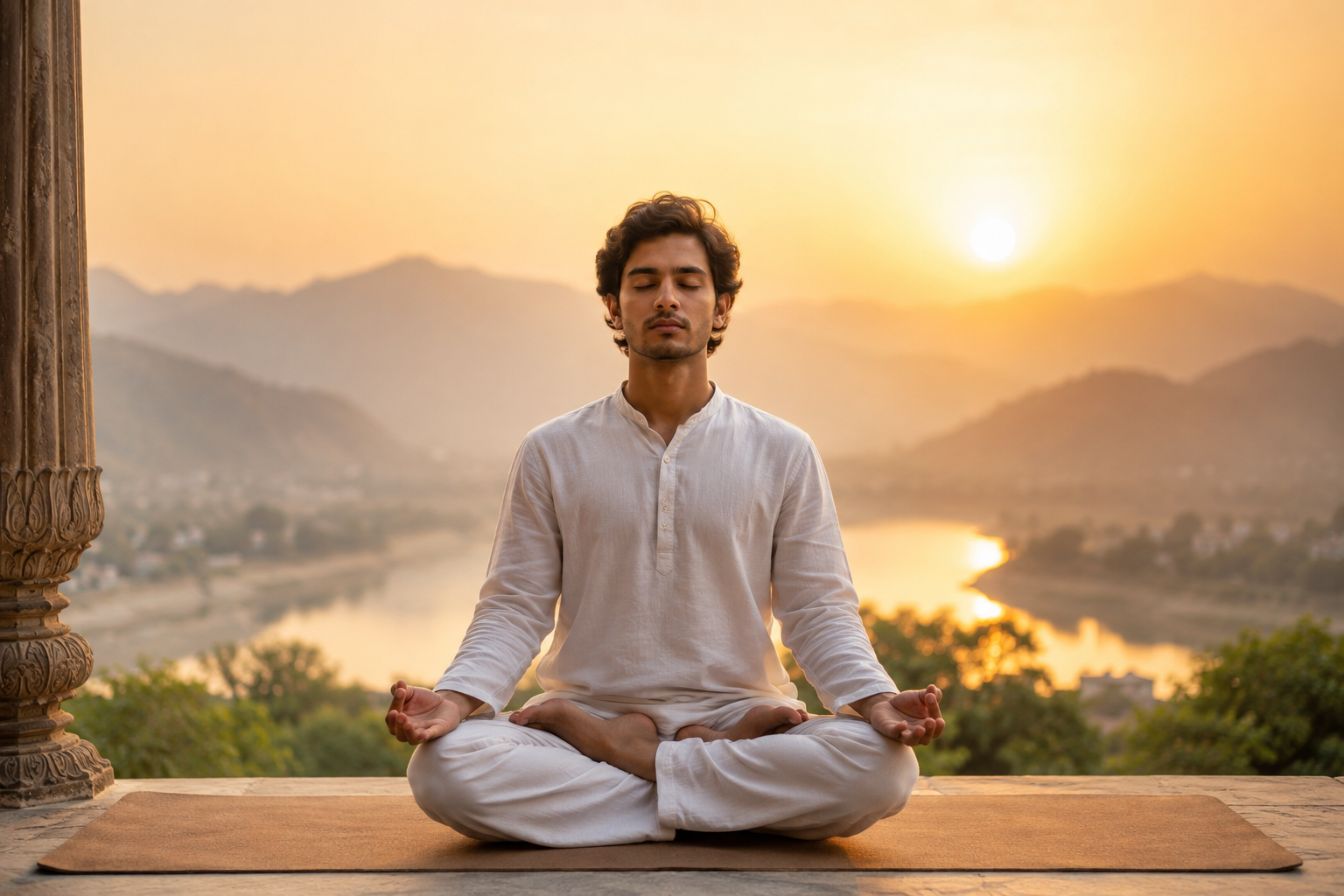
Vīrāsana (Hero Pose — Classical Seated Form): The Complete Reference Guide
Editorial note, stated once: throughout this article, traditional yogic claims are presented as traditional belief, not scientific fact, unless a specific evidence source is cited alongside them. This article covers the classical seated form of Vīrāsana, not the modern kneeling pose taught in most contemporary yoga classes — see Historical Background below for why this distinction matters.
Name & Meaning
- Sanskrit: वीरासन (Vīrāsana)
- English: Hero Pose (classical seated form)
- Etymology: Vīra (hero, brave one) + āsana (posture/seat)
Described in the Haṭha Yoga Pradīpikā, Chapter 1, Verse 21:
एकं पादमथैकस्मिन् विन्यसेदूरुणि स्थिरम्।
इतरस्मिंस्तथा चोरुं वीरासनमितीरितम्॥ २१॥
Placing one foot firmly upon the opposite thigh, and the other thigh in the same manner by the other foot — this is called Vīrāsana.
Introduction
- The classical Vīrāsana is a cross-legged seated meditation posture, with one foot placed on the opposite thigh and the other tucked beneath — structurally closer to what many practitioners today would recognize as a half-lotus variant
- This is a genuinely different pose from the widely taught modern "Hero Pose," in which the practitioner kneels with the shins on the floor and sits back between the heels — see Historical Background below for the important distinction between the two
- This article covers the classical seated form specifically, given its solid, multiply attested textual lineage
- Intended, like Svastikāsana, primarily as a stable meditation seat rather than a strength or flexibility showcase pose
How to Practice Vīrāsana (Classical Seated Form): Step-by-Step
| Step | Action | Breath | Cue |
|---|---|---|---|
| 1 | Sit with legs extended, spine tall | Natural breath | "Ground evenly through both sit bones." |
| 2 | Bend the right knee and place the right foot firmly on the left thigh | Exhale to settle the foot | "Let the foot rest, don't force it up the thigh." |
| 3 | Bend the left knee, tucking the left foot and shin beneath the right thigh | Exhale to settle | "Let the base leg fold naturally beneath." |
| 4 | Lengthen the spine, hands resting on the knees | Inhale to lift through the crown | "Build height from a stable base, not effort in the shoulders." |
| 5 | Hold for meditation or prāṇāyāma; alternate leg order between sessions | Steady, natural breath | "This seat exists to be forgotten — settle into stillness." |
Benefits
- Physical: stretches the hip external rotators and knee joint capsule of the top leg; provides a stable, low-effort seated base suitable for extended holds
- Mental: like other stable classical seated postures, removes ongoing postural-control demand, freeing attention for concentration or breath work — a plausible, widely accepted mechanism rather than something specifically studied for this exact pose
- Traditional: traditionally associated with cultivating steadiness (sthira) and inner courage — the "heroism" referenced in the name is traditionally understood as the discipline to sit still and observe the mind, not physical prowess. This is a traditional/symbolic interpretation, not a scriptural claim beyond the text's own description of the physical form.
Common Mistakes & Corrections
- Forcing the top foot high onto the thigh before the hip is ready → correction: let the foot rest wherever it naturally reaches; depth develops with practice, not force
- Collapsing the spine to compensate for hip tightness → correction: sit on a folded blanket or cushion to elevate the hips, restoring a neutral spine
- Always crossing the same leg first → correction: alternate which leg goes on top across sessions to avoid asymmetrical hip development
Contraindications & Precautions
- Acute knee injury or significant knee joint pathology, given the rotational load on the top leg's knee
- Severe hip tightness where the position cannot be achieved without strain — use props or an easier cross-legged variant instead
- Sciatica or lower-back conditions that worsen with prolonged seated hip flexion
Sequencing: Preparatory, Follow-up & Variations
- Preparatory poses: gentle hip-opening stretches, seated forward folds, ankle and knee mobility work
- Placement in sequence: like Svastikāsana, typically used as a seated base for prāṇāyāma or meditation at the start or end of a session, rather than within a dynamic sequence
- Follow-up poses: often held for extended periods rather than followed by another posture — practitioners commonly move directly into prāṇāyāma or dhyāna from this seat
- Variations: using a blanket or cushion under the hips, alternating which leg crosses on top, progressing toward Ardha Padmāsana (half-lotus) or full Padmāsana as hip flexibility develops, since the classical Vīrāsana sits structurally close to these more demanding seats
In more detail: because the classical seated Vīrāsana places significant rotational demand on the top leg's knee and hip, it's generally considered somewhat more advanced than Svastikāsana in the traditional progression of seated postures, even though both are described early in the Haṭha Yoga Pradīpikā's list. The preparatory hip work matters more here than for many poses precisely because the pose is meant to be held for extended, motionless periods during meditation — a seat that requires ongoing micro-adjustment defeats its own purpose. Progressing toward Ardha Padmāsana or Padmāsana from this base is a natural extension for practitioners with developing hip mobility, since the underlying joint action (one foot resting on the opposite thigh) is structurally similar, just deepened.
Modifications
- Tight hips or knees: sit on a folded blanket or cushion to elevate the hips; let the top foot rest lower on the shin rather than high on the thigh
- Knee sensitivity: reduce rotational depth significantly, or substitute a simpler cross-legged seat (Sukhāsana or Svastikāsana) until more hip mobility develops
- Lower back discomfort: sit against a wall for light support, or shorten the duration of the hold
- Seniors or limited floor mobility: a simple cross-legged seat on a chair edge can substitute for the meditative function without full leg-lock
- Pregnancy: generally well-tolerated with an elevated seat for comfort; adjust as the pregnancy progresses
Historical Background & Classical References
- The classical Vīrāsana is genuinely and directly described as a cross-legged meditation seat — in the Haṭha Yoga Pradīpikā (1.21, quoted above), and independently in two earlier sources: the 8th-century Pātañjalayogaśāstravivaraṇa (2.46–48) and the 13th-century Vāsiṣṭha Saṃhitā (1.72), both describing the same cross-legged meditation-seat form
- This gives classical Vīrāsana one of the more solidly and multiply attested lineages among seated postures — genuinely ancient by name, found across three independent classical sources spanning roughly seven centuries
- Critically, the widely taught modern "Hero Pose" — kneeling with shins on the floor, sitting back between the heels — is a different posture that happens to share the same name. This kneeling form appears first in 20th-century sources, notably B.K.S. Iyengar's Light on Yoga, and is recommended there specifically for lengthening the quadriceps — a different intent from the classical seat's meditative purpose
- This is directly comparable to the situation with Utkaṭāsana discussed elsewhere in this series: a classical name persisting while the actual physical form changes substantially over centuries. The honest account is that both forms are legitimately called "Vīrāsana" by their respective traditions, but they are structurally different postures with different purposes, and conflating them risks misattributing either one's benefits or historical pedigree to the other
Alignment Principles
- Both sit bones grounded evenly, hips level
- Spine held straight, as the HYP verse's broader context (shared with the Svastikāsana verse) implies for seated postures generally
- Top foot resting on the thigh without the ankle collapsing into strain
- Shoulders relaxed, hands resting on the knees rather than gripping
Anatomy & Biomechanics
- Primary stretch targets: hip external rotators and adductors of the top leg, knee joint capsule under rotational load
- Postural stabilizers: erector spinae and deep core musculature, maintaining upright posture without back support
- Joint actions: top leg — hip flexion, abduction, external rotation, knee flexion with rotational load; base leg — hip flexion, knee flexion, ankle plantarflexion
- Biomechanics: the top leg's knee experiences meaningful rotational (not just flexion) load in this pose, which is part of why hip flexibility — not just knee flexibility — genuinely matters here; forcing the position without adequate hip external rotation tends to transfer strain directly into the knee joint rather than the hip, which is the mechanism behind the most important caution in this pose
Nervous System & Breathing Effects
- As a stable, low-exertion seated posture, it minimizes postural-control demand on the nervous system, similar to Svastikāsana, supporting sustained meditation or prāṇāyāma practice
- General research on seated meditation postures (not this pose specifically) associates stable, comfortable seated positions with easier sustained attention
- Breath is typically slow and natural; this pose is frequently used as a base for structured prāṇāyāma practice
Yogic Perspective
- The "hero" (vīra) in the name is traditionally understood as referring to inner courage — the discipline required for sustained, still self-observation — rather than physical strength or battlefield valor
- As with other classical seated postures in this series, it is traditionally treated as supportive of steady prāṇa flow during prāṇāyāma practice
Therapeutic Applications
| Condition | Mechanism | Precaution |
|---|---|---|
| Difficulty sustaining a meditation seat | A stable, structured alternative seated posture for extended practice | Requires reasonable hip mobility; not a beginner's first seated pose |
| Progression toward Padmāsana | Structurally similar joint action at an earlier stage of hip external rotation demand | Progress gradually; never force the top foot's position |
Yoga is never a replacement for medical treatment; serious or persistent conditions require a qualified healthcare professional.
Teaching Notes
- Cue: "Let the top foot rest on the thigh the way a hand rests on an armrest — supported, not straining."
- Hands-on adjustment (with consent, within scope): light guidance at the shoulders to cue relaxation; never pressing on the top knee to force depth
Myth vs. Fact
| Myth | Fact |
|---|---|
| The kneeling "Hero Pose" taught in most modern classes is the same posture described in classical texts | The classical Vīrāsana is a cross-legged meditation seat; the modern kneeling version is a 20th-century pose that shares only the name — see Historical Background above |
| Both versions of "Vīrāsana" have the same benefits and purpose | The classical form is a meditation seat; the modern kneeling form is primarily taught as a quadriceps-lengthening stretch — genuinely different purposes |
Conclusion
Vīrāsana is perhaps the clearest example in this series of a single name covering two genuinely different postures across history — a cross-legged meditation seat attested across three classical sources spanning centuries, and an entirely separate kneeling stretch popularized in the 20th century. Neither version is "wrong," but treating them as interchangeable obscures both the classical seat's real lineage and the modern kneeling pose's real, more recent purpose. Practiced with attention to hip readiness rather than forced depth, the classical seated form remains a genuinely well-attested option for sustained meditation practice.
Quick Facts
| Category | Seated, meditative (classical form) |
| Difficulty | Beginner–Intermediate |
| Duration | Several minutes to extended meditation sessions |
| Classical sources | Haṭha Yoga Pradīpikā 1.21; Pātañjalayogaśāstravivaraṇa 2.46–48 (8th c.); Vāsiṣṭha Saṃhitā 1.72 (13th c.) |
| Primary Areas | Hip external rotators, knee (top leg); spinal erectors (postural endurance) |
| Contraindications | Acute knee injury, severe hip restriction without props |
Frequently Asked Questions
Is this the same as the kneeling Hero Pose I learned in class?
No — that's a different, more recent (20th-century) posture that happens to share the same name. See Historical Background above.
Is the classical seated form really ancient?
Yes — attested in three independent classical sources spanning the 8th to 15th centuries.
Why does my knee feel strained in this pose?
Usually from insufficient hip external rotation transferring load into the knee joint — see Anatomy & Biomechanics above; don't force depth.
Do I need a cushion?
Many practitioners use one indefinitely for comfort and spinal alignment — it's a legitimate long-term tool.
How does this relate to Padmāsana (Lotus Pose)?
It's structurally similar and often used as a step in the traditional progression toward half- or full-lotus postures.
Can I use this pose for prāṇāyāma?
Yes — like Svastikāsana, it's traditionally intended as a stable seated base for breathing and meditation practice.
References
1. Classical Yoga Texts: Haṭha Yoga Pradīpikā 1.21 (15th century, Svātmārāma). Pātañjalayogaśāstravivaraṇa 2.46–48 (8th century). Vāsiṣṭha Saṃhitā 1.72 (13th century) — all three independently describing the classical cross-legged form.
2. Modern Yoga Institutions: Iyengar, B.K.S. Light on Yoga, Schocken Books, pp. 123–125 (source of the modern kneeling form and its quadriceps-lengthening rationale). Mallinson, J. & Singleton, M. (2017). Roots of Yoga. Penguin Classics, pp. 96, 105 (cross-referenced for the classical seated form's textual history).
3. Peer-Reviewed Scientific Research: No Vīrāsana-specific peer-reviewed research (either form) was identified through available sources. General research on seated meditation posture applies at the category level only, and is not cited here as pose-specific.
This article deliberately separates the two historically distinct forms of "Vīrāsana" rather than merging their sources or benefits, consistent with this series' editorial standard.
This article is for educational purposes and does not replace individualized medical or physical therapy advice. Consult a qualified healthcare provider before beginning any new practice, especially with a pre-existing health condition.