Vīrabhadrāsana (Warrior Pose): The Complete Reference Guide to Warrior I, II & III
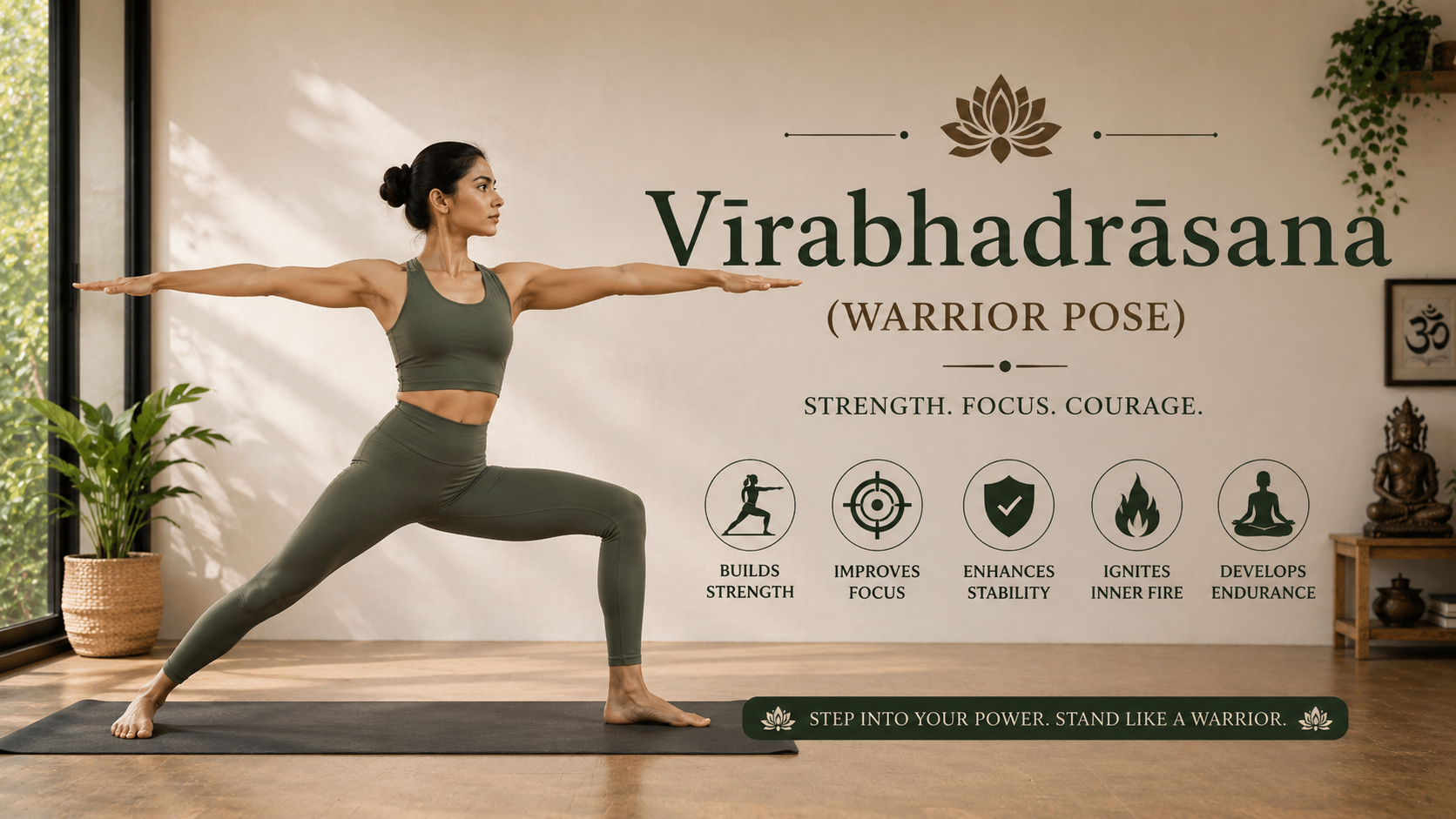
Vīrabhadrāsana (Warrior Pose): The Complete Reference Guide to Warrior I, II & III

Editorial note, stated once: throughout this article, traditional yogic, mythological, and Āyurvedic associations (dṛṣṭi symbolism, doṣa references, the Vīrabhadra narrative) are presented as traditional belief or symbolism, not scientific fact, unless a specific evidence source is cited alongside them.
Name & Meaning
- Sanskrit: वीरभद्रासन (Vīrabhadrāsana)
- English: Warrior Pose (Warrior I, II, III)
- Etymology: Vīra (hero/warrior) + Bhadra (auspicious) + Āsana (posture) — together naming Vīrabhadra, a specific warrior-deity of Hindu mythology, not literally describing the pose as "gently heroic"
Introduction
- Vīrabhadrāsana is a family of standing, lunging postures — Warrior I, II, and III are the core three, with Reverse Warrior and Humble Warrior as common variants
- One of the most widely taught standing-pose groups in modern yoga, and — like Naṭarājāsana — a useful case study in how a pose's name can be genuinely ancient while its physical form is a modern synthesis
- Unlike Vṛkṣāsana, Vīrabhadrāsana has no citable medieval Haṭha Yoga textual source; see Historical Background below for exactly what is and isn't established about its origin
- Builds leg strength, hip mobility, shoulder endurance, and — in Warrior III specifically — single-leg balance
How to Practice: Step-by-Step
Vīrabhadrāsana I (Warrior I)
| Step | Action | Breath | Cue |
|---|---|---|---|
| 1 | From Tāḍāsana, step one foot back 3.5–4 feet; turn the back foot in ~45–60°, front foot pointing straight ahead | Inhale to lengthen the spine | "Root the back foot before you bend the front knee." |
| 2 | Square the hips and torso toward the front of the mat as far as comfortable; bend the front knee to roughly 90° | Exhale to settle into the lunge | "Let the back hip stay a little open rather than forcing it square." |
| 3 | Raise both arms overhead, palms facing each other or joined | Inhale to lift through the arms | "Draw the lower ribs in as the arms lift, so the back doesn't overarch." |
| 4 | Hold for 5–8 breaths; release and repeat on the second side | Steady, even breath | "Keep the front knee stacked over the ankle the whole time." |
Vīrabhadrāsana II (Warrior II)
| Step | Action | Breath | Cue |
|---|---|---|---|
| 1 | From a wide stance, turn the front foot fully forward, back foot in ~90–100°, heels roughly aligned | Natural breath | "Line your heels up like train tracks." |
| 2 | Bend the front knee to 90° while keeping the back leg straight; open the hips and torso to the side (do not square forward) | Exhale to sink into the lunge | "Two front doors open to the side, not forward." |
| 3 | Extend the arms parallel to the floor, gaze over the front fingertips | Inhale to lengthen through the fingertips | "Reach the arms apart, don't just hold them out." |
| 4 | Hold for 5–8 breaths; release and repeat on the second side | Steady breath | "Stack your shoulders directly over your hips." |
Vīrabhadrāsana III (Warrior III)
| Step | Action | Breath | Cue |
|---|---|---|---|
| 1 | From standing or Warrior I, fix a soft gaze on one still point ahead | Natural breath | "Choose your point before you move." |
| 2 | Hinge forward from the hips while lifting the back leg, keeping the standing knee softly bent, not locked | Exhale to hinge slowly | "Press the lifted heel back like there's a wall behind it." |
| 3 | Extend the arms forward (or alongside the torso) until torso, arms, and lifted leg form one line parallel to the floor | Steady, even breath | "Grow long from fingertips to lifted heel." |
| 4 | Hold briefly, release with control, repeat on the second side | Natural breath | "Lower the leg with the same control you lifted it." |
Reverse Warrior (Viparīta Vīrabhadrāsana) sweeps the front arm up and back from Warrior II while the back hand slides down the back leg. Humble Warrior (Baddha Vīrabhadrāsana) interlaces the hands behind the back and folds the torso forward inside the front leg from Warrior I. Both are addressed further under Sequencing & Variations below.
Benefits
- Physical: strengthens the quadriceps, glutes, and calves of both legs; builds shoulder and upper-back endurance (Warrior I/II); improves single-leg balance and proprioception (Warrior III); stretches the hip flexors of the back leg
- Mental: the balance demand in Warrior III requires sustained one-point focus; in Warrior I/II, the isometric hold requires steady attention to alignment
- Emotional: general yoga practice (not specific to this pose) is linked in several reviews to reduced perceived stress over time — moderate evidence level
- Muscle-activation research: a peer-reviewed EMG study found significantly higher biceps femoris (hamstring) activation during Vīrabhadrāsana I compared with simple standing, and a separate EMG study measured meaningful ankle- and thigh-muscle engagement of the standing leg during Vīrabhadrāsana III relative to a resting baseline — see Scientific Research below for full citations
- Traditional/symbolic: some teachers frame the pose as cultivating a "spiritual warrior" quality of courage and one-pointed resolve, drawing on the Vīrabhadra narrative — a modern pedagogical/symbolic framing, not a classical scriptural claim, given the pose's absence from Haṭha Yoga texts (see Historical Background)
Common Mistakes & Corrections
- Front knee collapsing inward or extending past the toes → correction: track the knee in line with the second toe, stacked over the ankle; widen the stance if needed
- Torso leaning over the front thigh in Warrior II → correction: keep the torso upright and stacked directly over the pelvis, weight even in both feet
- Forcing the back heel flat and hips fully square in Warrior I → correction: let the back heel lift slightly and the back hip stay a little open rather than torquing the back knee
Contraindications & Precautions
- Recent or unstable knee injury (ligament or meniscus) — the deep front-knee bend loads the joint significantly
- Hip replacement or acute hip injury
- Uncontrolled high or low blood pressure — arms-overhead holds (Warrior I) warrant caution
- Shoulder injury — modify or omit the overhead arm position
- Balance disorders or significant vestibular impairment — practice Warrior III near a wall or omit it
- Sacroiliac joint instability — a forced square pelvis in Warrior I can aggravate SI joint symptoms
Sequencing: Preparatory, Follow-up & Variations
- Preparatory poses: Tāḍāsana, Utthita Trikoṇāsana, Añjaneyāsana (Low Lunge), Utkaṭāsana
- Placement in sequence: Warrior I and II sit in the standing-pose section after basic standing poses have warmed the body; Warrior III is sequenced later, once the legs are warm and stable
- Follow-up poses: Uttānāsana or Bālāsana to release the lower back and legs; Supta Baddha Koṇāsana for a gentle hip release
- Variations: Reverse Warrior, Humble Warrior, Warrior III with a chair or wall for balance support
Warrior I is often used as an entry point because it demands less rotational hip mobility than Warrior II while building heat quickly through the quadriceps and shoulders. Warrior II frequently follows on the same wide-legged base, often flowing into Extended Side Angle and Triangle Pose without resetting the feet. Warrior III is usually approached later and more slowly — commonly via a controlled hinge from Warrior I rather than jumping directly into the balance from standing — because it asks the standing leg to do the balance work of Vṛkṣāsana while simultaneously stabilizing a moving torso and lifted leg. Counter-poses that lengthen the hip flexors and lower back are commonly placed after a Warrior-heavy sequence to offset the strong quadriceps and hip-flexor engagement.
Modifications
- Beginners: shorten the stance; keep the front knee bend shallower than 90° until strength builds; use a wall for Warrior III
- Seniors: practice Warrior I/II with a chair for support; reduce hold time; consider a seated/chair-yoga adaptation of the arm and torso actions
- Pregnancy: widen the stance for stability; avoid deep overhead reaching if it strains the lower back; avoid Warrior III in the second and third trimesters given the balance and core-loading demands; confirm with your own clinician
- Shoulder restrictions: replace the overhead-arm position in Warrior I with hands on the hips or a lower "cactus arm" position
- Limited ankle mobility: place a folded blanket or wedge under the back heel rather than forcing it flat
Historical Background & Classical References
- The name Vīrabhadra comes from Hindu mythology, narrated in Kālidāsa's Sanskrit poem Kumārasambhava and in Puranic material: when Śiva's wife Satī died after her father Dakṣa insulted Śiva, Śiva tore out a lock of hair in grief and rage, from which the warrior Vīrabhadra arose to destroy Dakṣa's sacrifice
- No medieval Haṭha Yoga text describes the physical posture. It is absent from the Haṭha Yoga Pradīpikā, Gheraṇḍa Saṃhitā, Śiva Saṃhitā, and Patañjali's Yoga Sūtras — this absence is stated plainly here rather than filled with an invented citation, consistent with this series' editorial standard
- There is a genuine (if debated) visual precedent older than the 20th century: rock carvings at the Ellora Caves (Cave 16 and Cave 29) depict a warrior-form of Śiva in a stance that scholars have described as somewhat resembling Vīrabhadrāsana while conquering demons or courting Pārvatī — documented in Dhavalikar's Ellora (Oxford University Press, 2005, pp. 49, 83). This is an iconographic resemblance noted by art-historical scholarship, not a documented textual description of the āsana as a yoga practice
- As a piece of yoga āsana practice specifically, the pose is a 20th-century addition. Historian Mark Singleton traces the standing "warrior" postures to early-20th-century physical-culture influences, including Niels Bukh's 1924 Danish gymnastics text Grundgymnastik eller primitiv gymnastik, itself rooted in 19th-century Scandinavian gymnastics associated with Pehr Henrik Ling
- K. Pattabhi Jois, a student of Tirumalai Krishnamacharya, was photographed in Warrior I around 1939 — one of the earliest documented instances of the posture in a yoga context
- B.K.S. Iyengar's 1966 Light on Yoga systematized Warrior I, II, and III with the alignment detail still widely taught today. Reverse Warrior, by contrast, does not appear in that 1966 text and may be as recent as the early 21st century — a useful reminder that even within the "modern" Warrior family, some variations are considerably newer than others
- Some teachers narratively map Warrior I, II, and III onto stages of the Vīrabhadra story (emerging from the earth, sighting Dakṣa, striking the blow); this is a modern pedagogical device, not a claim found in the ancient textual sources themselves
Alignment Principles (Iyengar Method)
- Foot tripod maintained on both feet: even weight across the base of the big toe, base of the little toe, and center of the heel
- Front knee tracks in line with the second/third toe — never inward or excessively outward
- Pelvis squared toward the front of the mat in Warrior I (within a comfortable range), open to the side in Warrior II
- Spine maintains its natural curves; crown of the head reaches upward in all three variations
- Shoulder blades draw down and broaden across the back rather than hiking toward the neck
Anatomy & Biomechanics
- Primary movers (front/bent leg): quadriceps, gluteus maximus and medius, hamstrings (co-contraction for knee stability)
- Primary movers (back/straight leg): gastrocnemius and soleus, quadriceps, hip flexors under active stretch
- Core & spine: transverse abdominis and obliques stabilize the pelvis; erector spinae works isometrically against the asymmetrical pull of the lunge
- Shoulders (Warrior I/II): deltoids hold the arm position; serratus anterior and lower trapezius stabilize the scapulae
- Joint actions: hip flexion/extension between the two legs, front-knee flexion, ankle dorsiflexion (front foot), spinal extension considerations depending on variation
- Biomechanics: in Warrior I and II, weight loads more heavily through the front foot due to the knee bend; in Warrior III, the center of gravity shifts forward and the standing ankle, knee, and hip make continuous micro-adjustments to maintain balance — a peer-reviewed kinematic and ground-reaction-force study of Warrior II specifically (see Scientific Research below) has directly measured this loading pattern in the lower extremity
Nervous System & Breathing Effects
- Warrior III combines proprioceptive and vestibular demand with active spinal and hip control, making it a substantially more complex balance task than simple double-leg standing
- Warrior I and II require sustained motor-neuron recruitment for isometric holding rather than dynamic balance correction
- Breath is typically kept steady; breath-holding tends to destabilize Warrior III specifically, given the number of systems already being coordinated
Yogic & Āyurvedic Perspective
- Within the modern teaching tradition (not classical Haṭha texts, where the pose does not appear), Vīrabhadrāsana is often framed around dṛṣṭi (focused gaze) and sthira-sukha (steady, comfortable effort — a general āsana principle from Yoga Sūtra 2.46, applied here rather than a description of this specific pose in that text)
- Āyurveda: some contemporary teachers describe the standing, strength-building Warrior series as balancing to Kapha doṣa through generating heat and movement — a modern integrative interpretation, not a documented classical Āyurvedic prescription for this non-classical posture
Therapeutic Applications
| Condition | Mechanism | Research / Precaution |
|---|---|---|
| Weak hip/knee stabilizers | Quadriceps, glute, and hamstring co-contraction under a lunge load | Directly measured via EMG for Vīrabhadrāsana I and III (Rathore et al., 2017; Kelley et al., 2019 — see References) |
| Fall risk / balance decline (older adults) | Single-leg proprioceptive training (Warrior III); general lower-limb strengthening (Warrior I/II) | A systematic review of RCTs found warrior-type postures, as part of a broader programme, can support lower-limb strength relevant to fall prevention in older women, though balance/gait results across trials were mixed (see References) |
| Tight hip flexors (e.g. from prolonged sitting) | Active stretch of the back leg's hip flexors | Mechanistically plausible; no Vīrabhadrāsana-specific stretch-outcome trial identified |
Yoga is never a replacement for medical treatment; serious or persistent conditions require a qualified healthcare professional.
Teaching Notes
- Cue: "Press the outer edge of your back foot down, and let your front knee float toward the little-toe side of your front foot."
- Hands-on adjustment (with consent, within scope): a light touch at the front knee to guide tracking over the ankle; two fingertips of light support at the hip points in Warrior III to cue a level pelvis, never forcing greater depth
Myth vs. Fact
| Myth | Fact |
|---|---|
| Vīrabhadrāsana is an ancient posture described in the Haṭha Yoga Pradīpikā or similar texts | No such classical description exists; it's a 20th-century addition to yoga practice, though a warrior-Śiva stance resembling it appears in older Ellora Cave carvings as art, not as a documented yoga posture |
| A fully squared pelvis is required in Warrior I for the pose to "count" | Individual hip anatomy varies; forcing a fully square pelvis can strain the SI joint or back knee, and a slightly open back hip is a safe, appropriate variation for many practitioners |
| All the Warrior variations are equally old within the "modern" pose family | Warrior I, II, and III were systematized by Iyengar's 1966 Light on Yoga; Reverse Warrior does not appear there and may be as recent as the early 21st century |
Conclusion
Vīrabhadrāsana is one of the clearer examples in this series of a pose whose name and symbolism reach back into genuine antiquity — the Vīrabhadra myth and even a resembling warrior-Śiva stance carved at Ellora — while the āsana itself, as practiced in yoga classes today, is a 20th-century synthesis systematized by Krishnamacharya's students. That distinction doesn't diminish the pose; it just means the honest account of "why we call it that" and "how old the shape actually is" are two different questions with two different answers. Practiced with attention to knee tracking and pelvic alignment, the Warrior series offers real, EMG-documented muscular engagement alongside widely taught but less scientifically isolated traditional and mental benefits.
Quick Facts
| Category | Standing, lunging asana |
| Difficulty | Beginner (I, II) – Intermediate (III) |
| Duration | 5–8 breaths per side (I, II); brief holds building up (III) |
| Classical textual basis | None found; iconographic resemblance at Ellora Caves noted by art-historical scholarship |
| Primary muscles | Quadriceps, glutes, calves, hip flexors, deltoids, core stabilizers |
| Contraindications | Acute knee/hip injury, uncontrolled hypertension, balance disorders (esp. III), shoulder injury |
Frequently Asked Questions
Is Vīrabhadrāsana mentioned in ancient yoga scriptures?
No — it's absent from the Haṭha Yoga Pradīpikā, Gheraṇḍa Saṃhitā, Śiva Saṃhitā, and Patañjali's Yoga Sūtras. A warrior-Śiva stance resembling it appears in Ellora Cave art, but that's an iconographic resemblance, not a textual description of the āsana.
What's the difference between Warrior I and Warrior II?
In Warrior I, the hips and torso square toward the front of the mat with arms overhead. In Warrior II, the hips and torso open to the side, arms extended parallel to the floor.
Which muscles does Warrior Pose work?
Primarily the quadriceps, glutes, and calves of both legs, plus core stabilizers and, in Warrior I/II, the shoulders — with EMG research directly confirming hamstring activation in Warrior I and lower-leg/thigh engagement in Warrior III.
Is Warrior Pose safe during pregnancy?
Widened, wall-supported variations of Warrior I/II are commonly practiced earlier in pregnancy; Warrior III is generally avoided later on due to balance and core-loading demands. Consult a prenatal-qualified teacher.
Why is my front knee hurting in Warrior I or II?
Usually the knee is tracking inward or past the ankle; shorten the stance and recheck alignment under Common Mistakes above.
Why is it called "Warrior" if "bhadra" means auspicious/gentle?
Because Vīrabhadra is a specific mythological warrior's proper name, not a literal description — his story is told in Kālidāsa's Kumārasambhava, though the physical posture itself isn't found in the Haṭha Yoga texts.
Is there real scientific research on this pose, or just general yoga research?
There is genuine pose-specific EMG research (hamstring activation in Warrior I, lower-leg/thigh activation in Warrior III, and kinematic/ground-reaction-force data for Warrior II) — see Scientific Research and References below for exact citations.
Can beginners do Warrior III?
Yes, with a wall or chair for support and a shallower hinge, building up gradually.
What is Reverse Warrior, and is it a "real" traditional pose?
It's a variation from Warrior II reaching the front arm up and back. It doesn't appear in Iyengar's 1966 Light on Yoga and may be as recent as the early 21st century — younger even than the core Warrior poses themselves.
Scientific Research
- A peer-reviewed narrative review of core-muscle EMG research reported that gluteus medius activation during a single-limb squat/deadlift movement pattern "as in Vīrabhadrāsana" was significantly greater than during several other common therapeutic exercises (Rathore et al., 2017)
- A peer-reviewed EMG study measured tibialis anterior, gastrocnemius, rectus femoris, and biceps femoris activity of the standing leg during Vīrabhadrāsana III (Warrior III), Tree Pose, and Half Moon Pose relative to a resting mountain-pose baseline, finding significantly greater ankle-musculature (TA, GA) activity than thigh-musculature (BF, RF) activity across all three poses, with biceps femoris exceeding rectus femoris specifically in Warrior III (Kelley et al., 2019)
- A peer-reviewed kinematics and ground-reaction-force study using 3D motion capture and force plates directly examined Vīrabhadrāsana II (Warrior II) alongside Crescent Lunge and Triangle Pose in experienced practitioners, providing pose-specific biomechanical data on lower-extremity loading (Whissell et al., 2021)
- A systematic review of randomized controlled trials on yoga for fall-related physical function in older women found that lower-limb-strengthening postures — including the warrior poses, mountain pose, and tree pose — can support the effectiveness of fall-prevention yoga programmes, though balance/gait results specifically were inconsistent across trials
- Evidence gap: no dedicated, large-scale randomized controlled trial isolating Vīrabhadrāsana's effect on a health outcome (blood pressure, bone density, mental health) independent of a broader yoga programme was identified. Claims beyond the EMG/kinematic findings above and the general-programme fall-prevention research should be treated as traditional belief or reasonable extrapolation, not established clinical fact.
References
1. Classical Yoga Texts: None directly — Vīrabhadrāsana is absent from the Haṭha Yoga Pradīpikā, Gheraṇḍa Saṃhitā, Śiva Saṃhitā, and Patañjali's Yoga Sūtras, as discussed in Historical Background above. Kālidāsa's Kumārasambhava (classical Sanskrit poem) is the literary source for the Vīrabhadra myth that gives the pose its name, not for its physical form. Dhavalikar, M.K. (2005). Ellora. New Delhi: Oxford University Press, pp. 49, 83 (art-historical source for the Ellora Cave warrior-Śiva carvings).
2. Modern Yoga Institutions: Iyengar, B.K.S. (1979) [1966]. Light on Yoga: Yoga Dipika. Unwin Paperbacks, pp. 69–74. Singleton, M. (2010). Yoga Body: The Origins of Modern Posture Practice. Oxford University Press, p. 161. Wikipedia contributors. Virabhadrasana. Retrieved from https://en.wikipedia.org/wiki/Virabhadrasana
3. Peer-Reviewed Scientific Research: Rathore, M., Trivedi, S., Abraham, J., & Sinha, M.B. (2017). Anatomical correlation of core muscle activation in different yogic postures. International Journal of Yoga, 10(2), 59–66. https://doi.org/10.4103/0973-6131.205515 (PMID: 28546675). Kelley, K.K., Giannico, K., Lesnett, G., & Romano, A. (2019). A comparison of EMG output of four lower extremity muscles during selected yoga postures. Journal of Bodywork and Movement Therapies, 23(2), 329–333. https://doi.org/10.1016/j.jbmt.2019.01.005. Whissell, E., Wang, L., Li, P., Li, J.X., & Wei, Z. (2021). Biomechanical characteristics on the lower extremity of three typical yoga manoeuvres. Applied Bionics and Biomechanics, 2021, Article 7464719. https://doi.org/10.1155/2021.7464719.
The three peer-reviewed citations above are genuine, verifiable sources with real DOIs and, where applicable, PMIDs — directly relevant to Vīrabhadrāsana rather than general/uncited yoga research.
This article is for educational purposes and does not replace individualized medical or physical therapy advice. Consult a qualified healthcare provider before beginning any new practice, especially with a pre-existing health condition.