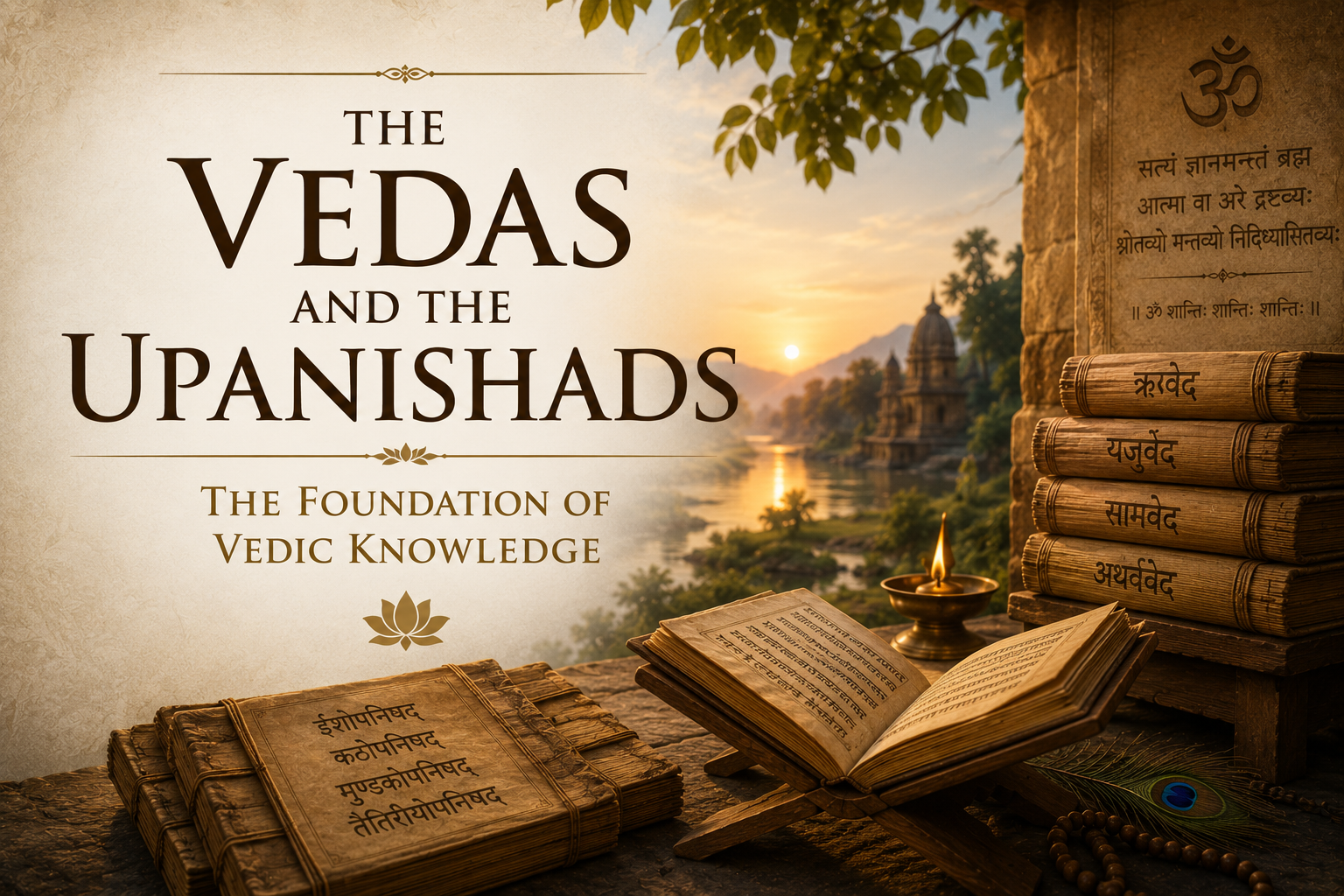
The Vedas and the Upanishads: The Foundation of Vedic Knowledge
Introduction
The Vedas and the Upanishads are the oldest and most important texts of the Indian Vedic tradition. The Vedas are regarded as the foundation of Sanātana Dharma, and the Upanishads as the highest philosophical expression of Vedic knowledge. Between them, these texts contain an extensive treatment of life, dharma, philosophy, spirituality, sacrificial ritual (Yajña), meditation, and Self-knowledge.

The Vedas
The word "Veda" comes from the Sanskrit root "Vid," meaning to know, to understand, to attain knowledge. Veda, therefore, means knowledge.
The composition of the Vedas is widely dated to somewhere between roughly 1500 and 500 BCE — a range that is itself debated among scholars, but commonly cited as an approximate window. Initially, the Vedas were not written down. They were preserved orally through the Guru-Śiṣya Paramparā (the teacher-disciple tradition), with disciples memorising the mantras along with their precise pronunciation, so that the original knowledge would remain uncorrupted across generations.
The Vedic tradition includes both Śruti (that which was heard) and Smṛti (that which was remembered) as forms of transmission.
The Four Vedas
1. Ṛgveda
Considered the oldest of the four Vedas. It contains roughly 1,028 hymns (Sūktas) organised into 10 Maṇḍalas (books). It contains praises of creation, of nature, and of the deities.
2. Yajurveda
Deals with the practical aspects of Yajña (sacrifice), ritual, mantra, and ceremonial procedure.
3. Sāmaveda
Often called the Veda of music and chanting. It preserves the musical rendering of Vedic mantras and the form these hymns take in communal worship.
4. Atharvaveda
Concerned with daily life, health, healing, protection, and practical knowledge. Traditionally, Āyurveda is associated with this Veda — though it is worth noting that classical Āyurvedic texts describe themselves as an Upaveda (auxiliary or applied branch of knowledge) connected to this tradition, rather than being a literal subsection contained within the Atharvaveda itself.
The Four Sections of Each Veda
Each Veda is traditionally divided into four parts:
| Section | Description |
|---|---|
| Saṃhitā | The collection of mantras, prayers, and hymns |
| Brāhmaṇa | Explanation of Yajña, ritual, and ceremonial procedure |
| Āraṇyaka | Spiritual contemplation intended for forest-dwellers and ascetics |
| Upaniṣad | The final, philosophical portion — knowledge of the Self |

The Upanishads
The Upanishads are the final and most profound philosophical portion of the Vedas. They are also known as Vedānta (the culmination or "end" of the Vedas).
The Meaning of "Upanishad"
The word is traditionally broken down as:
- Upa — near
- Ni — down (in the sense of "at the feet of," or with full attention directed downward toward the teacher)
- Sad — to sit
Taken together, Upaniṣad conveys the sense of sitting down near a teacher, with full attention and reverence, to receive knowledge.
If the Vedas are imagined as a tree:
- Saṃhitā = the root
- Brāhmaṇa = the flower
- Āraṇyaka = the raw fruit
- Upaniṣad = the ripened fruit (the highest knowledge)
This tree metaphor is a well-known traditional teaching device used to convey the relationship between the four sections — it is a pedagogical image, not a formal textual classification found verbatim in the Vedas themselves.
The Number of Upanishads
Two figures are commonly cited:
- Some scholars count as many as around 200 Upanishads.
- The Muktikā Upaniṣad itself lists 108 Upanishads by name.
Both figures are worth knowing, since sources differ depending on which counting tradition they follow.
The Principal Upanishads
Ten Upanishads are most commonly identified as the principal ones:
- Īśa
- Kena
- Kaṭha
- Praśna
- Muṇḍaka
- Māṇḍūkya
- Taittirīya
- Aitareya
- Chāndogya
- Bṛhadāraṇyaka
Some scholars extend this list with three additional Upanishads — commonly Śvetāśvatara, Kauṣītaki, and Maitrāyaṇī — bringing the total to 13 principal Upanishads.
Significance for a Yoga Teacher
A Yoga teacher's responsibility is not limited to teaching Āsana. It also includes preserving the authentic tradition of Yoga. The Vedas and Upanishads form the philosophical bedrock of Yoga darśana. For this reason, the teaching of Yoga should always be carried out with respect for the Guru-tradition and with care for the accuracy of the knowledge being transmitted.
Key Points
- Veda means knowledge.
- There are four Vedas: Ṛgveda, Yajurveda, Sāmaveda, and Atharvaveda.
- The Vedas were initially preserved orally through the Guru-Śiṣya tradition.
- Each Veda has four sections: Saṃhitā, Brāhmaṇa, Āraṇyaka, and Upaniṣad.
- The Upanishads are the final, philosophical portion of the Vedas, also called Vedānta.
- Upaniṣad means sitting down near a teacher, with reverence, to receive knowledge — from Upa (near) + Ni (down) + Sad (to sit).
- The number of Upanishads is commonly given as 108 (per the Muktikā Upaniṣad), though some scholars count as many as around 200.
- The principal Upanishads include Īśa, Kena, Kaṭha, Muṇḍaka, Māṇḍūkya, Taittirīya, Chāndogya, and Bṛhadāraṇyaka, among others.
- Knowledge of the Vedas and Upanishads is essential for the authentic teaching of Yoga.
Editorial Notes: Corrections and Clarifications
- The etymology of "Upanishad" needed correction. The original draft defined "Ni" as "complete surrender" (पूर्ण समर्पण). This is not the standard etymology. In the traditional breakdown, "Ni" means "down" — as in sitting down near the teacher, with attention directed toward them — not "surrender." The overall sense of devotion and reverence conveyed by the term comes from the practice being described (a disciple sitting attentively at a teacher's feet), not from the literal meaning of the syllable "Ni" itself.
- The Atharvaveda–Āyurveda connection is traditionally stated, but it is more accurate to describe Āyurveda as an Upaveda (an applied or auxiliary branch of knowledge) associated with the Atharvaveda, rather than implying it is a literal contained portion of that Veda.
- The dating of the Vedas (1500–500 BCE) is a commonly cited scholarly estimate, not a settled fact — the exact dating of Vedic composition remains a subject of ongoing academic debate, and this range should be understood as approximate.
- The "tree" metaphor (root, flower, raw fruit, ripe fruit) is a valuable traditional teaching image, but it is a pedagogical device rather than a classification stated in the Vedic texts themselves — this distinction is worth keeping clear for readers.

Conclusion
The Vedas represent the foundational knowledge of the Indian Vedic tradition, while the Upanishads represent its most refined philosophical fruit — the pursuit of Self-knowledge born from sitting attentively at the feet of a qualified teacher. For any serious student or teacher of Yoga, an accurate understanding of this lineage is not optional scholarship — it is the ground on which authentic practice and teaching stand.