Vajrāsana (Thunderbolt / Diamond Pose): The Complete Reference Guide
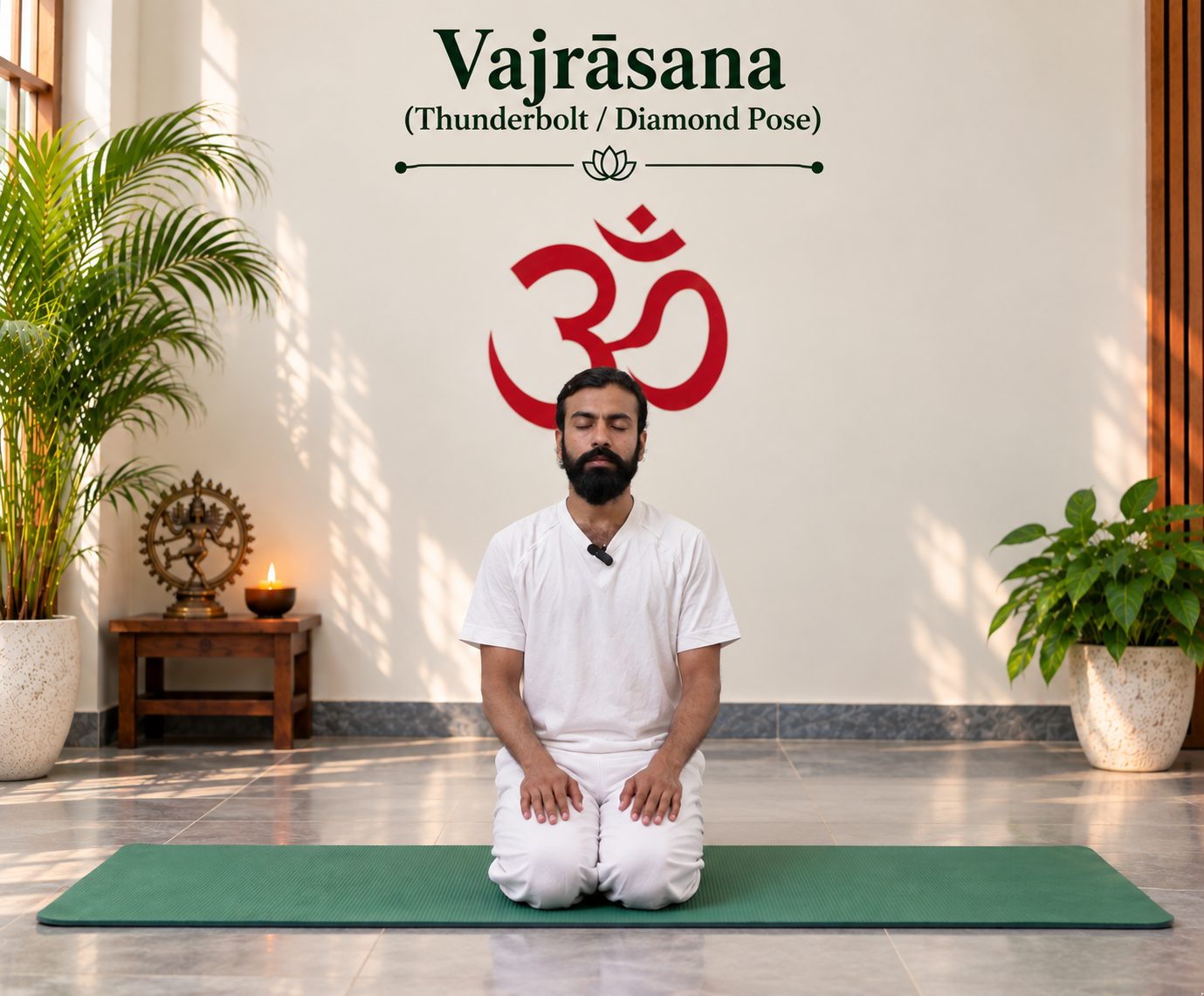
Vajrāsana (Thunderbolt / Diamond Pose): The Complete Reference Guide
Editorial note, stated once: throughout this article, traditional/symbolic associations (nadi, dosha, chakra references) are presented as traditional or symbolic, not scientific fact, unless a specific evidence source is cited alongside them.
Name & Meaning
- Sanskrit: वज्रासन (Vajrāsana)
- English: Thunderbolt Pose, Diamond Pose
- Etymology: Vajra (Indra's thunderbolt weapon; also "diamond," for its hardness) + Āsana (posture)
Introduction
- Vajrasana is arguably the most textually tangled name in this series — across the major classical Hatha Yoga texts, "Vajrasana" refers to at least two genuinely different shapes, and the modern standardized pose matches neither exactly
- Today it is a simple kneeling seat: buttocks resting on the heels, spine erect, most often used as a stable base for meditation and prāṇāyāma
- Notable as one of the very few asanas commonly recommended for practice directly after eating
- What "Vajrasana" means depends heavily on which text and era you're reading — see Historical Background below for the full picture
How to Practice Vajrasana: Step-by-Step
| Step | Action | Breath | Cue |
|---|---|---|---|
| 1 | Kneel on the mat, knees together, tops of the feet flat on the floor | Natural breath | "Let the tops of the feet spread wide on the floor first." |
| 2 | Bring the big toes together, separate the heels slightly, and lower the buttocks down onto the heels | Exhale to lower | "Sit your weight evenly into both heels, not just the tailbone." |
| 3 | Rest the palms on the thighs, lengthen the spine upward without over-arching the lower back | Inhale to lift through the crown | "Grow tall from a settled base, not by hardening the low back." |
| 4 | Relax the shoulders down and back; soften the jaw and gaze | Steady, even breath | "Still spine, soft face." |
| 5 | Hold from a few breaths up to several minutes, depending on purpose (post-meal sitting vs. meditation base) | Natural or slow diaphragmatic breathing | "No need to hold this longer than is comfortable." |
| 6 | Come out by lifting the hips, shaking out the ankles and lower legs before standing | Exhale to rise | "Let the blood flow return before you stand." |
Benefits
- Physical: maintains ankle (dorsiflexion/plantarflexion) and knee flexion range through regular practice; offers a stable, symmetrical seated base that doesn't require the hip external rotation demanded by cross-legged poses like Padmāsana
- Digestive: traditionally recommended directly after meals. A small mixed-methods study (Naragatti, 2023, Global Journal for Research Analysis, n=50) reported participant-reported improvements in digestive comfort — genuinely pose-specific, but a small, non-randomized, self-reported design from a regional journal, so this should be read as preliminary rather than conclusive
- Mental: the stillness and symmetry of the pose make it a commonly used base for concentration and prāṇāyāma practice, where a genuinely steady seat matters more than in most other asanas
- Traditional/spiritual: traditionally associated with the "vajra nadi," a subtle energy channel linked in traditional accounts to the genito-urinary system, and with cultivating diamond-like steadiness of mind — a traditional/symbolic association, not a scientific claim
Common Mistakes & Corrections
- Knees splayed apart instead of together → correction: keep the knees touching (or as close as comfortable) for an even, stable base
- Spine rounding or collapsing during longer holds → correction: lengthen upward from a settled pelvis rather than propping the torso up with muscular effort alone
- Shoulders creeping up toward the ears → correction: consciously release the shoulders down and back every few breaths
Contraindications & Precautions
- Recent knee injury, surgery, or significant knee osteoarthritis — the pose requires extreme knee flexion under body weight
- Ankle injury or very limited ankle dorsiflexion/plantarflexion range
- Varicose veins or a history of deep vein thrombosis in the legs — prolonged kneeling can restrict lower-leg circulation
- Later pregnancy — the kneeling position and abdominal pressure may be uncomfortable; consult a prenatal yoga specialist for a supported variation
- Sciatica or lower-back conditions that worsen with prolonged kneeling — approach cautiously and limit hold time
Sequencing: Preparatory, Follow-up & Variations
- Preparatory poses: gentle ankle and knee mobility work, a few rounds of cat-cow to warm the spine before longer holds
- Placement in sequence: commonly used to close a practice as a meditation/prāṇāyāma seat, or independently after meals; less commonly used as an active mid-sequence pose
- Follow-up poses: a brief forward fold, seated ankle rotations, or simply standing and walking to restore normal circulation to the lower legs after a longer hold
- Variations: a folded blanket between the calves and thighs, or under the ankles, to reduce joint pressure; Supta Vajrasana and Laghu Vajrasana (reclining/backbending variants) are related in name only and are considerably more advanced poses with their own separate technique and contraindications, not simple extensions of the basic seat
In more detail: because Vajrasana concentrates load through the knees and ankles rather than distributing it the way most seated cross-legged poses do, the padding and support props aren't a "beginner-only" accommodation — many long-term practitioners use a folded blanket under the ankles or between the calves and thighs indefinitely, particularly for extended meditation sits, without it representing a lesser or incomplete version of the pose. The reclining variants that share the name — Supta Vajrasana and Laghu Vajrasana — start from this same kneeling base but add a significant backbend, and should be treated as separate, more advanced postures with their own preparation, not as a natural "next step" to attempt casually from the basic seat.
Modifications
- Beginners / knee sensitivity: place a folded blanket behind the knees or under the shins for cushioning
- Ankle stiffness: roll a small towel under the ankles/dorsum of the feet to reduce the stretch
- Pregnancy: widen the knees to make space for the abdomen, and use a bolster or cushion between the calves and thighs — confirm with your own clinician, especially later in pregnancy
- Seniors / limited knee-ankle range: substitute a simple upright chair-seated posture for the same meditation-base purpose, rather than forcing the kneeling shape
- Long meditation sits: a wedge cushion under the buttocks, tilting the pelvis slightly forward, can reduce cumulative pressure through the knees
Historical Background & Classical References
- The 15th-century Haṭha Yoga Pradīpikā uses "Vajrasana" as a synonym for Siddhāsana — a cross-legged meditation pose where one heel presses near the perineum — not a kneeling shape at all
- The 17th-century Gheraṇḍa Saṃhitā, verse 2.12, describes a Vajrasana that B.K.S. Iyengar's Light on Yoga later identifies as what modern practice calls Vīrāsana (Hero Pose) — feet placed beside the buttocks, rather than the buttocks resting directly on the heels
- Yoga scholar Norman Sjoman has noted that Light on Yoga's own account of the related pose Laghu Vajrasana is itself unclear, adding a further layer of ambiguity that carried into 20th-century modern yoga rather than resolving it
- The shape now universally taught as "Vajrasana" — buttocks resting on the heels, big toes together — is the standardized modern convention, and it matches neither the Haṭha Yoga Pradīpikā's nor the Gheraṇḍa Saṃhitā's use of the name precisely
- So the honest account is: this may be the single clearest case in this series of one Sanskrit name covering genuinely different postures across different eras — not a case of a modern invention borrowing an old name, but of an old name whose referent has shifted more than once
Alignment Principles (Iyengar Method)
- Big toes together, heels separated slightly, buttocks resting evenly between and on top of the heels
- Spine lengthened and vertical, avoiding both slumping and over-arching the lower back
- Shoulders released down and back, away from the ears
- Weight distributed evenly across both knees and both heels, not concentrated toward one side
Anatomy & Biomechanics
- Stretched structures: quadriceps (especially rectus femoris, crossing both hip and knee), tibialis anterior and the dorsum of the foot/ankle (full plantarflexion under load)
- Compressed structures: the posterior knee joint capsule and menisci, and the calf musculature (gastrocnemius/soleus), which bear body weight between the thighs and heels
- Stabilizers: erector spinae and deep postural muscles maintain the erect seated spine without a backrest
- Joint actions: maximal knee flexion, full ankle plantarflexion, moderate hip flexion
- Biomechanics: combining maximal knee flexion with full ankle plantarflexion under sustained body weight compresses the anterior ankle and posterior knee more than most other seated postures — this is the direct mechanical explanation for the numbness or tingling some practitioners feel in the shins and feet during longer holds, and why the pose is generally exited gradually rather than abruptly
Nervous System & Breathing Effects
- A stable, symmetrical, unsupported seated base is widely used to support steady diaphragmatic breathing during prāṇāyāma, since it requires little ongoing balance correction once settled — unlike single-leg or unsupported standing poses
- General research on seated stillness and slow breathing supports parasympathetic ("rest and digest") activation at the category level; this is not evidence specific to Vajrasana as opposed to any other stable, comfortable seated posture
- Breath is typically slow and natural; the pose itself does not require any particular breathing pattern to sustain, unlike balance-dependent poses
Yogic & Āyurvedic Perspective
- Traditionally associated with the "vajra nadi," a subtle energy channel linked in traditional accounts to the genito-urinary system — a traditional belief, not an anatomical structure recognized in modern physiology
- The name's association with Indra's indestructible thunderbolt weapon is often used symbolically by modern teachers to frame the pose as cultivating steadiness and resilience — a traditional/symbolic interpretation
- Āyurveda: some contemporary teachers describe post-meal Vajrasana practice as supporting agni (digestive fire) and balancing Vāta — a modern interpretive framing rather than a claim documented in classical Āyurvedic source texts
Therapeutic Applications
| Condition | Mechanism | Research / Precaution |
|---|---|---|
| Post-meal digestive comfort | Upright, forward-leaning seated posture that avoids lying flat after eating | Preliminary, pose-specific evidence only (Naragatti, 2023, small mixed-methods study); widely repeated "gastric motility" claims from uncredited sources online could not be verified and are not cited here |
| Meditation/prāṇāyāma seat for those who can't sit cross-legged | Symmetrical kneeling base requiring less hip external rotation than Padmāsana or Sukhāsana | Mechanistically plausible; contraindicated for knee/ankle pathology, where a chair-seated alternative is preferable |
| General postural awareness practice | Unsupported erect spine trains postural endurance without a backrest | Plausible mechanism; not a substitute for targeted postural or physical therapy |
Yoga is never a replacement for medical treatment; serious or persistent conditions require a qualified healthcare professional.
Teaching Notes
- Cue: "Let the weight settle evenly into both heels — not just the tailbone, and not just the knees."
- Hands-on adjustment (with consent, within scope): a light touch at the top of the shoulders to cue release away from the ears; a light touch at the sacrum to cue a neutral, unarched pelvis. Never press down on the thighs or force the buttocks lower toward the heels.
Myth vs. Fact
| Myth | Fact |
|---|---|
| Vajrasana has always meant the kneeling seat taught in studios today | The 15th-century Haṭha Yoga Pradīpikā uses the name for Siddhāsana, a cross-legged pose — a completely different shape from the modern kneeling seat |
| Since it's a "resting" pose, you can hold it indefinitely | Prolonged holds can compress nerves and blood vessels in the lower leg, producing numbness — the pose should be exited and the legs allowed to recirculate periodically |
| Everyone should do Vajrasana after every meal for proven digestive benefit | The evidence here is a single small, preliminary, non-randomized study — reasonable to regard as gentle, harmless post-meal sitting rather than a clinically proven digestive treatment, and it's contraindicated for some knee/ankle conditions |
Conclusion
Vajrasana may be the most textually tangled name covered in this series: the Haṭha Yoga Pradīpikā's Siddhāsana-equivalent, the Gheraṇḍa Saṃhitā's Vīrāsana-equivalent, and the modern standardized kneeling seat are three genuinely different postures sharing one Sanskrit label. None of that undermines the pose's real, everyday value — it remains one of the most accessible meditation seats for people who find cross-legged sitting uncomfortable, and one of the few postures gently recommended right after a meal, provided the knees and ankles can tolerate the position.
Quick Facts
| Category | Seated, meditative, kneeling |
| Difficulty | Beginner (with knee/ankle caveats) |
| Duration | A few breaths up to several minutes, exited gradually |
| Traditional/symbolic association | Vajra (Indra's thunderbolt), the "vajra nadi" |
| Dosha (traditional) | Supportive for Agni / balancing for Vāta (modern interpretive framing) |
| Primary Areas Loaded | Knees (flexion), ankles (plantarflexion), quadriceps (stretched) |
| Contraindications | Acute knee/ankle injury, varicose veins/DVT history, later pregnancy |
Frequently Asked Questions
Has Vajrasana always looked the way it's taught today?
No — the Haṭha Yoga Pradīpikā uses the name for a cross-legged pose (Siddhāsana), and the Gheraṇḍa Saṃhitā's version matches what's now called Vīrāsana. See Historical Background above.
Is it really okay to practice right after eating?
It's one of the few postures traditionally considered appropriate then, and a small preliminary study supports subjective digestive comfort — but the evidence is limited, so treat it as gentle, not clinically proven.
Why do my feet go numb?
Full knee flexion combined with full ankle plantarflexion compresses nerves and blood vessels in the lower leg. Exit gradually and shake out the legs rather than holding through significant numbness.
Can I do this if I have knee pain?
Approach cautiously with padding under the knees, or substitute a chair-seated posture for the same meditative purpose — see Contraindications above.
What's the difference between Vajrasana and Vīrāsana (Hero Pose)?
In modern practice, Vajrasana sits the buttocks on the heels with feet together; Vīrāsana places the feet beside the hips with the buttocks on the floor between them. Interestingly, it's the Gheraṇḍa Saṃhitā's classical "Vajrasana" that actually matches today's Vīrāsana — see Historical Background.
Are Supta Vajrasana and Laghu Vajrasana the same pose?
They share the kneeling base but add a significant backbend, making them separate, more advanced postures with their own preparation and precautions.
Is it safe during pregnancy?
Widen the knees and use supportive props; avoid or modify significantly in later pregnancy, and confirm with your own clinician.
References
1. Classical Yoga Texts: Haṭha Yoga Pradīpikā (15th century) — uses Vajrasana as a synonym for Siddhāsana. Gheraṇḍa Saṃhitā, Chapter 2, Verse 12 (17th century) — describes what modern practice terms Vīrāsana.
2. Modern Yoga Institutions: Iyengar, B.K.S. Light on Yoga, Schocken Books, 1979 (modern standardization of the kneeling form). Sjoman, N.E. (1999). The Yoga Tradition of the Mysore Palace (2nd ed.), Abhinav Publications — scholarly note on ambiguity in Light on Yoga's treatment of the related Laghu Vajrasana.
3. Peer-Reviewed / Published Research: Naragatti, S. (2023). The Influence of Vajrasana (Thunderbolt Pose) on an Individual. Global Journal for Research Analysis, 12(9). DOI: 10.36106/gjra. A genuinely pose-specific mixed-methods study (n=50), though non-randomized and published in a regional journal — treated here as preliminary, not conclusive.
Several widely circulated online claims attribute a specific "2015 International Journal of Medical and Health Sciences" or "European Journal of Integrative Medicine" study to Vajrasana's effect on gastric motility. These could not be verified through available sources — no confirmable author, volume, or DOI was found — and are therefore not cited above, consistent with this series' policy against citing unverifiable references.
This article is for educational purposes and does not replace individualized medical or physical therapy advice. Consult a qualified healthcare provider before beginning any new practice, especially with a pre-existing health condition.