Uttānāsana (Standing Forward Bend): Classical Sources, Anatomy, Alignment & Evidence-Based Guide
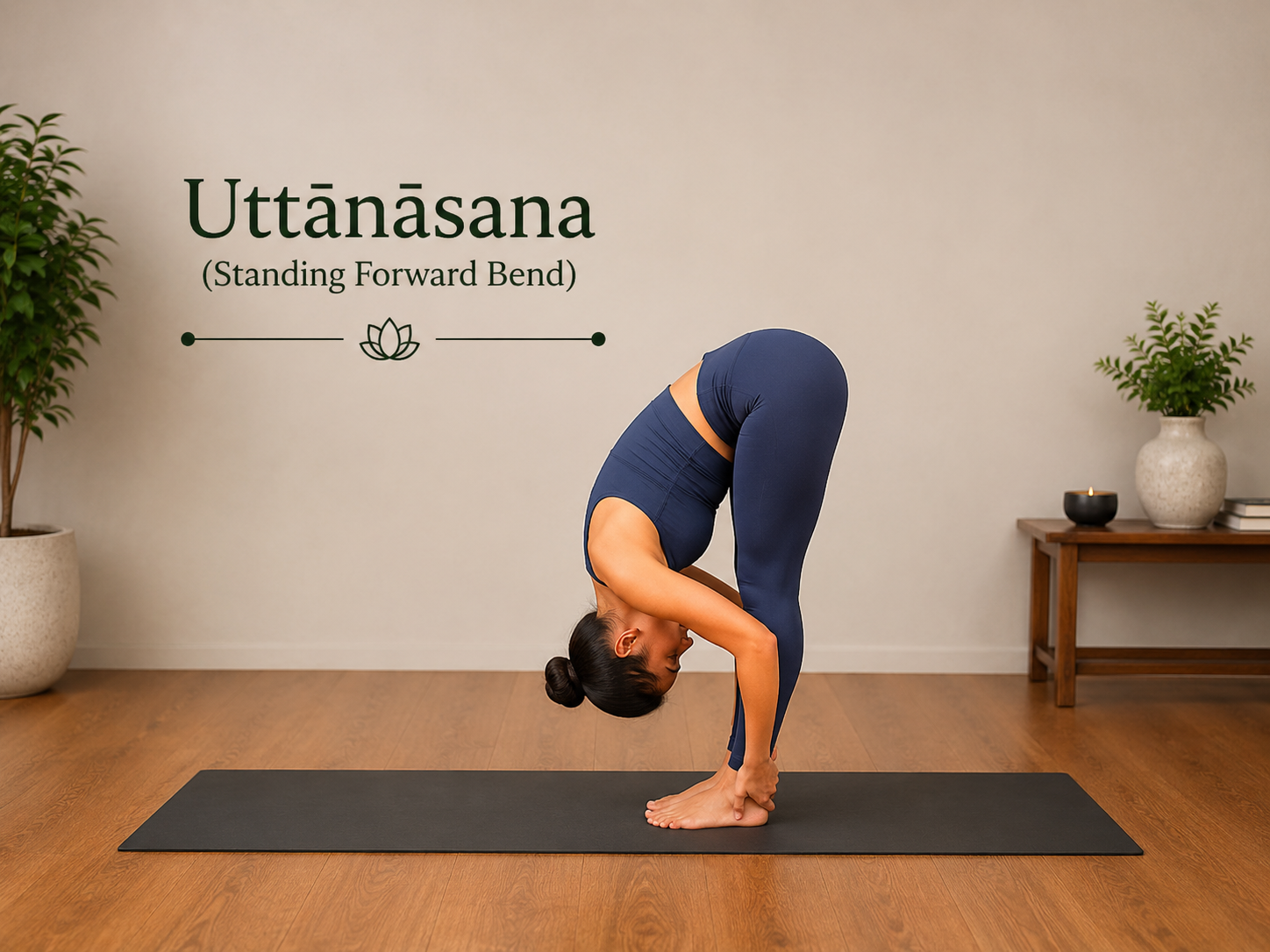
Uttānāsana (Standing Forward Bend): The Complete Reference Guide
Editorial note, stated once: throughout this article, traditional yogic and Āyurvedic claims (chakra, prāṇa, dosha associations) are presented as traditional belief, not scientific fact, unless a specific evidence source is cited alongside them.
Name & Meaning
- Sanskrit: उत्तानासन (Uttānāsana)
- IAST Transliteration: Uttānāsana / Uttanasana
- English: Standing Forward Bend / Intense Stretch Pose
- Etymology: Ut (intense / deliberate) + Tāna (stretch / extension) + Āsana (posture / seat). "The posture of intense deliberate extension, stretching the entire posterior chain of the body from the soles of the feet to the crown of the head."
Introduction
- Uttānāsana is the foundational standing forward fold in Haṭha and Vinyasa Yoga, serving as a primary transitional posture and a deeply restorative inversion.
- Characterized by standing with feet together (or hip-width apart), hinging directly from the hip joints with a long spine, descending the torso over the thighs, and placing the palms flat on the floor beside the feet while allowing the head to hang heavily.
- Essential to the Ashtanga Vinyasa Yoga system as the third and tenth vinyasa in Surya Namaskar A, and heavily detailed by B.K.S. Iyengar in Light on Yoga (Plates 47–48).
- Functions as an outstanding clinical diagnostic for evaluating hamstring length, sciatic nerve mobility, pelvic anterior tilt mechanics, and lumbar spinal health.
Benefits
- Posterior Chain Extensibility: Maximally lengthens the entire Superficial Back Line—hamstrings, gastrocnemius (calves), gluteus maximus, thoracolumbar fascia, and erector spinae.
- Spinal Decompression: Inverting the torso allows gravity to gently traction the cervical and thoracic spine, relieving compression in the intervertebral discs.
- Autonomic Nervous System Regulation: Placing the head below the heart triggers baroreceptors to stimulate the vagus nerve, increasing parasympathetic (rest-and-digest) tone and lowering heart rate.
- Visceral Massage: Pressing the abdomen against the thighs provides mild compression to digestive organs, encouraging colonic motility.
- Traditional/Spiritual: Believed to stimulate Svādhiṣṭhāna (sacral) chakra, direct Prāṇa Vāyu toward the head, and calm mental agitation—traditional belief, not a scientific claim.
How to Practice Uttānāsana: Step-by-Step
| Step | Action | Breath | Teacher Cue |
|---|---|---|---|
| 1 | Begin standing in Samasthitiḥ (Mountain Pose) with feet together or hip-width apart. Engage quadriceps to lift kneecaps. | Natural breath | "Stand tall, rooting down evenly through all four corners of your feet." |
| 2 | Inhale, sweep arms overhead (Urdhva Hastāsana), lengthening the side waists and lifting the sternum. | Inhale to lift | "Inhale, reach up to the sky, growing long through your spine." |
| 3 | Exhale, hinge forward directly from the hip creases (anterior pelvic tilt). Keep the front torso long, leading with the chest, not rounding the shoulders. | Exhale to hinge forward | "Fold from your hip sockets like a closing pocket knife, keeping your back flat." |
| 4 | Bring fingertips or palms to the floor beside or slightly in front of the feet. (Bend knees generously if hamstrings are tight to protect lower back). | Continue exhaling | "Plant your hands beside your feet, bending your knees as much as you need." |
| 5 | Relax the neck completely, letting the crown of the head point down toward the floor. Shift weight slightly forward into the balls of the feet to stack hips over ankles. Hold 5–10 breaths. | Deep, relaxed diaphragmatic breath | "Let your head hang heavy like a bowling ball, lifting your sit-bones to the sky." |
| 6 | To exit, press firmly into feet, engage core, inhale to lift halfway up (Ardha Uttānāsana), then sweep arms wide and rise all the way back to standing with a flat back. | Inhale to rise | "Root through your feet and inhale all the way up with a strong, straight back." |
Common Mistakes & Corrections
- Rounding the lower back (posterior pelvic tilt): Attempting to touch toes with tight hamstrings forces the lumbar spine to flex, risking disc herniation → Correction: Bend knees generously until the abdomen rests on the thighs, allowing the pelvis to tilt forward.
- Hyperextending or locking the knees: Pushing the knee joints backward strains the posterior cruciate ligament (PCL) → Correction: Keep a micro-bend in the knees and actively engage the quadriceps to lift the kneecaps.
- Shifting body weight entirely into the heels: Leaning backward causes the hips to sit behind the ankle line, reducing the hamstring stretch → Correction: Shift weight slightly forward into the balls of the feet so hips stack directly over ankles.
- Craning the neck to look forward: Holding tension in the cervical spine blocks relaxation → Correction: Release the neck completely; let the crown of the head point directly at the floor.
Contraindications & Precautions
- Acute Lumbar Disc Herniation or Sciatica: Deep passive forward flexion places high pressure on posterior intervertebral discs; keep knees deeply bent and avoid end-range stretching.
- Glaucoma, Detached Retina, or Uncontrolled Hypertension: Prolonged periods with the head below the heart increase intraocular and cranial vascular pressure.
- Acute Hamstring Tendinopathy: Full stretching at the ischial tuberosity (sit-bone) attachment can irritate healing tendons; bend knees to reduce tension.
- Pregnancy (Second & Third Trimesters): A narrow stance restricts the abdomen; practice with feet wider than shoulder-width apart to create space.
Sequencing: Preparatory, Follow-up & Variations
- Preparatory Poses: Samasthitiḥ, Ardha Uttānāsana (Half Forward Bend), Adho Mukha Śvānāsana (Downward Dog), Jānu Śīrṣāsana.
- Placement in Sequence: Essential transitional pose throughout Surya Namaskar (Sun Salutations) and practiced standalone as a cooling inversion.
- Follow-up Poses: Ardha Uttānāsana, Samasthitiḥ, Utkaṭāsana (Chair Pose), Pādāṅguṣṭhāsana (Big Toe Pose).
- Variations:
- Pādāṅguṣṭhāsana (Big Toe Pose): Catching big toes with peace fingers to create active arm leverage.
- Pādahastāsana (Gorilla Pose): Sliding palms face-up entirely underneath the soles of the feet to stretch wrists.
- Ragdoll Pose (Baddha Hasta Uttānāsana): Feet hip-width apart, holding opposite elbows, letting torso sway gently.
- Block-Supported Uttānāsana: Hands resting on yoga blocks to accommodate tight hamstrings.
Modifications
- Generous Knee Bend (Protects Lower Back): The most important modification for stiff hamstrings; bend knees enough so the chest and belly rest directly on the thighs.
- Hands on Yoga Blocks: Place two yoga blocks under the hands at any height. This brings the floor closer, preventing spinal rounding.
- Wall-Supported Forward Fold: Stand with heels 2-3 inches away from a wall and rest hips against the wall to provide stability and confidence in shifting weight forward.
Historical Background & Classical References
- Modern Postural Tradition: While forward bending has ancient roots, the precise vertical alignment of Uttānāsana was formalized in the 20th century by T. Krishnamacharya, heavily detailed by B.K.S. Iyengar in Light on Yoga (1966), and functions as the foundational hinge in Ashtanga Vinyasa.
- Philosophical Context: Uttānāsana symbolizes surrender and introspection, physically bowing the head (intellect) below the heart (wisdom and compassion).
Alignment Principles (Iyengar Method)
- Pelvic Hinging: Movement originates exclusively from the femoral-acetabular joints (hips), maintaining a neutral lumbar spine.
- Quadriceps Co-Contraction: Engaging the quadriceps femoris sends an inhibitory signal to the hamstrings (reciprocal inhibition), allowing them to yield and lengthen.
- Plumb Line Stacking: Center of the hip joint, knee joint, and ankle joint align vertically.
Anatomy & Biomechanics
- Primary Stretched Muscles: Hamstrings (Biceps Femoris, Semitendinosus, Semimembranosus), Gluteus Maximus, Gastrocnemius, Soleus, Erector Spinae, Thoracolumbar Fascia.
- Primary Active/Strengthening Muscles: Quadriceps Femoris (Rectus Femoris, Vastus Lateralis/Medialis), Iliopsoas (assists deep hip flexion), Tibialis Anterior.
- Joint Mechanics: Deep hip flexion; full knee extension (without hyperextension); ankle neutral or slight dorsiflexion; spine naturally flexed under gravity.
- Kinematic Chain: Tight hamstrings anchor the ischial tuberosities (sit-bones), preventing anterior pelvic tilt. If the pelvis cannot tilt forward, the body forces the lumbar spine to flex deeply to achieve the fold, risking disc injury. Bending the knees creates slack in the hamstrings, allowing the pelvis to tilt safely.
Nervous System & Breathing Effects
- Parasympathetic Shift: Baroreceptors in the carotid arteries detect increased pressure from the inverted head position, signaling the vagus nerve to decrease heart rate and induce calmness.
- Posterior Diaphragm Release: Relaxing the torso downward allows the posterior diaphragm and lower ribcage to expand fully during inhalation.
Yogic & Āyurvedic Perspective
- Dosha Impact: Highly effective for pacifying Pitta (cools heat and anger) and grounding Vāta when practiced with bent knees and slow breathing—traditional belief.
- Prāṇa Dynamics: Directs Apāna Vāyu downward through the legs while circulating Prāṇa Vāyu into the head and upper chakras (Ājñā and Sahasrāra).
Therapeutic Applications
| Condition | Mechanism | Research / Precaution |
|---|---|---|
| Stress, Anxiety & Insomnia | Inverted head position and steady breathing trigger profound parasympathetic relaxation | Supported by autonomic nervous system studies. Precaution: Rise up slowly to avoid dizziness. |
| Hamstring & Posterior Chain Tightness | Passive stretching under gravity elongates myofascial tissues of the back body | Supported by clinical flexibility protocols. Precaution: Keep knees bent if low back hurts. |
Yoga is never a replacement for medical treatment; serious or persistent conditions require a qualified healthcare professional.
Teaching Cues & Hands-On Adjustments
- Verbal Cues: "Hinge from your hips, not your lower back." / "Shift your weight slightly into the balls of your feet." / "Engage your thighs to lift your kneecaps, letting your head hang completely heavy."
- Hands-on Adjustment (Safe execution with consent):
- Stand beside student; place one hand gently on their sacrum and the other on their upper thigh to encourage anterior pelvic tilt.
- Place fingertips gently at the nape of their neck to remind them to release cervical tension and let the head drop.
Myth vs. Fact
| Myth | Fact |
|---|---|
| You must touch your toes or have perfectly straight legs to do the pose correctly. | Bending the knees to protect the lower back and resting hands on blocks provides the exact same anatomical benefits safely. |
| You should pull your upper body down with your arms to stretch deeper. | Yanking with the arms triggers a stretch reflex that tightens muscles; stretching should occur through gravity, breathing, and quadriceps engagement. |
Conclusion
Uttānāsana (Standing Forward Bend) is a profound posture of surrender and release. By prioritizing a deep hip hinge, engaging the front of the legs, and allowing the spine to decompress under gravity, practitioners release tension from the entire back body and quiet the busy mind.
Quick Facts
| Category | Standing forward fold / Mild inversion |
| Difficulty Level | Beginner |
| Primary Muscles Stretched | Hamstrings, Gluteus Maximus, Calves, Erector Spinae |
| Primary Muscles Active | Quadriceps Femoris, Iliopsoas, Tibialis Anterior |
| Classical Source? | Yes (Modern classical formalization in Ashtanga & Iyengar) |
| Traditional Chakra (Belief) | Svādhiṣṭhāna (Sacral) & Ājñā (Third Eye) |
| Dosha Impact (Belief) | Cooling (Pacifies Pitta & Vāta) |
Frequently Asked Questions
What does Uttānāsana mean in English?
Ut (intense) + Tāna (stretch) + Āsana (pose) = Intense Stretch Pose or Standing Forward Bend.
Why does my lower back hurt in Uttānāsana?
Lower back pain happens when tight hamstrings prevent your pelvis from tilting forward, forcing your lumbar spine to bend. To fix this, bend your knees generously until your belly touches your thighs.
Should my feet be together or apart?
In Ashtanga, feet are typically touching. However, for most practitioners, keeping feet hip-width apart provides better balance, eases lower back strain, and accommodates anatomical variations.
Is it okay to feel a stretch behind the knee?
You should feel the stretch in the belly of the hamstring muscle (mid-thigh), not directly behind the knee joint. Stretching behind the knee indicates over-stretching the tendon or sciatic nerve; bend your knees to shift the stretch upward.
References
1. Modern Classical Yoga Texts: Iyengar, B.K.S. (1966). Light on Yoga. Schocken Books, pp. 92–94 (Plates 47–48). Jois, K. Pattabhi (2002). Yoga Mala. North Point Press.
2. Peer-Reviewed Scientific Research:
- Sherman, K. J., et al. (2011). A randomized trial comparing yoga, stretching, and a self-care book for chronic low back pain. Archives of Internal Medicine, 171(22), 2019-2026.
- Ni, M., et al. (2014). Comparative muscle activation patterns during yoga postures in elderly adults. BMC Complementary and Alternative Medicine, 14, 401.
This article is for educational purposes and does not replace individualized medical or physical therapy advice. Consult a qualified healthcare provider before beginning any new practice.