Utkaṭāsana (Chair Pose / Fierce Pose): Complete Anatomy, Alignment & History Guide
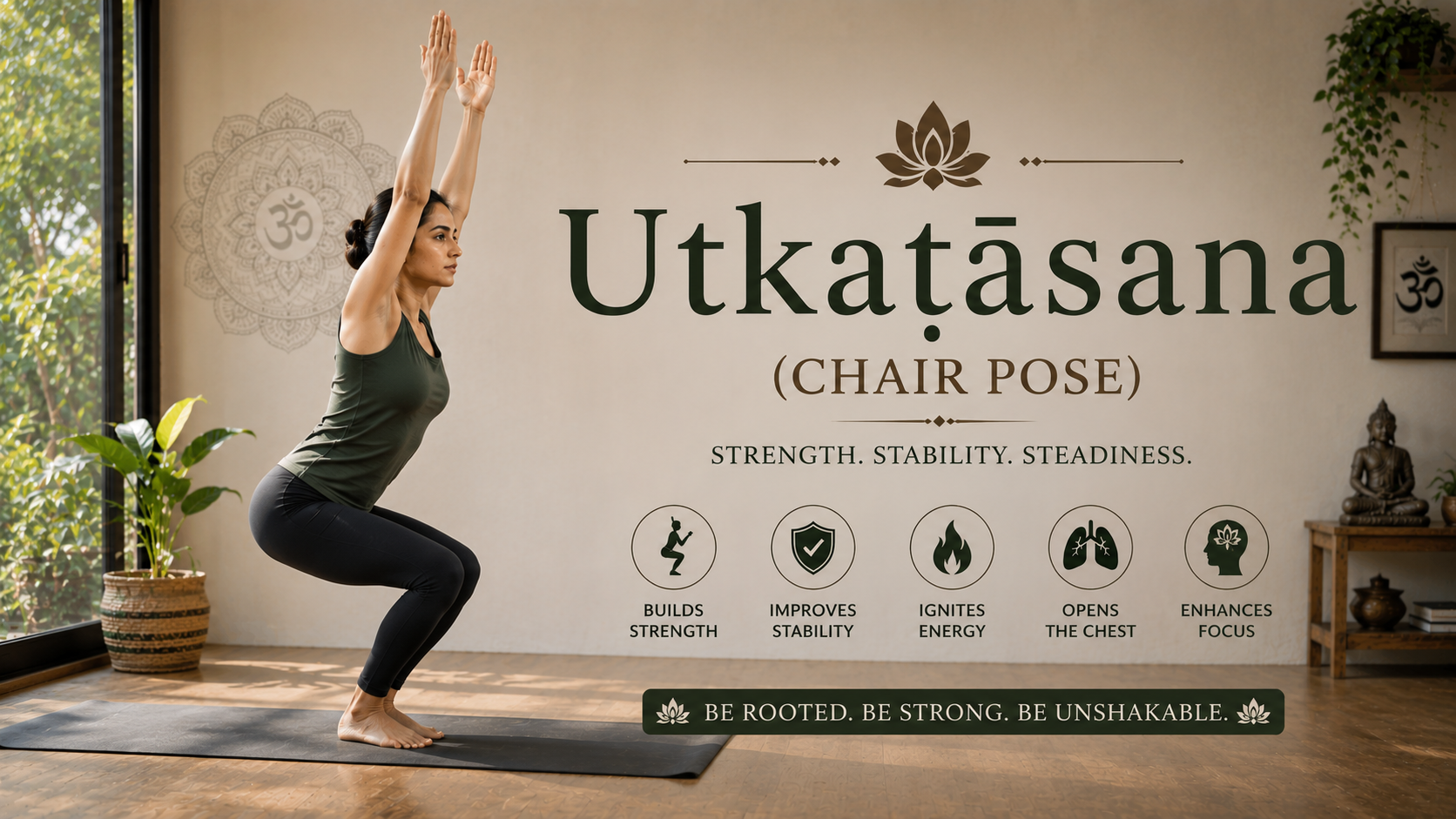
Utkaṭāsana (Chair Pose / Fierce Pose): The Complete Reference Guide
Editorial note, stated once: throughout this article, traditional yogic claims are presented as traditional belief, not scientific fact, unless a specific evidence source is cited alongside them.
Name & Meaning
- Sanskrit: उत्कटासन (Utkaṭāsana)
- English: Chair Pose, Fierce Pose, Awkward Pose
- Etymology: Utkaṭa — "wild, intense, powerful, fierce, above the usual" — + āsana (posture)
Introduction
- A standing posture resembling sitting in an invisible chair: knees bent, hips drawn back, chest lifted forward, arms typically raised overhead
- One of the more demanding standing postures purely in terms of sustained muscular effort, despite requiring no special flexibility
- A staple of Sun Salutation B in Ashtanga Vinyasa practice, where it appears twice
- Its modern form is genuinely different from its medieval ancestor — see Historical Background below for what actually changed and why that matters
How to Practice Utkaṭāsana: Step-by-Step
| Step | Action | Breath | Cue |
|---|---|---|---|
| 1 | Begin in Tāḍāsana, feet together or hip-width apart | Natural breath | "Root down before you bend." |
| 2 | Inhale, raise both arms overhead, palms facing each other or pressed together | Inhale on the arm-raise | "Reach up through the fingertips." |
| 3 | Exhale, bend the knees and sit the hips back and down, as if lowering onto a chair | Exhale into the bend | "Sit back into an invisible chair, not straight down." |
| 4 | Keep weight balanced toward the heels, knees tracking over (not past) the toes | Steady, even breath | "Weight in the heels, knees over the ankles." |
| 5 | Lengthen the spine, lift the sternum, hold | Natural breath through the hold | "Chest lifted even as the hips sink back." |
| 6 | Inhale to straighten the legs, exhale to lower the arms, returning to Tāḍāsana | Inhale to rise | "Rise with the same control you sat down with." |
Benefits
- Physical: strengthens quadriceps, glutes, and calves under sustained isometric load; engages the core to support spinal length against the forward-leaning torso; builds shoulder endurance if arms are held overhead
- Mental: the pose's discomfort makes it a fairly direct test of sustained mental steadiness under physical difficulty — a plausible, commonly cited rationale, though not one that has itself been isolated in dedicated research
- Emotional: general yoga practice (not specific to this pose) is linked in several reviews to reduced perceived stress over time — moderate evidence level
- Traditional: traditionally described as "fierce" and stimulating, said to build inner heat and resolve — a traditional characterization, not a measured physiological claim
Common Mistakes & Corrections
- Knees collapsing inward → correction: actively press the knees to track in line with the second/third toes, engaging the outer hips
- Weight shifting forward onto the toes → correction: root weight back into the heels, even lifting the toes briefly to find the correct weight shift, then setting them back down
- Lower back overarching to compensate for the hip hinge → correction: draw the low belly in slightly and lengthen the tailbone down, rather than letting the lumbar spine take the load
Contraindications & Precautions
- Chronic knee pain, arthritis, or ligament damage in the knee
- Recent ankle sprain or ankle instability
- Low back pain, particularly if it worsens with the forward hip-hinge and hip-hinge-plus-overhead-arm combination
- Headache or insomnia — commonly cited as traditional cautions, though this rests on traditional guidance rather than a specific clinical evidence base
- Practice with care during menstruation or with any existing low back pain
Sequencing: Preparatory, Follow-up & Variations
- Preparatory poses: Tāḍāsana (entry pose), gentle squats or quad-activation movements as a warm-up
- Placement in sequence: commonly placed early-to-mid in a standing sequence as a strength-building pose; appears twice within Sun Salutation B in Ashtanga Vinyasa practice specifically
- Follow-up poses: a forward fold (Uttānāsana) or gentle standing stretch to release the legs after the isometric hold
- Variations: Ardha Utkaṭāsana (a shallower half-bend, thighs closer to parallel with the floor and torso inclined more forward), Utkaṭa Koṇāsana / Goddess Pose (wide-legged variant with turned-out feet), Parivṛtta Utkaṭāsana (revolved/twisting variant), hands in Añjali Mudrā instead of overhead for a gentler shoulder demand
In more detail: the pose's difficulty scales almost entirely with how low the hips sink and how long the position is held, rather than with any flexibility requirement — this is part of why it's accessible to beginners in a way that deep backbends or advanced balances aren't, even though it's genuinely strength-taxing. The Ardha (half) variation is a legitimate way to build toward the full depth over time rather than a "lesser" version to graduate past quickly; sinking the hips too low too early, before the quadriceps and glutes can control the descent, is a common way beginners end up shifting weight forward onto the toes and losing the correct alignment described in Common Mistakes above. The overhead arm position adds a meaningful shoulder-endurance component on top of the leg work, which is why Añjali Mudrā at the chest is a genuinely useful variation for practitioners managing shoulder fatigue or injury, not just a simplification for absolute beginners.
Modifications
- Beginners: practice with a shallower bend (Ardha Utkaṭāsana); hands at heart-center instead of overhead
- Knee sensitivity: reduce the depth of the bend significantly, keeping the knee angle well short of 90 degrees
- Shoulder issues: hands in Añjali Mudrā at the chest, or arms held at a lower angle rather than fully overhead
- Low back concerns: focus on keeping the spine long rather than deepening the hip hinge; consider a shorter hold
- Pregnancy: widen the stance for stability and reduce hold duration; confirm modifications with your own clinician, particularly in later trimesters given the abdominal compression from the forward hip-hinge
- Seniors: practice with a wall behind for tactile depth feedback, or a chair genuinely placed behind the body as a safety net for the first attempts
Historical Background & Classical References
- Utkaṭāsana was a low squatting posture in medieval Haṭha Yoga — quite different from the standing, chair-like pose taught today. This is documented by the yoga historian Norman Sjoman (1999), and the older form — squatting low onto the heels, closer to the posture called Upaveśāsana — is depicted in the 19th-century compilation the Śrītattvanidhi
- A note on conflicting sources: some modern sources claim Utkaṭāsana is described in the 15th-century Haṭha Yoga Pradīpikā specifically. This does not hold up against more carefully sourced accounts — the Haṭhapradīpikā's own list of 15 named āsanas (Svastikāsana, Gomukhāsana, Vīrāsana, Kūrmāsana, Kukkuṭāsana, Uttānakūrmāsana, Dhanurāsana, Matsyendrāsana, Paścimatānāsana, Mayūrāsana, Śavāsana, and others) does not include Utkaṭāsana by that name. The more reliably sourced claim — an older squatting version documented in the 19th-century Śrītattvanidhi — is what this article follows, and the discrepancy between sources is noted here explicitly rather than silently picking one
- The modern standing, chair-like form is said to originate with Krishnamacharya in the 20th century, who is also credited with placing it into the now-familiar Sun Salutation B sequence
Alignment Principles (Iyengar Method)
- Weight rooted through the heels rather than the toes
- Knees tracking directly over the ankles, not collapsing inward or pushing past the toes
- Spine kept long even as the torso inclines forward from the hip hinge
- Sternum lifted to counterbalance the backward hip movement, preventing a rounded upper back
Anatomy & Biomechanics
- Primary movers: quadriceps (working eccentrically then isometrically), gluteus maximus and medius, erector spinae
- Secondary movers: gastrocnemius/soleus (ankle stabilization), deltoids (if arms are overhead)
- Stabilizers: transverse abdominis, intrinsic foot muscles
- Joint actions: hip flexion, knee flexion, ankle dorsiflexion, shoulder flexion (if arms overhead)
- Biomechanics: the pose loads the quadriceps and glutes isometrically at a joint angle many people rarely sustain outside a gym setting, which is a large part of why it's experienced as more demanding than its simple shape suggests — weight distribution toward the heels is critical to keep the knee's shear forces manageable and to prevent the knees tracking past the toes under load
Nervous System & Breathing Effects
- Sustained isometric holds of this kind are a recognized stimulus for building muscular endurance and postural control, in the general strength-training literature (not Utkaṭāsana-specific research)
- Breath is typically kept steady; breath-holding under this kind of muscular effort tends to increase perceived strain, so even breathing is often taught as functionally useful, not incidental
Yogic Perspective
- Traditionally described as "fierce" or "powerful," said to generate internal heat (traditional characterization, consistent with the pose's Sanskrit name)
- Sometimes associated with cultivating resolve and inner strength through sustained physical discomfort — a traditional interpretive framing rather than a scriptural doctrine, given the pose's modern standing form postdates the classical texts
Therapeutic Applications
| Condition | Mechanism | Precaution |
|---|---|---|
| Weak quadriceps/glutes | Isometric strength training under bodyweight load | Avoid with acute knee injury; build depth gradually |
| Poor ankle/knee tracking awareness | Direct feedback on knee alignment under load | Best learned with a mirror or teacher feedback initially |
| General postural endurance goals | Combined lower-body and core endurance challenge | Not a substitute for targeted physical therapy for a diagnosed condition |
Yoga is never a replacement for medical treatment; serious or persistent conditions require a qualified healthcare professional.
Teaching Notes
- Cue: "Sit back into an invisible chair — weight in your heels, chest lifted, like you could hold a piece of paper between your thighs and belly."
- Hands-on adjustment (with consent, within scope): light touch at the sacrum to cue the hips settling back rather than down; light guidance at the knees to cue correct tracking
Myth vs. Fact
| Myth | Fact |
|---|---|
| Today's standing Utkaṭāsana is exactly what's described in classical Haṭha Yoga texts | The medieval version was a low squat, closer to sitting on the heels — the standing "chair" form is a 20th-century development, most likely from Krishnamacharya |
| Deeper is always better in this pose | Depth achieved by shifting weight onto the toes or overarching the low back is a misalignment, not a deeper "correct" version |
Conclusion
Utkaṭāsana is a useful reminder that a pose's name and rough shape can persist across centuries while its actual form changes substantially — the "fierce" squat of medieval Haṭha Yoga and the standing "chair" pose taught today share a name and an intensity, but not really a shape. Practiced with attention to heel-weighting and knee tracking rather than raw depth, it remains one of the more efficient standing postures for building genuine lower-body strength and endurance.
Quick Facts
| Category | Standing, strength |
| Difficulty | Beginner–Intermediate |
| Duration | 15–60 seconds |
| Traditional characterization | "Fierce," generates internal heat |
| Primary Muscles | Quadriceps, gluteus maximus/medius, erector spinae |
| Contraindications | Chronic knee pain, ankle instability, acute low back pain |
Frequently Asked Questions
Is chair pose really ancient?
The name and a squatting version are medieval, but today's standing form is a 20th-century development — see Historical Background above.
Why do my knees hurt in this pose?
Usually from weight shifting forward onto the toes or knees tracking inward — see Common Mistakes.
Should my thighs be parallel to the floor?
Not necessarily, especially for beginners — Ardha Utkaṭāsana (a shallower bend) is a legitimate full expression of the pose at an earlier stage, not a lesser version.
Is it normal for this pose to feel really hard?
Yes — it's one of the more isometrically demanding standing poses despite requiring no special flexibility.
Can I do this pose during pregnancy?
With a wider stance and shorter holds, often yes — confirm modifications with your own clinician, especially later in pregnancy.
Where should my weight be?
Rooted back into the heels, not the toes — this is the single most common alignment correction needed in this pose.
References
1. Classical Yoga Texts: A low-squatting predecessor form is documented in the 19th-century Śrītattvanidhi, per Sjoman (1999) — not, as some sources claim, in the 15th-century Haṭha Yoga Pradīpikā, whose own list of 15 named āsanas does not include Utkaṭāsana; this discrepancy is noted explicitly in Historical Background above.
2. Modern Yoga Institutions: Sjoman, N. E. (1999). The Yoga Tradition of the Mysore Palace. Abhinav Publications (source for the historical squatting form and its origin in the Śrītattvanidhi). Iyengar, B.K.S. Light on Yoga, Schocken Books (alignment methodology).
3. Peer-Reviewed Scientific Research: No Utkaṭāsana-specific peer-reviewed research was identified through available sources. General strength-training and isometric-exercise literature applies at the category level only, and is not cited here as pose-specific.
Where sources genuinely disagreed (the Haṭha Yoga Pradīpikā attribution claim vs. the Śrītattvanidhi-based account), that disagreement is stated explicitly above rather than one account being silently chosen without explanation.
This article is for educational purposes and does not replace individualized medical or physical therapy advice. Consult a qualified healthcare provider before beginning any new practice, especially with a pre-existing health condition.