Utkata Koṇāsana (Goddess Pose): Classical Sources, Anatomy, Alignment & Evidence-Based Guide
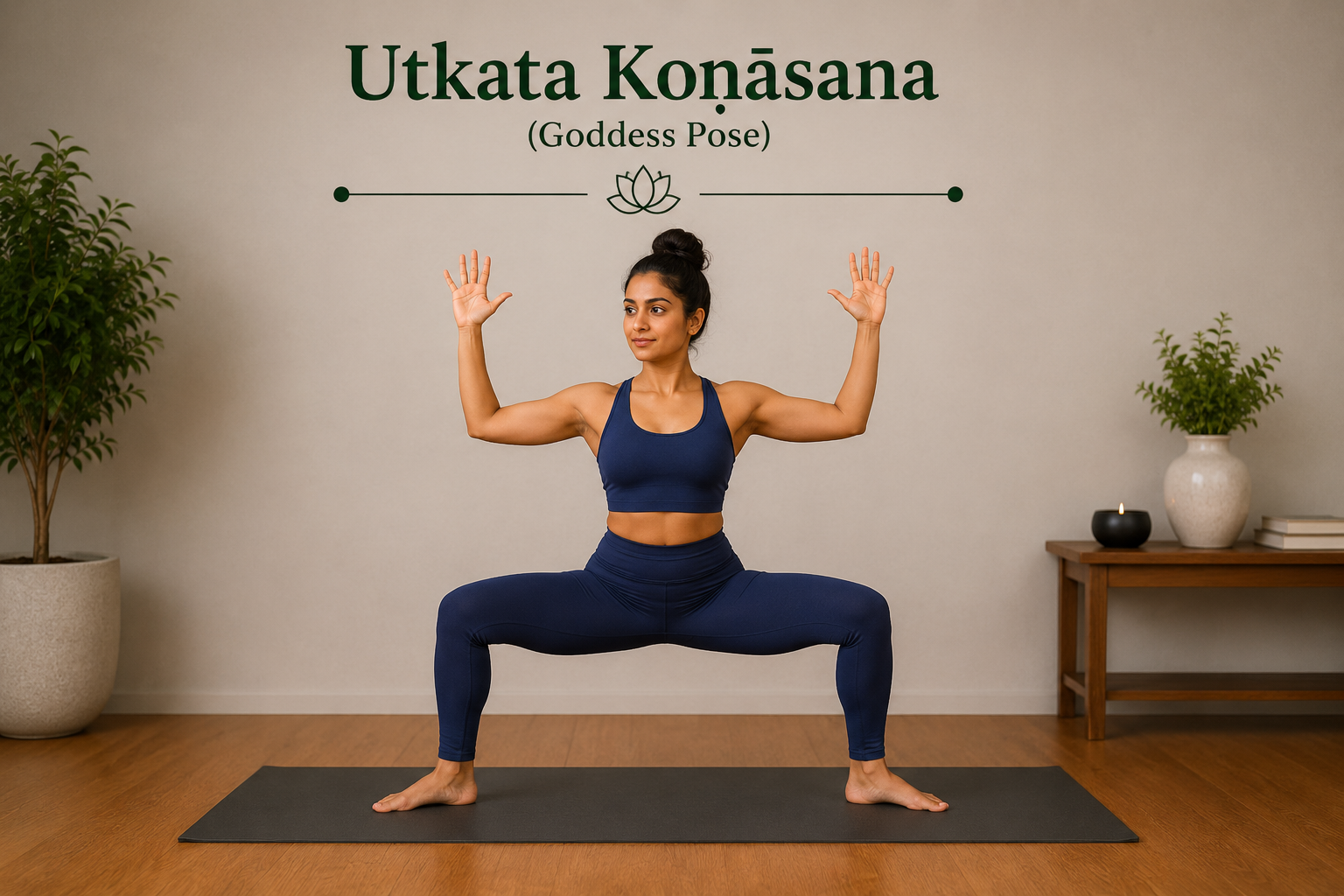
Utkata Koṇāsana (Goddess Pose): The Complete Reference Guide
Editorial note, stated once: throughout this article, traditional yogic and Āyurvedic claims (chakra, prāṇa, dosha associations) are presented as traditional belief, not scientific fact, unless a specific evidence source is cited alongside them.
Name & Meaning
- Sanskrit: उत्कटकोणासन (Utkata Koṇāsana)
- IAST Transliteration: Utkata Koṇāsana / Utkata Konasana
- English: Goddess Pose / Fierce Angle Pose / Mighty Angle Posture
- Etymology: Utkata (fierce / mighty / uneven / powerful) + Koṇa (angle) + Āsana (posture / seat). "The posture of fierce angular geometry, invoking powerful grounding, strength, and divine feminine energy."
Introduction
- Utkata Koṇāsana is a powerful wide-stance squatting posture widely utilized in modern Vinyasa, Kundalini, and Haṭha Yoga systems.
- Characterized by stepping feet wide apart, turning toes outward at 45 degrees, bending knees deeply to stack directly over ankles (forming 90-degree right angles), lowering pelvis until thighs are parallel to the floor, and bending arms at 90-degree goalpost angles.
- Often referred to in modern traditions as Goddess Pose, embodying strength, stability, and open-hip mobility.
- Functions as an outstanding clinical diagnostic for evaluating hip external rotator strength, ankle dorsiflexion, adductor extensibility, and pelvic floor control.
Benefits
- Inner Thigh & Hip External Rotator Strengthening: Intensely engages the adductor magnus, gluteus maximus, piriformis, and deep external rotators of the hip.
- Lower Body Muscular Endurance: Builds functional strength in the quadriceps femoris (vastus lateralis/medialis) and hamstring complex under isometric squat loading.
- Pelvic Floor & Core Activation: Recruits deep transverse abdominis and pelvic floor musculature (levator ani) to stabilize the torso upright.
- Chest Girdle & Upper Back Opening: Arm positioning opens the pectoral fascia and strengthens rhomboids and middle trapezius.
- Traditional/Spiritual: Believed to awaken Mūlādhāra and Svādhiṣṭhāna chakras, invoke divine feminine Śakti energy, and ground erratic mental energy—traditional belief, not a scientific claim.
How to Practice Utkata Koṇāsana: Step-by-Step
| Step | Action | Breath | Teacher Cue |
|---|---|---|---|
| 1 | Step your feet wide apart on your mat (about 3.5 to 4 feet). Turn your heels inward and toes outward at a 45-degree angle. | Natural breath | "Step wide, turning your heels in and toes out at 45 degrees." |
| 2 | Exhale, bend both knees deeply, lowering your pelvis down until your thighs are parallel to the floor (creating 90-degree angles at your knees). | Exhale to squat down | "Bend your knees and sink your hips down until thighs are parallel to the floor." |
| 3 | Ensure your knees track directly outward in line with the center of your feet (preventing them from rolling inward). | Inhale to check knee alignment | "Press your knees back open, tracking them directly over your second and third toes." |
| 4 | Lengthen your tailbone straight down toward the floor and draw your lower belly inward to neutralize your pelvis (avoiding forward arching). | Exhale to tuck tailbone | "Lengthen your tailbone down and draw your lower belly in to keep your torso upright." |
| 5 | Raise your arms and bend your elbows at 90 degrees into goalpost arms, palms facing forward. Broaden your collarbones. Hold for 5–8 breaths. | Steady, expansive diaphragmatic breath | "Bring your arms into goalpost shapes, shining your heart wide and bright." |
| 6 | To exit, inhale, press firmly into the outer edges and heels of your feet, straighten your legs, and step feet back together to Samasthitiḥ. | Inhale to press up | "Press into your heels, straighten your legs, and step back to Mountain Pose." |
Common Mistakes & Corrections
- Knees rolling inward (valgus collapse): Allowing knees to drop toward the midline strains knee ligaments → Correction: Actively engage glutes and outer hips to press knees open in line with toes.
- Leaning the torso forward and sticking buttocks out: Hinching chest toward the mat shifts weight incorrectly → Correction: Lengthen tailbone straight down and keep shoulders stacked directly over hips.
- Heels lifting off the floor: Tight calf muscles or narrow stance causes heels to pop up → Correction: Widen your stance slightly and press outer heels down firmly into the mat.
- Shrugging shoulders up toward ears: Tensing neck muscles during goalpost arm hold → Correction: Broaden collarbones and draw shoulder blades down the back.
Contraindications & Precautions
- Acute Knee Injury (Meniscus, ACL, or Patellar Tendonitis): Deep wide squatting under load can aggravate knee pathology; keep squat shallow.
- Severe Hip Impingement or Labral Tear: Wide external hip rotation can pinch anterior hip joint structures; reduce stance width.
- Acute Ankle or Foot Sprain: Closed-chain weight-bearing requires stable ankle alignment.
Sequencing: Preparatory, Follow-up & Variations
- Preparatory Poses: Prāsarita Pādottānāsana (Wide-Legged Forward Fold), Baddha Koṇāsana (Bound Angle), Malāsana (Garland Pose).
- Placement in Sequence: Mid-sequence standing strength block, bridging standing postures with floor hip openers.
- Follow-up Poses: Prāsarita Pādottānāsana, Skandāsana (Side Lunge), Uttānāsana, Śavāsana.
- Variations:
- Hands at Heart Center (Anjali Mudra): Resting palms together at chest if goalpost arms cause shoulder fatigue.
- Heel-Raised Goddess Pose: Lifting onto balls of feet to challenge ankle balance and calf strength.
- Dynamic Goddess Squat: Inhaling to straighten legs and reach arms overhead, exhaling to sink back down into squat.
Modifications
- Shallow Squat Depth: Do not sink thighs all the way parallel to the floor; stay higher up where knees and hips feel completely supported.
- Hands Resting on Thighs: Place hands on upper thighs to support torso upright if core or leg fatigue sets in.
- Back Against a Wall: Stand with back lightly touching a wall to provide tactile feedback for keeping the torso upright.
Historical Background & Classical References
- Modern Vinyasa Evolution: While wide stances appear in traditional martial arts and temple sculpture across India, Utkata Koṇāsana was popularized globally in modern Vinyasa and Kundalini traditions as Goddess Pose.
- Symbolism: Embodies the fierce, stable, and nurturing qualities of divine feminine energy (Śakti).
Alignment Principles (Iyengar Method)
- Vertical Torso Stack: Shoulders stack directly over the pelvis throughout the squat.
- Knee-Toe Tracking: Knees track precisely outward in the exact direction of the angled toes.
- Neutral Pelvic Tilt: Tailbone drops downward while lower abdomen stays integrated.
Anatomy & Biomechanics
- Primary Stretched Muscles: Adductor Magnus, Adductor Longus, Gracilis, Pectineus, Pectoralis Major.
- Primary Active/Strengthening Muscles: Quadriceps Femoris, Gluteus Maximus, Gluteus Medius, Piriformis, Transverse Abdominis, Rhomboids.
- Joint Mechanics: Bilateral hip flexion, external rotation, and abduction; deep knee flexion (approx. 90°); ankle dorsiflexion; scapular adduction and depression.
- Hip Rotator & Adductor Dynamics: The wide external rotation stance places high demand on the gluteus maximus and deep external rotators to keep knees tracking outward, preventing medial knee collapse.
Nervous System & Breathing Effects
- Sympathetic Invigoration: Lower body isometric loading stimulates sympathetic alertness, generating internal heat and focus.
- Thoracic Expansion: Arm positioning opens the chest wall and promotes deep intercostal breathing.
Yogic & Āyurvedic Perspective
- Dosha Impact: Stimulates Pitta (builds internal heat and strength) and grounds uncentered Vāta—traditional belief.
- Prāṇa Dynamics: Awakens Mūlādhāra and Svādhiṣṭhāna chakras, circulating Apāna Vāyu through the pelvic bowl.
Therapeutic Applications
| Condition | Mechanism | Research / Precaution |
|---|---|---|
| Weak Outer Hips & Inner Thigh Tightness | Loaded wide squat strengthens external rotators while stretching adductor fascia | Supported by physical therapy hip studies. Precaution: Keep knees tracking over toes. |
| Lower Body Atrophy & Instability | Isometric squatting builds functional quadriceps and gluteal endurance | Supported by exercise physiology research. Precaution: Adjust squat depth as needed. |
Yoga is never a replacement for medical treatment; serious or persistent conditions require a qualified healthcare professional.
Teaching Cues & Hands-On Adjustments
- Verbal Cues: "Sink your hips down, tracking your knees wide open over your toes." / "Lengthen your tailbone straight down and lift your chest." / "Bring your arms into goalpost shapes and breathe wide into your ribs."
- Hands-on Adjustment (Safe execution with consent):
- Stand behind student; place hands gently on their shoulders to help them stack their torso upright and avoid leaning forward.
- Place hands softly on their outer thighs to encourage external rotation so knees track over toes.
Myth vs. Fact
| Myth | Fact |
|---|---|
| You must sink your hips lower than your knees for Goddess Pose to count. | Lowering thighs parallel to the floor (90 degrees) provides optimal quadriceps and glute expression without straining knee cartilage. |
| Goddess Pose is just a resting stretch. | It is an intense isometric strengthening posture that demands active engagement from legs, glutes, and core. |
Conclusion
Utkata Koṇāsana (Goddess Pose) is a magnificent, empowering posture that builds lower body resilience, opens the hips, and awakens inner strength. By keeping the torso upright, tracking knees over toes, and breathing with intention, practitioners embody steady warrior poise.
Quick Facts
| Category | Wide-stance squat / External hip opener |
| Difficulty Level | Beginner to Intermediate |
| Primary Muscles Stretched | Adductor Magnus, Gracilis, Pectoralis Major |
| Primary Muscles Active | Quadriceps Femoris, Gluteus Maximus, Gluteus Medius, Rhomboids |
| Classical Source? | Yes (Modern classical vinyasa formalization) |
| Traditional Chakra (Belief) | Mūlādhāra (Root) & Svādhiṣṭhāna (Sacral) |
| Dosha Impact (Belief) | Ignites Pitta & grounds Vāta |
Frequently Asked Questions
What does Utkata Koṇāsana mean in English?
Utkata (fierce / powerful) + Koṇa (angle) + Āsana (pose) = Goddess Pose or Fierce Angle Pose.
Why do my knees hurt in Goddess Pose?
Knee pain occurs when knees roll inward toward each other instead of tracking outward in line with your toes. Push your knees wide open and engage your glutes.
Should my torso lean forward in Utkata Konasana?
No, your torso should remain upright with your shoulders stacked directly over your hips. Avoid leaning your chest forward.
How long should I hold Goddess Pose?
Hold for 5 to 8 steady breaths (about 20 to 40 seconds).
References
1. Modern Yoga & Vinyasa Manuals: Contemporary alignment and sequencing literature.
2. Peer-Reviewed Scientific Research:
- Sherman, K. J., et al. (2011). A randomized trial comparing yoga, stretching, and a self-care book for chronic low back pain. Archives of Internal Medicine, 171(22), 2019-2026.
- Ni, M., et al. (2014). Comparative muscle activation patterns during yoga postures in elderly adults. BMC Complementary and Alternative Medicine, 14, 401.
This article is for educational purposes and does not replace individualized medical or physical therapy advice. Consult a qualified healthcare provider before beginning any new practice.