Trikoṇāsana (Triangle Pose): Classical Sources, Anatomy, Alignment & Evidence-Based Guide
Trikoṇāsana (Triangle Pose): The Complete Reference Guide
Editorial note, stated once: throughout this article, traditional yogic and Āyurvedic claims (chakra, prāṇa, dosha associations) are presented as traditional belief, not scientific fact, unless a specific evidence source is cited alongside them.
Name & Meaning
- Sanskrit: त्रिकोणासन (Trikoṇāsana) or उत्थित त्रिकोणासन (Utthita Trikoṇāsana)
- IAST Transliteration: Trikoṇāsana / Utthita Trikoṇāsana
- English: Triangle Pose / Extended Triangle Pose
- Etymology: Tri (three) + Koṇa (angle) + Āsana (posture / seat). Utthita translates to extended or stretched out.
Introduction
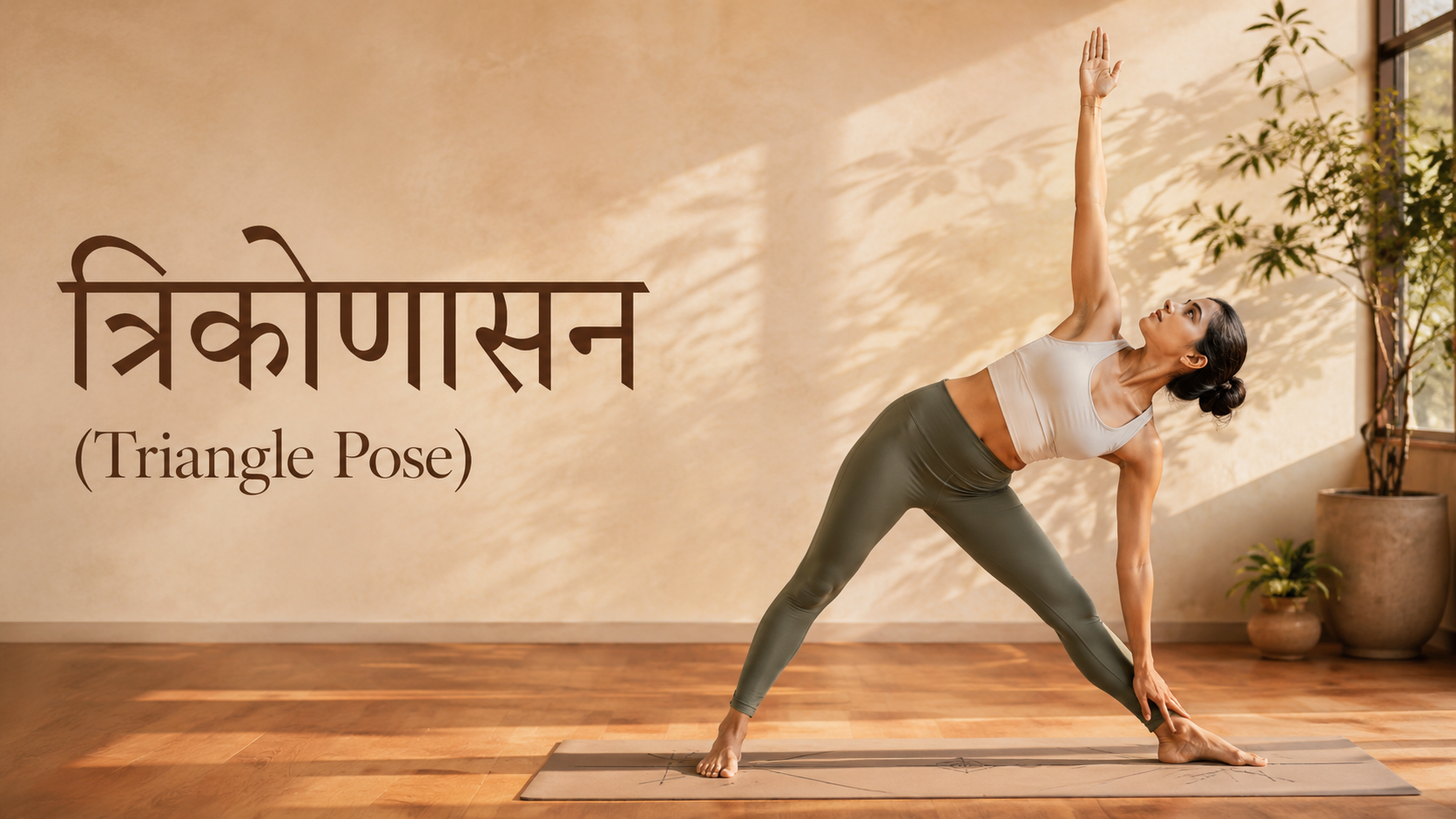
- Trikoṇāsana is one of the foundational standing postures in modern postural yoga, creating three distinct geometrical triangles with the body (between feet and floor, lower side waist and front leg, top arm and torso).
- A standing lateral extension pose that combines hamstring flexibility, hip abduction, pelvic articulation, core stabilization, and open thoracic rotation.
- Widely recognized as a staple posture across Ashtanga, Iyengar, Hatha, and Vinyasa systems, functioning as both an opening pose and a diagnostic key for spinal and pelvic mobility.
- Offers significant balance, proprioceptive, and musculoskeletal benefits, requiring active grounding through the feet while maintaining axial length through the spine.
Benefits
- Physical: Lengthens hamstrings, adductors, and lateral spinal flexors (quadrate lumborum); strengthens quadriceps, gluteus medius, and core stabilizers; improves joint mobility in hips and thoracic spine.
- Mental: Demands spatial awareness and steady concentration (dṛṣṭi), cultivating present-moment focus and body-mind integration.
- Emotional: Expands the thoracic cavity and chest, promoting deep diaphragmatic breathing which correlates with reduced subjective stress—supported by general yoga efficacy studies.
- Postural & Balance: Enhances single-leg stability and weight distribution across the plantigrade foot, stimulating proprioceptive receptors in the ankles and hips.
- Traditional/Spiritual: Believed in traditional yogic practice to harmonize Prāṇa Vāyu and Apāna Vāyu, balancing ground energy with upward ascension, and stimulating the Manipūra (solar plexus) and Svadhiṣṭhāna (sacral) chakras—traditional belief, not a scientific claim.
How to Practice Trikoṇāsana: Step-by-Step
| Step | Action | Breath | Teacher Cue |
|---|---|---|---|
| 1 | Begin in Tāḍāsana. Step or lightly hop feet wide apart (3.5 to 4 feet), arms parallel to floor in a T-shape. | Inhale to expand | "Root into the outer edges of both feet; extend energy out through the fingertips." |
| 2 | Turn right foot out 90 degrees; turn left foot slightly inward (about 15 degrees), aligning right heel with left arch. | Exhale to settle | "Thigh cap turns outward so the center of the right kneecap aligns with the second toe." |
| 3 | Reach right arm far forward over the right leg, hinging directly from the right hip crease while keeping both sides of the torso long. | Inhale to lengthen | "Reaching forward comes from the hip fold, not rounding the spine." |
| 4 | Lower right hand to shin, ankle, block, or big toe (if practicing Ashtanga). Extend left arm straight up toward sky. | Exhale to lower hand | "Keep the underside waist extended—do not dump weight into your lower hand." |
| 5 | Rotate chest open to the left, keeping pelvis in an organic angle. Turn gaze up toward left thumb (or forward if neck hurts). | Steady, deep breathing | "Revolve the sternum toward the sky while staying rooted through the back heel." |
| 6 | Press firmly through back heel, engage core, inhale to stand up smoothly. Reverse foot orientation and repeat on left side. | Inhale to rise | "Pull up through the back leg back heel to lift yourself out of the pose with control." |
Common Mistakes & Corrections
- Collapsing the lower side waist: Practitioners often reach too far down to touch the floor, rounding the lower flank → Correction: Place hand higher on a yoga block or shin to preserve equal length on both sides of the torso.
- Hyperextending the front knee: Locking the joint backward leads to knee strain and ligament pressure → Correction: Maintain a micro-bend in the front knee, actively engaging the front quadriceps to pull up the kneecap.
- Forcing hips completely into a single plane: Forcing hips flat like "between two sheets of glass" misaligns the sacroiliac (SI) joint → Correction: Allow the top hip to naturally angle slightly forward and down to follow natural pelvic mechanics.
- Weight dumping onto lower hand: Resting heavy weight on the front leg collapses the chest → Correction: Lighten the bottom hand, engaging core oblique muscles to sustain trunk suspension.
- Craning the neck upward aggressively: Straining the cervical spine to look at top thumb → Correction: Keep neck long and aligned with spinal curvature; look forward or down if experiencing cervical discomfort.
Contraindications & Precautions
- Acute Cervical Spine Issues: Avoid turning gaze upward; keep neck neutral, facing forward or looking down at the floor.
- Severe Low Back Pain / Acute Disc Herniation: Lateral flexion with rotation places asymmetric loads on intervertebral discs; practice with micro-bended knees and light depth under physical therapy guidance.
- Uncontrolled High Blood Pressure: Avoid raising the upper arm for extended durations and keep gaze forward rather than up.
- Migraine or Dizziness / Low Blood Pressure: Rapid movement into or out of side bends can provoke lightheadedness; transition slowly with wall support.
- Late Pregnancy: Take a wider stance near a wall to prevent balance loss; avoid aggressive pelvic rotation.
Sequencing: Preparatory, Follow-up & Variations
- Preparatory Poses: Tāḍāsana (establishes alignment), Vṛkṣāsana (prepares hip abductors/balance), Virabhadrasana II (opens adductors), Supta Pādāṅguṣṭhāsana (prepares hamstrings).
- Placement in Sequence: Main standing posture sequence, ideally positioned early after warming up the legs and spine.
- Follow-up Poses: Parivṛtta Trikoṇāsana (Revolved Triangle Pose), Utthita Pārśvakoṇāsana (Extended Side Angle Pose), Virabhadrasana I & II, or forward bends like Prasārita Pādottānāsana to balance pelvis.
- Variations: Bound Triangle Pose (Baddha Trikoṇāsana), Revolved Triangle (Parivṛtta Trikoṇāsana), Triangle at the wall (for stability).
In more detail: Trikoṇāsana is a fundamental pivot point in standing sequences. Its placement early in a practice allows instructors to assess hamstring length, lateral trunk flexibility, and hip mobility before introducing deeper hip openers or balance poses like Ardha Chandrāsana (Half Moon Pose). Transitioning smoothly from Virabhadrasana II into Trikoṇāsana is common because both share similar wide-legged foot setups, though Trikoṇāsana requires straightening the front leg and angling the pelvis differently. Following Trikoṇāsana with counter-twists such as Parivṛtta Trikoṇāsana ensures balanced engagement across asymmetrical fascial lines and lumbar rotators.
Modifications
- Beginners: Place a block on the high setting outside the front ankle; rest lower hand on the block rather than forcing reach to the floor.
- Seniors: Practice with the back against a wall for spatial reference and physical support; reduce stance width to maintain balance.
- Pregnancy: Elevate lower hand on a chair or high block to prevent abdominal compression; widen foot stance to accommodate altered center of gravity.
- Tight Hamstrings / Knee Issues: Maintain a visible micro-bend in the front knee; shorten the stance slightly; keep bottom hand on the shin.
- Children: Frame as a playful geometric posture; keep holds shorter (5–10 seconds) focusing on dynamic movement and joy over precision alignment.
Historical Background & Classical References
- Classical Text Absence: Trikoṇāsana is not mentioned in classical medieval Hatha texts such as the Haṭhayogapradīpikā, Gheraṇḍa Saṃhitā, or Śiva Saṃhitā. Traditional yogic texts almost exclusively emphasized seated meditation postures, pranayama, and mudras.
- Modern Origin: The posture emerged in the early 20th century, made famous by T. Krishnamacharya at the Mysore Palace and subsequently disseminated globally through his students B.K.S. Iyengar (Light on Yoga, 1966) and K. Pattabhi Jois (Ashtanga Yoga Primary Series).
- Sanskrit Śloka (Modern Conceptual Representation): Traditional texts lack a direct śloka for Trikoṇāsana; however, modern Sanskrit commentators describe its alignment as follows:
उत्तिष्ठन् पादौ प्रसार्य हस्तेन पादाङ्गुष्ठं गृहीत्वा पार्श्वाभ्यां शरीरम् वितत्य तिष्ठेत् इति त्रिकोणासनम्।
Uttiṣṭhan pādau prasārya hastena pādāṅguṣṭhaṁ gṛhītvā pārśvābhyāṁ śarīram vitatya tiṣṭhet iti trikoṇāsanam.
"Standing with feet spread apart, holding the big toe with the hand, and extending the body laterally—this is known as Trikoṇāsana."
(Note: Modern descriptive prose in classical style; not sourced from ancient texts.)
Alignment Principles (Iyengar Method)
- Foot Alignment: Front heel aligns directly with the back foot’s arch. Both feet pressed firmly into floor through all four corners (foot tripod).
- Leg Engagement: Quadriceps engaged strongly to draw the patella upward; front knee faces same direction as front toes.
- Pelvic Orientation: The pelvis does not lie entirely flat; the top hip dips slightly forward to allow safe articulation of the femoral head in the acetabulum without jamming the hip joint.
- Torso Length: Equal axial lengthening through both left and right sides of the waist. Chest rotates upwards toward ceiling without twisting the lower lumbar spine excessively.
- Arm & Shoulder Stack: Top arm extends directly above the bottom shoulder, creating a single clean vertical vector line from floor to sky.
Anatomy & Biomechanics
- Primary Movers (Target Muscles Stretch): Hamstrings (biceps femoris, semitendinosus, semimembranosus) of front leg, hip adductors (adductor magnus, longus), quadrate lumborum and external obliques on upper side of torso.
- Primary Stabilizers (Strengthening): Gluteus medius and minimus of front leg (preventing collapse), quadriceps femoris (knee stabilizer), internal/external obliques, erector spinae, tensor fasciae latae.
- Joint Actions: Front hip in flexion, abduction, and external rotation; back hip in extension, abduction, and internal rotation; lateral flexion of spine with mild thoracic axial rotation; shoulder extension and abduction.
- Biomechanics: Ground Reaction Force (GRF) travels up through the triangular base of support created by the feet. The body’s Center of Gravity (COG) shifts laterally and downward, requiring isometric contraction of core flexors and foot intrinsic muscles to maintain dynamic balance.
Nervous System & Breathing Effects
- Proprioception & Balance: Wide asymmetric stance stimulates vestibular system and joint mechanoreceptors in ankle and hip joints.
- Respiratory Dynamics: Asymmetric open-chest position stretches intercostal muscles on top side, promoting unilateral lung expansion and increasing tidal volume capacity.
- Autonomic Function: Deep, unforced diaphragmatic breathing in standing postures stimulates vagal tone following initial exertion, promoting sympathetic-parasympathetic balance.
Yogic & Āyurvedic Perspective
- Dosha Effects: Trikoṇāsana generates mild heat while grounding energy. Traditionally considered balancing for Kapha (stimulates digestion and lateral flexibility) and Vāta (provides grounding structure), but can increase Pitta if held aggressively with high strain—traditional belief.
- Prāṇa Dynamics: Directs Apāna Vāyu downward into the earth for stability, while encouraging Prāṇa Vāyu to expand outward across chest and arms.
Therapeutic Applications
| Condition | Mechanism | Research / Precaution |
|---|---|---|
| Mild Sciatica / Tight Hamstrings | Eccentric lengthening of posterior thigh muscles and piriformis decompression | Plausible biomechanical mechanism. Precaution: Keep front knee micro-bent; avoid if nerve pain acutely radiates down leg. |
| Non-specific Low Back Stiffness | Strengthens gluteus medius and stretches tight quadratus lumborum | General yoga trial evidence supports standing postures for chronic low back pain management (e.g., Sherman et al., 2011). Avoid deep rotation during acute sprains. |
| Postural Drooping / Hyperkyphosis | Strengthens upper back extensor muscles and opens pectoralis major | Biomechanical support; requires continuous active extension of thoracic spine. |
Yoga is never a replacement for medical treatment; serious or persistent conditions require a qualified healthcare professional.
Teaching Cues & Hands-On Adjustments
- Verbal Cues: "Press firmly through the outer edge of your back foot." / "Lengthen both sides of your waist equally." / "Imagine leaning your chest back against a wall behind you."
- Hands-on Adjustment (Safe execution with consent):
- Stand behind student; place front hand gently on top hip crest, guiding it slightly down and back to lengthen lower flank.
- Place other hand on student’s upper chest or shoulder, gently guiding chest rotation upward without forcing lumbar twist.
Myth vs. Fact
| Myth | Fact |
|---|---|
| You must touch your toes or the floor for a "complete" pose. | Resting on a block or shin with a long waist is superior alignment to touching the floor with a rounded spine. |
| Your hips must be completely flat in a single 2D plane. | Human hip anatomy requires the top hip to angle slightly forward to avoid hip impinement and SI joint strain. |
| Trikoṇāsana originates from ancient 2,000-year-old scriptures. | It is a modern postural addition popularized in the 20th century by T. Krishnamacharya and B.K.S. Iyengar. |
Conclusion
Trikoṇāsana stands as a cornerstone of modern yoga posture practice, synthesizing strength, flexibility, balance, and spatial geometry into a single posture. While absent from medieval Hatha manuscripts, its biomechanical value is indisputable when practiced with modern anatomical principles. By prioritizing side waist length over touching the floor and allowing natural pelvic movement, practitioners of all levels can safely harvest the physical and mental rewards of this iconic standing pose.
Quick Facts
| Category | Standing lateral extension / posture |
| Difficulty Level | Beginner to Intermediate |
| Primary Muscles Stretched | Hamstrings, Adductors, Quadratus Lumborum, Obliques |
| Primary Muscles Strengthened | Quadriceps, Gluteus Medius, Core flexors, Erector Spinae |
| Classical Source? | No (Modern posture, 20th century origin) |
| Traditional Chakra (Belief) | Manipūra & Svadhiṣṭhāna |
| Dosha Impact (Belief) | Pacifies Kapha & Vāta; increases Pitta if overexerted |
Frequently Asked Questions
Is Trikoṇāsana found in classical ancient Hatha Yoga texts?
No, Trikoṇāsana is a modern posture popularized in the 20th century through T. Krishnamacharya, B.K.S. Iyengar, and Pattabhi Jois.
Should my bottom hand reach the floor?
Only if you can maintain equal length on both sides of your waist without rounding your spine. Using a block is often more beneficial.
Is it normal to feel a deep stretch in the inner thigh and back of leg?
Yes, Trikoṇāsana deeply stretches the hamstrings and hip adductors. Always micro-bend the knee if you feel strain near the joint.
How do I keep my front knee safe in Triangle Pose?
Engage your quadriceps to lift the kneecap and maintain a subtle micro-bend to avoid hyperextension.
Should I force my hips completely flat into a single plane?
No. Forcing the hips flat can strain the SI joint and pin the hip socket. Allow the top hip to angle slightly forward.
Where should I look during the pose?
Look up toward your top thumb if your neck feels comfortable. Otherwise, look straight ahead or down at the floor.
Can I practice Trikoṇāsana during pregnancy?
Yes, with modifications: use a wider stance near a wall and rest your lower hand on a chair or high block.
How long should I hold Trikoṇāsana?
Typically 30 to 60 seconds (5 to 10 deep breaths) per side.
What is the difference between Utthita Trikonasana and Parivrtta Trikonasana?
Utthita Trikonasana is an open lateral side bend; Parivrtta Trikonasana involves revolving the torso inward across the front leg.
Why do I feel lightheaded coming out of Triangle Pose?
Rapid changes in head position can affect blood pressure. Inhale slowly and use back leg strength to lift your torso up with control.
References
1. Classical Yoga Texts: Modern postural posture; absent in medieval manuals (Haṭhayogapradīpikā, Gheraṇḍa Saṃhitā). Modern conceptual alignment framework adapted from early 20th-century traditions.
2. Modern Yoga Institutions: Iyengar, B.K.S. (1966). Light on Yoga. Schocken Books, pp. 63-65. Jois, K. Pattabhi (2002). Yoga Mala. North Point Press. Bihar School of Yoga publications (Asana Pranayama Mudra Bandha).
3. Peer-Reviewed Scientific Research:
- Sherman, K. J., et al. (2011). A randomized trial comparing yoga, stretching, and a self-care book for chronic low back pain. Archives of Internal Medicine, 171(22), 2019-2026.
- Ni, M., et al. (2014). Comparative muscle activation patterns during yoga postures in elderly adults. BMC Complementary and Alternative Medicine, 14, 401.
This article is for educational purposes and does not replace individualized medical or physical therapy advice. Consult a qualified healthcare provider before beginning any new practice, especially with a pre-existing health condition.