The Traditional Legend of Maharishi Patanjali

Introduction
Many inspiring stories are told about Maharṣi Patañjali within the Yoga tradition. This particular story is told not as a historical record, but as a way of conveying Yoga philosophy, the Guru-disciple relationship, discipline, and the value of knowledge. Its purpose is to cultivate reverence, awareness, and respect for Yoga among practitioners.
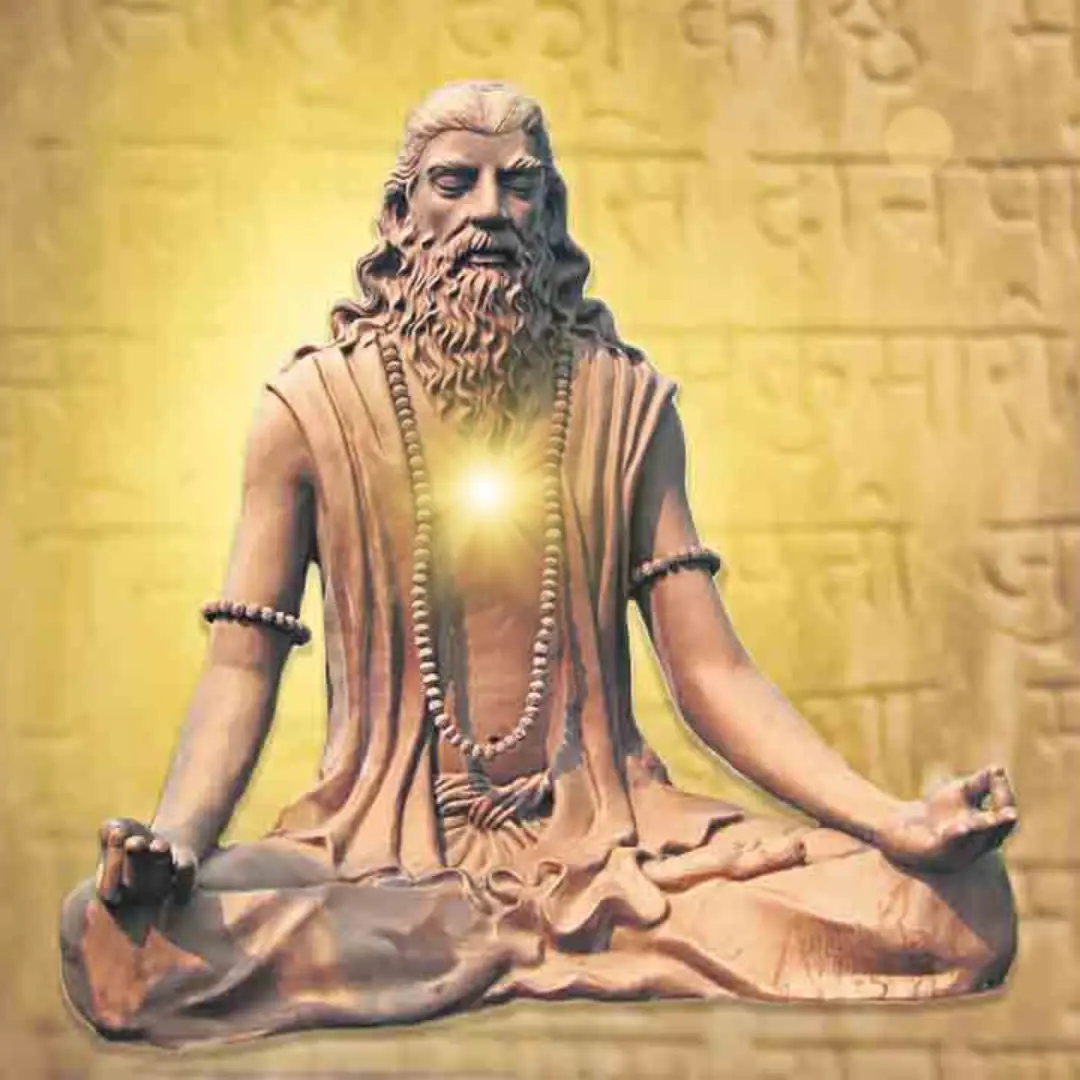
How the Story Begins
In ancient times, as the world began to fill with mental and physical unrest, envy, and negativity, many sages approached Lord Viṣṇu in search of a solution. At that time, Lord Viṣṇu was resting in Yoga-nidrā upon Ādi Śeṣa.
For the welfare of the world, Lord Viṣṇu instructed Ādi Śeṣa to descend to earth in human form. According to tradition, Ādi Śeṣa took birth as Maharṣi Patañjali.
Maharṣi Patañjali's Purpose
Maharṣi Patañjali wished to give humanity three essential forms of knowledge:
- Yoga — for the purification of mind and consciousness.
- Āyurveda — for the purification of the body and its health.
- Grammar (Vyākaraṇa) — for the purification of speech and language.

The Conditions of His Gurukul
Before imparting this knowledge, Maharṣi Patañjali set two important conditions:
- He would teach only 1,000 students.
- A veil would remain between the teacher and the students, and no student would leave the assembly without his permission.
The transmission of knowledge took place through silent meditation — the students received knowledge from Maharṣi Patañjali without a single word being spoken.
The Breach of Discipline and Its Consequence
One student stepped out of the assembly to attend to a natural bodily need. In that moment, another student, overcome by curiosity, lifted the veil. According to the story, because this breach of discipline occurred, the remaining 999 students were reduced to ash. Only the student who had stepped outside survived.
Maharṣi Patañjali forgave him, but placed one condition upon him: until he passed the knowledge of Yoga on to someone else, he would have to remain in the form of a Brahmarākṣasa (a tormented spirit born of unfulfilled duty).
The Preservation of Knowledge
The Brahmarākṣasa searched continuously for a worthy disciple. Eventually, Maharṣi Patañjali himself took the form of a disciple and approached him, receiving the complete knowledge of Yoga from him over seven days. According to the story, he then wrote this knowledge down on palm leaves (Tāḍapatra). This knowledge went on to be preserved within the Yoga tradition.
The Symbolic Meaning of the Story
According to those who tell it, this story carries several layers of symbolic meaning:
- The veil represents the fact that every student's capacity to learn is different, and that a teacher guides each disciple according to their own path.
- Discipline is the most essential condition of Yoga Sādhana.
- The protection of knowledge is essential — if a practitioner is not vigilant, knowledge can lose its value.
- Knowledge is not meant only for oneself, but for the welfare of society. Passing it forward is the true spirit of the Guru tradition.
The Central Message
The knowledge of Yoga is a priceless inheritance received through the Guru-disciple tradition. Learning it with reverence, discipline, and authenticity — and carrying it forward for the benefit of society — is the duty of every Yoga practitioner and teacher.
Key Points
- This is a traditional spiritual legend associated with Maharṣi Patañjali, not a historical account.
- According to the story, Maharṣi Patañjali is regarded as an incarnation of Ādi Śeṣa.
- His purpose was to bring the knowledge of Yoga, Āyurveda, and grammar to humanity.
- The story places great emphasis on discipline and trust within the Guru-disciple relationship.
- The protection and correct transmission of knowledge is central to the spirit of the Yoga tradition.
- Knowledge should not be kept only for oneself, but shared for the welfare of society.
- The story's central message is: reverence, discipline, awareness, and selfless service through knowledge.
A Note on This Story
This piece is presented, correctly, as a traditional legend rather than a historical claim — and that framing has been preserved throughout rather than altered. Stories like this one function within the Yoga tradition as teaching devices: their value lies in the symbolic lessons about discipline, humility, and the responsibility that comes with receiving knowledge, not in claims about verifiable historical events. Read in that spirit, the legend is a meaningful and long-standing part of how Yoga's Guru-disciple culture understands itself.

Conclusion
The story of Maharṣi Patañjali's Gurukul, the broken veil, and the knowledge preserved through seven days of humble exchange is not told to record history — it is told to remind every practitioner of what real transmission of knowledge requires: discipline, patience, humility, and the understanding that what is learned is meant to be shared, not hoarded. In this sense, the legend carries forward exactly what the Yoga Sūtras themselves teach in a different form.