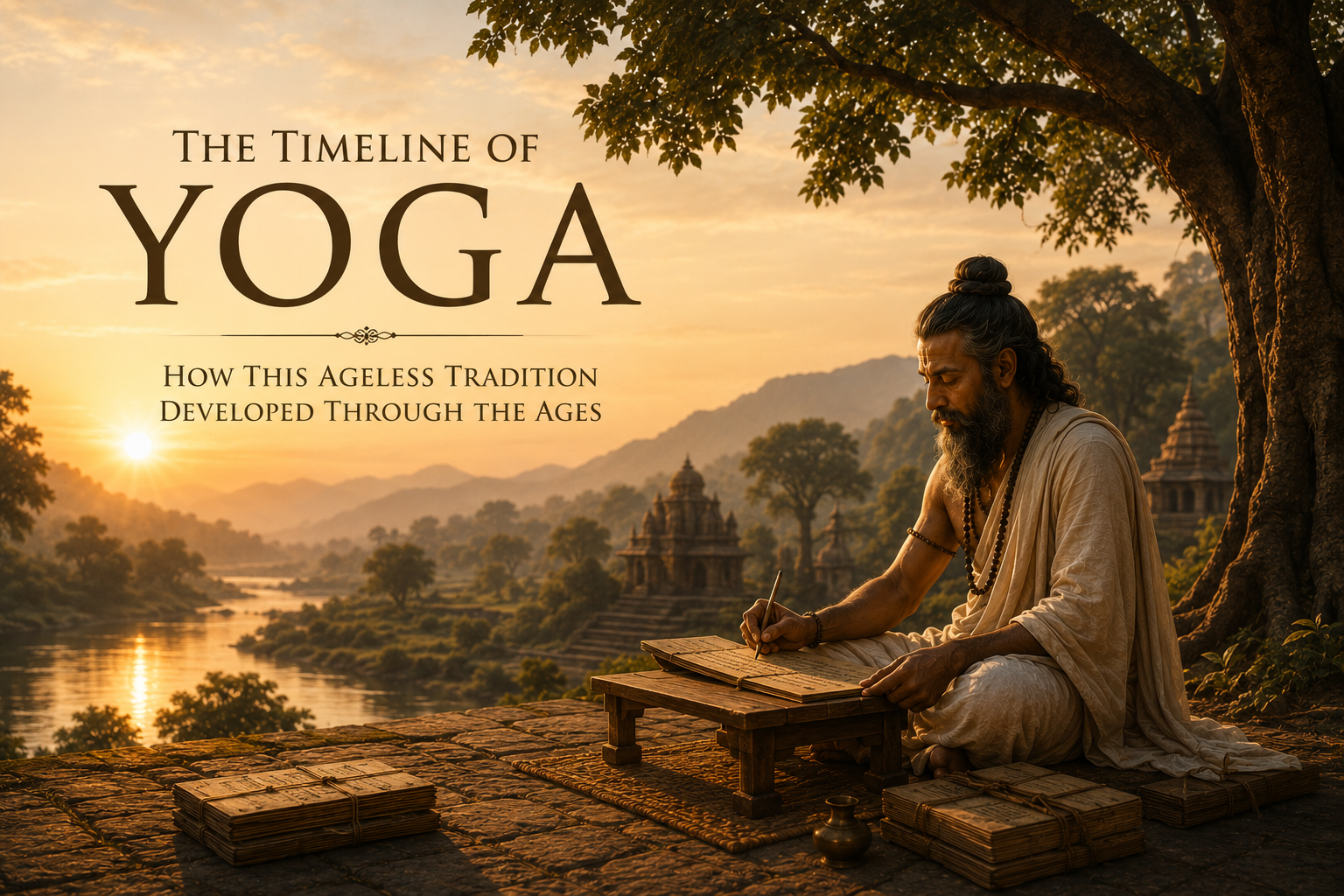
The Timeline of Yoga: How This Ageless Tradition Developed Through the Ages
Introduction
Yoga is an ageless tradition, developed over thousands of years across several distinct stages. In every era, great sages, teachers, and Yoga masters enriched Yoga's philosophy and carried it forward in a systematic way. The history of Yoga is generally divided into five broad periods: the Vedic, Pre-Classical, Classical, Post-Classical, and Modern eras.

1. The Vedic Era
This is considered the earliest phase of Yoga's history. It is during this period that the four Vedas were composed:
- Ṛgveda
- Yajurveda
- Sāmaveda
- Atharvaveda
Yajña (sacrificial ritual), mantra, Vedic ceremony, and ritual practice were central to this era.
Tradition credits Maharṣi Veda Vyāsa with organising and elucidating the Vedas, making them more accessible and systematic. The Brahma Sūtras and the Mahābhārata, both attributed to him, are regarded as foundational texts of Indian philosophy.
2. The Pre-Classical Era
This is considered one of the richest and most formative periods in Yoga's history.
During this era:
- The Upanishads were composed.
- The Bhagavad Gītā emerged.
In this age, spiritual practice was no longer confined to external Yajña alone — human attention began turning toward inner consciousness, Self-knowledge, and spiritual development. The philosophical dimension of Yoga matured significantly during this period.

3. The Classical Era
The defining event of this era is Maharṣi Patañjali's compilation of the Yoga Sūtras.
The Yoga Sūtras gave Yoga philosophy a systematic and rigorously structured form. Following this, a commentary titled the Yoga Bhāṣya was written on the Yoga Sūtras, traditionally attributed to a figure known as Vyāsa.
This era also saw a clear articulation of the different paths of Yoga:
- Jñāna Yoga — the path of knowledge
- Karma Yoga — the path of selfless action
- Bhakti Yoga — the path of devotion and surrender
- Rāja Yoga — the path of the mind and meditation
4. The Post-Classical Era
In this era, many great saints and teachers carried Yoga and Indian philosophy further.
Key developments include:
- The philosophical expositions of Ādi Śaṅkarācārya.
- The spread of Bhakti Yoga through Tulsīdās, Sūrdās, and Mīrābāī.
- The development of Haṭha Yoga, broadly dated across a long span of Indian history, from roughly the early medieval period through to the eighteenth century.
The contribution of the principal Nāth Yogis during this period was significant:
- Matsyendranāth
- Gorakṣanāth
- Caurangīnāth
This era also saw the composition of important texts such as the Haṭha Yoga Pradīpikā.

5. The Modern Era
In the modern age, many great Yoga teachers made Yoga popular across the world.
The principal Yoga teachers of this era include:
- Swami Vivekananda
- Swami Rama
- Sri Aurobindo
- Gurudev Sri Sri Ravi Shankar
- B.K.S. Iyengar
- T. Krishnamacharya
- Swami Sivananda
- Swami Satyananda Saraswati
Each of these figures played a significant role in bringing Yoga to modern global society.
The Central Message of This Timeline
Yoga is not confined to any single era or individual. It is a continuously evolving spiritual tradition, preserved by countless sages, teachers, and Yoga masters. It is the responsibility of every Yoga teacher and practitioner to carry this ancient knowledge forward to future generations with its authenticity intact.
Key Points
- The history of Yoga is broadly divided into the Vedic, Pre-Classical, Classical, Post-Classical, and Modern eras.
- The four Vedas were composed during the Vedic era.
- The Upanishads and the Bhagavad Gītā developed during the Pre-Classical era.
- In the Classical era, Maharṣi Patañjali compiled the Yoga Sūtras, and the Yoga Bhāṣya commentary followed.
- The Post-Classical era saw the development of Haṭha Yoga, the Nāth tradition, and the Bhakti movement.
- In the Modern era, numerous Yoga teachers spread Yoga globally.
- Yoga is an ageless, continuously evolving tradition.
- Preserving the authenticity of Yoga is the responsibility of every Yoga teacher and practitioner.
Editorial Notes: Corrections and Clarifications
A few points from the original draft are worth clarifying rather than stating as settled fact:
-
The authorship of the "Vyāsa" texts needs an important distinction. The original draft attributed the Brahma Sūtras, the Mahābhārata, and the Yoga Bhāṣya commentary to the same "Maharṣi Veda Vyāsa" in a single, unbroken line. Tradition does credit Veda Vyāsa (also called Kṛṣṇa Dvaipāyana Vyāsa) with compiling the Vedas and composing the Mahābhārata and Brahma Sūtras. However, the author of the Yoga Bhāṣya — the classical commentary on Patañjali's Yoga Sūtras — is traditionally referred to simply as "Vyāsa" as well, and many scholars consider this to be a distinct author from Veda Vyāsa, since "Vyāsa" (meaning "compiler" or "arranger") functioned historically as a title applied to more than one figure, not exclusively a single individual's proper name. Popular teaching material often collapses this distinction; it is more accurate to note it explicitly.
-
The dating of Haṭha Yoga's development ("800–1780 CE" in the original) is very broad and should be treated as an approximate teaching range, not a precise historical window. The Nāth yogis (Matsyendranāth, Gorakṣanāth) are more commonly dated to roughly the 9th–12th centuries CE, and the Haṭha Yoga Pradīpikā itself is generally dated to around the 15th century CE. Later Haṭha texts, such as the Gheraṇḍa Saṃhitā and Śiva Saṃhitā, extend into the 17th–18th centuries. The wide range in the original draft is best understood as spanning "the early Nāth-influenced period through the last major classical Haṭha texts," rather than a single continuous development across 900+ years.
-
The "four paths of Yoga" (Jñāna, Karma, Bhakti, Rāja) is a widely taught framework, but it is worth knowing its layered origin. The Bhagavad Gītā itself primarily emphasises three margas — Jñāna, Karma, and Bhakti Yoga. "Rāja Yoga" as a fourth path, referring to Patañjali's eightfold (Aṣṭāṅga) system of mental discipline and meditation, became a standard part of this fourfold framework later, especially through its popularisation by teachers such as Swami Vivekananda in the modern era. This doesn't make the fourfold framework incorrect — it is a well-established and useful teaching structure — but it is helpful to know that its four parts were not all articulated together in a single classical source.
Conclusion
Yoga's timeline shows a tradition that has never stood still — from the ritual world of the Vedas, through the introspective philosophy of the Upanishads and the Gītā, into Patañjali's systematic Yoga Sūtras, through the embodied practices of Haṭha Yoga, and finally into a living, globally practised tradition carried forward by modern teachers. Understanding this arc — with its genuine complexities and scholarly nuances intact — is part of what allows a teacher to carry Yoga forward authentically, rather than as a flattened, oversimplified story.