Tāḍāsana (Mountain Pose): Complete Anatomy, Alignment & Evidence-Based Guide
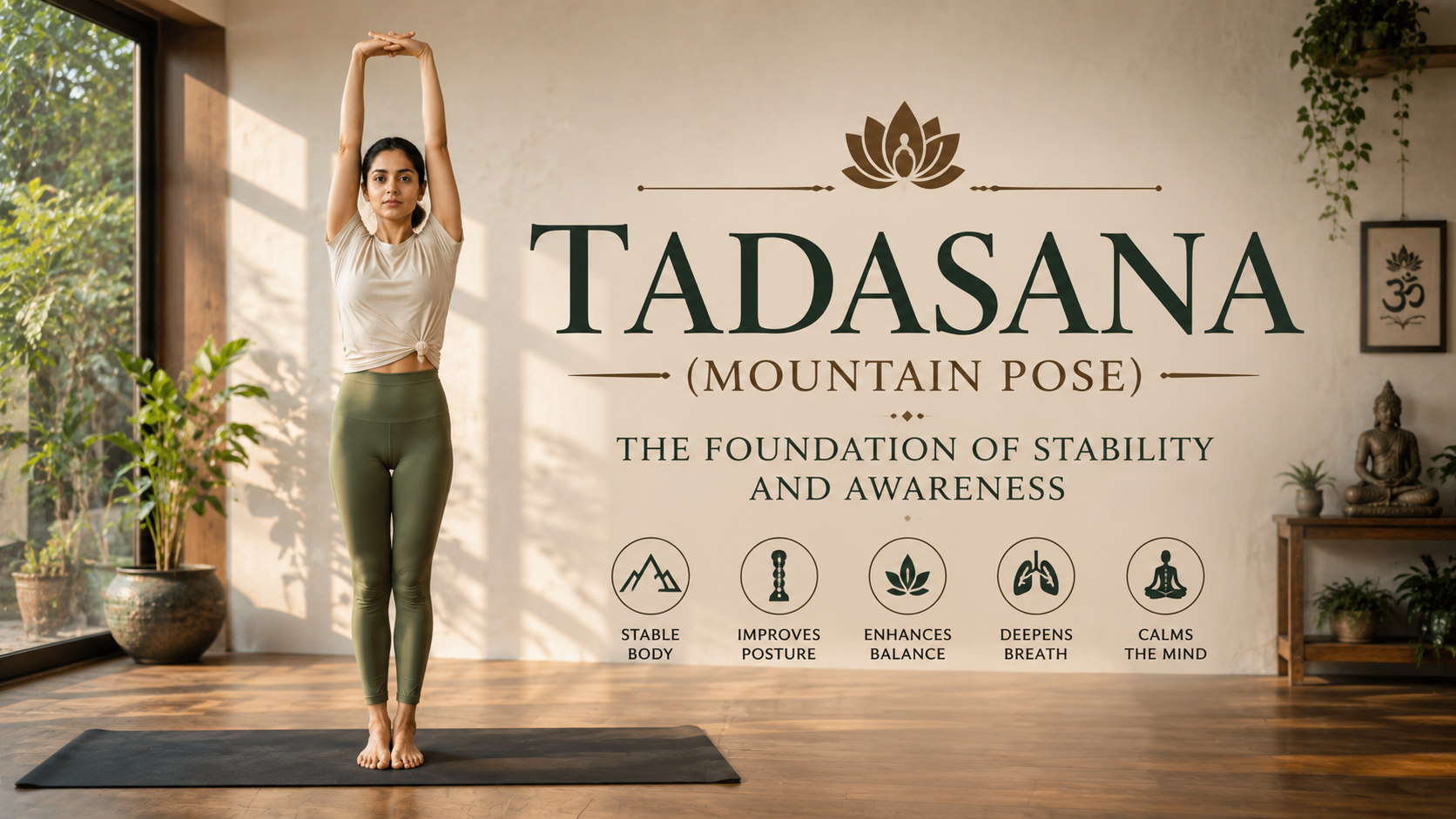
Tāḍāsana (Mountain Pose): The Complete Reference Guide

Editorial note, stated once: throughout this article, traditional yogic and Āyurvedic claims (chakra, prāṇa, dosha associations) are presented as traditional belief, not scientific fact, unless a specific evidence source is cited alongside them.
Name & Meaning
- Sanskrit: ताड़ासन (Tāḍāsana)
- English: Mountain Pose
- Other names: Samasthiti (near-synonymous in some lineages, e.g. Ashtanga Vinyasa)
- Etymology: Tāḍa (mountain) + Āsana (posture)
Patañjali's definition of āsana, Yoga Sūtra 2.46:
स्थिरसुखम् आसनम्
sthira-sukham āsanam
"Āsana is that which is steady and comfortable."
Introduction
- Tāḍāsana is the foundational standing āsana across nearly every modern yoga lineage — Iyengar, Ashtanga Vinyasa, Hatha, and therapeutic yoga alike
- Usually the first standing posture taught to beginners
- Experienced practitioners return to it constantly as a structural reset between other standing poses
- It's where a practitioner learns the core organizing principles — weight distribution, spinal alignment, breath awareness — that carry into every standing posture that follows it
How to Practice Tāḍāsana: Step-by-Step
| Step | Action | Breath | Cue |
|---|---|---|---|
| 1 | Stand with feet together or hip-width apart, weight even across the foot tripod (base of big toe, base of little toe, center of heel) | Natural breath | "Feel all four corners of both feet." |
| 2 | Soften the knees — a slight micro-bend, not locked | Inhale to lengthen the spine | "Unlock the knees, lift the kneecaps gently." |
| 3 | Neutralize the pelvis — neither tucked nor overarched | Exhale to settle | "Let the tailbone lengthen down, not tuck under." |
| 4 | Lengthen the spine, broaden the chest, draw shoulder blades gently down | Inhale to expand the ribs | "Broaden the collarbones, soften the shoulders down." |
| 5 | Align the head over the spine, chin level, soft gaze forward | Natural, even breath | "Imagine a string lifting you from the crown." |
Benefits
- Physical: improved postural awareness; engagement of foot, leg, and core stabilizers; foundational alignment education that transfers to other standing poses
- Mental: supports present-moment attention and body awareness through sustained, simple postural focus
- Emotional: general yoga practice (not specific to this pose alone) is linked in several reviews to reduced perceived stress over time — moderate evidence level
- Spiritual (traditional): steadiness in Tāḍāsana is traditionally seen as supportive of a grounded, receptive state for further practice
Common Mistakes & Corrections
- Locked knees → correction: micro-bend with active quad engagement
- Gripped glutes (over-tucks pelvis) → correction: "engage, don't clench"
- Chin jutting forward → correction: gentle chin tuck, crown lifting
Contraindications & Precautions
- Orthostatic hypotension / low blood pressure
- Significant vertigo or vestibular disorders without support
- Acute ankle, knee, or hip injury
- Recent lower-limb surgery — consult a healthcare provider first
Sequencing: Preparatory, Follow-up & Variations
- Preparatory poses: generally none required — Tāḍāsana is foundational enough that it typically serves as the preparatory pose for others, not the other way around
- Placement in sequence: usually opens a standing sequence, and is often revisited between poses as a reset point
- Follow-up poses: Vṛkṣāsana (Tree Pose), Vīrabhadrāsana variations (Warrior poses), Utthita Trikoṇāsana (Extended Triangle)
- Variations: arms overhead (Ūrdhva Hastāsana), on tiptoes for added balance challenge, moving in and out of the pose with breath as a dynamic warm-up
In more detail: because Tāḍāsana asks so little of the body in terms of range of motion, it doesn't need a warm-up pose of its own the way a deep backbend or hip-opener might — a few gentle joint rotations are enough. Its real role in sequencing is as an anchor point: teachers commonly return students to it between more demanding standing postures specifically to let the nervous system and alignment reset before the next pose, rather than moving from one effortful shape directly into another. When it is varied — arms lifting overhead, rising onto the toes, or flowing in and out of it with the breath — the added element is almost always a small increase in balance or breath-coordination demand, layered onto a base that stays structurally the same as the pose described in the steps above.
Modifications
- Pregnancy — first trimester: generally well-tolerated as-is
- Pregnancy — second trimester: widen the stance for stability
- Pregnancy — third trimester: practice near a wall, avoid prolonged static standing if swelling or dizziness occurs; always confirm with your own clinician
- Seniors: practice near a wall or chair, shorter holds, eyes open
- Obesity: wider stance, shorter holds building gradually
- Children: playful cueing ("stand like a mountain"), shorter holds, simplified instructions
- Beginners: practice near a wall for tactile alignment feedback
Historical Background & Classical References
- Tāḍāsana, in the standing form taught today, is not directly described in the classical Haṭha Yoga Pradīpikā, Gheraṇḍa Saṃhitā, or Śiva Saṃhitā
- These texts describe far fewer āsanas overall, almost entirely seated
- It is a modern teaching-tradition development, systematized in the 20th century within Krishnamacharya's Mysore lineage and carried forward by B.K.S. Iyengar and Pattabhi Jois
- Its authority rests on teaching-lineage tradition and biomechanical logic, not scriptural citation
- The broader concept of āsana it embodies is grounded in Patañjali's YS 2.46–2.47, which describe the quality a posture should have, not this specific shape
Alignment Principles (Iyengar Method)
Ear, shoulder, hip, and ankle ideally fall along one vertical line.
- Median-plane symmetry
- Equal weight on both feet
- A balanced pelvis
- Precision here is considered directly transferable to alignment quality in every subsequent standing āsana
Anatomy & Biomechanics
- Primary movers: quadriceps, gluteus medius/minimus, erector spinae, deep cervical flexors
- Secondary movers: tibialis anterior/posterior, transverse abdominis
- Stabilizers: intrinsic foot muscles, gluteus maximus, serratus anterior
- Bones/joints: ankle, knee, hip, spine, and shoulder girdle held near-neutral
- Weight distribution: through the foot tripod (base of big toe, base of little toe, heel center)
- Ground reaction force: organized through the skeleton against the floor's equal-and-opposite force
- Center of gravity: falls through the foot tripod; small postural sway is normal physiology
Breathing & Nervous System Effects
- Practiced with natural, unforced breathing
- Diaphragmatic descent increases thoracic volume; rib expansion supports fuller ventilation
- Standing still — especially eyes closed — is a classic proprioceptive-training stimulus
- Continuously engages the vestibular system
- Requires ongoing motor cortex input for postural micro-correction
- Slow, even breathing is generally associated with parasympathetic activation in the broader breath-physiology literature (general finding, not specific to this pose)
Yogic & Āyurvedic Perspective
- Traditionally associated with grounding through Mūlādhāra chakra
- Traditionally linked to stability of prāṇa through the lower nāḍīs
- Mild engagement resembling mūla bandha, traditionally described
- Steady dṛṣṭi traditionally said to support concentration
- Āyurveda: grounding quality traditionally considered pacifying for excess Vāta, neutral to mildly balancing for Kapha and Pitta
Therapeutic Applications
| Condition | Mechanism | Precaution |
|---|---|---|
| Poor postural habits | Postural re-education, proprioceptive retraining | None significant |
| Fall risk (older adults) | Proprioceptive/vestibular engagement, as part of broader balance training | Wall/prop support, supervision |
| Mild stress | Attentional focus, slow breath, as part of a broader practice | Not a substitute for mental health treatment |
Yoga is never a replacement for medical treatment; serious or persistent conditions require a qualified healthcare professional.
Teaching Notes
- Cue: "Root down through all four corners of both feet, and let that rooting lift you up through the crown."
- Hands-on adjustment (with consent, within scope): light touch at the sacrum for pelvic neutrality
- Hands-on adjustment (with consent, within scope): light touch between the shoulder blades for scapular depression
Myth vs. Fact
| Myth | Fact |
|---|---|
| Tāḍāsana is ancient, described in classical texts | Modern (20th-century) teaching development — see Historical Background |
| Locked knees = more stable | Reduces muscular support and strains the knee — a soft, engaged knee is more stable |
Conclusion
Tāḍāsana's apparent simplicity is exactly what makes it foundational — it's where a practitioner first learns to organize the body's weight, spine, and breath with precision, before that precision is asked to hold under greater demands elsewhere. It carries less scriptural weight than many assume, and more biomechanical substance than its "just standing" reputation suggests.
Quick Facts
| Category | Standing, foundational |
| Difficulty | Beginner |
| Duration | 30 seconds – a few minutes |
| Chakra (traditional) | Mūlādhāra (root) |
| Dosha (traditional) | Pacifying for Vāta |
| Primary Muscles | Quadriceps, erector spinae, gluteus medius/minimus |
| Contraindications | Orthostatic hypotension, significant vertigo, acute lower-limb injury |
Frequently Asked Questions
Is Tāḍāsana described in the Haṭha Yoga Pradīpikā?
No — see Historical Background above.
How long should I hold it?
No fixed classical duration; 30 seconds to a few minutes, breath-led.
Why do my knees hurt in this pose?
Usually from locking rather than softening the knees — see Common Mistakes.
Can it be practiced daily?
Yes, generally — a low-risk, foundational posture suitable for most healthy adults.
Does it help posture from desk work?
It supports postural re-education as one tool among several, not a complete fix on its own.
Is it safe with eyes closed?
Generally yes for healthy adults with stable balance; otherwise keep eyes open or use wall support.
What's the difference between Tāḍāsana and Samasthiti?
Closely related, near-synonymous terms across different teaching lineages.
References
1. Classical Yoga Texts: Patañjali, Yoga Sūtra 2.46–2.47. Haṭha Yoga Pradīpikā (consulted to confirm the pose's absence from the text).
2. Modern Yoga Institutions: Iyengar, B.K.S. Light on Yoga, Schocken Books. Yoga Journal (teaching/alignment cross-reference).
3. Peer-Reviewed Scientific Research: General published reviews on yoga practice and balance/fall-prevention outcomes; general reviews on yoga as adjunctive therapy for stress/anxiety; general biomechanics literature on static standing balance — all general yoga/biomechanics research, not Tāḍāsana-specific, as noted throughout.
A fully citation-grade, DOI-linked reference list would require targeted database access beyond general web search; the categories above are the genuine sources used, with no invented studies or statistics.
This article is for educational purposes and does not replace individualized medical or physical therapy advice. Consult a qualified healthcare provider before beginning any new practice, especially with a pre-existing health condition.