Swami Vivekananda Biography: Life, Philosophy, Teachings, and Global Legacy
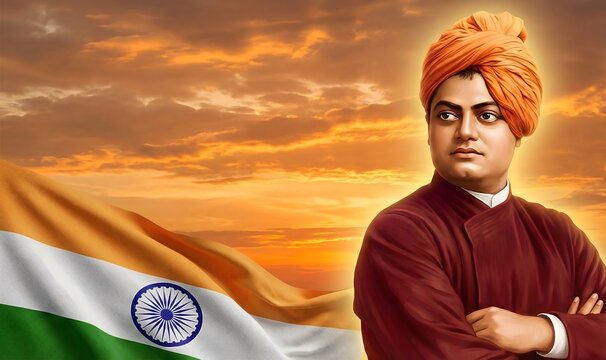
Swami Vivekananda Biography: Life, Philosophy, Teachings, and Global Legacy
Explore the extraordinary life, spiritual awakening, historic Chicago address, Vedanta philosophy, and immortal legacy of Swami Vivekananda — the visionary monk who bridged East and West.
Introduction
On September 11, 1893, at the Parliament of Religions in Chicago, a young Indian monk in a bright orange robe and turban stepped onto the grand platform. Before him sat thousands of delegates and spectators from across the globe, representing the intellectual and religious elites of the Western world. When he began his address with four simple words — "Sisters and brothers of America" — a wave of astonishment swept through the auditorium, eliciting a standing ovation that lasted for minutes.
That monk was Swami Vivekananda.
In an era when Western colonial powers viewed India through the lens of political subjugation and cultural backwardness, Vivekananda stood as a towering titan of spiritual intellect, proclaiming the universal truth of Vedanta, the scientific rigor of Raja Yoga, and the inherent divinity of every human soul. He was not merely a religious preacher; he was a patriot-saint, a brilliant philosopher, a master storyteller, and a fiery social reformer who awoke a dormant nation to its own self-respect.
This is the comprehensive story of Swami Vivekananda — tracing his journey from the restless, questioning intellect of young Narendranath Datta in nineteenth-century Calcutta to the global apostle of modern spiritual consciousness.
Quick Information Table
| Field | Details |
|---|---|
| Full Name | Narendranath Datta (later Swami Vivekananda) |
| Known As | Global Apostle of Vedanta, Pioneer of Modern Yoga in the West, Patriot-Saint of India |
| Birth (Date & Place) | January 12, 1863, Calcutta (Kolkata), Bengal, British India |
| Death (Date & Place) | July 4, 1902 (aged 39), Belur Math, Howrah, Bengal, British India |
| Parents | Bishwanath Datta (attorney) and Bhuvaneshwari Devi |
| Guru | Sri Ramakrishna Paramahamsa |
| Major Institutions Founded | Ramakrishna Math and Ramakrishna Mission (1897) |
| Philosophical Tradition | Advaita Vedanta, Raja Yoga |
| Nationality | Indian |
| Profession / Role | Monk, Philosopher, Author, Social Reformer, Educator |
| Major Achievements | Historic 1893 Chicago Parliament of Religions address, spreading Vedanta across the US and Europe |
| Famous Books | Raja Yoga (1896), Jnana Yoga, Bhakti Yoga, Karma Yoga, Inspired Talks |
| Official Website / Repository | belurmath.org / rkmission.org |
Early Life: The Quest of Narendranath Datta
Born on January 12, 1863, during the festival of Makar Sankranti in Calcutta, Narendranath Datta grew up in an affluent, intellectually vibrant Bengali family. His father, Bishwanath Datta, was a successful attorney at the Calcutta High Court known for his rational, progressive outlook. His mother, Bhuvaneshwari Devi, was a deeply pious woman endowed with profound spiritual intelligence, traditional poise, and strong moral character.
As a boy, Naren (as he was affectionately called) displayed extraordinary intellectual gifts. He possessed an uncanny memory, boundless physical energy, and a sharp, skeptical mind that refused to accept anything on blind faith. He excelled in academics, mastering Western philosophy, history, literature, logic, and European classical music. He was an accomplished gymnast, swimmer, wrestler, and singer.
Yet, beneath his playful exterior lay an intense existential restlessness. As a young college student at the General Assembly's Institution (now Scottish Church College), Naren wrestled with the ultimate philosophical questions: Does God exist? Can human consciousness experience absolute truth? If God is good and all-powerful, why is there so much suffering in the world?
He traveled across intellectual circles in Calcutta, meeting leaders of the Brahmo Samaj — a monotheistic reform movement — and asking prominent thinkers whether they had personally seen God. Most offered theological abstractions or polite evasions. Naren’s unyielding demand for direct, empirical verification of the divine set the stage for a life-altering encounter.

The Turning Point: Meeting Sri Ramakrishna Paramahamsa
In late 1881 or early 1882, during his college years, Naren met the eccentric, ecstatic mystic of Dakshineswar Kali Temple: Sri Ramakrishna Paramahamsa.
Their first meeting was dramatically unconventional. Invited to sing devotional songs at a gathering, Naren’s powerful baritone voice captivated Sri Ramakrishna. Recognizing in the young collegian a vessel of extraordinary spiritual power, the mystic pulled Naren aside, locked the door, and wept with joy, saying: "Ah! You have come so late. Why have you been so unkind as to make me wait so long? My ears are nearly burnt listening to the idle talk of worldly people."
Naren was initially stunned and skeptical. He viewed Sri Ramakrishna’s ecstatic trances (samadhi) as hallucinations or nervous disorders. Yet, despite his intellectual resistance, Naren found himself irresistibly drawn back to Dakshineswar time and again. He tested the mystic mercilessly, questioning his visions, rejecting dogmas, and scrutinizing every spiritual claim. Sri Ramakrishna welcomed this scientific skepticism with humor and profound patience, famously telling him: "Test me as the money-changer tests his coins. Do not accept anything blindly until you have experienced it yourself."
The relationship evolved into one of the most profound master-disciple bonds in spiritual history. Sri Ramakrishna transmitted the essence of Advaita Vedanta (non-duality) and God-realization to Naren, preparing him quietly for a massive mission to humanity.
The Passing of the Master and the Wandering Years (Parivrajaka)
When Sri Ramakrishna passed away from throat cancer in August 1886, the young disciples led by Naren were plunged into grief. However, bound by their love for the master and their shared spiritual brotherhood, Naren and his brother disciples took formal monastic vows, transforming a dilapidated house in Baranagore into their first monastery. Naren took the monastic name Swami Vividishananda, which he later changed to Swami Vivekananda (Vivekananda meaning "the bliss of discriminatory wisdom").
Following a period of intense monastic discipline, Vivekananda felt an irresistible urge to experience India in all its raw reality. In 1888, he set out as a wandering monk (Parivrajaka), traversing the length and breadth of the Indian subcontinent entirely on foot or by third-class railway carriage, carrying only a staff, a water pot, and a few books.
This multi-year journey across princely states, remote villages, ashrams, and royal courts opened his eyes to the profound tragedy of India: widespread poverty, crushing caste oppression, widespread illiteracy, and deep spiritual degradation coexisting with an immortal philosophical heritage. He witnessed the starvation of peasants and the apathy of the elite. It was during these lonely wanderings — particularly while meditating on a solitary rock off the coast of Kanyakumari in December 1892 — that Vivekananda formulated his life's mission: spiritual awakening must go hand-in-hand with practical social upliftment. India could not be spiritually free while its masses groaned under hunger and ignorance.
The Historic 1893 Chicago Parliament of Religions
With financial support from well-wishers, disciples, and the Raja of Khetri, Vivekananda sailed for the United States in May 1893, arriving in Chicago to attend the inaugural World's Parliament of Religions, an ambitious assembly organized as part of the World's Columbian Exposition.
Vivekananda arrived without formal credentials or an official invitation, yet his magnetic presence, profound eloquence, and universal message electrified the assembly. On September 11, 1893, when he delivered his opening address, he rejected sectarian fanaticism, declaring:
"Sisters and brothers of America — It fills my heart with joy unspeakable to rise in response to the warm and cordial welcome which you have given us. I thank you in the name of the most ancient order of monks in the world; I thank you in the name of the mothers of all religions; and I thank you in the name of millions and millions of Hindu people of all classes and sects."
He quoted passages from the Bhagavad Gita to emphasize religious harmony: "As the different streams having their sources in different places all mingle their waters in the sea, so, O Lord, the different paths which men take through different tendencies, various though they appear, crooked or straight, all lead to Thee."
Over the next few weeks, Vivekananda delivered multiple lectures at the Parliament and across America, expounding on the philosophy of Advaita Vedanta, the harmony of religions, and the practical application of yoga. Overnight, he became a media sensation in the United States, hailed by newspapers as a "cyclone monk from India."
Spreading Vedanta and Raja Yoga in the West
Following the Parliament of Religions, Vivekananda spent nearly four years traveling extensively across the United States and Europe, lecturing, establishing study groups, and training dedicated Western disciples — most notably figures like Margaret Noble (later known as Sister Nivedita), Josephine MacLeod, and William James (the pioneering American psychologist who found deep psychological resonance in Vivekananda's teachings on the mind).
In 1896, Vivekananda published his groundbreaking masterwork, Raja Yoga, a systematic English translation and commentary on the Yoga Sutras of Patanjali. This text single-handedly revolutionized how the Western world understood yoga, stripping it of exotic orientalist mysticism and presenting it as an empirical, psychological science of mental mastery and self-realization.
Through his lectures in New York, London, and Paris, Vivekananda articulated the core tenets of Vedanta:
- The divinity of the soul (Atman).
- The unity of existence (Non-duality / Advaita).
- The harmony of all spiritual paths (Yato mat tata path — as many faiths, so many paths).
- The rejection of sin in favor of human potentiality (teaching that to call a human a "sinner" is a grave sin in itself).
Founding the Ramakrishna Math and Mission (1897)
Returning to India in early 1897 to a hero's welcome, Vivekananda realized that spiritual awakening required institutional scaffolding. In May 1897, in Calcutta, he officially founded the Ramakrishna Mission and the Ramakrishna Math, headquartered at Belur Math on the banks of the Hooghly River.
Unlike traditional ascetic orders that focused solely on personal liberation (moksha), Vivekananda introduced a revolutionary dual mandate: Atmano mokshartham jagat hitaya cha — "For one's own salvation and for the welfare of the world."
The Mission launched pioneering humanitarian initiatives across India:
- Setting up hospitals, dispensaries, and mobile medical units for the sick and poor.
- Establishing schools, colleges, and vocational training centers emphasizing character-building education.
- Organizing famine relief, disaster response, and rural development programs.
- Promoting religious harmony, interfaith dialogue, and cultural renaissance.
Philosophy & Core Teachings
Swami Vivekananda's philosophical framework combined ancient Vedic wisdom with modern humanistic pragmatism:
- Practical Vedanta: Vedanta was not meant to be debated merely in monastic caves; it was meant to be lived in the bustling marketplace. Seeing the divine in every human being (Shiv conhecimentos) formed the bedrock of his social ethics.
- Education as Manifestation: Vivekananda famously defined education not as the accumulation of facts, but as "the manifestation of the perfection already in man."
- Fearlessness and Strength: Repeatedly invoking the Upanishads, his favorite rallying cry was "Abhihi!" (Fearlessness!). He urged youth to cultivate physical strength, moral courage, and iron willpower.
Legends and Miracles — Handled with Care
In the hagiographical literature and oral traditions surrounding Swami Vivekananda, numerous extraordinary accounts are preserved by his disciples. Stories of his phenomenal memory (such as reading multi-volume encyclopedias overnight and reciting them verbatim), his capacity to enter profound states of superconscious absorption (nirvikalpa samadhi), and his ability to read the inner thoughts of visitors are widely recounted.
Historical and academic note: Modern historians and biographers approach these narratives as spiritual expressions of deep devotion and reverence common among disciples toward their spiritual master. While these accounts illustrate the immense charismatic and psychological presence Vivekananda commanded, they are understood outside hagiography as manifestations of extraordinary mental discipline, prodigious intellect, and profound meditative mastery rather than supernatural anomalies.
Interesting Facts About Swami Vivekananda
- As a child, Naren could effortlessly concentrate on multiple objects simultaneously, often winning games of deep focus and chess.
- He was an expert singer and instrumentalist, deeply well-versed in classical Indian dhrupad and vocal music.
- His historic 1893 speech in Chicago made him an overnight global celebrity, with major American newspapers calling him "an orator by divine right."
- He used several names during his monastic life, including Vividishananda, before settling on Vivekananda at the behest of the Maharaja of Khetri.
- He engaged in extensive scientific discussions with Nikola Tesla and William James, exploring the meeting points of quantum-era physics and Vedantic cosmology.
- His Irish disciple Margaret Noble dedicated her entire life to female education and Indian national awakening under the name Sister Nivedita.
- His complete works (The Complete Works of Swami Vivekananda) span nine massive volumes of speeches, letters, poems, and philosophical commentaries.
- Vivekananda frequently remarked that he would not live to see his fortieth year — a prophecy that tragically came true when he passed away at age 39.
- He personally designed the architectural layout of Belur Math to incorporate stylistic elements of Hindu, Islamic, and Christian temples, symbolizing religious harmony.
- He walked across thousands of miles of colonial India on foot, sleeping on temple floors and eating with the poorest peasants.
- Even as a monk, he maintained rigorous physical fitness, practicing fencing, boxing, and yoga daily.
- He argued passionately that a nation that does not respect and educate its women can never progress.
- January 12, his birth anniversary, is celebrated annually across India as National Youth Day.
Chronological Timeline
- January 12, 1863: Born as Narendranath Datta in Calcutta.
- Late 1881: First meets Sri Ramakrishna Paramahamsa at Dakshineswar.
- August 1886: Sri Ramakrishna passes away; Naren and brother disciples take monastic vows.
- 1888–1893: Years of wandering across India as a Parivrajaka, witnessing the plight of the masses.
- December 1892: Deep meditation on the rock at Kanyakumari, crystallizing his life mission.
- May 1893: Sails for America to attend the Parliament of Religions.
- September 11, 1893: Delivers his historic address at the Chicago Parliament of Religions.
- 1896: Publishes his monumental work Raja Yoga in New York.
- May 1897: Founds the Ramakrishna Math and Mission in Calcutta.
- 1899–1900: Second visit to the West, establishing Vedanta societies in California and New York.
- July 4, 1902: Passes away in meditation at Belur Math at the age of 39.
Famous Quotes
"Arise, awake, and stop not until the goal is reached."
"You have to grow from the inside out. None can teach you, none can make you spiritual. There is no other teacher but your own soul."
"All power is within you; you can do anything and everything. Believe in that, do not believe that you are weak."
Legacy
Swami Vivekananda’s legacy is towering and multidimensional. To India, he is the spiritual architect of modern nationalism who restored civilizational self-confidence and reinterpreted ancient Vedanta into a dynamic force for social action. To the West, he is the pioneer who introduced authentic yoga philosophy and non-dualistic thought without proselytizing dogma. His vision of a harmonious world, anchored in human dignity and the realization of inner divinity, remains profoundly relevant in the 21st century.
Reader Learnings
- Awaken Inner Potential: True strength and wisdom cannot be borrowed; they must be unlocked from within through self-discipline and reflection.
- Service as Worship: Uplifting the suffering and seeing the divine in humanity (Daridra Narayan) is the highest form of spiritual practice.
- Fearlessness is Power: Overcoming mental hesitation and cultivating moral courage (Abhihi) is essential for achieving any noble goal in life.
Conclusion
Swami Vivekananda’s life was a blazing meteor that burned brightly for only thirty-nine years, yet illuminated the spiritual landscape of the entire world. He took the profound, esoteric truths of the Upanishads and handed them to the common man, teaching that spirituality is not an escape from life, but the supreme realization of life’s infinite possibilities.
Frequently Asked Questions
Who was Swami Vivekananda?
Swami Vivekananda was an Indian Hindu monk, philosopher, and the chief disciple of Sri Ramakrishna Paramahamsa who introduced Vedanta and Yoga to the Western world.
What was Swami Vivekananda's birth name?
His birth name was Narendranath Datta.
When and where was Swami Vivekananda born?
He was born on January 12, 1863, in Calcutta (Kolkata), West Bengal, India.
What made Swami Vivekananda famous globally?
His historic opening address at the World's Parliament of Religions in Chicago on September 11, 1893, where he introduced Hinduism and Vedanta to Western audiences.
Who was Swami Vivekananda's guru?
Sri Ramakrishna Paramahamsa.
What is the Ramakrishna Mission?
A spiritual and humanitarian organization founded by Swami Vivekananda in 1897 focused on personal salvation and social service (Atmano mokshartham jagat hitaya cha).
What books did Swami Vivekananda author?
He authored foundational texts including Raja Yoga, Jnana Yoga, Bhakti Yoga, Karma Yoga, and Inspired Talks.
What is Practical Vedanta?
Vivekananda's philosophy that Vedantic spiritual truths should not remain abstract metaphysics, but must be applied practically to uplift humanity and solve daily human problems.
When did Swami Vivekananda pass away?
He passed away on July 4, 1902, at Belur Math, West Bengal, at the age of 39.
Why is January 12 celebrated in India?
January 12, his birth anniversary, is celebrated nationally as National Youth Day.
References
- Belur Math (Ramakrishna Math and Ramakrishna Mission) — Life and Teachings of Swami Vivekananda — belurmath.org
- The Complete Works of Swami Vivekananda — Advaita Ashrama, Mayavati — 9 Volumes.
- Encyclopædia Britannica — Swami Vivekananda | Indian Philosopher and Monk — britannica.com
Want to go deeper into authentic Yoga practice with Iti Iti Yogashram?
Get in Touch