Skandāsana (Side Lunge / Skanda's Pose): Classical Sources, Anatomy, Alignment & Evidence-Based Guide
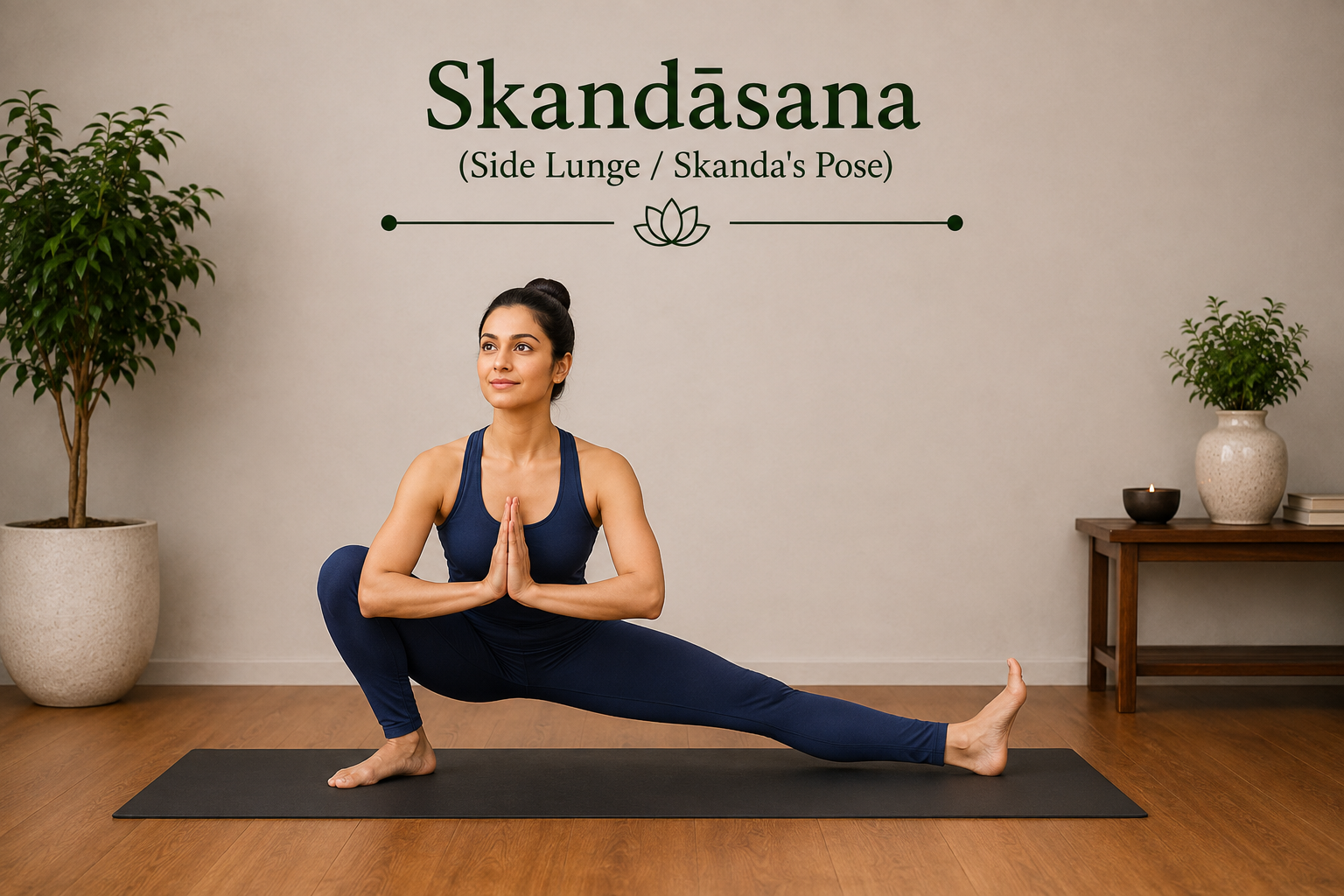
Skandāsana (Side Lunge / Skanda's Pose): The Complete Reference Guide
Editorial note, stated once: throughout this article, traditional yogic and Āyurvedic claims (chakra, prāṇa, dosha associations) are presented as traditional belief, not scientific fact, unless a specific evidence source is cited alongside them.
Name & Meaning
- Sanskrit: स्कन्दासन (Skandāsana)
- IAST Transliteration: Skandāsana / Skandasana
- English: Side Lunge / Skanda's Pose / Lateral Deep Squat
- Etymology: Skanda (another name for Kartikeya, the Hindu god of war and general of the celestial armies, often depicted wielding a spear) + Āsana (posture / seat). "The fierce lateral combat stance mirroring the agility, focused readiness, and dynamic power of Lord Skanda."
Introduction
- Skandāsana is a dynamic, powerful lateral deep squat in modern Vinyasa and Haṭha Yoga, acting as an exceptional bridge between standing wide-legged postures and floor stretches.
- Characterized by shifting body weight entirely onto one leg while bending that knee into a deep single-leg squat, keeping the heel anchored to the floor (or elevated on a prop), extending the opposite leg straight out to the side with toes pointing upward, and maintaining an upright or gracefully hinged spine.
- Widely integrated into modern vinyasa flows, martial arts conditioning, and contemporary mobility practices as a supreme test of lower body flexibility and ankle dorsiflexion.
- Functions as an outstanding clinical diagnostic for evaluating ankle dorsiflexion range of motion, inner thigh (adductor magnus/gracilis) extensibility, and single-leg knee flexion tolerance.
Benefits
- Inner Thigh & Groin Lengthening: Deeply stretches the adductor longus, adductor magnus, gracilis, and pectineus muscles of both the bent and extended legs.
- Ankle Dorsiflexion & Calf Mobility: Demands extreme closed-chain ankle dorsiflexion on the squatting leg, mobilizing the talocrural joint and calf complex.
- Single-Leg Quadriceps & Gluteal Strength: Intensely strengthens the quadriceps femoris (vastus lateralis/medialis), gluteus maximus, and gluteus medius under a loaded, full-flexion squat.
- Hip Joint Mobility & Internal/External Rotation: Unlocks deep hip socket mobility by combining unilateral hip flexion, adduction, and rotation.
- Traditional/Spiritual: Believed to stimulate Mūlādhāra (root) chakra, harness warrior vitality (Vīra Bhāva), and ground scattered energy—traditional belief, not a scientific claim.
How to Practice Skandāsana: Step-by-Step
| Step | Action | Breath | Teacher Cue |
|---|---|---|---|
| 1 | Begin in a wide-legged standing forward fold (Prāsarita Pādottānāsana) with feet parallel or slightly turned out. | Natural breath | "Start in a wide stance, folding forward with hands on the floor." |
| 2 | Exhale, bend your right knee deeply, lowering your right sit-bone down toward your right heel into a single-leg squat. Keep right heel flat on floor if possible (or place a blanket under it). | Exhale to squat right | "Bend your right knee deeply, dropping your seat toward your right heel." |
| 3 | Simultaneously straighten your left leg out to the side, flexing your left foot actively so toes and kneecap point straight up toward the ceiling. | Inhale as left leg extends | "Extend your left leg straight out, flexing your left foot with toes pointing skyward." |
| 4 | Bring your palms together at your heart center in Anjali Mudra, or keep fingertips on the floor for balance. Lift your chest and keep your spine tall. Hold 5 breaths. | Steady, expansive diaphragmatic breath | "Bring hands to your heart and lift your chest, or keep fingertips on the mat for support." |
| 5 | To transition, press down into your right foot, lift your hips back up through the center wide fold, and shift over to squat on your left leg. Hold 5 breaths. | Inhale through center, exhale to other side | "Press through your foot, rise through center, and shift over to the left side." |
Common Mistakes & Corrections
- Heel of the squatting leg popping up off the mat: Limited ankle dorsiflexion forces the heel to lift → Correction: Place a folded blanket or yoga wedge underneath the squatting heel, or keep fingertips on the floor for balance.
- Collapsing the torso forward and rounding the back: Weak core and tight hips cause the chest to sink → Correction: Press palms at heart center, draw shoulder blades down, and lift sternum forward and up.
- Straight leg toes pointing downward (internal rotation): Allowing the extended foot to roll forward misses the inner thigh stretch → Correction: Flex extended foot actively so toes and kneecap point straight up toward the ceiling.
- Squatting knee collapsing inward (valgus collapse): Letting bent knee drop inward strains knee ligaments → Correction: Track bent knee in line with second and third toes of that foot.
Contraindications & Precautions
- Acute Knee Injury (Meniscus, ACL, or Patellar Tendonitis): Deep flexion under full body weight can aggravate acute knee pathology; keep squat shallow.
- Severe Ankle Impingement or Arthritis: Extreme ankle dorsiflexion can pinch anterior joint structures; elevate heel on a folded blanket.
- Acute Groin or Adductor Strain: Forcing wide lateral extension can tear healing adductor fibers; limit depth of lunge.
Sequencing: Preparatory, Follow-up & Variations
- Preparatory Poses: Prāsarita Pādottānāsana (Wide-Legged Forward Fold), Utkata Koṇāsana (Goddess Pose), Malāsana (Garland Pose).
- Placement in Sequence: Mid-to-late standing transition flow, connecting wide-legged forward folds with lateral lunges.
- Follow-up Poses: Prāsarita Pādottānāsana, Uttānāsana, Bālāsana (Child's Pose), Śavāsana.
- Variations:
- Supported Skandāsana: Keeping fingertips or palms flat on the floor to support body weight and maintain chest lift.
- Heel-Elevated Skandāsana: Sliding a folded blanket under the squatting heel for practitioners with tight ankles.
- Bound Skandāsana: Wrapping arms around the bent knee in an advanced bind.
Modifications
- Blanket Under Squatting Heel: Fold a blanket and place it directly beneath the heel of the bent knee if ankle mobility causes the heel to lift off the floor.
- Fingertips on Floor for Balance: Keep hands resting on the mat in front of you to take weight off the legs and stabilize balance.
- Shallow Lunge Depth: Do not sink all the way down to the heel; stop halfway down where knees and ankles feel completely comfortable.
Historical Background & Classical References
- Modern Vinyasa Evolution: While deep lateral squats appear in traditional martial arts (such as Kalaripayattu in India), Skandāsana was popularized globally in modern Vinyasa and Yin yoga traditions as a premier functional mobility posture.
- Mythological Association: Named after Skanda (Kartikeya), the agile warrior deity known for readiness and lightning speed in combat stances.
Alignment Principles (Modern Vinyasa Method)
- Flat Foot Squat: Squatting heel remains anchored flat on the mat (or propped on a blanket).
- Active Extended Leg: Straight leg remains fully engaged with quadriceps active and toes pointing skyward.
- Vertical Torso Lift: Chest remains open and upright, avoiding forward spinal collapse.
Anatomy & Biomechanics
- Primary Stretched Muscles: Adductor Magnus, Adductor Longus, Gracilis, Hamstrings (extended leg), Gastrocnemius/Soleus (bent ankle).
- Primary Active/Strengthening Muscles: Quadriceps Femoris (bent leg), Gluteus Maximus, Gluteus Medius, Core Abdominis.
- Joint Mechanics: Bent leg deep knee flexion (approx. 140°–160°) and extreme ankle dorsiflexion; extended leg hip abduction, extension, and knee extension.
- Ankle-Hip Kinetic Chain: Skandāsana requires exceptional ankle dorsiflexion mobility. If ankle dorsiflexion is restricted, the body compensates by lifting the heel or pitching the torso excessively forward to maintain center of mass over the base of support.
Nervous System & Breathing Effects
- Functional Proprioceptive Training: Navigating deep unilateral flexion challenges vestibular balance and neuromuscular coordination across lateral planes of motion.
Yogic & Āyurvedic Perspective
- Dosha Impact: Grounds unrooted Vāta energy and sparks metabolic Pitta heat through active single-leg loading—traditional belief.
- Prāṇa Dynamics: Directs Apāna Vāyu downward into the earth while stimulating lower body vitality.
Therapeutic Applications
| Condition | Mechanism | Research / Precaution |
|---|---|---|
| Tight Groin & Stiff Adductor Muscles | Loaded lateral flexion lengthens hypertonic adductor magnus and gracilis fibers | Supported by functional mobility research. Precaution: Keep heel supported if tight. |
| Limited Ankle Dorsiflexion Range | Closed-chain deep flexion mobilizes talocrural joint capsule and calf complex | Supported by physical therapy ankle protocols. Precaution: Use blanket under heel. |
Yoga is never a replacement for medical treatment; serious or persistent conditions require a qualified healthcare professional.
Teaching Cues & Hands-On Adjustments
- Verbal Cues: "Drop your right sit-bone down toward your right heel." / "Flex your straight left foot and point your toes to the ceiling." / "Bring your palms to your heart and lift your chest."
- Hands-on Adjustment (Safe execution with consent):
- Stand behind student; place hands gently on their shoulders to help them lift their chest and avoid collapsing forward.
- Place a folded blanket gently under their squatting heel if their heel pops off the floor.
Myth vs. Fact
| Myth | Fact |
|---|---|
| It is a failure if your squatting heel lifts off the floor. | Heel elevation is completely normal due to anatomical ankle restrictions; sliding a blanket under the heel provides a stable, correct foundation. |
| Skandāsana and Malāsana are the exact same squat. | Malāsana is a symmetrical bilateral deep squat, whereas Skandāsana is an asymmetrical lateral single-leg lunge squat. |
Conclusion
Skandāsana (Side Lunge) is an extraordinary functional posture that builds lower body mobility, ankle flexibility, and adductor strength. By anchoring the heel, keeping the extended leg active, and lifting the chest, practitioners cultivate agile warrior strength and fluid movement.
Quick Facts
| Category | Lateral deep squat / Single-leg lunge |
| Difficulty Level | Intermediate |
| Primary Muscles Stretched | Adductor Magnus, Gracilis, Hamstrings (extended leg), Calves |
| Primary Muscles Active | Quadriceps Femoris, Gluteus Maximus, Gluteus Medius |
| Classical Source? | Yes (Modern classical vinyasa & functional mobility formalization) |
| Traditional Chakra (Belief) | Mūlādhāra (Root) |
| Dosha Impact (Belief) | Grounds Vāta & sparks Pitta |
Frequently Asked Questions
What does Skandāsana mean in English?
Skanda (Kartikeya, Hindu god of war) + Āsana (pose) = Side Lunge or Skanda's Pose.
What should I do if my heel pops up in Skandāsana?
Place a folded blanket or yoga wedge directly under your squatting heel, or keep your fingertips on the floor for balance support.
What is the difference between Skandāsana and Malāsana?
Malāsana is a symmetrical low squat with both feet flat and knees wide. Skandāsana is an asymmetrical lateral lunge squat where one knee is fully bent and the other leg is extended straight out to the side.
How long should I hold Side Lunge?
Hold for 5 steady breaths (about 20 to 30 seconds) on each side.
References
1. Modern Yoga & Mobility Literature: Functional Movement Systems protocols. Contemporary Vinyasa sequencing manuals.
2. Peer-Reviewed Scientific Research:
- Sherman, K. J., et al. (2011). A randomized trial comparing yoga, stretching, and a self-care book for chronic low back pain. Archives of Internal Medicine, 171(22), 2019-2026.
- Ni, M., et al. (2014). Comparative muscle activation patterns during yoga postures in elderly adults. BMC Complementary and Alternative Medicine, 14, 401.
This article is for educational purposes and does not replace individualized medical or physical therapy advice. Consult a qualified healthcare provider before beginning any new practice.