Siṁhāsana (Lion Pose): The Complete Reference Guide
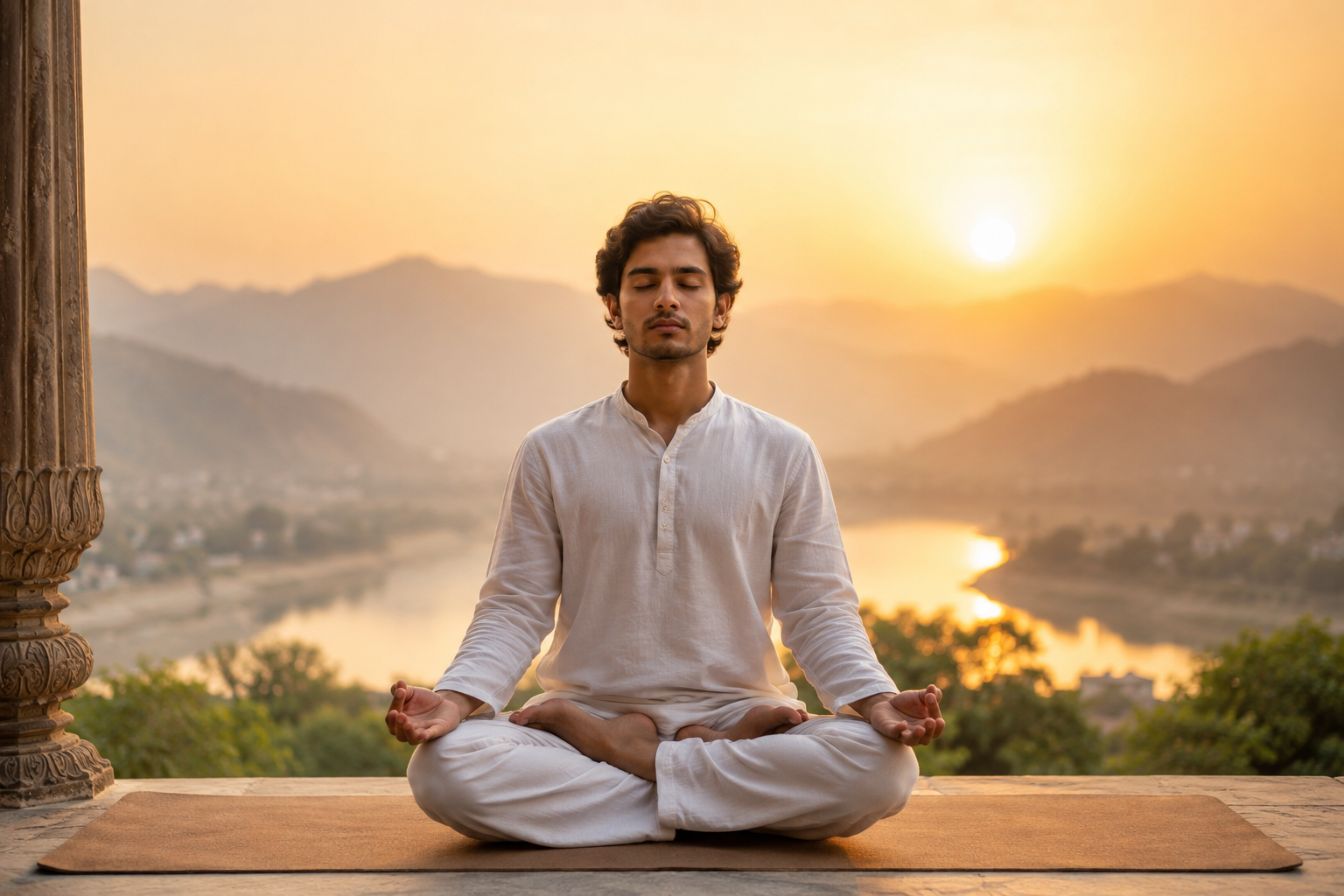
Siṁhāsana (Lion Pose): The Complete Reference Guide

Editorial note, stated once: throughout this article, traditional yogic and Āyurvedic claims (bandha, siddhi, chakra references, disease-destroying claims) are presented as traditional belief, not scientific fact, unless a specific evidence source is cited alongside them.
Name & Meaning
- Sanskrit: सिंहासन (Siṁhāsana)
- English: Lion Pose
- Etymology: Siṃha (lion) + Āsana (posture) — named for the wide-mouthed, tongue-extended, roaring facial expression the pose culminates in
- Alternate classical name: Narasiṃhāsana, used in the 19th-century Joga Pradipika, linking the pose to Narasiṃha, the lion-man avatar of Viṣṇu
- In everyday Sanskrit/Hindi, "siṃhāsana" is also the ordinary word for a royal throne — one root, two very different meanings depending on context
Introduction
- Siṁhāsana is one of the four principal āsanas named in the Haṭha Yoga Pradīpikā, alongside Siddhāsana, Padmāsana, and Bhadrāsana — like Bhadrāsana, this is a pose with a genuine, directly citable classical source, unlike several others in this series
- Unique among commonly taught postures for its combination of a kneeling seated shape with an active facial expression — wide-open mouth, extended tongue, and a forceful, often audible exhalation known as Lion's Breath (Siṃha Prāṇāyāma)
- Traditionally grouped with the meditation-seat āsanas, but practiced very differently in application: held briefly through one or a few strong exhalations rather than for sustained sitting
- Widely taught today across styles from Hatha to therapeutic and kids' yoga, in part because of its distinctive, memorable, low-injury-risk nature
How to Practice: Step-by-Step
Commonly Taught Modern Version
| Step | Action | Breath | Cue |
|---|---|---|---|
| 1 | Kneel with the buttocks resting on the heels or the inner arches of the feet; place the palms on the knees, fingers spread wide | Natural breath | "Ground through your shins before you do anything dramatic." |
| 2 | Inhale deeply through the nose | Full inhale | "Fill up before you roar — the exhale is only as strong as the inhale that feeds it." |
| 3 | Open the mouth wide, extend the tongue down toward the chin, widen the eyes, and exhale forcefully through the mouth with an audible "ha" sound, leaning the torso slightly forward | Strong, complete exhale | "Let the whole face join the roar, not just the mouth." |
| 4 | Release the expression, close the mouth, and return to a neutral seated position; repeat up to 3–5 times | Natural breath between rounds | "Let the face fully relax before the next round." |
Classical Haṭha Yoga Pradīpikā Version (Seated, Subtler Form)
| Step | Action | Breath | Cue |
|---|---|---|---|
| 1 | Sit with the ankles crossed beneath the body, right ankle under the left buttock on the left side of the perineum, left ankle under the right buttock on the right side | Natural breath | "This is a seat for stillness first." |
| 2 | Place the palms flat on the knees, fingers spread; lean the torso slightly forward, keeping the spine straight rather than rounded | Natural breath | "Lean from the hips, not the upper back." |
| 3 | Open the mouth, fix the gaze at the tip of the nose (or between the eyebrows, per some editions), and apply Jālandhara Bandha (chin lock) | Steady breath with bandha engaged | "The gaze and the lock are as much a part of this pose as the shape." |
| 4 | Hold briefly, then release with control | Natural breath on release | "Release the lock and gaze together, not one before the other." |
The Haṭha Yoga Pradīpikā's own description is notably subtler than the tongue-out, audibly roaring version most classes teach today — it doesn't mention extending the tongue or roaring at all. See Historical Background below for what this difference actually reflects.
Benefits
- Physical: stretches and releases tension in the facial muscles, jaw, and platysma (the thin muscle spanning the front of the neck); opens the chest; may improve posture through the kneeling base and spinal lengthening
- Respiratory: the forceful exhalation is a form of active breath work that can support deeper, more complete exhales than passive breathing
- Traditional/textual claim: the Gheraṇḍa Saṃhitā describes this āsana as "the destroyer of all diseases" — a traditional textual claim from a classical source, not a scientifically verified medical outcome
- Bandha practice: both the Haṭha Yoga Pradīpikā and Gheraṇḍa Saṃhitā connect this pose to practicing the three bandhas (Mūla, Uḍḍīyāna, and Jālandhara) — a traditional pedagogical framing from the texts themselves, not an independently tested physiological claim
- Mental/emotional: commonly taught as a release for pent-up tension, frustration, or self-consciousness, particularly useful for students who feel inhibited about vocalizing or making an "undignified" face in a group setting
- Peer-reviewed evidence (limited but real): a published case report in the Journal of Ayurveda and Integrative Medicine (Javed & Mishra, 2022) described Siṁhāsana as one component of a multi-week, multi-pose yoga and prāṇāyāma protocol for a single patient with social anxiety disorder, alongside meaningful improvements in standardized anxiety scales — this is a single case report using several combined practices, not a controlled trial isolating Siṁhāsana's effect specifically, and should be read as preliminary and suggestive rather than confirmatory (see Scientific Research below)
Common Mistakes & Corrections
- Weak, half-hearted exhale (defeats the purpose of the pose) → correction: fully empty the lungs on the exhale; commit to the sound and the facial expression rather than performing a token gesture
- Straining the neck and jutting the chin forward → correction: keep the length of the neck as the tongue extends, leading with the tongue rather than the jaw or chin
- Collapsing the kneeling base or slumping the spine → correction: keep the spine long even while leaning forward, supporting the lean from the hip hinge rather than a rounded back
Contraindications & Precautions
- Knee injury or significant knee sensitivity — the kneeling base loads the knee joint; a folded blanket under the knees/shins can help
- Recent jaw surgery, TMJ (temporomandibular joint) disorders, or significant jaw pain — the wide-mouth opening can aggravate these conditions
- Vertigo or a tendency toward lightheadedness — some practitioners report the forceful exhale feels overstimulating or disorienting; ease off intensity or frequency if this occurs
- Recent facial, dental, or throat surgery — consult a healthcare provider before practicing the forceful exhale/tongue-extension version
- Uncontrolled high blood pressure — forceful breath-holding or straining variants should be approached cautiously; the gentle, natural-breath classical version is a reasonable substitute if in doubt
Sequencing: Preparatory, Follow-up & Variations
- Preparatory poses: gentle neck and jaw stretches, Vajrāsana (Thunderbolt Pose) to prepare the kneeling base
- Placement in sequence: commonly used at the start of a practice as a warm-up/release, or at any point where facial and vocal tension needs releasing; well suited to precede pranayama or meditation given its cathartic, "clearing" quality
- Follow-up poses: a few rounds of calm, natural breathing in a seated pose such as Sukhāsana to settle after the intensity of the exhale
- Variations: Iyengar's Light on Yoga (1966) describes two forms — Siṁhāsana I, the traditional kneeling version described above, and Siṁhāsana II, which begins from Padmāsana (Lotus Pose) and moves the body forward onto the hands until the torso faces the floor with the shoulders stacked over the hands, keeping the same facial expression; simhāsana is also commonly practiced from Vajrāsana or Vīrāsana as an alternative seated base
Because the pose is held only briefly per round (a single strong exhale, repeated a few times) rather than sustained like a meditation seat, it doesn't need the same warm-up as deeper stretches — the main preparation is simply a comfortable kneeling base and a willingness to commit fully to the exhale and expression, since a half-effort version delivers little of the facial or vocal release the pose is built around. Teachers often introduce it early in a class specifically because its unusual, playful nature helps students let go of self-consciousness before moving into more demanding postures later in the sequence.
Modifications
- Knee sensitivity: place a folded blanket under the knees and shins, or practice seated in a chair with feet flat on the floor
- Ankle/ankle-crossing discomfort (classical version): use the simpler modern kneeling base (buttocks on heels) instead of the crossed-ankle classical placement
- TMJ or jaw sensitivity: reduce the width of the mouth opening; perform the breath and sound without the full facial stretch
- Self-consciousness in a group setting: practice facing away from the group or with eyes closed until comfort builds; the pose is commonly taught to children specifically because it normalizes "silly," expressive movement
- Vertigo-prone practitioners: reduce the force and frequency of the exhale, or substitute the gentler classical natural-breath version
Historical Background & Classical References
- Genuinely classical and directly citable — Siṁhāsana appears in the Haṭha Yoga Pradīpikā, Chapter 1, verses 50–52 (numbering varies slightly by edition), where Svātmārāma names Siddhāsana, Padmāsana, Siṃhāsana, and Bhadrāsana as the four principal āsanas, describing this one as suitable for practicing the three bandhas
- It is also described in the Gheraṇḍa Saṃhitā, Chapter 2 (commonly cited as verses 14–15 in some editions, though numbering again varies), which similarly states the posture "destroys all diseases" and lists it among ten especially important āsanas out of its larger enumerated set
- According to Wikipedia's sourcing, the posture is also described in the 10th–11th century Vimānārcanākalpa — if accurate, this would place a description of the pose earlier than either the Haṭha Yoga Pradīpikā (c. 15th century) or the Gheraṇḍa Saṃhitā (c. 17th century), though this article has not independently verified the Vimānārcanākalpa's exact wording and presents this as a secondary historical claim rather than a directly checked primary source
- The 19th-century Joga Pradipika names the pose Narasiṃhāsana, tying it explicitly to Narasiṃha, Viṣṇu's lion-man avatar who slew the demon king Hiraṇyakaśipu — a devotional/mythological association layered onto the posture's name in that particular text
- The tongue-out, roaring version most classes teach today is a real departure from the Haṭha Yoga Pradīpikā's own description, which specifies the gaze, the chin lock (Jālandhara Bandha), and a forward lean — but does not mention extending the tongue or making an audible roaring sound. B.K.S. Iyengar's 1966 Light on Yoga is the source most directly associated with codifying the two-part Siṁhāsana I/II system (kneeling and Padmāsana-based) still widely taught, and it is Iyengar's version — not the Pradīpikā's — that most closely resembles what students encounter in a typical class today
Alignment Principles
- Spine long and lifted, even while leaning the torso forward — the lean comes from the hip hinge, not a rounded upper back
- Hands pressed firmly into the knees or floor, fingers spread wide and active, supporting the forward lean
- Shoulders drawn down away from the ears despite the intensity of the exhale
- The facial expression is active and full — wide eyes, fully extended tongue, engaged jaw — rather than a token gesture
Anatomy & Biomechanics
- Primary muscles/structures engaged: platysma (thin muscle across the front of the neck and lower face), muscles of facial expression (orbicularis oris, buccinator), extrinsic tongue muscles (genioglossus, engaged in full tongue protrusion), muscles of the jaw and throat
- Respiratory mechanics: the forceful exhale actively recruits the abdominal muscles and the diaphragm's return stroke, producing a more complete, forced exhalation than passive breathing
- Kneeling base: loads the knee joint in deep flexion and places the ankles in a stretched, plantarflexed position (further intensified in the classical crossed-ankle version)
- Bandha mechanics (as described in the classical texts): Jālandhara Bandha (chin lock) involves cervical flexion that compresses the front of the throat; Mūla Bandha and Uḍḍīyāna Bandha involve pelvic floor and abdominal contraction respectively — these are traditional yogic techniques with described mechanical actions, though their broader physiological effects beyond the immediate muscular contraction are not independently, rigorously established in the peer-reviewed literature for this specific pose
Nervous System & Breathing Effects
- The forceful, complete exhalation is a form of active pranayama-adjacent breathwork, distinct from the slow, passive breathing used in most seated meditation postures
- Traditional yogic framing holds that the strong exhale and facial release help discharge pent-up tension or suppressed emotion — a plausible, widely reported subjective experience, though not something this article can confirm as a measured physiological mechanism beyond the general well-documented effects of active breathwork on arousal and tension
- Some practitioners report the pose's intensity as overstimulating rather than calming — this is a real, individually variable response worth noting rather than glossing over (see Contraindications)
Yogic & Āyurvedic Perspective
- Grouped in the Haṭha Yoga tradition with Siddhāsana, Padmāsana, and Bhadrāsana as one of the four principal āsanas, specifically linked to practicing the three bandhas
- Some modern teachers connect the throat-opening, vocal quality of the pose to Viśuddha (throat) chakra symbolism and themes of self-expression — a modern integrative/symbolic association, not a claim made explicitly about this pose in the classical texts
- Āyurveda: the releasing, expressive quality is sometimes described by contemporary teachers as helpful for excess Vāta-driven anxiety or suppressed emotional states — a modern integrative interpretation rather than a documented classical Āyurvedic prescription tied specifically to this āsana
Therapeutic Applications
| Condition | Mechanism | Research / Precaution |
|---|---|---|
| Facial/jaw tension (e.g. from teeth grinding, stress) | Active stretch of the muscles of facial expression and jaw | Mechanistically plausible; avoid with active TMJ pain or recent jaw/dental procedures |
| Social anxiety / self-consciousness about vocal expression | Structured, socially "permitted" loud vocal and facial release | A single published case report (Javed & Mishra, 2022) included this pose in a broader protocol alongside meaningful anxiety-scale improvement — preliminary evidence from one patient, not a controlled trial isolating this pose |
| Respiratory conditions (adjunctive) | Forceful, complete exhalation pattern similar in mechanism to some respiratory clearance techniques | A registered clinical trial (ClinicalTrials.gov NCT06319690) is evaluating lion's breath technique combined with chest percussion therapy in pneumonia patients — a registered protocol, not yet a completed/published outcome study at the time of writing |
Yoga is never a replacement for medical treatment; serious or persistent conditions require a qualified healthcare professional.
Teaching Notes
- Cue: "Inhale to gather it up, then let the exhale empty you completely — face, breath, and sound all at once."
- Hands-on adjustment (with consent, within scope): generally minimal hands-on adjustment is used for this pose given its expressive, breath-driven nature; a light touch at the shoulders to cue them drawing down and away from the ears is about the extent of appropriate physical guidance
Myth vs. Fact
| Myth | Fact |
|---|---|
| The tongue-out, roaring version everyone learns in class is exactly how the classical texts describe this pose | The Haṭha Yoga Pradīpikā's own description doesn't mention the tongue or roaring at all — it describes a quieter posture with a fixed gaze and chin lock; the more dramatic version is closer to what B.K.S. Iyengar codified in 1966 |
| This is just a "fun," non-serious pose without a real classical basis | It's genuinely one of only four āsanas the Haṭha Yoga Pradīpikā singles out as principal postures, alongside Siddhāsana, Padmāsana, and Bhadrāsana |
| A half-hearted, quiet exhale gives the same benefit as a full roar | The pose's release-oriented benefits (facial, vocal, and reportedly emotional) are tied to committing fully to the exhale and expression, not performing a token gesture |
Scientific Research
- Javed, D., & Mishra, S. (2022) published a peer-reviewed case report in the Journal of Ayurveda and Integrative Medicine describing a multi-week yoga and prāṇāyāma protocol — including Siṁhāsana, Vīrāsana, Baddha Koṇāsana, and other practices — for a single patient with social anxiety disorder and paruresis, reporting substantial reductions in Liebowitz Social Anxiety Scale and Social Phobia Inventory scores over the intervention period. This is a single-patient case report using a combined, multi-pose protocol; it cannot isolate Siṁhāsana's individual contribution and should be read as preliminary, hypothesis-generating evidence rather than confirmatory proof of this pose's effect.
- A registered clinical trial (ClinicalTrials.gov identifier NCT06319690) is evaluating the combined effect of lion's breath technique with chest percussion therapy in pneumonia patients, using spirometry and functional outcome measures. As a registered protocol rather than a completed, published study at the time of writing, this indicates active scientific interest in the technique's respiratory applications, but does not yet constitute completed evidence.
- Evidence gap: no dedicated, controlled trial isolating Siṁhāsana's effect on facial muscle tone, vocal function, blood pressure, or mental health outcomes independent of a broader practice protocol was identified. Claims about anti-aging effects, cure of specific throat or speech conditions, or disease prevention circulating in popular yoga literature should be treated as traditional belief or plausible-but-unverified extrapolation, not established clinical fact.
References
1. Classical Yoga Texts: Svātmārāma. Haṭha Yoga Pradīpikā, Chapter 1, verses 50–52 (verse numbering varies by edition). Gheraṇḍa. Gheraṇḍa Saṃhitā, Chapter 2 (commonly cited as verses 14–15; numbering varies by edition). Vimānārcanākalpa (10th–11th century; cited via secondary sourcing as an early textual reference — not independently verified against the primary Sanskrit by this article). Joga Pradipika (19th century; source of the alternate name Narasiṃhāsana).
2. Modern Yoga Institutions: Iyengar, B.K.S. (1979) [1966]. Light on Yoga: Yoga Dipika. Unwin Paperbacks (source of the codified Siṁhāsana I/II system). Wikipedia contributors. Simhasana. Retrieved from https://en.wikipedia.org/wiki/Simhasana.
3. Peer-Reviewed Scientific Research: Javed, D., & Mishra, S. (2022). Yoga practices in Social Anxiety Disorder (SAnD): A case report WSR to paruresis. Journal of Ayurveda and Integrative Medicine, 13(4), 100622. https://doi.org/10.1016/j.jaim.2022.100622. ClinicalTrials.gov. Combined Effects of Lion's Breath Technique With Chest Percussion Therapy in Pneumonia Patients. Identifier: NCT06319690. Retrieved from https://clinicaltrials.gov/study/NCT06319690.
The case report above is genuine and peer-reviewed but is a single-patient case study using a combined intervention, not a controlled trial of this pose alone; the clinical trial listing is a registered protocol, not yet published results. Both are presented with that context rather than as confirmed, isolated proof of this pose's effects.
This article is for educational purposes and does not replace individualized medical or physical therapy advice. Consult a qualified healthcare provider before beginning any new practice, especially with a pre-existing health condition.