Sanskrit Asana Names Explained: Meanings, Structure and Classification

Sanskrit Words in Asana Names: Meaning, Structure, and Classification
Introduction
Why is Adho Mukha Śvānāsana called by that name?
What does Parivṛtta Trikoṇāsana actually mean?
And why do names such as Ardha Matsyendrāsana, Uṣṭrāsana, Dhanurāsana, and Jānu Śīrṣāsana appear so different from one another?
For many Yoga students, Sanskrit āsana names initially seem long, difficult to pronounce, and disconnected from the physical posture.
However, once we begin to recognise recurring Sanskrit words within these names, patterns become visible.
Consider:
Adho — Downward or below
Mukha — Face or mouth
Śvāna — Dog
Āsana — Seat or posture; in modern Yoga nomenclature, a Yogic posture
Together, these elements form the familiar name:
Adho Mukha Śvānāsana — commonly translated as Downward-Facing Dog Pose.
Understanding Sanskrit vocabulary used in āsana names can help students and teachers recognise how many posture names are constructed.
But an important linguistic clarification is necessary.
In Yoga teaching, these components are sometimes casually described as “Sanskrit root words.”
Strictly speaking, this terminology is often inaccurate.
A Sanskrit verbal root is technically called a Dhātu. Words such as Hasta, Pāda, Jānu, Mukha, Śīrṣa, and Śvāna should not all be classified as verbal roots.
Therefore, throughout this article, I will use more careful expressions such as:
Sanskrit words, name elements, and compound components used in āsana nomenclature.
This distinction may appear small, but precision matters.
For a serious Yoga teacher, Sanskrit should not merely be used to make teaching sound traditional.
It should be approached with intellectual responsibility.
How Are Sanskrit Asana Names Formed?
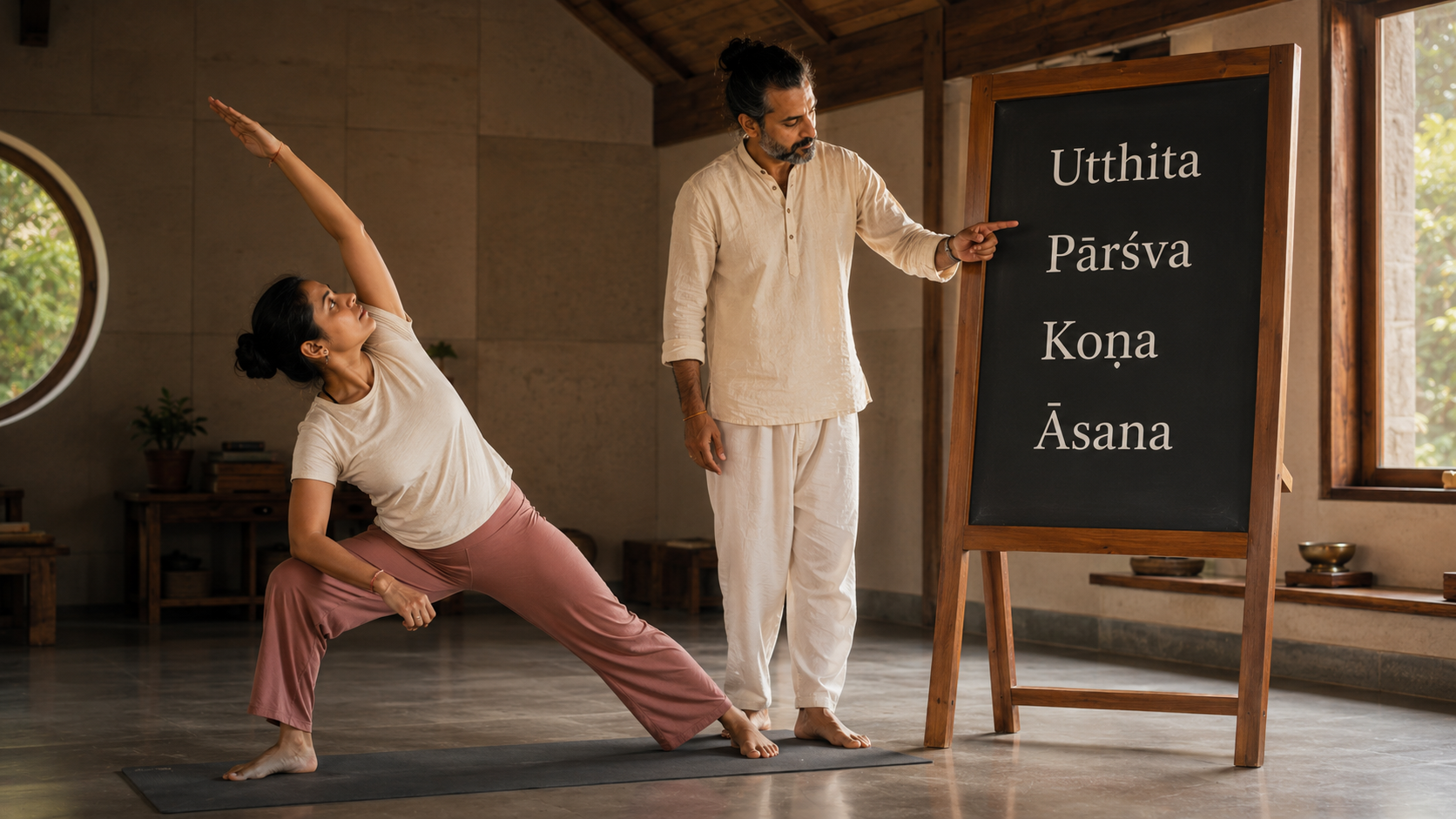
Many familiar āsana names contain Sanskrit elements that indicate some characteristic of the posture.
A name may refer to:
- Direction, orientation, position, or another characteristic
- A body part
- A sage, Yogic figure, divine figure, or named personality
- An animal or bird
- An object, plant, natural form, or visible shape
- A number or numerical arrangement
This classification is useful for teaching and memorisation.
However, it is important to state clearly:
These six categories are a practical educational framework. They are not an exhaustive classical taxonomy of all āsana names declared by a single authoritative Yoga or Sanskrit text.
Some names also contain elements from more than one category.
Consider:
Ardha Matsyendrāsana
For practical learning, we can recognise:
Ardha — Half
Matsyendra — Matsyendra or Matsyendranātha
Āsana — Posture
The name therefore contains both a qualifying element and the name of a Yogic figure.
Similarly, Eka Pāda Rājakapotāsana contains numerical, body-related, and named-form elements.
The purpose of classification is not to force every āsana into a rigid box.
The purpose is to make Sanskrit nomenclature more intelligible.
A Note on Analysing Sanskrit Compounds
Breaking an āsana name into familiar words is extremely useful for Yoga students.
However, this educational method should not always be confused with a complete grammatical analysis of a Sanskrit compound.
Sanskrit compounds, or Samāsas, follow grammatical principles.
When words enter compounds, their forms, relationships, and interpretation may require more careful linguistic analysis than simply placing English meanings beside each visible element.
Therefore, in this article, word-by-word breakdowns are primarily used as pedagogical tools for understanding āsana names.
They are not presented as a substitute for formal Sanskrit grammatical analysis.
1. Direction, Position, and Qualifying Terms
Many Sanskrit words used in āsana names describe direction, orientation, position, or another characteristic of a posture.
| Sanskrit Word | General Meaning | Example |
|---|---|---|
| Parivṛtta | Turned, revolved | Parivṛtta Trikoṇāsana |
| Ardha | Half | Ardha Matsyendrāsana |
| Adho | Downward, below | Adho Mukha Śvānāsana |
| Ūrdhva | Upward, above | Ūrdhva Mukha Śvānāsana |
| Baddha | Bound, tied | Baddha Koṇāsana |
| Supta | Lying down, reclining; also related to sleeping according to context | Supta Baddha Koṇāsana |
| Uttāna | Extended, stretched out, or lying with the face upward according to context | Uttānāsana |
| Utthita | Risen, raised, extended | Utthita Pārśvakoṇāsana |
| Pārśva | Side, flank | Pārśva Bakāsana |
| Prasārita | Spread, extended, expanded | Prasārita Pādottānāsana |
| Koṇa | Angle | Baddha Koṇāsana |
These elements often help distinguish one posture from another.
Consider:
Trikoṇāsana — Triangle Pose
and
Parivṛtta Trikoṇāsana — Revolved Triangle Pose
The word Parivṛtta changes the identification of the posture.
Similarly, Adho Mukha Śvānāsana and Ūrdhva Mukha Śvānāsana share the elements Mukha, Śvāna, and Āsana.
The qualifiers Adho and Ūrdhva indicate different orientations.
A Linguistic Caution About Uttāna
The word Uttāna deserves special attention because it is frequently explained in modern Yoga teaching as “intense stretch.”
This explanation is common and may appear meaningful when discussing postures such as Uttānāsana.
However, a Yoga teacher should be careful about presenting a convenient posture translation as though it were the only literal Sanskrit meaning of the word.
Depending on linguistic and textual context, uttāna may carry senses connected with being extended, stretched out, lying supine, or turned upward.
The familiar English expression “intense stretch” belongs largely to conventional modern Yoga translation and interpretation.
Therefore, when explaining Uttānāsana, it is safer to distinguish between the Sanskrit term, the conventional English posture name, and the physical action taught within a particular Yoga method.
2. Body-Related Terms in Asana Names
Many āsana names contain Sanskrit words associated with parts of the body.
| Sanskrit Word | General Meaning |
|---|---|
| Aṅguṣṭha | Thumb; in relevant foot compounds, the great or big toe |
| Hasta | Hand |
| Aṅguli | Finger |
| Pāda | Foot; sometimes interpreted more broadly in posture nomenclature |
| Jānu | Knee |
| Mukha | Face, mouth |
| Śīrṣa | Head |
| Karṇa | Ear |
| Bhuja | Arm |
| Aṅga | Limb, member, part |
| Sarvāṅga | All the limbs or all parts |
| Pārśva | Side, flank |
Jānu Śīrṣāsana
For practical learning, we can recognise:
Jānu — Knee
Śīrṣa — Head
Āsana — Posture
This helps explain the conventional translation Head-to-Knee Pose.
However, a Sanskrit name should not automatically be treated as a complete biomechanical instruction.
The name does not necessarily tell every practitioner that the head must be aggressively forced onto the knee.
Safe execution still depends upon anatomy, mobility, the purpose of practice, and appropriate teaching.
Pādāṅguṣṭhāsana
The name contains elements associated with:
Pāda — Foot
Aṅguṣṭha — Thumb or, in this compound context, the big toe
Āsana — Posture
Therefore, in Pādāṅguṣṭhāsana, Aṅguṣṭha is understood in relation to the great toe.
Śīrṣāsana
Śīrṣa means head.
Śīrṣāsana is conventionally translated as Headstand in modern Yoga teaching.
Sarvāṅgāsana
The name contains:
Sarva — All, entire
Aṅga — Limb, member, or part
Āsana — Posture
The compound Sarvāṅga conveys the sense of all the limbs or all parts.
Yet Sarvāṅgāsana is commonly called Shoulderstand in English-language Yoga teaching.
Sarvāṅgāsana does not literally mean “shoulder stand.”
Are Pūrva and Paścima Anatomical Terms?
Not strictly.
This is an important correction to a common explanation in Yoga teacher training.
Pūrva may carry meanings such as east, former, earlier, prior, or—in particular interpretive contexts—front.
Paścima may refer to west, western, later, or posterior according to context.
These are fundamentally directional and relational terms.
They are not anatomical nouns in the same sense as Jānu — Knee or Śīrṣa — Head.
In āsana nomenclature and later Yoga explanation, Pūrva and Paścima may be associated with the anterior and posterior aspects of the body.
Modern Yoga teachers commonly explain Paścimottānāsana in relation to the extension of the posterior or back aspect of the body.
Similarly, Pūrvottānāsana is commonly explained in relation to the anterior or front aspect.
“Back of the body” is a contextual Yoga explanation of Paścima in this nomenclature. It is not the only lexical meaning of Paścima.
3. Asanas Associated with Sages, Yogic Figures, and Divine Forms
| Asana | Associated Figure |
|---|---|
| Matsyendrāsana / Ardha Matsyendrāsana | Matsyendra or Matsyendranātha |
| Marīcyāsana | Marīci |
| Bharadvājāsana | Bharadvāja |
| Vīrabhadrāsana | Vīrabhadra |
| Naṭarājāsana | Naṭarāja, the dancing form of Śiva |
| Hanumānāsana | Hanumān |
Ardha Matsyendrāsana
For practical learning, we can recognise:
Ardha — Half
Matsyendra — Matsyendra
Āsana — Posture
Matsyendranātha occupies an important position in the history and traditional memory of Nātha and Haṭha Yoga.
The Haṭha Yoga Pradīpikā includes Matsyendrāsana among the āsanas it describes and associates the posture with Matsyendra.
However, the appearance of an āsana name in a premodern text does not automatically establish that every modern lineage performs the posture in exactly the same physical form.
Marīcyāsana
Marīcyāsana is associated by name with Marīci.
Modern Yoga culture often attaches elaborate mythological stories to posture names.
A Yoga teacher should distinguish between:
- the linguistic form of the name,
- the traditional or cultural association,
- historical textual documentation,
- and a later popular Yoga story.
These categories may overlap. They are not automatically identical.
Vīrabhadrāsana and Naṭarājāsana
Vīrabhadrāsana is named in relation to Vīrabhadra, a powerful figure associated with Śiva in Hindu narrative traditions.
Naṭarājāsana derives its name from Naṭarāja—the Lord of Dance, the celebrated dancing form of Śiva.
These names carry significant cultural and symbolic associations.
However, the antiquity of the associated figure does not automatically prove the equal antiquity of the modern physical posture performed under that name.
An ancient name, deity, sage, or story does not by itself establish the historical age of a modern āsana form.
A Necessary Clarification About Surya Namaskara
Sūrya Namaskāra is frequently included in discussions of postures associated with divine figures or natural forces.
Sūrya means the Sun.
Namaskāra conveys salutation, homage, or respectful greeting.
However:
Sūrya Namaskāra is not simply one āsana.
In modern Yoga practice, the term generally refers to a sequence of bodily positions performed in a particular order.
Depending upon the tradition or teaching system, the sequence may be coordinated with breathing, mantra, attention, or other ritual and Yogic elements.
Therefore, it is more precise to discuss Sūrya Namaskāra as a sequence or practice rather than placing it in a list as though it were a single posture equivalent to Uṣṭrāsana or Bhujaṅgāsana.
4. Asanas Named After Animals and Birds

| Sanskrit Term | General Meaning |
|---|---|
| Śvāna | Dog |
| Baka | A crane, heron, or wading bird according to lexical and translation context |
| Uṣṭra | Camel |
| Bhujaṅga | Serpent, snake |
| Matsya | Fish |
| Kūrma | Tortoise |
| Kapota | Pigeon or dove |
| Śalabha | Locust |
| Mayūra | Peacock |
| Siṃha | Lion |
Consider Bhujaṅgāsana.
The element Bhujaṅga refers to a serpent or snake.
The physical form of the posture is conventionally associated with the image of a serpent raising the anterior part of its body.
Similarly:
Uṣṭrāsana — Camel Pose
Matsyāsana — Fish Pose
Kūrmāsana — Tortoise Pose
Mayūrāsana — Peacock Pose
Animal-based names can provide strong visual associations and may help students remember postures.
However, linguistic imagery should not be converted into fabricated physiological theory.
The fact that an āsana is named after an animal does not establish that the practitioner activates exactly the same muscles as the animal, reproduces the animal's physiology, or scientifically receives the animal's “energy.”
The Sanskrit name and the physiological effects of an āsana are separate subjects of inquiry.
A Note on Bakāsana
Bakāsana is frequently translated as Crane Pose.
The Sanskrit term Baka refers to a type of wading bird, commonly rendered as crane or heron depending upon lexical and translation choices.
The conventional posture name should therefore be understood with linguistic caution.
What About Bitilāsana?
The modern posture commonly called Bitilāsana or Bitilasana—Cow Pose is widely taught in contemporary Yoga.
However, its familiarity should not automatically be mistaken for proof of ancient textual documentation under the same name and physical form.
The nomenclature of modern postural Yoga has developed through complex processes of textual transmission, teaching lineages, physical culture, institutional Yoga, and modern pedagogical standardisation.
The presence of a Sanskrit name does not automatically prove the antiquity of the posture under that exact name and physical form.
Sanskritisation and historical antiquity are not identical.
5. Asanas Named After Objects, Plants, Natural Forms, and Shapes
| Asana | Sanskrit Reference | Common English Meaning |
|---|---|---|
| Halāsana | Hala | Plough |
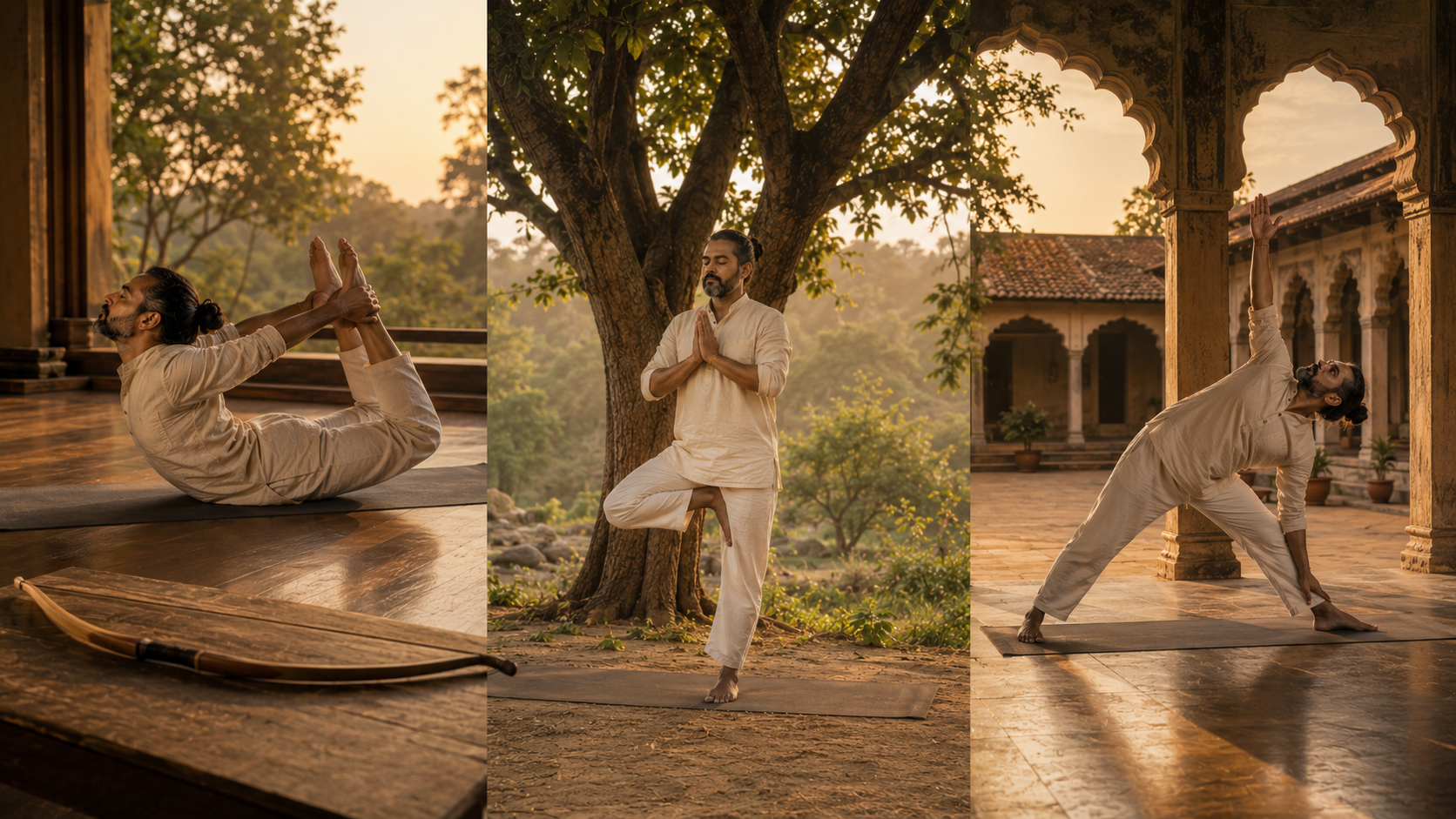
| Vṛkṣāsana | Vṛkṣa | Tree |
| Setu Bandha | Setu and Bandha | Bridge or bridge formation |
| Tāḍāsana | Tāḍa | Commonly associated with a palm tree in particular naming traditions |
| Dhanurāsana | Dhanus | Bow |
| Naukāsana | Naukā | Boat |
| Daṇḍāsana | Daṇḍa | Staff, rod |
| Cakrāsana | Cakra | Wheel |
| Trikoṇāsana | Trikoṇa | Triangle |
Dhanurāsana
The name contains:
Dhanus — Bow
Āsana — Posture
The form of the body in the posture is compared with a drawn bow.
Daṇḍāsana
Daṇḍa means a staff, rod, or stick.
Daṇḍāsana is conventionally understood through the image of a firm and extended staff-like form.
Trikoṇāsana
Trikoṇa means triangle or a three-angled form.
For elementary learning, students often recognise:
Tri — Three
Koṇa — Angle
The conventional meaning of Trikoṇāsana is Triangle Pose.
A Note on Tāḍāsana
The interpretation of Tāḍāsana requires some caution because nomenclature and posture identification vary across modern Yoga traditions.
The name is often explained through Tāḍa, associated with the palm tree.
However, modern schools do not always use Tāḍāsana and Samasthitiḥ in identical ways.
Nor should one assume that every modern standing alignment taught as “Mountain Pose” is linguistically contained in the Sanskrit word Tāḍāsana.
Mountain Pose is a conventional English Yoga label.
6. Sanskrit Number Words in Yoga Terminology
| Sanskrit | Number |
|---|---|
| Eka | One |
| Dvi | Two |
| Tri | Three |
| Catur / Catuḥ | Four |
| Pañca | Five |
| Ṣaṭ | Six |
| Sapta | Seven |
| Aṣṭa | Eight |
| Nava | Nine |
| Daśa | Ten |
Eka Pāda
For practical Yoga vocabulary:
Eka — One
Pāda — Foot
In āsana nomenclature, Eka Pāda is conventionally used to indicate a one-footed or one-legged arrangement, depending upon the posture and English teaching context.
Tri and Trikoṇa
Tri is associated with three.
Koṇa means angle.
Trikoṇa refers to a triangle or three-angled form.
Aṣṭāṅga
The term Aṣṭāṅga contains:
Aṣṭa — Eight
Aṅga — Limb or member
Therefore:
Aṣṭāṅga — Eight-limbed
In Yoga Sūtra 2.29, Patañjali lists:
- Yama
- Niyama
- Āsana
- Prāṇāyāma
- Pratyāhāra
- Dhāraṇā
- Dhyāna
- Samādhi
These constitute the eight limbs in the Pātañjala framework.
However, a major terminological distinction is necessary.
Aṣṭāṅga Yoga in the Pātañjala context refers to this eight-limbed system.
The modern postural system commonly known as Ashtanga Vinyasa Yoga belongs to a particular modern teaching history and lineage.
The two should not simply be treated as identical because both use the Sanskrit term Aṣṭāṅga.
Understanding Compound Asana Names
The practical advantage of learning recurring Sanskrit elements becomes especially clear when analysing longer posture names.
Utthita Pārśvakoṇāsana
Utthita — Extended or raised
Pārśva — Side
Koṇa — Angle
Āsana — Posture
Supta Baddha Koṇāsana
Supta — Reclining or lying down in this posture context
Baddha — Bound
Koṇa — Angle
Āsana — Posture
Prasārita Pādottānāsana
Prasārita — Spread or extended
Pāda — Foot
Uttāna — Extended or stretched out according to context
Āsana — Posture
Pedagogical word recognition is the beginning of understanding a Sanskrit compound, not necessarily the completion of its grammatical analysis.
For most Yoga teachers, this recognition is already extremely useful.
Sanskrit Names Are Not Complete Alignment Instructions
A common mistake is to assume that the Sanskrit name of an āsana provides a complete technical description of how the posture should be performed.
It does not.
A posture name may identify a visible form, a direction, a body part, an associated figure, an animal, an object, or a symbolic comparison.
But the name alone does not necessarily tell us how much joint range is appropriate, where mechanical load should be distributed, which variation is suitable for a particular practitioner, how the posture differs between teaching lineages, or whether a student has a relevant medical contraindication or precaution.
Knowing that Śīrṣa means head does not qualify a person to teach Śīrṣāsana safely.
Similarly, understanding that Jānu means knee does not mean the head must be forced towards the knee in Jānu Śīrṣāsana.
Sanskrit knowledge and practical teaching competence are related areas of Yoga education. They are not identical.
Why Sanskrit Asana Vocabulary Matters for Yoga Teachers
1. It Makes Asana Names Easier to Remember
When a teacher understands recurring terms such as Ardha, Parivṛtta, Pārśva, Pāda, Hasta, Jānu, and Śīrṣa, longer names become easier to recognise.
2. It Improves Teaching Clarity
A teacher can help students understand why a posture has a particular name.
For example:
Adho — Downward
Mukha — Face
Śvāna — Dog
The name Adho Mukha Śvānāsana becomes easier to recognise and remember.
3. It Supports Better Pronunciation
Recognising word elements can improve pronunciation.
However, correct Sanskrit pronunciation requires more than reading Roman letters as though they were English.
Consider the distinctions between ś, ṣ, and s; t and ṭ; d and ḍ; and short and long vowels such as a and ā.
These distinctions have linguistic significance.
4. It Helps Preserve Cultural and Historical Context
Yoga is not merely a collection of modern fitness exercises with exotic names.
Its terminology developed within Indian linguistic, philosophical, ascetic, religious, and physical-practice contexts.
Understanding Sanskrit terminology can help Yoga teachers engage with this heritage more carefully.
Historical honesty is part of respecting tradition.
5. It Encourages Intellectual Responsibility
A Yoga teacher should learn to distinguish between:
- what a Sanskrit word means,
- how an āsana is conventionally translated,
- how a particular lineage teaches the posture,
- what a traditional narrative associates with the name,
- and what historical texts actually document.
These layers may overlap.
They are not always identical.
Confusing them creates misinformation. Distinguishing them creates better Yoga education.
A Practical Method for Learning Sanskrit Asana Names
When you encounter a long āsana name, do not immediately try to memorise the entire name as one unfamiliar sound.
Instead, examine it step by step.
First, identify a directional or qualifying element
Is the name using Adho, Ūrdhva, Ardha, Parivṛtta, Supta, or Utthita?
Next, look for a body-related term
Can you recognise Hasta, Pāda, Jānu, Śīrṣa, or Mukha?
Look for an animal, object, or natural form
Perhaps the name contains Śvāna, Uṣṭra, Bhujaṅga, Vṛkṣa, or Dhanus.
Ask whether the name refers to a person or Yogic figure
For example: Matsyendra, Marīci, Bharadvāja, or Hanumān.
Look for a numerical element
Can you recognise Eka, Tri, Catur, or Aṣṭa?
Finally, examine how these elements function together in the complete name.
This method changes Sanskrit āsana nomenclature from a pure memory problem into a process of recognition.
Key Points
- Many āsana names contain recurring Sanskrit words and compound elements.
- Calling every component a “root word” is linguistically imprecise; a Sanskrit verbal root is technically called a Dhātu.
- Breaking an āsana name into familiar words is useful for learning, but it is not always equivalent to a complete Sanskrit grammatical analysis.
- A practical educational classification may group names according to direction or characteristics, body-related terms, associated figures, animals, objects or forms, and numbers.
- These categories are a teaching framework, not an exhaustive classical taxonomy of all āsana names.
- Aṅguṣṭha should be interpreted contextually; in Pādāṅguṣṭhāsana, it refers to the big toe.
- Pūrva and Paścima are fundamentally directional or relational terms rather than anatomical nouns.
- The appearance of an āsana name in a premodern text does not automatically prove that every modern physical variation is identical to the historical form.
- Sūrya Namaskāra is better understood as a sequence or practice rather than a single āsana.
- A Sanskrit name does not automatically prove the antiquity of a modern posture.
- Sanskritisation and historical antiquity are not identical.
- The conventional English name of an āsana may not be a literal translation of the Sanskrit name.
- Sanskrit posture names are not complete biomechanical or alignment instructions.
- Pātañjala Aṣṭāṅga Yoga and modern Ashtanga Vinyasa Yoga should not be treated as identical systems.
- Respect for Yoga tradition requires both cultural sensitivity and historical precision.
Conclusion
Sanskrit āsana names may initially appear complicated.
But as recurring words become familiar, many names begin to reveal their structure.
Adho indicates a downward orientation.
Jānu refers to the knee.
Śīrṣa means head.
Śvāna means dog.
Vṛkṣa means tree.
Dhanus means bow.
Ardha means half.
Aṣṭa means eight.
With growing familiarity, long posture names stop appearing as meaningless collections of unfamiliar sounds.
Patterns begin to emerge.
For a Yoga teacher, however, the purpose of learning Sanskrit vocabulary is not to display complicated terminology in class.
The deeper responsibility is precision.
Know what the Sanskrit term can mean.
Know when an English posture name is conventional rather than literal.
Know when a word-by-word breakdown is a teaching tool rather than a complete grammatical analysis.
Know when a story is traditionally associated with a name but historically difficult to verify.
Know when the presence of Sanskrit terminology does not prove the antiquity of a modern posture.
And most importantly:
Teach only what you can explain responsibly.
Understanding Sanskrit āsana vocabulary is one small but significant step towards becoming a more informed, precise, and intellectually responsible Yoga teacher.
Respect for Yoga tradition does not require exaggeration.
It requires careful study, clear distinctions, and the intellectual discipline to say only what the available linguistic, textual, and historical evidence allows us to say.