Saṅkaṭāsana (Difficult Pose): Classical Sources, Anatomy, Alignment & Evidence-Based Guide
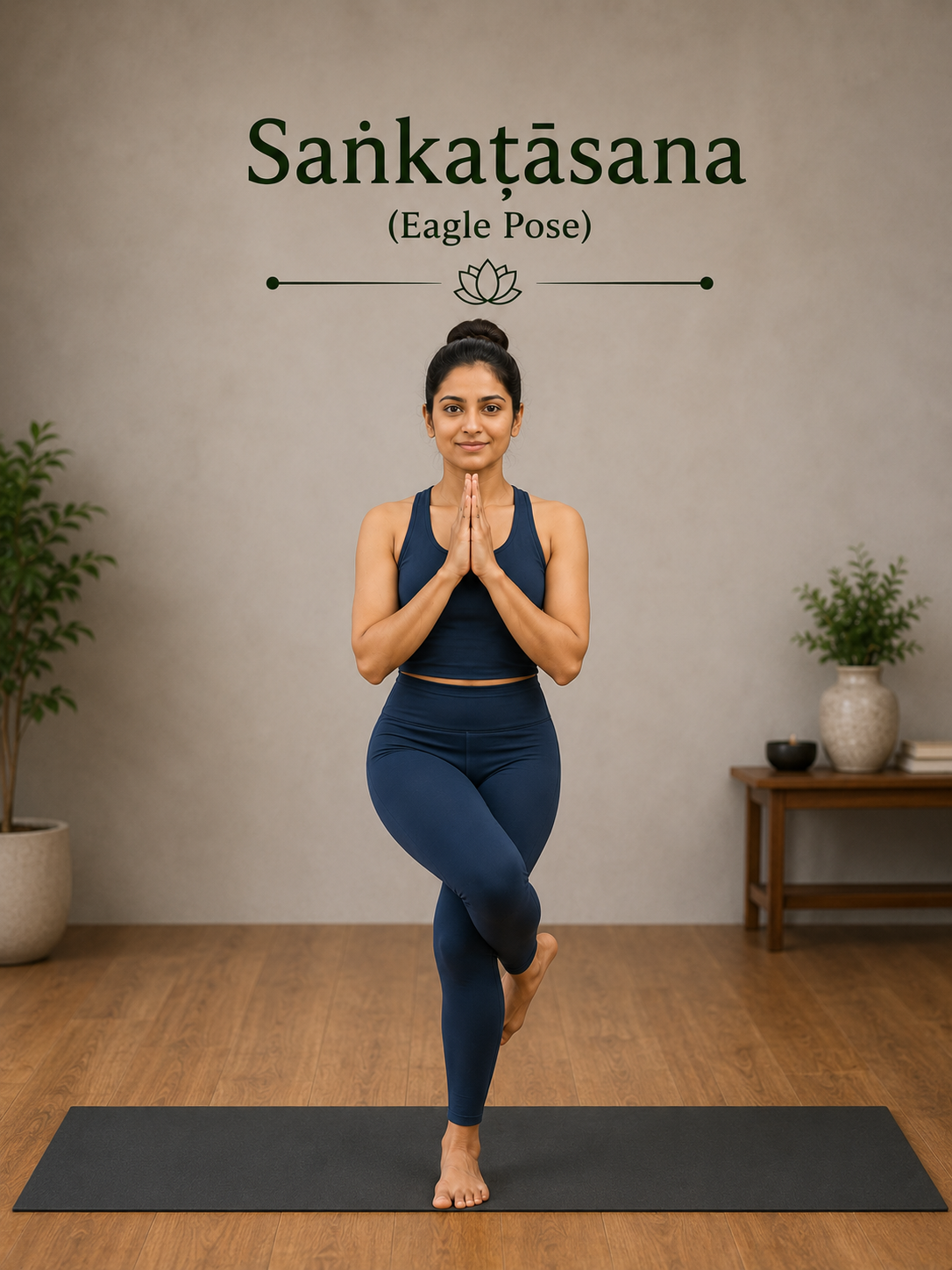
Saṅkaṭāsana (Difficult Pose): The Complete Reference Guide
Editorial note, stated once: throughout this article, traditional yogic and Āyurvedic claims (chakra, prāṇa, dosha associations) are presented as traditional belief, not scientific fact, unless a specific evidence source is cited alongside them.
Name & Meaning
- Sanskrit: सङ्कटासन / संकटासन (Saṅkaṭāsana)
- IAST Transliteration: Saṅkaṭāsana / Sankatasana
- English: Difficult Pose / Contracted Pose / Troubled Pose
- Etymology: Saṅkaṭa (narrow / contracted / difficult / critical state) + Āsana (posture / seat). "The posture where the lower limbs are tightly bound, contracted, and interlaced beneath the body, testing physical balance and mental steadiness under compression."
Introduction
- Saṅkaṭāsana is a classical, highly focused posture in Haṭha Yoga that challenges ankle joint plantarflexion, knee flexibility, and centered equilibrium.
- Characterized in classical texts by sitting or balancing on one folded ankle on the earth, wrapping the opposite leg firmly around the standing/grounded leg, and resting both hands calmly on the knees with an unshakeable mind.
- Holds an indisputable classical lineage, explicitly documented in the 17th-century Gheraṇḍa Saṃhitā (Chapter 2, Verse 28) as one of the 32 essential physical postures for human health and mental mastery.
- Functions as a master diagnostic posture for testing subtalar joint mobility, peroneal tendon flexibility, knee medial collateral ligament (MCL) safety, and proprioceptive focus under asymmetrical loading.
Benefits
- Ankle & Foot Tendon Mobilization: Deeply stretches the extensor digitorum, peroneus longus, and anterior tibialis muscles while building joint stability in the tarsal and metatarsal bones.
- Core & Pelvic Floor Activation: Balancing on a contracted base forces continuous isometric engagement of the pelvic floor (levator ani) and deep transverse abdominis.
- Lower Limb Circulation & Vascular Flush: Contracted compression of the popliteal and femoral arteries temporarily reduces lower leg blood flow, creating a restorative flush of oxygenated blood upon releasing the pose.
- Proprioceptive Balance & Equanimity: Demands intense single-pointed concentration (Ekāgratā), steadying vestibular control and training the mind to remain calm in constrained positions.
- Traditional/Spiritual: Classically stated in the Gheraṇḍa Saṃhitā to cure diseases of the lower legs, balance Apāna Vāyu at the pelvic base, stimulate Mūlādhāra (root) chakra, and eliminate nervous restlessness—traditional belief, not a scientific claim.
How to Practice Saṅkaṭāsana: Step-by-Step
| Step | Action | Breath | Teacher Cue |
|---|---|---|---|
| 1 | Kneel on a soft yoga mat in Vajrāsana (Thunderbolt Pose) with spine erect and shoulders relaxed. | Natural breath | "Kneel upright, lengthening the back of your neck toward the sky." |
| 2 | Shift body weight forward onto hands. Place the left foot flat on the floor, resting the left ankle and top of foot firmly on the mat beneath the pelvis. | Exhale to set foundation | "Anchor your left foot and ankle securely flat against the floor." |
| 3 | Cross the right leg tightly over the left thigh/knee, wrapping the right shin around the left calf so the right foot tucks neatly behind the left ankle. | Inhale as leg wraps | "Wrap your right leg tightly around your left leg like a vines coiling a branch." |
| 4 | Lower your pelvis down to sit balanced on the crossed foot base. Keep both knees stacked directly above one another. | Exhale to settle seat | "Lower your seat centered over your heels, keeping your spine straight." |
| 5 | Rest right palm on right knee and left palm on left knee (or stack palms on top knee). Fix gaze (Driṣṭi) on a single unmoving point ahead. Hold for 5–8 steady breaths. | Slow, quiet diaphragmatic breath | "Rest hands on your knees and steady your mind in silent equilibrium." |
| 6 | To exit, lean forward onto hands, unwrap right leg, sit back into Vajrāsana, take 3 deep breaths, and repeat wrapping the left leg over the right. | Inhale to release | "Lean forward softly, unwrap your legs, and pause in Thunderbolt Pose." |
Common Mistakes & Corrections
- Twisting the knee joint to force the leg wrap: Forcing leg rotation from the knee rather than the hip strains the medial collateral ligament (MCL) → Correction: Initiate thigh adduction and internal rotation from hip joint; wrap leg only as far as knees allow naturally.
- Slouching backward and rounding the lower spine: Inability to balance over foot base causes posterior pelvic collapse → Correction: Place a folded blanket or foam block beneath hips to raise sitting height and keep spine erect.
- Sickling or jamming the bottom ankle against floor: Allowing foot to twist sideways causes acute malleolus bone pressure → Correction: Keep top of foot evenly pressed against mat or cushion ankle with a soft towel roll.
- Tensing shoulders and holding breath: Physical difficulty leads to sympathetic jaw and shoulder clenching → Correction: Soften collarbones, broaden chest, and maintain slow diaphragmatic exhalations.
Contraindications & Precautions
- Acute Knee Ligament Injuries (MCL, ACL, Meniscus Tears): Deep knee flexion combined with leg wrapping places lateral shear stress on knee cartilage.
- Severe Ankle Osteoarthritis, Sprain, or Fractures: Carrying body weight on a fully plantarflexed ankle is strictly contraindicated until healed.
- Severe Sciatica or Acute Lumbar Herniation: Asymmetrical compressed pelvic position can aggravate inflamed sciatic nerve roots.
- Severe Varicose Veins or Deep Vein Thrombosis (DVT): Deep venous compression in tight leg folds requires gentle non-contracted postures.
Sequencing: Preparatory, Follow-up & Variations
- Preparatory Poses: Vajrāsana (Thunderbolt), Vīrāsana (Hero Pose), Garuḍāsana (Eagle Pose), Baddha Koṇāsana (Bound Angle), Daṇḍāsana.
- Placement in Sequence: Mid-to-late seated meditative or ankle-balancing block, preceding restorative counter-folds and relaxation.
- Follow-up Poses: Dwi Pāda Uttānāsana (Legs Extended Forward stretch), Paścimottānāsana (Symmetrical forward fold counter-reset), Śavāsana.
- Variations:
- Standing Saṅkaṭāsana (Garuda-style): Standing single-leg balance with legs wrapped and arms bound.
- Block-Supported Saṅkaṭāsana: Resting pelvis on a yoga block positioned between feet.
- Chair Saṅkaṭāsana: Practicing leg crossing while seated upright on a chair to protect sensitive knees.
In more detail: Saṅkaṭāsana acts as a powerful bridge between seated grounding and asymmetrical leg binding. In classical systems, it cultivates the ankle resilience and hip adductor flexibility required for advanced seated padmāsana (lotus) and standing balance variations.
Modifications
- Yoga Block Beneath Pelvis (Relieves Knee & Ankle Pressure): Place a foam block vertically or flat between feet to support body weight, removing heavy pressure from folded ankles.
- Rolled Towel Under Ankle Joints: Place a soft rolled towel underneath the front ankle crease if limited foot plantarflexion causes top-of-foot pain.
- Practice Standing Eagle (Garuḍāsana) Progression: If floor kneeling hurts knees, build leg-wrapping strength by practicing standing Garuḍāsana against a wall.
Historical Background & Classical References
- Classical Scripture Source: Gheraṇḍa Saṃhitā (Chapter 2, Verse 28):
वामपादतले गुल्फं संस्थाप्य धरणीतले।
पाददण्डेन पादं च वेष्टयित्वा समाहितः॥ २८ ॥
जानुयुग्मे करद्वन्द्वमेतत्सङ्कटमासनम्।
Vāmapādatale gulphaṁ saṁsthāpya dharaṇītale |
Pādadaṇḍena pādaṁ ca veṣṭayitvā samāhitaḥ || 2.28 ||
Jānuyugme karadvandvametatsaṅkaṭamāsanam |
"Placing the left foot and ankle flat upon the ground, wrapping the right leg around the left leg, resting both hands calmly on the knees, with a focused mind—this is known as Saṅkaṭāsana." - Modern Classical Continuance: Featured in 20th-century classical instructional manuals by Swami Dhirendra Brahmachari (Yogic Sukshma Vyayama) and Swami Satyananda Saraswati (Bihar School of Yoga).
Alignment Principles (Classical Method)
- Ankle Base Stability: The grounded foot remains fully extended (plantarflexed) along the mat line to form a solid supportive wedge.
- Midline Adduction: Inner thighs squeeze firmly inward toward the sagittal center line, creating a tight interlocking leg bind.
- Vertical Trunk Axis: Spine, sternum, and crown of head maintain vertical alignment directly above the center of pelvis.
- Focused Driṣṭi: Gaze remains fixated steadily forward at eye level, establishing nervous system balance.
Anatomy & Biomechanics
- Primary Stretched Muscles: Peroneus Longus/Brevis, Tibialis Anterior, Extensor Digitorum Longus, Gluteus Medius/Minimus, Piriformis (top wrapped leg).
- Primary Active/Strengthening Muscles: Adductor Magnus, Adductor Longus, Gracilis, Transverse Abdominis, Pelvic Floor (Levator Ani), Erector Spinae.
- Joint Mechanics: Extreme ankle plantarflexion; deep knee flexion with controlled femoral internal rotation and adduction; hip flexion and adduction; neutral spinal extension.
- Joint Load Distribution: Wrapping legs reduces the base of support to a narrow foot axis. Engaging hip adductors locks the pelvic bowl, preventing lateral shear force across the L4–L5 lumbar vertebrae and protecting the knee joint.
Nervous System & Breathing Effects
- Vagal Activation & Central Focus: Maintaining stillness on a narrow, contracted base triggers proprioceptive sensory inputs that quiet mental chatter (Citta Vṛtti).
- Uninhibited Diaphragmatic Respiration: Upright vertical spine positioning permits uncompressed movement of the thoracic diaphragm.
Yogic & Āyurvedic Perspective
- Dosha Impact: Highly effective for grounding hyperactive Vāta (calms nervous anxiety, mental agitation, and joint instability) while dispelling Kapha lethargy—traditional belief.
- Prāṇa Dynamics: Activates Mūlādhāra Chakra at the pelvic root, regulates Apāna Vāyu (downward grounding energy), and fosters deep inner stability.
Therapeutic Applications
| Condition | Mechanism | Research / Precaution |
|---|---|---|
| Ankle Stiffness & Weak Feet Arches | Plantarflexion under body weight mobilizes anterior ankle retinaculum and tarsal joints | Supported by ankle mobility literature. Precaution: Cushion ankles with a towel roll. |
| Lack of Mental Focus & Restless Anxiety | Proprioceptive balance demands single-pointed awareness, down-regulating sympathetic arousal | Supported by autonomic relaxation studies. Precaution: Maintain steady gaze. |
Yoga is never a replacement for medical treatment; serious or persistent conditions require a qualified healthcare professional.
Teaching Cues & Hands-On Adjustments
- Verbal Cues: "Sit tall over your folded ankle like an arrow resting on its notch." / "Squeeze your inner thighs together tightly." / "Rest your hands gently on your knees and find an unmoving gaze ahead."
- Hands-on Adjustment (Safe execution with consent):
- Stand behind student; place hands gently on top of their shoulders, applying soft downward pressure to help them anchor their weight centered over their ankles.
- Place hand lightly against their upper mid-back to encourage vertical spinal lengthening if they begin to slouch.
Myth vs. Fact
| Myth | Fact |
|---|---|
| Saṅkaṭāsana is just another name for Garuḍāsana (Eagle Pose). | While related in leg-wrapping mechanics, classical Saṅkaṭāsana as documented in the Gheraṇḍa Saṃhitā (2.28) is a seated/kneeling ankle balance with hands on knees. |
| Pain in the top of the foot or ankle is normal and should be ignored. | Sharp joint pain signals tissue distress; elevate hips on a block or use a towel roll under ankles immediately. |
| Saṅkaṭāsana is a modern invention. | It is one of the authentic 32 classical physical postures specifically described in the 17th-century Gheraṇḍa Saṃhitā. |
Conclusion
Saṅkaṭāsana (Difficult Pose) is a timeless classical posture that transforms physical difficulty into unshakeable poise. By binding the lower limbs with precision, grounding the ankles, and maintaining a serene, focused mind, practitioners turn physical constraint into a gateway for deep inner mastery.
Quick Facts
| Category | Seated/kneeling ankle balance / Contracted limb posture |
| Difficulty Level | Intermediate |
| Primary Muscles Stretched | Tibialis Anterior, Extensor Digitorum, Gluteus Medius, Piriformis |
| Primary Muscles Active | Adductor Magnus/Longus, Transverse Abdominis, Pelvic Floor |
| Classical Source? | Yes (Gheraṇḍa Saṃhitā 2.28) |
| Traditional Chakra (Belief) | Mūlādhāra (Root) & Svādhiṣṭhāna (Sacral) |
| Dosha Impact (Belief) | Strongly pacifies Vāta & grounds Kapha |
Frequently Asked Questions
What does Saṅkaṭāsana mean in English?
Saṅkaṭa (difficult / contracted / critical) + Āsana (pose) = Difficult Pose or Contracted Pose.
Is Saṅkaṭāsana mentioned in ancient yoga scriptures?
Yes! It is explicitly listed in the 17th-century Gheraṇḍa Saṃhitā (Chapter 2, Verse 28).
Why do my feet or ankles hurt in Sankatasana?
Pain occurs when ankle plantarflexion is limited or when the bony ankle press flat against a hard floor. Place a soft folded towel under your ankle crease and sit on a yoga block.
What is the difference between Saṅkaṭāsana and Garuḍāsana?
Garuḍāsana (Eagle Pose) is typically practiced as a standing upright balance with wrapped arms. Classical Saṅkaṭāsana is a seated/kneeling posture resting balanced on crossed, folded ankles with hands on knees.
How long should I hold Difficult Pose?
Hold for 5 to 8 steady breaths (about 30 to 60 seconds) per leg crossing.
References
1. Classical Yoga Texts: Gheraṇḍa Saṃhitā, Chapter 2, Verse 28 (17th century).
2. Modern Yoga Literature: Saraswati, Swami Satyananda (1996). Asana Pranayama Mudra Bandha. Bihar School of Yoga. Brahmachari, Swami Dhirendra. Yogic Sukshma Vyayama.
3. Peer-Reviewed Scientific Research:
- Sherman, K. J., et al. (2011). A randomized trial comparing yoga, stretching, and a self-care book for chronic low back pain. Archives of Internal Medicine, 171(22), 2019-2026.
- Ni, M., et al. (2014). Comparative muscle activation patterns during yoga postures in elderly adults. BMC Complementary and Alternative Medicine, 14, 401.
This article is for educational purposes and does not replace individualized medical or physical therapy advice. Consult a qualified healthcare provider before beginning any new practice, especially with a pre-existing health condition.