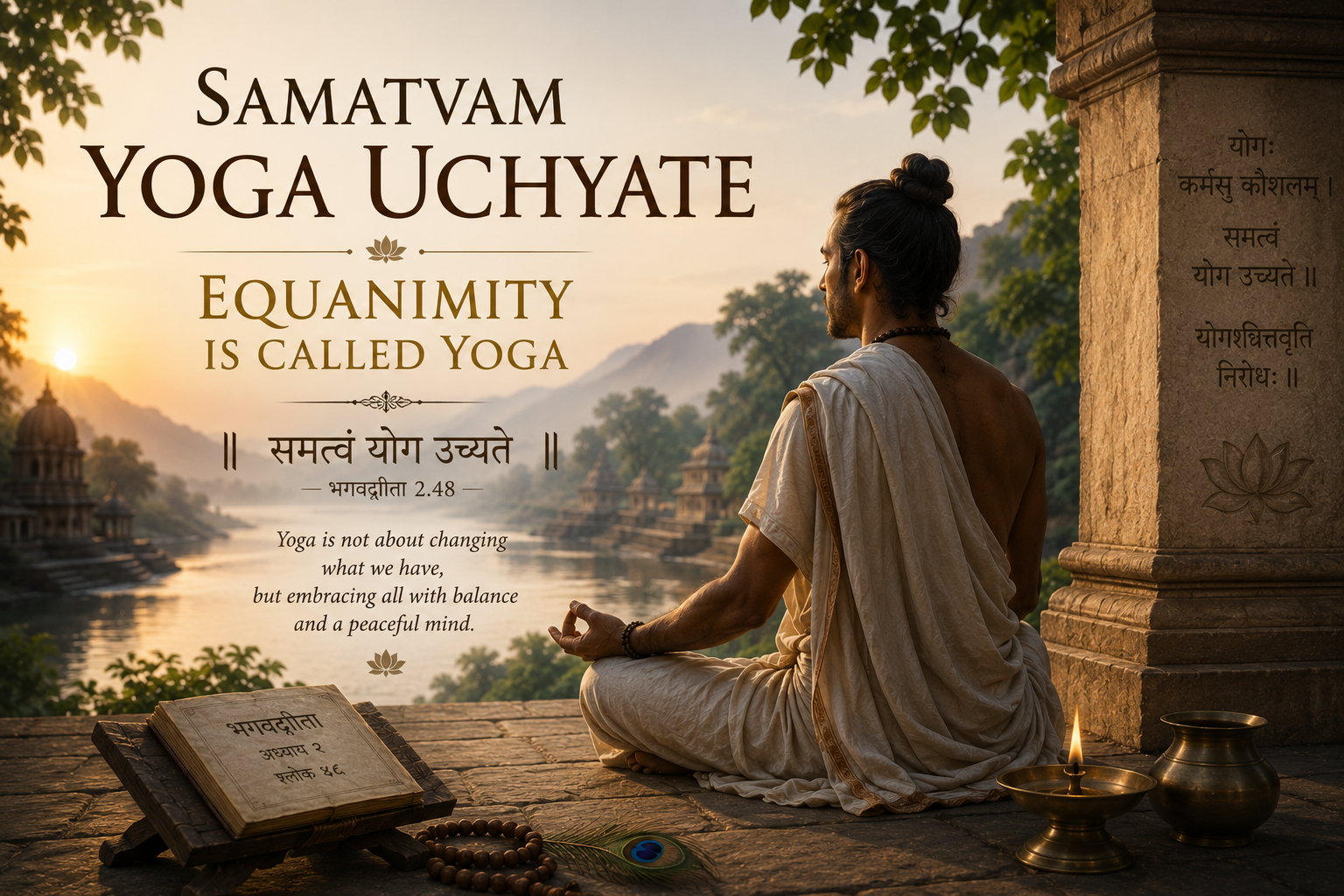
Samatvam Yoga Uchyate: Equanimity Is Called Yoga (Bhagavad Gita 2.48)
Introduction
"Samatvaṁ Yoga Uchyate" is one of the most quoted definitions of Yoga in the entire Bhagavad Gītā, spoken by Śrī Kṛṣṇa to Arjuna in Chapter 2, Verse 48.
It means that maintaining a balanced, equanimous mind in every circumstance of life is itself Yoga. Yoga, in this teaching, does not ask a person to run away from life's situations — it asks them to meet every situation with the same steady mind.

The Full Verse and Its Context
The phrase does not stand alone. It is the closing line of a complete verse:
योगस्थः कुरु कर्माणि सङ्गं त्यक्त्वा धनञ्जय। सिद्ध्यसिद्ध्योः समो भूत्वा समत्वं योग उच्यते॥ (2.48)
Yoga-sthaḥ kuru karmāṇi saṅgaṁ tyaktvā dhanañjaya, siddhy-asiddhyoḥ samo bhūtvā samatvaṁ yoga uchyate
"Established in Yoga, O Dhanañjaya (Arjuna), perform your actions, abandoning attachment, remaining even-minded in success and failure. This evenness of mind is called Yoga."
This context matters. Kṛṣṇa is not offering a general statement about emotional balance in isolation — he is teaching Arjuna how to act. The verse belongs to Kṛṣṇa's teaching on Niṣkāma Karma, action performed without attachment to its results. Equanimity, here, is specifically the equanimity of someone who continues to perform their duty (karma) while remaining unmoved by whether the outcome is success or failure.
Word Meanings
- Samatvam (समत्वम्) — evenness of mind, equanimity, balance
- Yoga (योग) — union; in this context, the disciplined state of a mind fixed on right action, undisturbed by outcome
- Uchyate (उच्यते) — is called, is said to be
Meaning: "That evenness and balance of mind — sustained through action — is what is called Yoga."
What Is Samatva (Equanimity)?
Samatva means keeping the mind balanced through every pair of opposites life presents:
- Success or failure
- Pleasure or pain
- Gain or loss
- Honour or insult
- Fame or disrepute
Remaining steady and calm through all of these — without being carried away by either extreme — is Samatva.

Rising Above the Dualities (Dvandvas)
Opposing conditions will always exist in life:
- Day and night
- Joy and sorrow
- Success and failure
Yoga does not eliminate these dualities. It teaches a person to remain balanced between them. When a practitioner rises above being pulled by these opposites, real Yoga — in this specific sense that Kṛṣṇa is describing — begins.
Material and Spiritual Life Are Not Separate
According to this teaching, material (Bhautik) and spiritual (Ādhyātmik) life are not two separate worlds. They are two dimensions of a single life.
What matters is not that a person abandons the world, but that they:
- Remain balanced amid circumstances
- Continue to fulfil their duties
- Preserve inner peace while doing so
Yoga, in this sense, does not mean escaping the world — it means living a balanced life while remaining active within it.
The Importance of Perception
Yoga does not change external circumstances. It changes our perception of them.
When a person's thinking is balanced:
- External events find it harder to disturb them.
- They become more emotionally resilient.
- Their capacity to make sound decisions improves.
The Practical Message of This Teaching
- Accept every circumstance as it comes.
- Keep emotional responses balanced.
- Don't let external situations overpower inner peace.
- Regard both pleasure and pain with an even outlook.
- Practise remaining content in every condition.
Key Points
- "Samatvaṁ Yoga Uchyate" is Kṛṣṇa's definition of Yoga in Bhagavad Gītā 2.48.
- The full verse frames this equanimity specifically in the context of performing action without attachment to its results (Niṣkāma Karma) — not as a standalone statement detached from action.
- Yoga means equanimity and mental balance.
- Remaining even-minded through success and failure, joy and sorrow, honour and disrepute — this is Yoga.
- Yoga teaches a person to rise above life's dualities, not to escape them.
- Material and spiritual life are not separate — they are two aspects of the same life.
- Yoga changes our perception more than it changes our circumstances.
- Mental balance makes a person emotionally stronger.
- True Yoga is a state in which no external circumstance can disturb one's inner peace.
Editorial Note: What the Verse Says, and What It Doesn't
One clarification is worth making directly, since it's easy to read "Samatvaṁ Yoga Uchyate" as a free-floating definition of Yoga in general:
The equanimity Kṛṣṇa describes here is tied to action, not separate from it. Verse 2.48 opens with "yoga-sthaḥ kuru karmāṇi" — "established in yoga, perform your actions" — and only then defines that established, steady state as samatva. This is a teaching about how to act: performing one's duty fully, while releasing attachment to whether the result is success or failure. It is a foundational statement of Karma Yoga specifically, even though its wisdom is rightly applied much more broadly to daily life, as this article does. Presenting it as a general life philosophy is a legitimate and valuable application — but it's worth knowing that in the Gītā itself, it arrives embedded in a teaching about action and its fruits.

Conclusion
"Samatvaṁ Yoga Uchyate" tells us that Yoga is not confined to postures or breathing techniques — it is, at its root, a state of mind: one that remains even and undisturbed through every pair of opposites life presents, while a person continues, without hesitation, to perform their rightful duty.
To live with such balance — acting fully, yet unattached to outcome — is, in Kṛṣṇa's own words, the very definition of Yoga.