Samasthitiḥ (Equal Standing Posture): Classical Sources, Anatomy, Alignment & Evidence-Based Guide
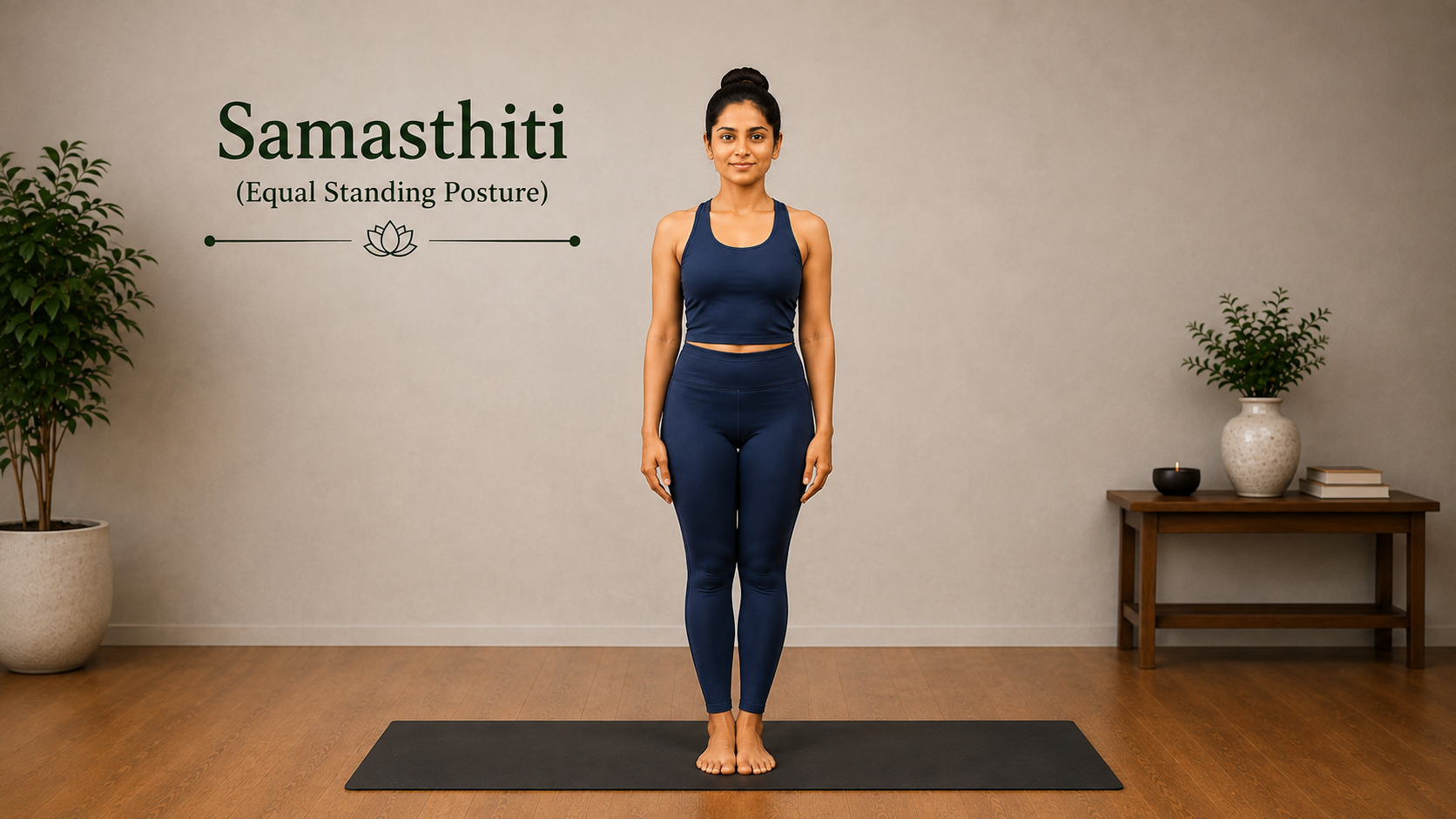
Samasthitiḥ (Equal Standing Posture): The Complete Reference Guide
Editorial note, stated once: throughout this article, traditional yogic and Āyurvedic claims (chakra, prāṇa, dosha associations) are presented as traditional belief, not scientific fact, unless a specific evidence source is cited alongside them.
Name & Meaning
- Sanskrit: समस्थितिः (Samasthitiḥ)
- IAST Transliteration: Samasthitiḥ / Samasthiti
- English: Equal Standing Posture / Steadiness Pose
- Etymology: Sama (equal / balanced / level) + Sthiti (standing / position / steadiness). "The posture of standing in perfect equilibrium, where body weight is distributed symmetrically across both feet and mind rests in unwavering stillness."
Introduction
- Samasthitiḥ is the foundational reference posture for all standing āsanas in Haṭha and Vinyasa Yoga, establishing the anatomical blueprint for vertical posture and body awareness.
- Characterized by standing upright with big toes touching, heels slightly apart or touching, weight balanced evenly across the four corners of both feet, knees extended, pelvis in neutral, chest broad, and arms resting along the sides of the body with palms facing thighs or forward.
- Central to the Ashtanga Vinyasa Yoga system (formalized by K. Pattabhi Jois) as the starting and return point (reset) for every Vinyasa sequence, and closely synonymous with Tāḍāsana (Mountain Pose) in the Iyengar tradition.
- Functions as an essential diagnostic for clinical posture analysis, identifying foot pronation/supination, pelvic tilting, shoulder asymmetry, and head-forward posture.
Benefits
- Postural Realignment & Axial Balance: Trains static equilibrium, aligning ears, shoulders, hips, knees, and ankles along a vertical gravity line.
- Plantar Surface Activation & Foot Arch Support: Engages intrinisic foot muscles and plantarfacia, promoting healthy medial longitudinal foot arches.
- Quadriceps & Core Co-Contraction: Builds endurance in deep spinal erectores, quadriceps femoris, transverse abdominis, and gluteal stabilizers.
- Proprioceptive Enhancement: Reduces body sway by recalibrating vestibular and somatosensory feedback loops in static standing.
- Traditional/Spiritual: Believed to activate Mūlādhāra (root) chakra, harmonize Prāṇa Vāyu and Apāna Vāyu, and cultivate Sama-Citta (mental equanimity)—traditional belief, not a scientific claim.
How to Practice Samasthitiḥ: Step-by-Step
| Step | Action | Breath | Teacher Cue |
|---|---|---|---|
| 1 | Stand at front of mat with inner big toe mounds touching and heels slightly apart (or feet parallel hip-width apart if lower back or balance requires). | Natural breath | "Bring big toes to touch, spreading toes wide and anchoring into the earth." |
| 2 | Press evenly through big toe mound, little toe mound, inner heel, and outer heel. Engage quadriceps to lift kneecaps upward without hyperextending joints. | Inhale as legs engage | "Firm your thighs and lift your kneecaps, balancing weight evenly across all four corners of your feet." |
| 3 | Align pelvis in neutral—tailbone lengthening gently toward floor while lower abdomen rolls softly inward and upward (Mūla & Uḍḍīyāna Bandha support). | Exhale to ground pelvis | "Lengthen your tailbone down and lightly draw lower belly to spine." |
| 4 | Broaden collarbones and roll shoulders back and down. Extend arms alongside body, fingers soft yet active, pointing downward. | Inhale to lift chest | "Roll shoulders away from ears, opening your chest broad and wide." |
| 5 | Draw chin parallel to floor, crown of head reaching skyward. Fix gaze (Driṣṭi) softly at eye level (Nāsāgra or Bhrūmadhya). Hold for 5–10 steady breaths. | Steady, even diaphragmatic breathing | "Stand tall, breathing fully into the circumference of your ribs." |
| 6 | Maintain stillness, observing natural breath flow before transitioning into next movement or Vinyasa sequence. | Natural breath | "Feel rooted in the earth, light through the crown of your head." |
Common Mistakes & Corrections
- Hyperextending knees into joint locking: Pushing knee joints past neutral strains posterior cruciate ligaments (PCL) → Correction: Micro-bend knees slightly, engaging hamstrings and quadriceps together to keep joint neutral.
- Anterior pelvic tilt with flared ribs: Arching lower back collapses lumbar spine and bulges belly → Correction: Lengthen tailbone down toward heels, soften front ribs, and pull navel gently inward.
- Collapsing inner foot arches (over-pronation): Weight rolling onto inner foot borders flattens arches → Correction: Press firmly through outer heel and big toe mound, actively lifting medial foot arch.
- Forward head protrusion and rounded shoulders: Slouching neck strains upper trapezius → Correction: Slide chin slightly back (cervical retraction) so ears align directly above shoulder joints.
Contraindications & Precautions
- Acute Dizziness, Vertigo, or Low Blood Pressure (Orthostatic Hypotension): Standing completely still with eyes closed can trigger disorientation; keep eyes open fixed on a point, or stand with feet hip-width near a wall.
- Severe Plantar Fasciitis or Calcaneal Spurs: Full weight-bearing on bare floor may irritate inflamed fascial tissue; practice on a supportive mat or cushioned prop.
- Third-Trimester Pregnancy: Standing with feet touching alters center of balance and strains sacroiliac joints; widen stance to hip- or shoulder-width for stability.
Sequencing: Preparatory, Follow-up & Variations
- Preparatory Poses: None required (acts as the universal starting position for all standing practices).
- Placement in Sequence: Beginning of practice, transition between standing postures, and reset point in Ashtanga Surya Namaskar A & B.
- Follow-up Poses: Urdhva Hastāsana (Upward Salute), Uttānāsana (Standing Forward Bend), Vṛkṣāsana (Tree Pose), Vīrabhadrāsana series.
- Variations:
- Feet Hip-Width Samasthitiḥ: Modified stance for balance or lumbar comfort.
- Wall-Supported Samasthitiḥ: Heels, sacrum, shoulder blades, and back of head resting against wall to re-calibrate alignment.
- Samasthitiḥ with Anjali Mudra: Palms pressed together at heart center.
Modifications
- Feet Hip-Width Apart (For Balance & Low Back): Separating feet under hip joints broadens base of support, relieving sacroiliac pressure.
- Block Between Thighs (Enforces Inner Thigh Engagement): Squeeze a yoga block between upper inner thighs to encourage neutral hip alignment and prevent knee collapse.
- Back Against Wall (Tactile Postural Feedback): Stand against a wall with heels 2 inches away, contacting sacrum, upper back, and head against wall surface.
Historical Background & Classical References
- Ashtanga & Classical Lineage: While static standing postures were historically auxiliary in early medieval texts compared to seated meditation seats, Samasthitiḥ was formalized in 20th-century classical systems by T. Krishnamacharya, B.K.S. Iyengar (as Tāḍāsana), and Pattabhi Jois as the absolute baseline for postural discipline.
- Philosophical Roots: Embodies the Patanjali Yoga Sutra requirement of Sthira-Sukham Āsanam (1.46)—steady and comfortable posture—where physical stability serves as a foundation for mental tranquility.
Alignment Principles (Iyengar Method)
- Plumb Line Alignment: Ear, shoulder joint, greater trochanter (hip), lateral knee center, and lateral malleolus (ankle) form a straight vertical line.
- Four Corners of the Feet: Equal weight distribution across inner heel, outer heel, big toe mound, and pinky toe mound.
- Lift of the Sternum: Sternum rises upward while front ribs remain contained and lower abdomen stays lifted.
Anatomy & Biomechanics
- Primary Stretched Muscles: Mild passive lengthenings in suboccipital muscles, chest flexors (if slouching previously), and calf complex.
- Primary Active Muscles: Tibialis Anterior, Peroneus Longus, Quadriceps Femoris, Gluteus Medius/Minimus, Transverse Abdominis, Multifidus, Erector Spinae, Rhomboids, Lower Trapezius.
- Joint Mechanics: Ankle neutral; knee extension; hip neutral extension; pelvis neutral tilt; spine anatomical neutral curves; shoulder girdle neutral retraction and depression.
- Center of Pressure Dynamics: In Samasthitiḥ, the body constantly makes micro-adjustments via postural sway managed by calf and ankle musculature (ankle strategy). Equalizing weight between left and right foot reduces asymmetrical wear on hip and knee cartilage.
Nervous System & Breathing Effects
- Autonomic Equanimity: Standing erect without tension promotes balanced autonomic tone, bridging alertness and relaxation.
- Full Diaphragmatic Expansion: A neutral spine permits uncompressed 360-degree expansion of the diaphragm during inhalation.
Yogic & Āyurvedic Perspective
- Dosha Impact: Strongly pacifies Vāta (grounds unrooted energy) and cools excess Pitta through calm mental focus—traditional belief.
- Prāṇa Dynamics: Establishes equal balance between Prāṇa Vāyu (upward vital energy) and Apāna Vāyu (downward grounding energy) along the central Suṣumnā Nāḍī.
Therapeutic Applications
| Condition | Mechanism | Research / Precaution |
|---|---|---|
| Postural Fatigue & Forward Head Slouching | Re-educates proprioceptors to align head, spine, and pelvis over feet | Supported by postural physical therapy studies. Precaution: Keep chin parallel to floor. |
| Flat Feet (Pes Planus) / Weak Foot Arches | Engages intrinsic foot flexors and tibialis posterior to rebuild arch support | Supported by podiatric biomechanics protocols. Precaution: Press big toe mound firmly. |
Teaching Cues & Hands-On Adjustments
- Verbal Cues: "Ground through all four corners of your feet like tree roots." / "Lift your kneecaps without locking your knees." / "Grow tall through the crown of your head while softening your shoulders."
- Hands-on Adjustment (Safe execution with consent):
- Stand beside student; place one hand gently on their upper chest and other hand on mid-upper back to guide vertical axial expansion.
- Place hands on sides of pelvis to encourage level hips and neutral pelvic tilt.
Myth vs. Fact
| Myth | Fact |
|---|---|
| Samasthitiḥ is just "standing around" with no active work involved. | It is an active isometric posture requiring coordinated engagement of feet, legs, core, and back muscles. |
| Your knees should be pushed back as far as possible. | Locking knees hyperextends joints; quadriceps must lift kneecaps while keeping a subtle micro-softness in the joint. |
Conclusion
Samasthitiḥ (Equal Standing Posture) is far more than a simple transition—it is the foundational standard for alignment, balance, and mindfulness across all standing practices. By rooting into the earth and extending upward with poise, practitioners cultivate physical equilibrium and mental stillness.
Quick Facts
| Category | Standing neutral foundational pose |
| Difficulty Level | Beginner / Foundational |
| Primary Muscles Active | Quadriceps, Tibialis Anterior, Transverse Abdominis, Erector Spinae |
| Classical Source? | Yes (Modern classical formalization in Ashtanga & Iyengar) |
| Traditional Chakra (Belief) | Mūlādhāra (Root) |
| Dosha Impact (Belief) | Pacifies Vāta & Pitta |
Frequently Asked Questions
What is the difference between Samasthitiḥ and Tāḍāsana?
In Ashtanga Yoga, the posture is called Samasthitiḥ (emphasizing equal standing equilibrium). In Iyengar and other Haṭha traditions, it is termed Tāḍāsana (Mountain Pose). They refer to the same standing foundation.
Should feet be together or hip-width apart in Samasthitiḥ?
Traditionally, big toes touch with heels slightly apart. If you have lower back stiffness, balance concerns, or are pregnant, standing with feet hip-width apart is recommended.
How long should I hold Samasthitiḥ?
Hold for 5 to 10 deep breaths (about 30 to 60 seconds) at the beginning or end of standing sequences.
References
1. Classical & Modern Yoga Manuals: Iyengar, B.K.S. (1966). Light on Yoga. Schocken Books. Jois, K. Pattabhi (2002). Yoga Mala. North Point Press.
2. Peer-Reviewed Scientific Research:
- Sherman, K. J., et al. (2011). A randomized trial comparing yoga, stretching, and a self-care book for chronic low back pain. Archives of Internal Medicine, 171(22), 2019-2026.
- Ni, M., et al. (2014). Comparative muscle activation patterns during yoga postures in elderly adults. BMC Complementary and Alternative Medicine, 14, 401.
This article is for educational purposes and does not replace individualized medical or physical therapy advice. Consult a qualified healthcare provider before beginning any new practice.