Samādhi: The Final Limb of Aṣṭāṅga Yoga (Kaivalya vs. Vedāntic Union — What Patañjali Actually Says)
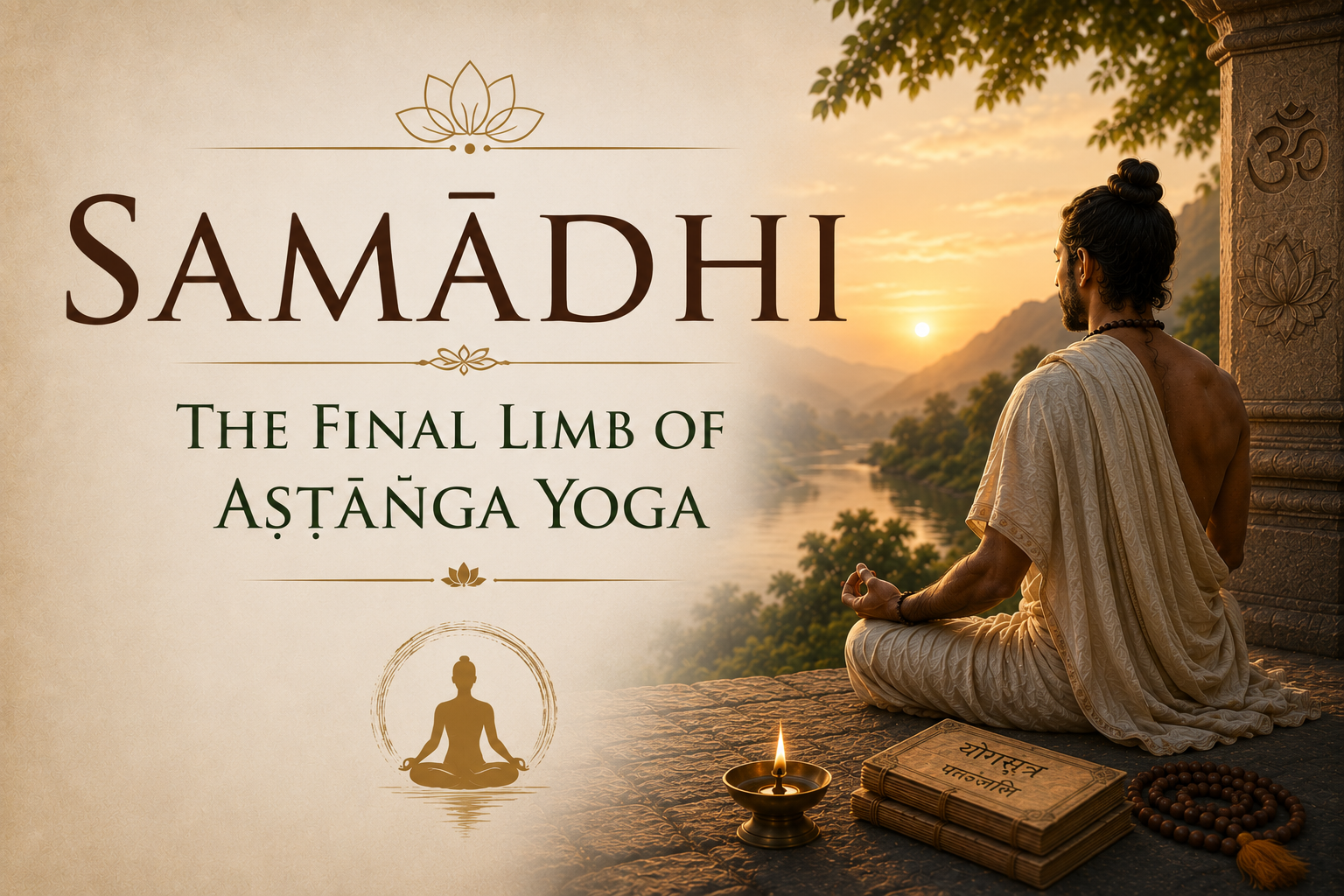
Samādhi — The Eighth and Final Limb of Aṣṭāṅga Yoga

Introduction
Samādhi is the eighth and final limb (aṅga) of Patañjali's eightfold yoga (YS 2.29). It is regarded as the culminating state of yogic practice, in which the practitioner experiences profound stillness and, ultimately, the isolation of pure consciousness from all that is not itself. It's worth being precise about what this state actually is according to Patañjali's own system — a system built on classical Sāṅkhya philosophy, which differs in important ways from the non-dual frameworks many readers associate with "spiritual union."
The Meaning of the Word
The popular gloss "Samādhi = Sama (balance) + Dhī (intellect)" is a common teaching device, but it isn't linguistically accurate. Samādhi actually derives from the verbal root √dhā ("to place, to hold, to put") combined with the prefixes sam- ("together") and ā- ("toward"): literally, "placing together" or "complete absorption." So the more precise sense of the word is total, unbroken absorption of the mind in its object — not, etymologically, "balanced intellect," though that phrase does capture something of the experience even if it misstates the derivation.
What Samādhi Actually Is (According to Patañjali)
Rather than one uniform bliss-state, Patañjali's text distinguishes different stages of samādhi. In the Samādhi Pāda, he describes:
- Samprajñāta samādhi (YS 1.17) — absorption still accompanied by an object of cognition (with further sub-stages: reasoning, reflection, joy, and pure I-am-ness)
- Asamprajñāta samādhi (YS 1.18) — a deeper absorption where even that object falls away, leaving only latent impressions
This structure matters because it shows samādhi in Patañjali's system is a graded path, not a single switch that flips on.

A Crucial Clarification: What Samādhi Is Not, in This System
It's common in popular yoga writing to describe samādhi as "the individual consciousness merging with universal consciousness." This is actually Vedāntic language, describing non-dual union with Brahman — and it does not accurately describe Patañjali's own system.
Patañjali's Yoga is built on classical Sāṅkhya metaphysics, which is explicitly dualistic: reality consists of puruṣa (pure consciousness — and there are, importantly, many distinct puruṣas, not one universal one) and prakṛti (matter/nature, including mind, thought, and ego). In this framework, the goal of samādhi is not "merging into" anything. It is the progressive isolation of puruṣa from its false identification with prakṛti — recognizing, with total clarity, that consciousness was never actually mixed with matter in the first place. Nothing merges; something is finally seen clearly as separate.
This is a genuinely different claim than Vedāntic union, and conflating the two blurs two distinct philosophical systems that historically developed different — sometimes competing — answers to the nature of liberation.
Dhāraṇā, Dhyāna, and Samādhi — Together as Saṃyama
The final three limbs of Aṣṭāṅga Yoga:
- Dhāraṇā (concentration)
- Dhyāna (meditation)
- Samādhi (absorption)
together are called saṃyama, defined explicitly in YS 3.4: trayam ekatra saṃyamaḥ — "the three [practiced] together, [applied] to one object, is saṃyama."
According to the Vibhūti Pāda, sustained practice of saṃyama refines the practitioner's consciousness to a high degree, and the text goes on to describe a range of extraordinary capacities (siddhis) said to arise from it. Patañjali himself, notably, treats these as noteworthy but ultimately as obstacles to samādhi if the practitioner becomes attached to them (YS 3.37) — worth keeping in mind before treating siddhis as the goal.

The Final Aim: Kaivalya
The ultimate goal of the complete Aṣṭāṅga path, in Patañjali's own terms, is kaivalya (YS 4.34) — literally "aloneness" or "isolation": the state in which puruṣa, having disentangled itself from prakṛti, abides in its own true nature.
Kaivalya is often translated loosely as "liberation" or equated with the Vedāntic mokṣa, and there's real overlap in the experiential territory both traditions point toward — freedom from suffering, from mental bondage, from misidentification. But technically, these are terms from two different philosophical systems, and it's more accurate to name them separately than to treat them as one and the same doctrine.
The Wholeness of Aṣṭāṅga Yoga
The eight limbs of Aṣṭāṅga Yoga are interconnected:
- Yama
- Niyama
- Āsana
- Prāṇāyāma
- Pratyāhāra
- Dhāraṇā
- Dhyāna
- Samādhi
Neglecting any one limb leaves the practice incomplete. Yoga is not limited to āsana, prāṇāyāma, or meditation alone — the practitioner is meant to develop conduct, thought, body, breath, the senses, the mind, and consciousness together.
(A commonly used teaching image compares this to a four-legged chair — if one leg is missing, the whole thing loses balance. This is a helpful illustrative metaphor for teaching purposes, not a classical textual analogy, but it captures the point well.)
My Practical Reflection
(This section is personal contemplation, not classical doctrine.) I find it genuinely clarifying — not diminishing — to know that Patañjali's samādhi isn't about dissolving into some cosmic oneness. There's something almost more rigorous about the idea that liberation is clarity about what was always separate, rather than achieving a union that wasn't there before. It changes what the practice is actually pointing toward: not addition, but subtraction of misidentification.
Key Points
- Samādhi is the eighth and final limb of Aṣṭāṅga Yoga (YS 2.29).
- Its etymology is sam + ā + √dhā ("complete absorption"), not "sam + dhī."
- Patañjali describes graded types of samādhi (samprajñāta/asamprajñāta, YS 1.17–18), not one uniform state.
- Dhāraṇā, dhyāna, and samādhi together constitute saṃyama (YS 3.4).
- Samādhi in Patañjali's dualistic Sāṅkhya-based system is the isolation of puruṣa from prakṛti — not a merger with universal consciousness (that is Vedāntic language, a different system).
- The final goal is kaivalya (YS 4.34) — technically distinct from, though experientially related to, the Vedāntic mokṣa.
- All eight limbs function as an interconnected whole.