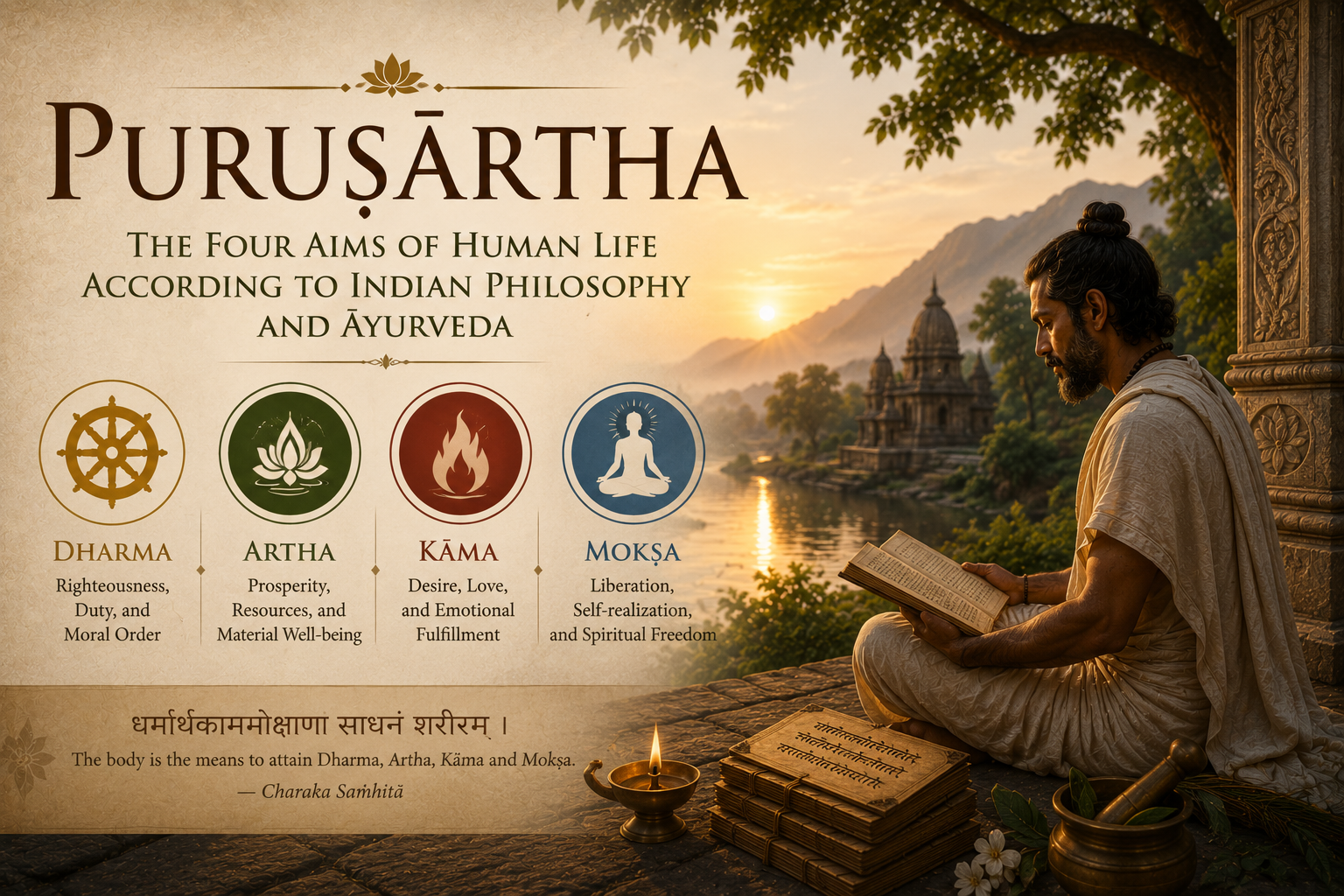
Puruṣārtha: The Four Aims of Human Life According to Indian Philosophy and Āyurveda
Introduction
What is a human being actually working towards?
Indian philosophy answers this question through the concept of Puruṣārtha — the four fundamental aims that give direction, meaning, and structure to human life.
Puruṣārtha does not describe four disconnected goals to be pursued one after another. It describes four dimensions of a single, well-lived life — ethical, material, emotional, and spiritual — that Āyurveda and Indian philosophy see as interdependent.
The Meaning of the Word Puruṣārtha
Puruṣārtha = Puruṣa + Artha
- Puruṣa — a word that is often narrowly translated as "man," but in classical Indian philosophy it more accurately means the human being, the individual self, or, in several darśanas (especially Sāṅkhya), pure consciousness itself, distinct from matter (Prakṛti).
- Artha — aim, purpose, or goal.
So Puruṣārtha means: the aims that give purpose to human existence — the goals worth pursuing, and the path of self-development that runs through them.

Why Puruṣārtha Matters
The four Puruṣārthas:
- Give direction to a human life.
- Help in making decisions — practical and moral.
- Teach a person to live a balanced life.
- Create harmony between material and spiritual existence.
- Ultimately point towards Self-realisation.
Health as Understood in Āyurveda
Āyurveda does not define health merely as the absence of disease.
The Suśruta Saṃhitā (Sūtrasthāna, Chapter 15) offers a classical, often-quoted definition of a healthy person:
समदोषः समाग्निश्च समधातुमलक्रियः। प्रसन्नात्मेन्द्रियमनः स्वस्थ इत्यभिधीयते॥
"One whose doṣas are in balance, whose digestive fire (agni) is balanced, whose tissues (dhātus) and processes of waste elimination (mala-kriyā) are in order, and whose self, senses, and mind remain in a state of contentment — that person is called svastha (healthy)."
Note on the citation: different printed editions of the Suśruta Saṃhitā number this verse slightly differently (it appears variously cited as 15.38, 15.41, or 15.48 depending on the edition and commentary). The verse itself and its content, however, are consistently attributed to the Sūtrasthāna's fifteenth chapter, and this discrepancy is worth knowing rather than papering over.
The Markers of a Healthy Person (Svastha)
According to this definition, health rests on seven markers:
- Balanced doṣas (Vāta, Pitta, Kapha)
- Balanced Agni (digestive and metabolic fire)
- Balanced Dhātus (bodily tissues)
- Normal elimination of Malas (waste products)
- A contented Ātman (self)
- Contented Indriyas (senses)
- A contented mind (Manas)
This is Āyurveda's real definition of health — not simply the absence of disease, but a state of physiological, sensory, and mental equilibrium.

The Four Aims of Puruṣārtha
- Dharma — righteous duty
- Artha — material wealth and security
- Kāma — desire, pleasure, and aesthetic joy
- Mokṣa — liberation
1. Dharma
Meaning
Dharma is often reduced to "religious ritual" in casual usage, but its real meaning is far broader:
- Duty
- Ethics and moral conduct
- Truthfulness
- Righteous living
- A just and fair life
The Purpose of Dharma
- Living rightly
- Contributing to the welfare of society
- Self-discipline
- Upholding truth
- Compassion
- Integrity
The Core Qualities of Dharma
- Satya (truthfulness)
- Ahiṃsā (non-violence)
- Karuṇā (compassion)
- Sevā (service)
- A sense of duty
- Justice
2. Artha
Meaning
Artha refers to:
- Wealth
- Resources
- Security
- Prosperity
- The material means of living
The Purpose of Artha
- Supporting one's family
- Education
- Health and wellbeing
- Social responsibility
- Economic stability
The Āyurvedic View
Āyurveda does not ask a person to renounce Artha. What matters is that wealth is earned through Dharma and used wisely — acquisition and use both aligned with righteous conduct.
3. Kāma
Meaning
Kāma is commonly reduced to sexual desire, but this is a significant narrowing of the term. In its classical sense, Kāma includes:
- All legitimate desire
- Joy and pleasure
- Love
- Aesthetic sensibility
- Art
- Music
- Companionship and warmth
- Emotional fulfilment
The Purpose of Kāma
- Experiencing joy in life
- Love
- The experience of beauty
- Mental and emotional satisfaction
A Word of Caution
When Kāma is unmoored from Dharma, it can give rise to:
- Greed
- Craving
- Addiction
- Overindulgence
- Attachment
This is why classical thought places Kāma under the governance of Dharma — pleasure pursued within an ethical framework, not pleasure as an end unrestrained by anything else.

4. Mokṣa
Meaning
Mokṣa is regarded as the highest of the four Puruṣārthas.
What Mokṣa Means
- Self-knowledge
- Self-realisation
- Freedom from the cycle of birth and death
- The dissolution of ignorance (Avidyā)
- Ultimate freedom
How Mokṣa Is Approached
Indian philosophy holds that Dharma, Artha, and Kāma are not merely stepping stones abandoned once "completed." Rather, when these three are established and balanced together in a person's life, the seeker naturally moves towards Mokṣa as the culminating aim.
How the Four Puruṣārthas Relate to Each Other
A note of caution is needed here, because a common misreading treats the four Puruṣārthas as a strict, one-after-another staircase — first Dharma, then Artha, then Kāma, and only at the very end, Mokṣa.
That is not the classical position.
The four Puruṣārthas are pursued together, throughout life — not in mechanical sequence. What the tradition does insist on is a hierarchy of governance, not a hierarchy of timing:
- Dharma regulates and governs how Artha and Kāma are pursued.
- Mokṣa remains the final, overarching spiritual aim towards which a well-ordered life — one where Dharma, Artha, and Kāma are held in balance — naturally inclines.
So the relationship is less a ladder and more concentric: Dharma as the boundary within which Artha and Kāma operate, and Mokṣa as the horizon toward which the whole of it moves.
Āyurveda and Puruṣārtha
Āyurveda's purpose is not limited to curing disease.
Its deeper aim is to provide a state of health that allows a person to:
- Live according to Dharma
- Earn and sustain Artha
- Experience Kāma in a balanced, wholesome way
- And ultimately move towards Mokṣa
In this sense, health is not incidental to the Puruṣārthas — it is their foundation. A body and mind in a state of imbalance make all four aims harder to pursue.
Puruṣārtha and Yoga
Yoga guides a person towards:
- Purification of the mind
- Steadiness of the intellect (Buddhi)
- Mastery over the senses (Indriya-nigraha)
- Self-knowledge
In this way, Yoga functions as one of the principal means by which the Puruṣārthas — particularly Mokṣa — are realised.
The Practical Significance of Puruṣārtha
- An ethical life
- Balanced economic development
- Healthy relationships
- Mental equilibrium
- Spiritual growth
- Overall life satisfaction
Key Points for Study and Recall
- Puruṣārtha = Puruṣa + Artha
- The four Puruṣārthas are Dharma, Artha, Kāma, and Mokṣa
- Mokṣa is regarded as the highest Puruṣārtha
- Āyurveda's classical definition of health comes from the Suśruta Saṃhitā's line beginning "Samadoṣaḥ samāgniśca..." (Sūtrasthāna, Chapter 15 — exact verse numbering varies by edition)
- Dharma is the ethical foundation of life
- Artha must be earned and used in keeping with Dharma
- Kāma must remain governed by Dharma
- Mokṣa is the goal of Self-realisation and freedom from the cycle of birth and death
- The four Puruṣārthas are pursued together in life, not in a rigid sequence; Dharma governs the other three, and Mokṣa is the final aim they all point towards
Editorial Notes: Corrections and Clarifications
A few clarifications are worth stating plainly, since they are commonly misunderstood even in otherwise good teaching material:
-
"Puruṣa" does not mean "man" in the gendered sense. In Indian philosophy, Puruṣa refers to the human being, the individual self, or — in several schools of thought, most notably Sāṅkhya — pure consciousness itself, as distinct from Prakṛti (matter/nature).
-
The Puruṣārthas are not a strict sequence. The idea that one must "complete" Dharma before moving to Artha, then Kāma, and only then aspire to Mokṣa, is a simplification. Classical thought holds that all four are cultivated concurrently, with Dharma acting as the governing principle for Artha and Kāma, and Mokṣa remaining the final spiritual horizon.
-
Kāma is not synonymous with sexual desire. Classically, it encompasses all legitimate desire — for beauty, art, music, companionship, and emotional fulfilment — not merely the physical.
-
The Suśruta Saṃhitā verse-numbering varies by edition. Rather than asserting a single verse number as definitive, it is more accurate to cite the source as Sūtrasthāna, Chapter 15, while noting that different published editions number the exact verse differently.
Conclusion
Puruṣārtha is not a checklist to be worked through — it is a framework for living a complete human life: ethically grounded (Dharma), materially secure (Artha), emotionally and aesthetically fulfilled (Kāma), and ultimately, spiritually free (Mokṣa).
Āyurveda's contribution to this vision is foundational rather than incidental: a body and mind in balance are what make the pursuit of all four aims possible in the first place.
To live well, in the classical Indian view, is to hold all four of these aims in balanced, simultaneous practice — not to chase them one at a time.