Pratyahara: The Fifth Limb of Ashtanga Yoga
Introduction
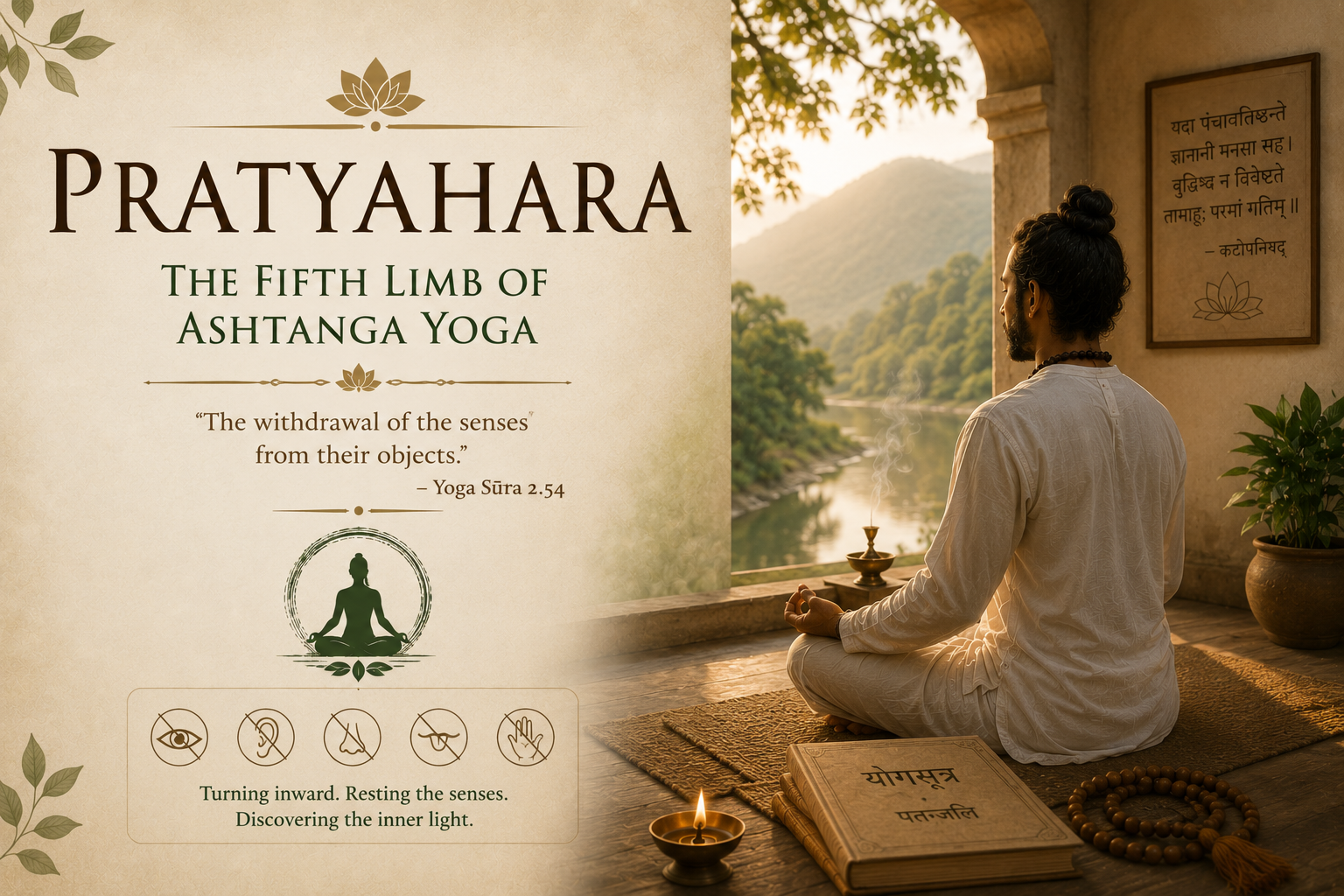
Pratyāhāra is the fifth limb of Ashtanga Yoga. It is often called the bridge of Ashtanga Yoga, because it is the transition point between the external practices (Bahiraṅga Yoga) and the internal practices (Antaraṅga Yoga). Pratyāhāra's central purpose is to draw the senses away from external objects and turn them inward.

The Meaning of Pratyāhāra
Pratyāhāra = Prati + Āhāra
- Prati — back, in the opposite direction
- Āhāra — to take in, or the intake of objects by the senses
So: turning the senses away from external objects and directing them inward is Pratyāhāra.
Maharṣi Patañjali defines it precisely in Yoga Sūtra 2.54:
"Svaviṣayāsaṃprayoge cittasvarūpānukāra ivendriyāṇāṃ pratyāhāraḥ."
Meaning: when the senses disengage from their respective objects, and, as it were, take on the very nature of the mind itself, that is Pratyāhāra.
Vyāsa's commentary offers a well-known image for this: just as bees follow wherever the queen bee goes and settle wherever she settles, the senses follow the mind — when the mind becomes still, the senses too cease their outward activity.

The Purpose of Pratyāhāra
A person's five sense organs (Jñānendriyas) are constantly drawn toward the outer world:
- Eyes — seeing
- Ears — hearing
- Nose — smelling
- Tongue — tasting
- Skin — touching
The purpose of Pratyāhāra is to gain mastery over these senses, drawing the mind away from external attractions and turning it toward inner consciousness.
The Importance of Pratyāhāra
- Control over the senses develops.
- The mind begins to free itself from external distractions.
- Self-awareness increases.
- The mind is prepared for meditation.
- The practitioner moves closer to their true nature.

Pratyāhāra and Yoga Nidrā
Yoga Nidrā is often taught, in contemporary Yoga traditions, as an effective way to cultivate the state of Pratyāhāra.
During Yoga Nidrā:
- The body remains in a state of rest.
- The senses begin withdrawing from external objects.
- The mind becomes centred inward.
- The practitioner experiences their inner consciousness.
It's worth being precise about this connection: Yoga Nidrā, as a named and systematised technique, is a modern development — most closely associated with Swami Satyananda Saraswati and the Bihar School of Yoga in the 20th century — rather than a practice described by that name in Patañjali's Yoga Sūtras themselves. That said, the state it aims to cultivate — sense-withdrawal alongside inner wakefulness — aligns meaningfully with the classical understanding of Pratyāhāra, which is why the connection is widely and reasonably drawn in modern teaching. The two are complementary, not identical.
Pratyāhāra and Ashtanga Yoga
Pratyāhāra connects the practice of the first four limbs —
- Yama
- Niyama
- Āsana
- Prāṇāyāma
— to the internal practices that follow. After Pratyāhāra, a practitioner moves more naturally toward the next three limbs:
- Dhāraṇā
- Dhyāna
- Samādhi
This is precisely why the Yoga Sūtras' own classification groups the first five limbs (Yama through Pratyāhāra) as Bahiraṅga Yoga (external practice), and the final three (Dhāraṇā, Dhyāna, Samādhi) as Antaraṅga Yoga (internal practice, together called Saṃyama) — with Pratyāhāra sitting at the hinge between the two.
The Benefits of Pratyāhāra
- Control over the senses develops.
- Mental restlessness decreases.
- Concentration improves.
- The mind is prepared for meditation.
- Inner peace and self-awareness develop.
- The influence of external circumstances on the mind lessens.
Key Points
- Pratyāhāra is the fifth limb of Ashtanga Yoga.
- It is the bridge between external (Bahiraṅga) and internal (Antaraṅga) Yoga.
- Pratyāhāra means turning the senses away from external objects and directing them inward (Yoga Sūtra 2.54).
- Its purpose is to free the mind from external attractions.
- Yoga Nidrā is a widely taught modern practice associated with cultivating the state of Pratyāhāra, though it is a later systematisation rather than a Sūtra-era technique by that name.
- After Pratyāhāra, a practitioner is prepared for Dhāraṇā, Dhyāna, and Samādhi.
- Regular practice develops sensory control, mental steadiness, and self-awareness.
Editorial Notes: Corrections and Clarifications
-
The original draft did not cite Patañjali's actual definition of Pratyāhāra. Yoga Sūtra 2.54 gives a precise definition — the senses disengaging from their objects and taking on the nature of the mind — which has been added here along with Vyāsa's well-known "bees following the queen bee" illustration, for scriptural precision.
-
The connection between Pratyāhāra and Yoga Nidrā has been clarified. The original draft presented this connection without qualification. Yoga Nidrā as a named, systematised practice is a 20th-century development, most associated with Swami Satyananda Saraswati. The underlying state it cultivates does meaningfully align with classical Pratyāhāra, so the teaching connection is reasonable — but it is worth knowing that the specific practice and the Sūtra-era limb are not the same thing.
-
The Bahiraṅga/Antaraṅga classification has been made explicit, consistent with the same classical structure discussed in the broader Ashtanga Yoga overview — Pratyāhāra completes the five external limbs before the three internal limbs (Saṃyama) begin.
-
A note on scientific context (per your standing request to check facts against both scripture and science): the general concept behind Pratyāhāra — deliberately reducing sensory input to support attention and inner focus — has some correspondence with contemporary research on sensory deprivation, attentional control, and the physiological relaxation response associated with practices like guided body-scan relaxation (which Yoga Nidrā closely resembles). These findings support the general plausibility of reduced sensory engagement aiding calm and focus, but they do not constitute scientific confirmation of the deeper spiritual claim that Pratyāhāra leads the practitioner toward their "true nature" or Self — that remains a claim of a different kind.
Conclusion
Pratyāhāra is the quiet hinge of the entire eightfold path — the point where outward discipline of body, breath, and conduct turns inward toward the deeper work of concentration and meditation. By deliberately withdrawing the senses from their habitual pull toward the external world, a practitioner does not shut down awareness — they redirect it, laying the essential groundwork for Dhāraṇā, Dhyāna, and ultimately Samādhi.
Want to go deeper into authentic Yoga practice with Iti Iti Yogashram?
Get in Touch