Prāṇāyāma: The Fourth Limb of Aṣṭāṅga Yoga (Patañjali vs. Haṭha Yoga Techniques)
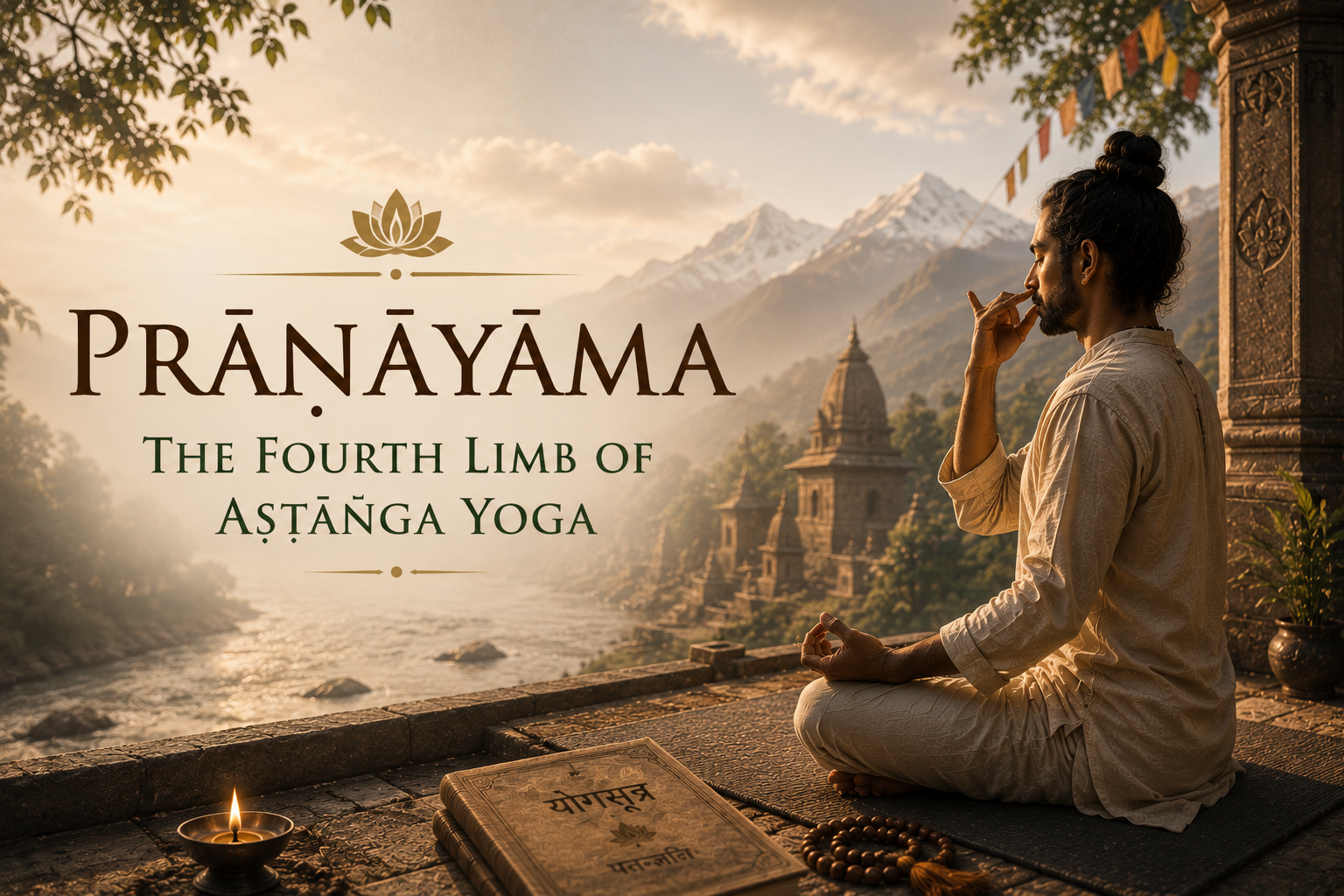
Prāṇāyāma — The Fourth Limb of Aṣṭāṅga Yoga
Introduction
Prāṇāyāma is the fourth limb (aṅga) of Patañjali's eightfold yoga, named directly in the Yoga Sūtra as following āsana in the sequence of practice (YS 2.29). It is far more than "breathing exercises" — it is a deliberate, structured discipline for regulating prāṇa, the vital force, using the breath as its instrument. In yogic philosophy, breath is understood as the visible bridge connecting the body, the mind, and consciousness itself.
The Meaning of the Word
Prāṇāyāma = Prāṇa + Āyāma
- Prāṇa — vital/life force, not merely "oxygen" or physical breath
- Āyāma — extension, regulation, and restraint
So prāṇāyāma is the conscious extension and regulation of the breath and, through it, of the life force itself.
Patañjali's own definition (YS 2.49) is notably technical: prāṇāyāma is described as the cessation of the natural movement of inhalation and exhalation (śvāsa-praśvāsayoḥ gati-vicchedaḥ) once āsana is steady. He then classifies its movements (YS 2.50) into external (bāhya), internal (ābhyantara), and retained (stambha-vṛtti) breath, each further regulated by place, time, and number (deśa-kāla-saṅkhyā), becoming progressively long and subtle (dīrgha-sūkṣma).

Why It Matters
Yogic philosophy holds that the quality of one's breath reflects — and shapes — the quality of one's mind:
- A calm breath tends to accompany a calm mind.
- An erratic breath tends to accompany an unsteady mind.
- Learning to regulate breath is, practically, a first step toward regulating the mind.
This is why prāṇāyāma is traditionally regarded as the essential bridge between the outer, physical practice of āsana and the inner, mental practice of concentration and meditation.
Vyāsa's Commentary: What the Bhāṣya Adds
Vyāsa's Yoga Bhāṣya on these sūtras adds a layer Patañjali's terse sūtras don't spell out on their own: mastering prāṇāyāma thins the veil of impurity (āvaraṇa) covering the light of discernment (prakāśa), making the mind fit for concentration (dhāraṇā-yogyatā). Classically, prāṇāyāma is not primarily framed as a wellness tool — its stated purpose in the tradition is to prepare the mind for meditative absorption, later in the eight limbs.
Named Techniques — Where They Actually Come From
It's worth being precise here: the following well-known techniques are not named in Patañjali's Yoga Sūtras. They belong to the later Haṭha Yoga tradition (roughly 9th–15th century CE texts such as the Haṭhapradīpikā and Gheraṇḍa Saṃhitā), which built an elaborate technical vocabulary on top of Patañjali's more abstract framework:
- Nāḍī Śodhana (alternate-nostril breathing)
- Bhrāmarī (humming-bee breath)
- Bhastrikā (bellows breath)
- Sūrya Bhedana (right-nostril/"solar" breath)
- Candra Bhedana (left-nostril/"lunar" breath)
- Ujjāyī (victorious/ocean breath)
- Kapālabhāti — classified in the Haṭhapradīpikā as one of the six ṣaṭkarmas (cleansing actions), though commonly taught alongside prāṇāyāma today
Breath and Emotion
Across yogic and contemplative literature, emotional states are consistently linked to breath patterns:
- Anger tends to quicken and roughen the breath.
- Fear tends to make breath shallow and irregular.
- Calm, meditative states are associated with breath that is slow and deep.
The practical implication yoga draws from this is that consciously regulating the breath can, in turn, help steady emotional and mental states — a plausible and widely practiced application, though best understood as a skill developed with practice rather than an instant fix.
What Current Research Actually Supports
Modern research on slow, controlled breathing practices shows reasonably consistent evidence for:
- Increased heart rate variability (HRV), a marker of autonomic nervous system balance
- Activation of the parasympathetic ("rest and digest") response, reducing physiological stress markers
- Subjective reduction in anxiety and improved perceived sleep quality in several controlled studies
Evidence is more limited and mixed for stronger claims such as direct immune-system enhancement or metabolic disease reversal — these remain areas of ongoing research, not settled science.
Prāṇāyāma Within Aṣṭāṅga Yoga
Prāṇāyāma is not a standalone technique — it functions within the architecture of Patañjali's eight limbs:
- Āsana prepares and steadies the body.
- Prāṇāyāma regulates and steadies prāṇa.
- Dhāraṇā/Dhyāna (concentration/meditation) steadies the mind.
Together, this progression is what the tradition considers the path toward inner steadiness and, ultimately, deeper states of absorption.
My Practical Reflection
(This section is personal contemplation, not classical doctrine.) In my own practice, I've found that prāṇāyāma is the limb most likely to be rushed — practitioners often move straight to advanced retention practices before their nervous system or breath awareness is ready. The texts themselves counsel gradualness (deśa-kāla-saṅkhyā — regulated by place, time, count) — I take this as a caution against forcing depth or duration before it's earned through steady, patient practice.

Key Points
- Prāṇāyāma is the fourth limb of Aṣṭāṅga Yoga (YS 2.29).
- Prāṇāyāma = Prāṇa (life force) + Āyāma (regulation/extension).
- Patañjali defines it structurally (YS 2.49–53); he does not name specific techniques.
- Named techniques (Nāḍī Śodhana, Bhrāmarī, Bhastrikā, etc.) come from the later Haṭha Yoga tradition, not the Yoga Sūtra itself.
- Vyāsa's commentary frames prāṇāyāma's purpose as preparing the mind for meditation.
- Research supports breath regulation's effect on the autonomic nervous system and stress markers; stronger claims remain preliminary.
- Prāṇāyāma bridges āsana (body) and dhyāna (mind) within the eightfold path.