Parvatāsana (Seated Mountain Pose): Classical Sources, Anatomy, Alignment & Evidence-Based Guide
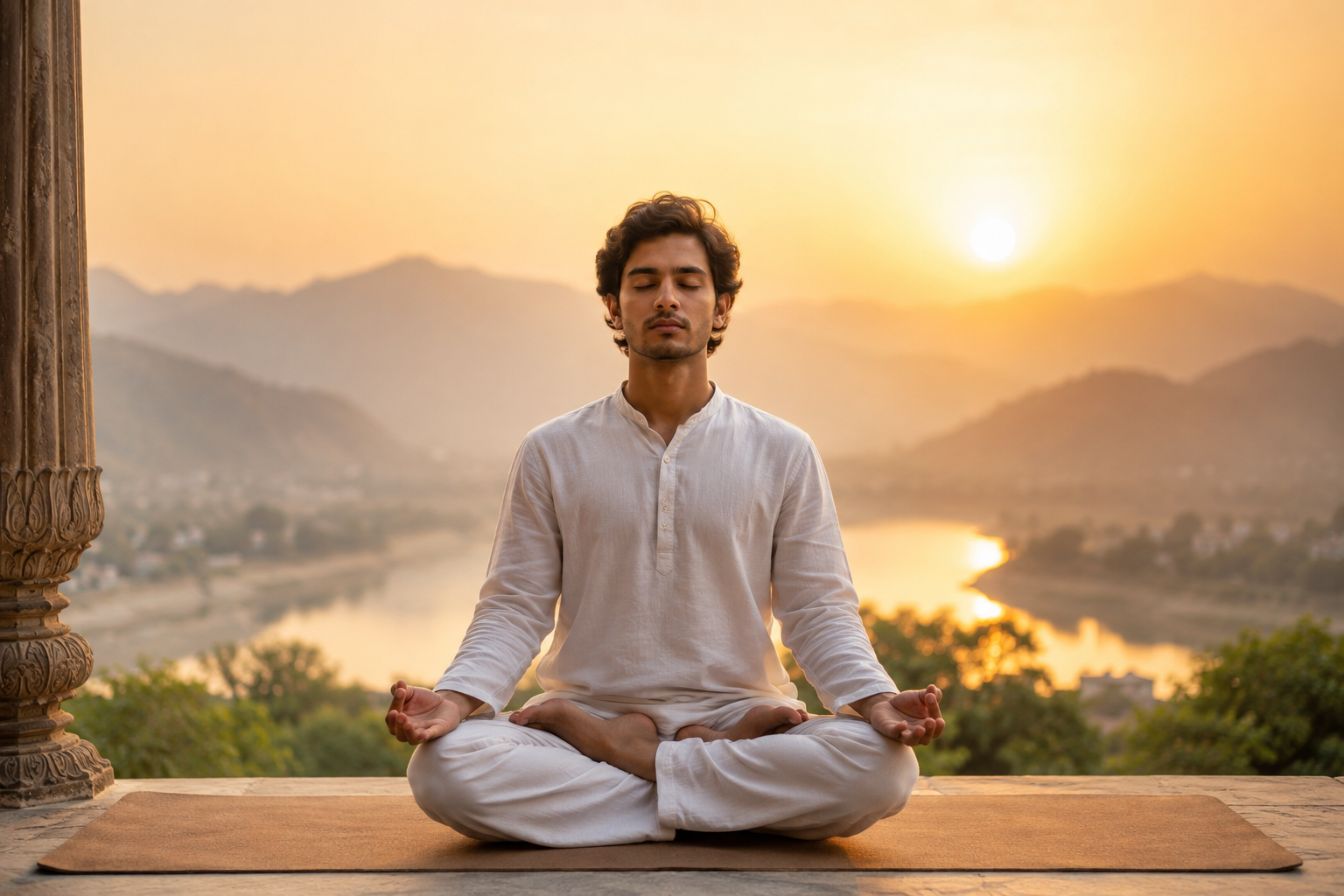
Parvatāsana (Seated Mountain Pose): The Complete Reference Guide
Editorial note, stated once: throughout this article, traditional yogic and Āyurvedic claims (chakra, prāṇa, dosha associations) are presented as traditional belief, not scientific fact, unless a specific evidence source is cited alongside them.
Name & Meaning
- Sanskrit: पर्वतासन (Parvatāsana)
- IAST Transliteration: Parvatāsana
- English: Seated Mountain Pose / Mountain Pose in Lotus
- Etymology: Parvata (mountain) + Āsana (posture / seat). "The posture where the seated body forms the majestic, immovable, and towering peak of a mountain."
Introduction
- Parvatāsana is an elegant, highly effective seated posture that merges the grounded stability of a cross-legged base (typically Padmāsana or Siddhāsana) with dynamic overhead axial spinal extension.
- Characterized by interlocking the fingers, inverting the palms toward the sky, and fully extending the arms overhead alongside the ears while keeping the pelvis firmly rooted to the earth.
- While the name "Parvatāsana" is used in some dynamic traditions (like the Bihar School of Yoga) to denote the inverted V-shape stance in Sūryanamaskāra, in classical postural systems—most notably Iyengar Yoga—Seated Parvatāsana refers specifically to this overhead spinal-lengthening posture.
- Functions as a premier diagnostic and therapeutic posture for expanding ribcage mobility, correcting thoracic kyphosis, lengthening shortened latissimus dorsi muscles, and encouraging diaphragmatic breathing.
Benefits
- Physical: Lengthens the latissimus dorsi, intercostals, serratus anterior, and abdominal wall; strengthens upper trapezius, triceps, and erector spinae; mobilizes the glenohumeral and thoracic intervertebral joints.
- Chest Expansion & Respiratory Capacity: Lifting the ribcage vertically pulls the intercostal muscles taut, expanding thoracic volume and facilitating uninhibited diaphragmatic excursion.
- Postural Correction: Directly counteracts desk-bound slouched posture (rounded shoulders, collapsed chest, thoracic hyperkyphosis) by reinforcing axial extension.
- Mental & Neurological: Combining grounded pelvic stability with upward energetic expansion creates a state of balanced alertness, dispelling mental lethargy.
- Traditional/Spiritual: Believed in traditional Haṭha Yoga to awaken Anāhata (heart) and Viśuddha (throat) chakras, while drawing Prāṇa Vāyu upward along the central Suṣumnā Nāḍī—traditional belief, not a scientific claim.
How to Practice Parvatāsana: Step-by-Step
| Step | Action | Breath | Teacher Cue |
|---|---|---|---|
| 1 | Sit in Padmāsana (Lotus Pose), Siddhāsana, or Sukhāsana (Easy Pose) on a firm mat with spine upright. | Natural breath | "Root your sit-bones and knees firmly into the earth." |
| 2 | Interlock fingers cleanly up to the webbing in front of the chest. Turn palms facing outward away from body. | Exhale to interlock fingers | "Interlock your fingers firmly right to the knuckles." |
| 3 | Inhale deeply, sweep both arms overhead, extending wrists and palms fully toward the ceiling. | Inhale to reach up | "Lift your side waists high as palms press toward the sky." |
| 4 | Lock elbows straight, align biceps alongside ears, and draw lower ribs gently inward to avoid lumbar arching. | Exhale to settle ribs | "Straighten elbows completely without letting your ribs flare." |
| 5 | Draw shoulder blades down the back while extending up through palm centers. Gaze softly forward at eye level. Hold for 5 to 8 deep breaths. | Deep diaphragmatic breathing | "Reach up through your palms while anchoring your hips down." |
| 6 | Exhale, lower arms down to chest height, release interlock. Change the interlock of fingers (opposite pinky finger on bottom) and repeat. | Exhale to release | "Lower arms with control and change finger interlock." |
Common Mistakes & Corrections
- Scrunching shoulders into ears (shoulder shrugging): Over-activating upper trapezius while reaching arms overhead compresses the cervical spine → Correction: Draw scapulae down the back toward hips, keeping sides of neck broad and relaxed.
- Bent or sagging elbows: Tight latissimus dorsi or shoulders cause elbows to buckle outward → Correction: Lock elbows straight by fully extending triceps; use a yoga belt around upper arms if needed.
- Flaring the lower ribs (swayback lumbar arch): Pushing lower ribcage forward to fake arm height creates lumbar compression → Correction: Draw front lower ribs in toward spine and engage transversus abdominis.
- Ungrounded knees or tilted pelvis: Lifting knees off floor while reaching up → Correction: Sit on a firm cushion so knees remain anchored flat.
Contraindications & Precautions
- Acute Rotator Cuff Tear or Shoulder Impingement: Reaching overhead with interlocked palms places high tension on supraspinatus tendons; practice with arms separate or at shoulder height.
- Severe Cervical Spine Pathology / Acute Disc Herniation: Avoid compressing neck muscles; keep head neutral facing forward.
- Acute Wrist Sprain or Carpal Tunnel Syndrome: Full wrist extension with interlocked fingers can aggravate flexor tendons; hold a strap between hands instead.
- Acute Knee Pathology: If sitting in Padmāsana causes knee pain, practice in Sukhāsana (Easy Pose) or sit upright on a chair.
Sequencing: Preparatory, Follow-up & Variations
- Preparatory Poses: Padmāsana / Sukhāsana (establishes seated base), Gomukhāsana arms (prepares shoulder rotation), Urdhva Hastāsana in Tāḍāsana.
- Placement in Sequence: Mid-to-late seated practice, ideal during Prāṇāyāma or seated upper body lengthening block.
- Follow-up Poses: Seated spinal twists (e.g., Ardha Matsyendrāsana), Paschimottānāsana (Seated Forward Bend), Shavāsana.
- Variations: Parvatāsana in Sukhāsana, Parvatāsana in Vajrāsana, Chair Parvatāsana, Reverse Interlock Parvatāsana.
In more detail: Parvatāsana provides an unparalleled vertical decompression stimulus for the upper torso. Positioning it after opening the hips in seated postures allows the practitioner to focus entirely on upper spinal axial extension. Following Parvatāsana with gentle seated twists capitalizes on the newly created intervertebral height, making spinal rotation safer and deeper.
Modifications
- Beginners / Tight Hips: Sit in Sukhāsana (Easy Pose cross-legged) or sit on a firm yoga block/cushion to elevate pelvis.
- Tight Shoulders / Wrist Pain: Hold a yoga strap shoulder-width apart between palms instead of interlocking fingers.
- Cannot Lock Elbows: Place a loop strap around upper arms just above elbows to prevent arms from splaying outward.
- Seniors / Desk Workers: Practice seated in a sturdy chair with feet flat on the floor, reaching arms overhead with fingers interlocked.
Historical Background & Classical References
- Modern Postural Tradition: Seated Parvatāsana is prominently featured and popularized in 20th-century postural yoga traditions, most notably B.K.S. Iyengar's Light on Yoga (1966, Plate 122).
- Terminology Distinctions in Classical Texts: The word Parvatāsana appears in modern dynamic Hatha texts (e.g., Bihar School of Yoga) to denote the inverted V stance in Sun Salutations. However, medieval texts like the Haṭhayogapradīpikā do not list Parvatāsana among their primary 15 postures.
- Iyengar Systematization: Iyengar systematized Parvatāsana in Padmāsana as an essential posture for un-collapsing the chest and teaching vertical axial extension.
Alignment Principles (Iyengar Method)
- Base Anchoring: Sit-bones and outer knees firmly rooted to floor, establishing a solid triangular foundation.
- Palm Inversion & Finger Lock: Fingers interlocked deeply up to webbing; palms inverted fully to face ceiling.
- Elbow Locking: Triceps contracted strongly to lock elbow joints completely straight.
- Axial Rib Lift: Lateral ribcage and side waists pulled upward away from hip crests; lower ribs drawn softly inward.
Anatomy & Biomechanics
- Primary Stretched Muscles: Latissimus dorsi, pectoralis major/minor, intercostals, serratus anterior, wrist flexors.
- Primary Strengthening Muscles: Triceps brachii, anterior/medial deltoids, upper trapezius, serratus anterior (scapular upward rotation), erector spinae.
- Joint Mechanics: Glenohumeral elevation, abduction, and external rotation; scapular upward rotation and elevation; elbow extension; wrist extension; axial spinal extension.
- Scapulohumeral Rhythm: Elevating arms overhead requires smooth coordination between the humerus and scapula (2:1 ratio). Scapular upward rotation driven by serratus anterior and trapezius prevents subacromial impingement.
Nervous System & Breathing Effects
- Respiratory Volume Expansion: Vertical lift of ribcage stretches intercostal muscles, directly expanding thoracic volume and improving vital lung capacity.
- Sympathetic Alertness & Postural Renewal: Upright axial lengthening combined with chest opening dispels sleepiness, boosting alertness during long meditation sessions.
Yogic & Āyurvedic Perspective
- Dosha Impact: Strongly pacifies Kapha (relieves chest congestion, lethargy, and slouched depression) and grounds Vāta when rooted through heels/sit-bones—traditional belief.
- Prāṇa Dynamics: Stimulates Prāṇa Vāyu at the heart and chest center, encouraging upward energetic flow along Suṣumnā Nāḍī.
Therapeutic Applications
| Condition | Mechanism | Research / Precaution |
|---|---|---|
| Thoracic Kyphosis / Slouched Posture | Axial extension stretches shortened latissimus dorsi and strengthens upper spinal extensors | Supported by spinal biomechanical principles. Precaution: Keep lower ribs tucked. |
| Shallow Breathing & Asthma Management | Vertical ribcage lift stretches intercostals, enhancing diaphragmatic movement and lung volume | Supported by respiratory therapy principles. Precaution: Do not strain shoulders. |
Yoga is never a replacement for medical treatment; serious or persistent conditions require a qualified healthcare professional.
Teaching Cues & Hands-On Adjustments
- Verbal Cues: "Reach up through the centers of your palms like a towering mountain peak." / "Keep your lower ribs tucked in as your side waist grows tall." / "Anchor your sit-bones down while reaching your palms up."
- Hands-on Adjustment (Safe execution with consent):
- Stand behind student; place hands gently on upper outer arms (triceps), guiding elbows straight and arms inward alongside ears.
- Place hand lightly between shoulder blades to cue thoracic extension upward.
Myth vs. Fact
| Myth | Fact |
|---|---|
| You must be able to sit in Full Lotus Pose for Parvatāsana to be effective. | Parvatāsana can be practiced in Easy Pose, Vajrāsana, or on a chair while delivering identical shoulder and spinal benefits. |
| Parvatāsana is an ancient 2,000-year-old posture found in medieval Hatha manuals. | Seated Parvatāsana was popularized in the 20th century by B.K.S. Iyengar and modern postural yoga traditions. |
| Scrunching shoulders to ears is necessary to get max height. | Scrunching compresses cervical vertebrae; proper alignment draws shoulder blades down while palms reach up. |
Conclusion
Parvatāsana (Seated Mountain Pose) provides a simple yet profound method for counteracting sedentary upper body stiffness. By anchoring the pelvis in a stable seated position and extending the arms overhead with interlocked palms, practitioners create space between intervertebral discs, expand respiratory capacity, and cultivate enduring poise.
Quick Facts
| Category | Seated axial extension / posture |
| Difficulty Level | Beginner to Intermediate |
| Primary Muscles Stretched | Latissimus Dorsi, Intercostals, Pectoralis Major, Wrist Flexors |
| Primary Muscles Strengthened | Triceps Brachii, Serratus Anterior, Erector Spinae |
| Classical Source? | No (Modern 20th century posture; popularized by B.K.S. Iyengar) |
| Traditional Chakra (Belief) | Anāhata (Heart) & Viśuddha (Throat) |
| Dosha Impact (Belief) | Pacifies Kapha & Vāta |
Frequently Asked Questions
What does Parvatāsana mean?
Parvata (mountain) + Āsana (seat) = Seated Mountain Pose.
How does Seated Parvatāsana differ from Tāḍāsana?
Tāḍāsana is a standing posture, whereas Seated Parvatāsana is practiced in a cross-legged position with fingers interlocked overhead.
Why shouldn't I arch my lower back in Parvatāsana?
Arching the lower back compresses lumbar vertebrae. Draw your front lower ribs in to keep the stretch focused in your upper back and shoulders.
What if I cannot straighten my elbows?
Tight shoulder muscles or latissimus dorsi restrict arm extension. Hold a yoga strap between your hands shoulder-width apart until shoulder mobility improves.
Why do I need to change the interlock of my fingers?
Interlocking fingers with the opposite pinky on the bottom balances neural pathways and shoulder joint loading across both sides.
Can desk workers practice Parvatāsana in a chair?
Yes! Chair Parvatāsana is an exceptional office stretch for relieving slouched shoulders and upper back fatigue.
References
1. Classical Yoga Texts: Modern postural posture; absent in medieval manuals (Haṭhayogapradīpikā, Gheraṇḍa Saṃhitā).
2. Modern Yoga Institutions: Iyengar, B.K.S. (1966). Light on Yoga. Schocken Books, pp. 132–134 (Plate 122). Bihar School of Yoga (Asana Pranayama Mudra Bandha).
3. Peer-Reviewed Scientific Research:
- Sherman, K. J., et al. (2011). A randomized trial comparing yoga, stretching, and a self-care book for chronic low back pain. Archives of Internal Medicine, 171(22), 2019-2026.
- Ni, M., et al. (2014). Comparative muscle activation patterns during yoga postures in elderly adults. BMC Complementary and Alternative Medicine, 14, 401.
This article is for educational purposes and does not replace individualized medical or physical therapy advice. Consult a qualified healthcare provider before beginning any new practice, especially with a pre-existing health condition.