Pārśvottānāsana (Intense Side Stretch / Pyramid Pose): Classical Sources, Anatomy, Alignment & Evidence-Based Guide
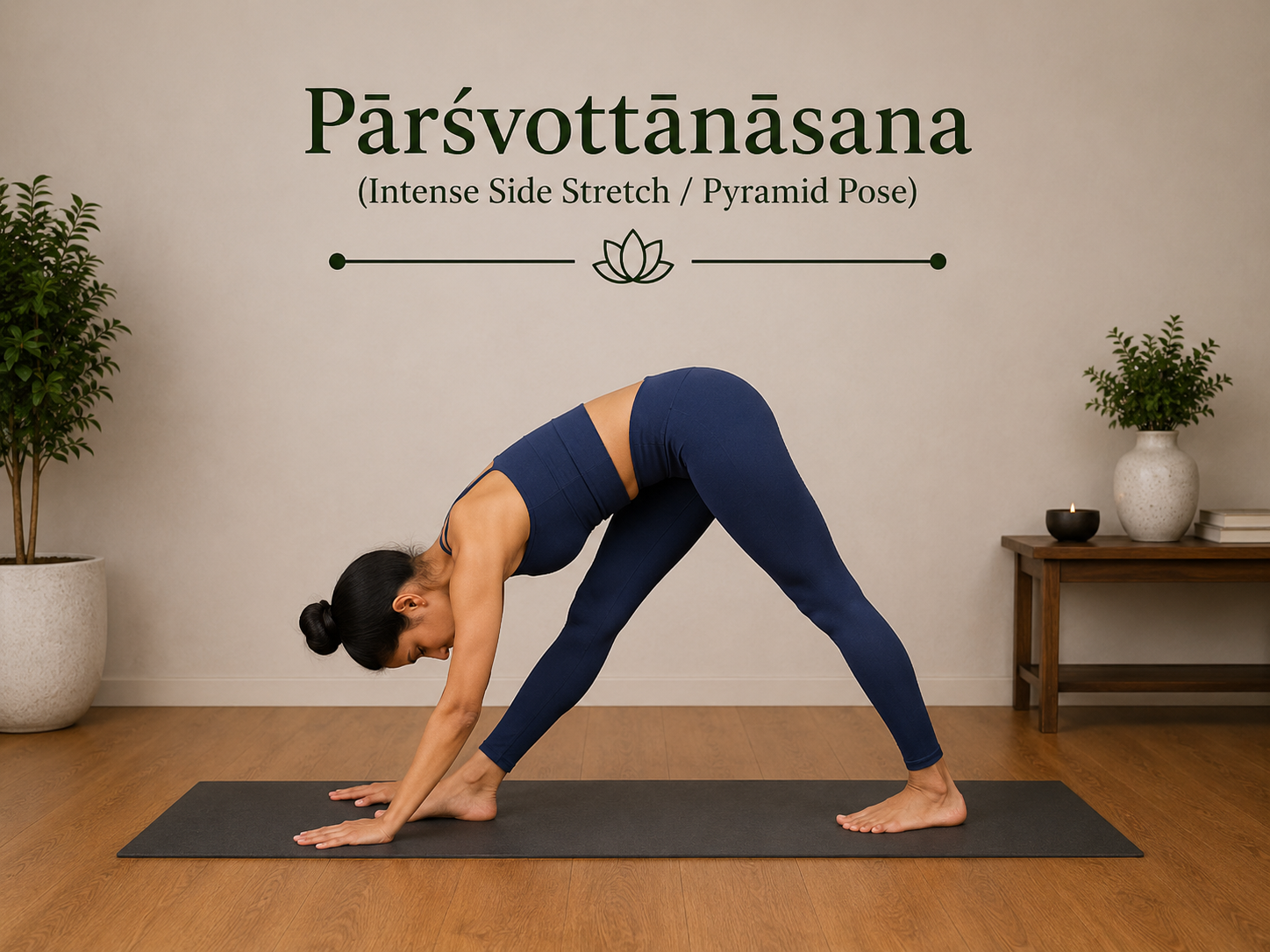
Pārśvottānāsana (Intense Side Stretch / Pyramid Pose): The Complete Reference Guide
Editorial note, stated once: throughout this article, traditional yogic and Āyurvedic claims (chakra, prāṇa, dosha associations) are presented as traditional belief, not scientific fact, unless a specific evidence source is cited alongside them.
Name & Meaning
- Sanskrit: पार्श्वोत्तानासन (Pārśvottānāsana)
- IAST Transliteration: Pārśvottānāsana / Parsvottanasana
- English: Intense Side Stretch Pose / Pyramid Pose / Side Intensely Stretched Posture
- Etymology: Pārśva (side / flank) + Ut (intense) + Tāna (stretch / extension) + Āsana (posture / seat). "The posture of intense lateral stretching, folding over the front flank while keeping both legs straight and pelvis squared forward."
Introduction
- Pārśvottānāsana is an essential asymmetrical standing forward fold in Haṭha and Vinyasa Yoga, combining deep hamstring lengthening on the front leg with calf stretching on the rear leg.
- Characterized by stepping one foot back 2.5 to 3 feet with the back foot turned out at 45–60 degrees and heel grounded, squaring both hip bones forward, bringing the hands into Reverse Prayer (Paścima Namaskārāsana) or clasping elbows behind the back, and folding the torso flat over the front thigh.
- Extensively codified in modern classical traditions by B.K.S. Iyengar in Light on Yoga (Plates 51–53) and incorporated into the Primary Series of Ashtanga Vinyasa Yoga.
- Functions as an outstanding clinical diagnostic for evaluating hamstring extensibility discrepancies between left and right legs, pelvic rotation asymmetry, and shoulder internal rotation.
Benefits
- Front Leg Hamstring & Calf Lengthening: Intensely stretches the hamstrings (biceps femoris, semitendinosus, semimembranosus) and gastrocnemius of the front leg.
- Rear Leg Achilles & Soleus Stretch: Anchoring the back heel flat stretches the calf complex and Achilles tendon of the rear leg.
- Shoulder Girdle & Chest Opening: Utilizing Reverse Prayer (Paścimottānāsana arms) opens tight pectoral muscles and stretches anterior shoulders and wrists.
- Pelvic Realignment & Leveling: Training the pelvis to square forward corrects lateral pelvic tilt and realigns sacroiliac (SI) joint motion.
- Traditional/Spiritual: Believed to stimulate Svādhiṣṭhāna (sacral) chakra, balance Apāna Vāyu, and calm the nervous system through deep, introspective folding—traditional belief, not a scientific claim.
How to Practice Pārśvottānāsana: Step-by-Step
| Step | Action | Breath | Teacher Cue |
|---|---|---|---|
| 1 | Begin standing in Samasthitiḥ at the front of the mat. Step right foot back 2.5 to 3 feet. Turn right foot out 45 degrees, pressing right heel flat into the floor. | Exhale to step back | "Step right foot back into a short stride, pressing your back heel flat." |
| 2 | Bring hands behind your back into Reverse Prayer (palms pressed together between shoulder blades) or grasp opposite elbows. Rotate chest and pelvis square to front edge. | Inhale to square hips | "Bring your palms together behind your back and steer both hip bones forward." |
| 3 | Inhale, lift your chest, roll shoulders back, and create axial length through your spine. | Inhale to lengthen spine | "Inhale, grow tall through your spine, broadening across your collarbones." |
| 4 | Exhale, hinge forward directly from your left hip crease, keeping both legs straight (micro-bend knees if tight). Reach your chest and chin forward over your left shin. | Exhale to fold forward | "Exhale, hinge from your left hip socket, keeping your spine flat and long." |
| 5 | Lower your torso down, resting abdomen to thigh, then chest to knee, and finally chin or forehead toward shin. Hold for 5–8 steady breaths. | Slow, rhythmic diaphragmatic breathing | "Melt your torso over your front leg, keeping both legs active and straight." |
| 6 | To exit, inhale, press firmly into both feet, engage core, and rise all the way back up to standing with a flat back. Step right foot forward to Samasthitiḥ. Repeat on other side. | Inhale to rise up | "Root through your feet and inhale back up to standing." |
Common Mistakes & Corrections
- Back hip opening outward away from the front leg: Allowing the pelvis to twist sideways turns the pose into a wide stance rather than a squared pyramid → Correction: Draw the back hip forward and outer front hip back to level pelvis.
- Rounding the lower back to force the fold: Slouching the spine to touch nose to knee compresses lumbar discs → Correction: Keep chest broad, spine flat, and stop folding when back begins to round; use blocks under hands.
- Lifting the back heel off the floor: Stance is often set too long, preventing the rear heel from grounding → Correction: Shorten the stride distance between feet to 2.5 feet so rear heel anchors completely flat.
- Locking front knee backward: Jamming front knee joint into hyperextension strains knee ligaments → Correction: Maintain a micro-softness in front knee while engaging quadriceps.
Contraindications & Precautions
- Acute Hamstring Tendinopathy or Ischial Avulsion: Full passive stretching at proximal tendon attachment can aggravate healing tissue; bend front knee.
- Acute Lumbar Disc Herniation or Sciatica: Asymmetrical forward folding under tight hamstrings places high shear stress on lumbar discs.
- Shoulder or Wrist Injury (Reverse Prayer): Forcing Reverse Prayer (Paścima Namaskārāsana) with tight shoulders strains wrists and rotator cuffs; hold opposite elbows instead.
- Severe High Blood Pressure or Vertigo: Inverting head below heart can cause lightheadedness; use blocks under hands and do not fold fully.
Sequencing: Preparatory, Follow-up & Variations
- Preparatory Poses: Samasthitiḥ, Uttānāsana, Vīrabhadrāsana I, Trikoṇāsana, Pārśvakoṇāsana.
- Placement in Sequence: Standing asymmetrical sequence block, following Warrior I or Triangle poses, preceding balancing postures.
- Follow-up Poses: Trikoṇāsana, Uttānāsana, Vṛkṣāsana, Śavāsana.
- Variations:
- Elbow-Grab Variation: Holding opposite elbows behind back instead of Reverse Prayer for tight shoulders.
- Block-Supported Pārśvottānāsana: Placing two yoga blocks on floor beside front foot to maintain a flat back.
- Hands on Hips Variation: Resting hands on hips to monitor and maintain level pelvic squaring.
Modifications
- Yoga Blocks Under Hands: Place two yoga blocks on floor beside front foot to elevate upper body, preventing lower back rounding.
- Hold Opposite Elbows Behind Back: If Reverse Prayer strains wrists or tightens shoulders, clasp opposite elbows behind back.
- Shortened Stance & Micro-Bent Front Knee: Shorten stride distance and keep front knee softly bent to relieve excessive hamstring and calf tension.
Historical Background & Classical References
- Modern Classical Synthesis: Codified in 20th-century classical postural systems by T. Krishnamacharya at Mysore Palace and popularized globally by B.K.S. Iyengar in Light on Yoga (1966).
- Ashtanga Primary Series: Serves as a fundamental seated/standing transition pose, emphasizing breath-synchronized internal focus and hamstring lengthening.
Alignment Principles (Iyengar Method)
- Squared Pelvic Plane: Both anterior-superior iliac spines (hip bones) remain parallel and equidistant to the front edge of mat.
- Straight-Leg Co-Contraction: Both quadriceps engage to lift kneecaps while legs remain fully extended without joint locking.
- Spinal Axial Extension: Front torso and sternum reach forward over front thigh before descending.
Anatomy & Biomechanics
- Primary Stretched Muscles: Hamstrings (front leg), Gastrocnemius and Soleus (both legs), Gluteus Maximus, Pectoralis Major, Anterior Deltoids (in Reverse Prayer).
- Primary Active/Strengthening Muscles: Quadriceps Femoris (both legs), Iliopsoas, Rectus Abdominis, Transverse Abdominis, Subscapularis.
- Joint Mechanics: Front hip flexion (90°) and knee extension; rear hip extension, internal rotation, and adduction; rear ankle dorsiflexion; spine neutral flexion; shoulder girdle internal rotation.
- Pelvic Biomechanics: Squaring the hips in a short stride requires internal rotation of the back hip and external rotation/adduction of the front hip. If the back hip is tight, it pulls the pelvis open; shortening the stance and grounding the back heel corrects this leverage.
Nervous System & Breathing Effects
- Parasympathetic Vagal Activation: Prolonged static folding with steady exhalations stimulates vagal afferents, lowering resting heart rate.
- Posterior Diaphragmatic Expansion: Resting abdomen against front thigh encourages posterior intercostal and back rib breathing.
Yogic & Āyurvedic Perspective
- Dosha Impact: Cools excess Pitta and grounds restless Vāta through deep introspective folding—traditional belief.
- Prāṇa Dynamics: Directs Apāna Vāyu downward into grounding roots while calming upper Prāṇa Vāyu channels.
Therapeutic Applications
| Condition | Mechanism | Research / Precaution |
|---|---|---|
| Tight Hamstrings & Calf Stiffness | Static asymmetrical folding lengthens front leg hamstrings and rear calf complex | Supported by flexibility research protocols. Precaution: Use blocks under hands. |
| Poor Posture & Rounded Shoulders | Reverse Prayer arm position stretches tight chest muscles and opens pectoral fascia | Supported by postural physical therapy studies. Precaution: Hold elbows if wrists strain. |
Yoga is never a replacement for medical treatment; serious or persistent conditions require a qualified healthcare professional.
Teaching Cues & Hands-On Adjustments
- Verbal Cues: "Steer your back hip forward and pull your front hip back to square your pelvis." / "Hinge from your front hip crease with a long, flat spine." / "Press your back heel down firmly into the mat."
- Hands-on Adjustment (Safe execution with consent):
- Stand behind student; place flat hands on their pelvis to gently guide their back hip forward and down, leveling their hips.
- Place hands on their upper mid-back to encourage chest extension forward rather than rounding their spine.
Myth vs. Fact
| Myth | Fact |
|---|---|
| Your nose must touch your knee in Pārśvottānāsana for the pose to be correct. | Forcing nose-to-knee with a rounded back strains lumbar discs; keeping the spine flat and long with hands on blocks yields full benefits. |
| Your back foot should be turned out at 90 degrees like a Warrior II stance. | The back foot must be angled forward at 45–60 degrees to allow the pelvis to square forward. |
Conclusion
Pārśvottānāsana (Intense Side Stretch / Pyramid Pose) is an exceptional classical posture that refines pelvic alignment, lengthens the entire back leg line, and opens the shoulders. By anchoring the back heel, squaring the hips, and folding with a flat spine, practitioners cultivate deep physical openness and mental clarity.
Quick Facts
| Category | Standing asymmetrical forward fold / Pyramid stretch |
| Difficulty Level | Intermediate |
| Primary Muscles Stretched | Hamstrings (front leg), Gastrocnemius/Soleus (both legs), Pectorals |
| Primary Muscles Active | Quadriceps (both legs), Iliopsoas, Transverse Abdominis, Subscapularis |
| Classical Source? | Yes (Modern classical formalization in Iyengar & Ashtanga) |
| Traditional Chakra (Belief) | Svādhiṣṭhāna (Sacral) |
| Dosha Impact (Belief) | Cooling (Pacifies Pitta & Vāta) |
Frequently Asked Questions
What does Pārśvottānāsana mean in English?
Pārśva (side) + Ut (intense) + Tāna (stretch) + Āsana (pose) = Intense Side Stretch Pose or Pyramid Pose.
Why is it so hard to square my hips in Pyramid Pose?
Tightness in the outer hip (tensor fasciae latae) or calf of the back leg often restricts internal rotation. Shortening your stride distance and turning the back foot slightly more forward makes squaring easier.
Should my back heel stay on the floor?
Yes! Both heels must remain firmly anchored flat on the mat to ensure the calves and Achilles tendons receive their intended stretch.
How long should I hold Pārśvottānāsana?
Hold for 5 to 8 steady breaths (about 30 to 60 seconds) on each side.
References
1. Modern Classical Yoga Texts: Iyengar, B.K.S. (1966). Light on Yoga. Schocken Books, pp. 74–76 (Plates 51–53). Jois, K. Pattabhi (2002). Yoga Mala. North Point Press.
2. Peer-Reviewed Scientific Research:
- Sherman, K. J., et al. (2011). A randomized trial comparing yoga, stretching, and a self-care book for chronic low back pain. Archives of Internal Medicine, 171(22), 2019-2026.
- Ni, M., et al. (2014). Comparative muscle activation patterns during yoga postures in elderly adults. BMC Complementary and Alternative Medicine, 14, 401.
This article is for educational purposes and does not replace individualized medical or physical therapy advice. Consult a qualified healthcare provider before beginning any new practice.