Pārśvakoṇāsana (Extended Side Angle Pose): Classical Sources, Anatomy, Alignment & Evidence-Based Guide
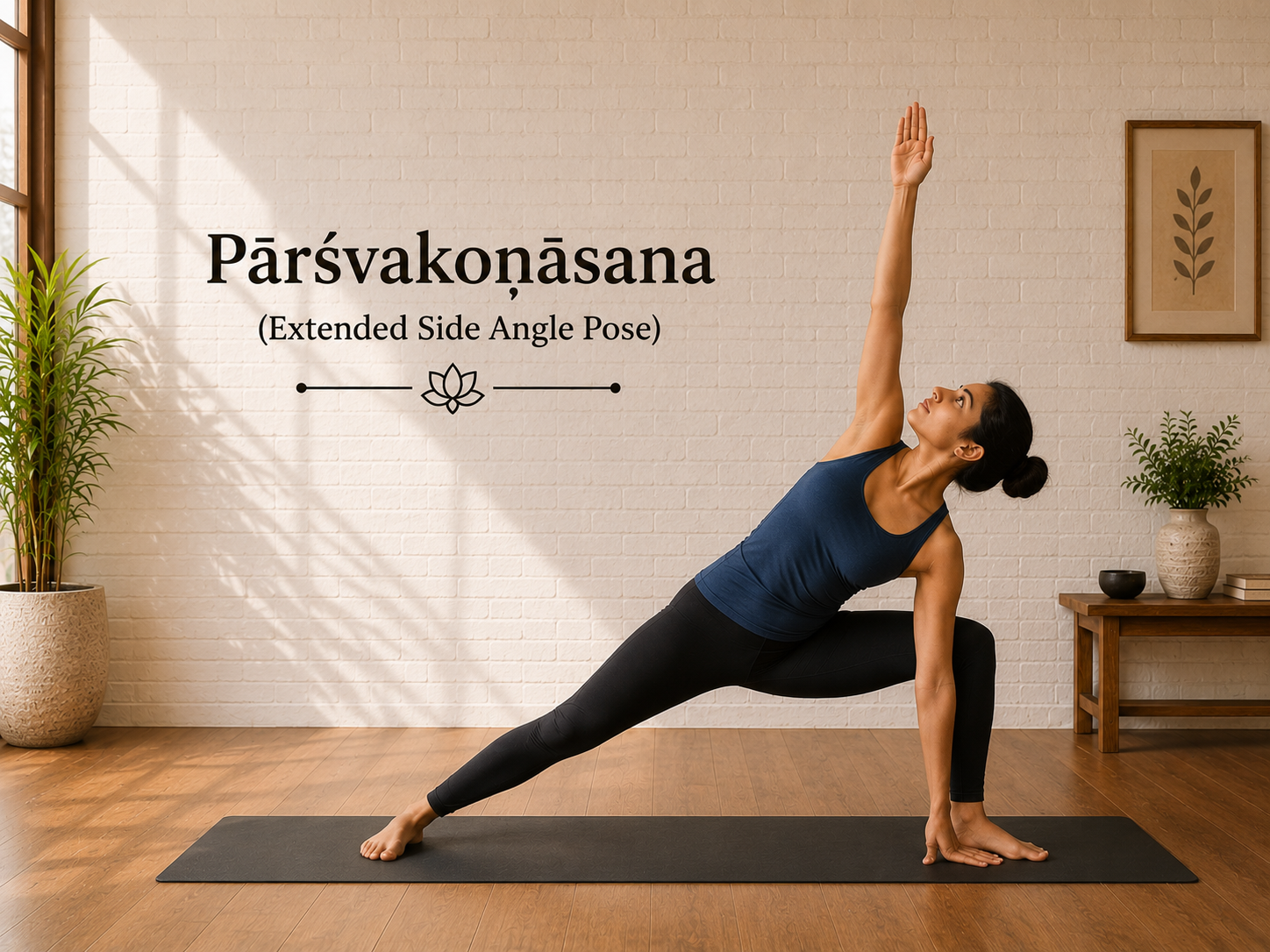
Pārśvakoṇāsana (Extended Side Angle Pose): The Complete Reference Guide
Editorial note, stated once: throughout this article, traditional yogic and Āyurvedic claims (chakra, prāṇa, dosha associations) are presented as traditional belief, not scientific fact, unless a specific evidence source is cited alongside them.
Name & Meaning
- Sanskrit: पार्श्वकोणासन (Pārśvakoṇāsana) or उत्थित पार्श्वकोणासन (Utthita Pārśvakoṇāsana)
- IAST Transliteration: Pārśvakoṇāsana / Utthita Pārśvakoṇāsana
- English: Extended Side Angle Pose / Side Angle Pose
- Etymology: Utthita (extended/stretched out) + Pārśva (side/flank) + Koṇa (angle) + Āsana (posture / seat). "The posture where the side of the body forms a single diagonal line of lateral angle extension from back heel to top fingertips."
Introduction
- Pārśvakoṇāsana is a powerful, dynamic standing posture that creates a continuous line of lateral extension along the entire flank of the body—stretching from the outer edge of the back foot all the way to the top fingertips.
- Combines deep quadriceps endurance, hip adductor lengthening, lateral spinal stretch, thoracic rotation, and shoulder girdle mobility in a single closed-chain standing stance.
- A staple standing posture across major modern yoga systems, including Ashtanga Vinyasa Yoga (standing series), Iyengar Yoga, and Hatha practices, functioning both as a strength builder and a hip opener.
- Functions as an excellent clinical assessment posture for evaluating knee tracking stability, hip abduction mobility, intercostal extensibility, and lateral core engagement.
Benefits
- Physical: Deeply strengthens quadriceps femoris, gluteus medius, and ankle stabilizers; lengthens hip adductors, groin muscles, intercostal muscles, and obliques; mobilizes the thoracic spine.
- Respiratory & Chest Expansion: Extending the top arm overhead while revolving the chest opens the lateral ribcage and intercostal spaces, enhancing thoracic breathing capacity.
- Mental: Sustaining a deep knee bend while extending the upper torso requires focused presence, endurance, and disciplined mental focus (dṛṣṭi).
- Postural & Metabolic: Stimulates lower body muscular endurance, improves pelvic stability, and counteracts lateral asymmetry or spinal tightness.
- Traditional/Spiritual: Believed in traditional Haṭha Yoga to awaken Manipūra (solar plexus) and Anāhata (heart) chakras, balancing Samāna Vāyu across the abdominal navel center—traditional belief, not a scientific claim.
How to Practice Pārśvakoṇāsana: Step-by-Step
| Step | Action | Breath | Teacher Cue |
|---|---|---|---|
| 1 | Begin in Tāḍāsana. Step or hop feet wide apart (about 4 to 4.5 feet). Raise arms parallel to floor in a T-shape. | Inhale to expand stance | "Root into the outer edges of both feet with arms extended wide." |
| 2 | Turn right foot out 90 degrees; turn left foot slightly in (about 15 degrees). Align right heel with left arch. | Exhale to set feet | "Keep your back leg strong and back heel firmly anchored." |
| 3 | Bend right knee to a 90-degree angle, ensuring right knee stacks directly over right ankle and points toward second toe. | Exhale into lunge | "Sink your thigh parallel to the floor without letting the knee collapse inward." |
| 4 | Place right palm on floor or block outside right ankle (or rest right forearm on right thigh for modified version). | Inhale to reach down | "Light touch on the floor—do not dump weight into your lower arm." |
| 5 | Sweep left arm overhead alongside left ear, palm facing down, creating a straight diagonal line from left outer heel to left fingertips. Revolve chest up. | Exhale to extend arm | "Revolve your chest toward the sky like a flower opening to the sun." |
| 6 | Hold for 5 to 8 deep breaths. To release, press firmly into back heel, inhale, engage core to stand up into Virabhadrasana II, then return to Tāḍāsana. Repeat on left side. | Inhale to rise | "Rise smoothly using the power of your back leg and core." |
Common Mistakes & Corrections
- Front knee collapsing inward (valgus collapse): Gluteus medius weakness causes front knee to track inside second toe, straining medial knee ligaments → Correction: Press front knee outward against arm/thigh, keeping kneecap tracking over second toe.
- Sagging ribcage onto front thigh (dumping weight): Failing to engage core obliques leads to heavy collapse onto front arm → Correction: Lift lower side waist away from thigh and use a block under lower hand to elevate flank.
- Back heel lifting off the floor: Loss of rear foot grounding breaks the diagonal line of energy → Correction: Anchor the outer edge of back foot strongly into floor; engage back leg quadriceps.
- Cranking the neck upward aggressively: Straining cervical spine to look at top palm → Correction: Keep neck extended naturally with spine; look forward or down if experiencing neck tension.
Contraindications & Precautions
- Acute Knee Injury / Ligament Strain (ACL/MCL): Deep 90-degree flexion under weight-bearing can strain healing knee joint tissue; reduce knee bend to 45 degrees.
- Severe Cervical Spine Issues: Avoid turning head upward toward top arm; keep neck neutral, facing forward or looking down.
- Uncontrolled High Blood Pressure / Vertigo: Reaching top arm overhead for long holds can elevate blood pressure or induce lightheadedness; keep top hand on hip.
- Late Pregnancy: Deep pelvic abduction and lateral leaning require modifications; place forearm on thigh or use a high block near a wall.
Sequencing: Preparatory, Follow-up & Variations
- Preparatory Poses: Tāḍāsana (standing foundation), Virabhadrasana II (prepares 90-degree lunge), Utthita Trikoṇāsana (opens lateral hips and hamstrings), Vṛkṣāsana (activates abductors).
- Placement in Sequence: Main standing sequence, typically positioned right after Virabhadrasana II or Utthita Trikoṇāsana.
- Follow-up Poses: Parivṛtta Pārśvakoṇāsana (Revolved Side Angle counter-twist), Virabhadrasana I, Prasārita Pādottānāsana (neutralizes pelvis).
- Variations: Modified Forearm-on-Thigh Side Angle, Block-Assisted Side Angle, Bound Side Angle (Baddha Pārśvakoṇāsana), Revolved Side Angle (Parivṛtta Pārśvakoṇāsana).
In more detail: Pārśvakoṇāsana serves as a fundamental cornerstone in standing vinyasa sequences. Transitioning seamlessly from Virabhadrasana II into Pārśvakoṇāsana is standard because both postures share an identical wide-legged lunge base. Following Pārśvakoṇāsana with counter-postures like Parivṛtta Pārśvakoṇāsana or wide-legged forward folds (Prasārita Pādottānāsana) ensures balanced stimulation across asymmetrical fascial lines and lumbar rotators.
Modifications
- Beginners: Rest front forearm on front thigh (elbow stacked over knee) rather than placing lower hand on floor; keep top arm extending overhead or on top hip.
- Tight Hips / Groin: Place a yoga block on high or medium setting outside front foot; rest lower palm firmly on block.
- Seniors / Balance Issues: Practice with back against a wall for physical support and spatial guidance; keep stance narrower.
- Shoulder Impingement: Place top hand on hip rather than extending arm overhead alongside ear.
Historical Background & Classical References
- Modern Postural Lineage: Pārśvakoṇāsana is not described in ancient or medieval Haṭha Yoga manuscripts like the Haṭhayogapradīpikā, Gheraṇḍa Saṃhitā, or Śiva Saṃhitā (which focused almost exclusively on seated meditation seats and pranayama).
- 20th-Century Development: Popularized globally through the teachings of T. Krishnamacharya at the Mysore Palace, B.K.S. Iyengar (Light on Yoga, 1966), and K. Pattabhi Jois in the Ashtanga Vinyasa Primary Series.
Alignment Principles (Iyengar Method)
- Leg & Knee Geometry: Front knee bent at a precise 90-degree angle; thigh parallel to floor; knee stacked directly over heel. Back leg straight, outer foot edge firmly pressed into floor.
- Diagonal Vector Line: Continuous straight diagonal vector of energy extending from outer back heel through outer torso, shoulder, and arm to top fingertips.
- Chest Rotation: Ribcage revolved open toward ceiling; lower side waist lengthened rather than squished.
- Shoulder & Arm Engagement: Bottom arm presses firmly into floor/block/thigh to create leverage for upper shoulder rotation; top arm fully extended alongside ear.
Anatomy & Biomechanics
- Primary Stretched Muscles: Adductor magnus, adductor longus, gracilis (front leg groin); Latissimus dorsi, Intercostals, External obliques (top flank); Tensor fasciae latae / IT-band (back leg).
- Primary Strengthening Muscles: Quadriceps femoris (rectus femoris, vastus medialis/lateralis of front leg), Gluteus medius and minimus, Gluteus maximus, Deltoids, Serratus anterior.
- Joint Mechanics: Front hip flexed, abducted, externally rotated; back hip extended, abducted, internally rotated; front knee flexed 90 degrees; thoracic spine axial rotation with lateral flexion.
- Kinetic Chain & Ground Reaction Force: Ground reaction force travels up through back heel anchor and front foot tripod, enabling core obliques to suspend torso cleanly without overworking lumbar vertebrae.
Nervous System & Breathing Effects
- Proprioceptive & Vestibular Challenge: Asymmetrical wide lunge stance with head rotated upward challenges balance centers and joint mechanoreceptors in ankles and hips.
- Respiratory Capacity: Extending top arm stretches intercostal muscles on top flank, opening upper lung lobes and facilitating deep intercostal breathing.
Yogic & Āyurvedic Perspective
- Dosha Impact: Highly effective for invigorating Kapha (relieves sluggishness and builds lower body heat) and balancing Vāta when rooted through heels. Can elevate Pitta if practiced aggressively in hot environments—traditional belief.
- Prāṇa Dynamics: Channels Samāna Vāyu at the navel center, promoting digestive vitality, while drawing Prāṇa Vāyu across expanded chest and arms.
Therapeutic Applications
| Condition | Mechanism | Research / Precaution |
|---|---|---|
| Tight Hip Adductors / Groin Stiffness | Deep eccentric lengthening of groin and inner thigh muscles in wide abducted stance | Supported by physical therapy stretching protocols. Precaution: Keep front knee tracking over second toe. |
| Weak Quadriceps / Knee Instability | Isometric loading of vastus medialis obliquus (VMO) stabilizes patellar tracking | Supported by lower limb exercise mechanics. Precaution: Avoid letting knee collapse inward. |
| Sluggish Digestion | Intercostal stretching and lateral abdominal compression stimulate abdominal organ perfusion | Traditional yogic belief; plausible mechanical massage effect. |
Yoga is never a replacement for medical treatment; serious or persistent conditions require a qualified healthcare professional.
Teaching Cues & Hands-On Adjustments
- Verbal Cues: "Create one straight line of energy from your back heel to your top fingertips." / "Press your front knee against your front arm to keep your hip open." / "Lift your bottom waist away from your thigh."
- Hands-on Adjustment (Safe execution with consent):
- Stand behind student; place one hand gently against outer back foot to cue grounding, while other hand lightly touches top hip/shoulder, encouraging chest rotation upward.
- Place hand lightly outside front knee, cuing student to press knee gently outward into hand to correct valgus collapse.
Myth vs. Fact
| Myth | Fact |
|---|---|
| Your lower hand must touch the floor for the pose to be valid. | Resting forearm on thigh or using a block keeps the side waist long and chest open, which is far superior to touching the floor with a collapsed spine. |
| Pārśvakoṇāsana is an ancient posture mentioned in the Vedas. | It is a modern 20th-century posture popularized by T. Krishnamacharya, B.K.S. Iyengar, and Pattabhi Jois. |
| Your hips should be forced completely flat into a single two-dimensional plane. | Forcing hips flat can strain the sacroiliac joint and hip socket; allowing a subtle natural pelvic angle protects joint mechanics. |
Conclusion
Pārśvakoṇāsana (Extended Side Angle Pose) synthesizes leg power, hip mobility, lateral extension, and thoracic rotation into an iconic standing posture. By maintaining a 90-degree knee bend, grounding the back heel, and elevating the flank using blocks or forearm modifications when needed, practitioners of all levels can safely experience the invigorating physical and energetic benefits of this posture.
Quick Facts
| Category | Standing lateral extension / posture |
| Difficulty Level | Beginner to Intermediate |
| Primary Muscles Stretched | Hip Adductors, Intercostals, Latissimus Dorsi, Obliques |
| Primary Muscles Strengthened | Quadriceps Femoris, Gluteus Medius, Ankle Stabilizers, Core flexors |
| Classical Source? | No (Modern posture, 20th century origin) |
| Traditional Chakra (Belief) | Manipūra (Solar Plexus) & Anāhata (Heart) |
Frequently Asked Questions
What does Pārśvakoṇāsana mean?
Pārśva (side/flank) + Koṇa (angle) = Side Angle Pose / Extended Side Angle Pose.
Should my lower hand be inside or outside my front foot?
Classical Iyengar and Ashtanga teach placing lower hand outside front foot. Placing hand inside foot or resting forearm on thigh is ideal for beginners with tight hips.
How do I prevent my front knee from caving inward?
Engage your gluteus medius and press your knee lightly outward so it stays stacked directly over your second toe.
Is Extended Side Angle Pose mentioned in ancient yoga texts?
No, it is a modern 20th-century posture popularized by Krishnamacharya, Iyengar, and Jois.
Can beginners practice Pārśvakoṇāsana?
Yes! Beginners can rest their front forearm on their front thigh or use a yoga block outside the front ankle.
How long should I hold Side Angle Pose?
Hold for 5 to 8 deep, smooth breaths (roughly 30 to 60 seconds) per side.
References
1. Classical Yoga Texts: Modern posture; absent in medieval manuals (Haṭhayogapradīpikā, Gheraṇḍa Saṃhitā).
2. Modern Yoga Institutions: Iyengar, B.K.S. (1966). Light on Yoga. Schocken Books, pp. 68-71. Jois, K. Pattabhi (2002). Yoga Mala. North Point Press. Bihar School of Yoga (Asana Pranayama Mudra Bandha).
3. Peer-Reviewed Scientific Research:
- Sherman, K. J., et al. (2011). A randomized trial comparing yoga, stretching, and a self-care book for chronic low back pain. Archives of Internal Medicine, 171(22), 2019-2026.
- Ni, M., et al. (2014). Comparative muscle activation patterns during yoga postures in elderly adults. BMC Complementary and Alternative Medicine, 14, 401.
This article is for educational purposes and does not replace individualized medical or physical therapy advice. Consult a qualified healthcare provider before beginning any new practice, especially with a pre-existing health condition.