Parivṛtta Trikoṇāsana (Revolved Triangle Pose): Classical Sources, Anatomy, Alignment & Evidence-Based Guide
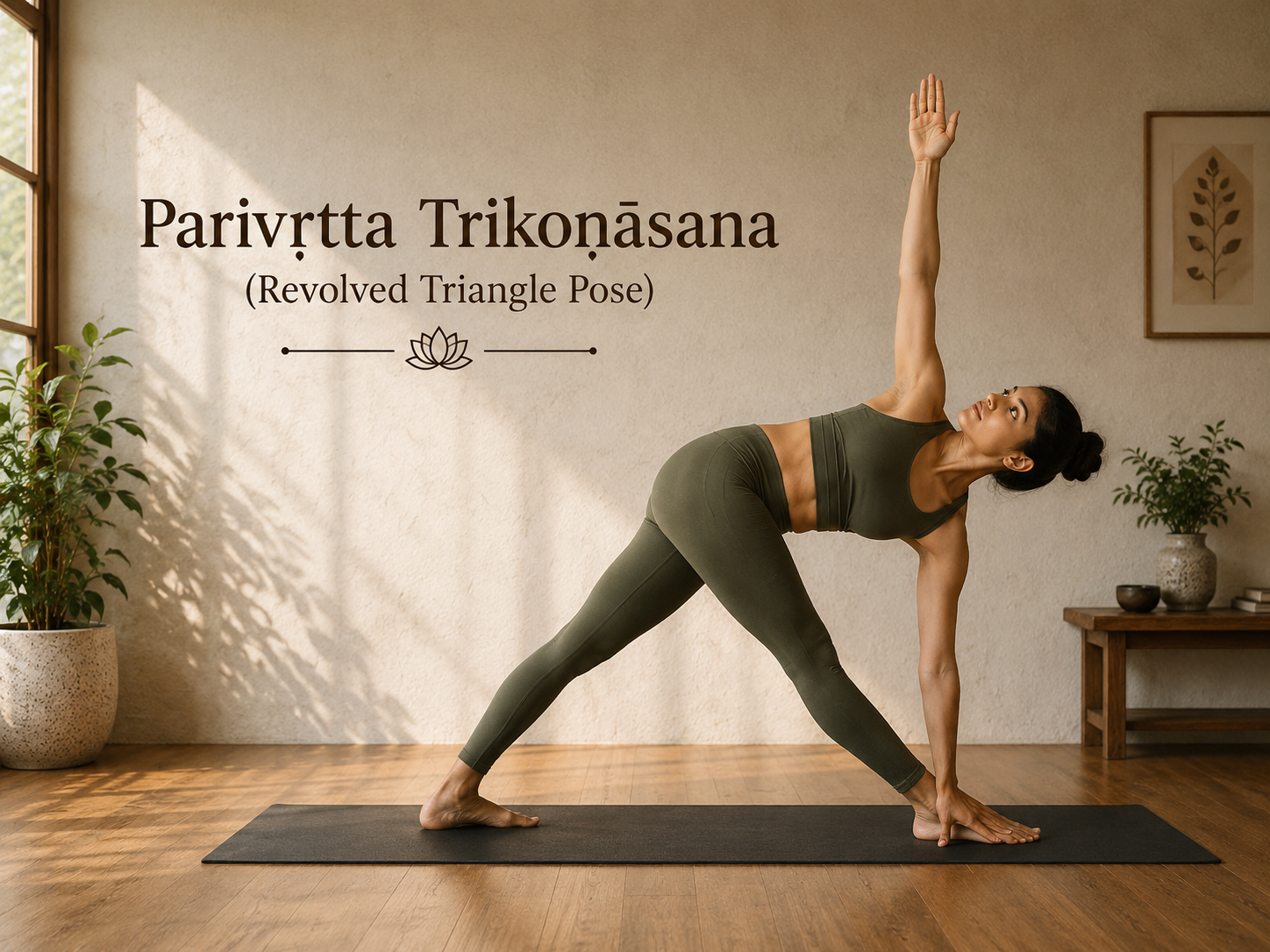
Parivṛtta Trikoṇāsana (Revolved Triangle Pose): The Complete Reference Guide

Editorial note, stated once: throughout this article, traditional yogic and Āyurvedic claims (chakra, prāṇa, dosha associations) are presented as traditional belief, not scientific fact, unless a specific evidence source is cited alongside them.
Name & Meaning
- Sanskrit: परिवृत्त त्रिकोणासन (Parivṛtta Trikoṇāsana)
- IAST Transliteration: Parivṛtta Trikoṇāsana
- English: Revolved Triangle Pose / Twisted Triangle Pose
- Etymology: Parivṛtta (revolved / turned around) + Tri (three) + Koṇa (angle) + Āsana (posture / seat). "The standing posture forming three triangles where the torso is revolved inwardly across the front leg."
Introduction
- Parivṛtta Trikoṇāsana is an invigorating, asymmetrical standing posture that combines forward folding, lateral hip stabilization, and deep spinal rotation.
- Functions as the counter-pose and rotational counterpart to Utthita Trikoṇāsana (Extended Triangle Pose), shifting from an open-hip lateral bend to a closed-hip rotational standing posture.
- A central posture in both the Iyengar and Ashtanga Vinyasa Yoga traditions (standing sequence of Ashtanga Primary Series), demanding hamstring length, IT-band extensibility, thoracic spine mobility, and core oblique control.
- Serves as a powerful diagnostic tool for testing thoracic spine rotation, sacroiliac joint stability, and outer hip mobility.
Benefits
- Physical: Lengthens the outer hip flexors, tensor fasciae latae (TFL), iliotibial (IT) band, piriformis, and hamstrings; strengthens the quadriceps, ankles, core obliques, and spinal erectors; improves thoracic spinal mobility.
- Mental: Combining spinal rotation with single-leg loading requires intense presence, steady breath, and heightened spatial orientation.
- Emotional: Twisting movements compress and release the abdominal region, symbolically and physically relieving stored muscular tension.
- Digestive & Visceral: The rotational compression of the abdominal cavity creates a gentle intra-abdominal massage that encourages peristaltic activity and abdominal organ perfusion.
- Traditional/Spiritual: Believed in traditional Haṭha Yoga to awaken Agni (metabolic digestive fire), balance Samāna Vāyu, and stimulate the Manipūra (solar plexus) chakra—traditional belief, not a scientific claim.
How to Practice Parivṛtta Trikoṇāsana: Step-by-Step
| Step | Action | Breath | Teacher Cue |
|---|---|---|---|
| 1 | Begin in Tāḍāsana. Step left foot back 3 to 3.5 feet. Turn left foot out 45 to 60 degrees; keep right foot facing straight forward. Align heel-to-heel or hip-width apart for stability. | Natural breath | "Square both hip points toward the front of your mat like headlights." |
| 2 | Place right hand on right hip. Extend left arm high overhead, lengthening the left side waist. | Inhale to lift arm | "Reach high through your left fingers to lengthen your spine before revolving." |
| 3 | Exhale, hinge forward from the hips with a flat back, reaching left hand forward over the right foot. | Exhale to fold | "Hinge from your hip crease while keeping your back leg heel pinned to the floor." |
| 4 | Place left hand on a block, the inner right foot, or across to the pinky-toe side (outer right ankle). | Inhale to lengthen spine | "Anchor your bottom hand firmly to create a leverage point for rotation." |
| 5 | Revolve torso to the right, opening chest toward the right wall. Extend right arm straight up toward sky. Gaze softly at top thumb. | Exhale to twist | "Revolve from your ribcage and thoracic spine, keeping your hips stable." |
| 6 | Hold for 5 to 8 deep breaths. To release, look down, lower top arm, engage core, press through back heel, and inhale to stand up. Repeat on left side. | Inhale to rise | "Drive through your back heel to lift yourself up with control." |
Common Mistakes & Corrections
- Twisting through a rounded lumbar spine: Twisting while the lower back is flexed increases shear forces on intervertebral discs → Correction: Place hand on a block to ensure spine remains long and neutral before revolving.
- Lifting the back heel off the floor: Loss of rear leg anchor collapses pelvic stability and reduces the leg-stretch benefit → Correction: Shorten stance slightly and press outer back heel firmly into the mat.
- Hyperextending the front knee: Locking the front joint puts pressure on hamstrings and joint capsule → Correction: Maintain an invisible micro-bend in front knee, pulling kneecap up with quadriceps.
- Distorting hips (allowing back hip to drop/swing): Cranking hips sideways to reach the floor → Correction: Draw the front-leg hip crease back and pin the back-leg hip forward to stabilize pelvis.
Contraindications & Precautions
- Acute Lumbar Disc Herniation or Sciatica: Combined spinal flexion and rotation generates high intradiscal pressure; avoid during acute flare-ups.
- Sacroiliac (SI) Joint Dysfunction: Asymmetrical torsion across the pelvis can strain vulnerable SI ligaments; practice with hip-width stance and block support under guidance.
- Uncontrolled High Blood Pressure / Migraine: Inverting and twisting can elevate intra-cranial pressure; keep gaze forward or down rather than turning up to top thumb.
- Late Pregnancy: Deep rotational compression of the abdominal wall is contraindicated; practice gentle open twists instead.
Sequencing: Preparatory, Follow-up & Variations
- Preparatory Poses: Utthita Trikoṇāsana (open-hip balance base), Pārśvottānāsana (prepares closed-hip hamstring stretch), Parivṛtta Sukhāsana (gentle seated twist).
- Placement in Sequence: Standing series peak posture, ideally following Utthita Trikoṇāsana and forward bends when hips and spine are warm.
- Follow-up Poses: Prasārita Pādottānāsana (wide-legged forward fold to neutralize pelvis), Uttānāsana, Parivṛtta Pārśvakoṇāsana (Revolved Side Angle).
- Variations: Block-assisted Revolved Triangle, Hand-on-Inner-Ankle Revolved Triangle (beginner), Wall-supported Revolved Triangle.
In more detail: Parivṛtta Trikoṇāsana requires a delicate balance between pelvic stabilization and thoracic rotation. Positioning it right after Utthita Trikoṇāsana provides a natural structural transition from open lateral extension to closed rotational engagement. Preparing the body with Pārśvottānāsana ensures that the posterior hamstring and hip flexor lines are sufficiently lengthened before introducing spinal rotation, minimizing compensation in the lumbar spine.
Modifications
- Beginners: Place a block on its highest setting inside or outside the front foot; rest lower hand on the block to keep spine flat.
- Tight Hamstrings / IT-Band: Take a wider stance (feet hip-width apart rather than heel-to-heel); keep a visible micro-bend in front knee.
- Seniors / Balance Difficulties: Practice with back heel pressed against a wall for physical support and spatial feedback.
- Neck / Cervical Strain: Keep gaze facing forward or looking down at the floor rather than turning head upward.
Historical Background & Classical References
- Modern Lineage Posture: Parivṛtta Trikoṇāsana is not mentioned in medieval Hatha texts like the Haṭhayogapradīpikā, Gheraṇḍa Saṃhitā, or Śiva Saṃhitā. Ancient texts focused on seated meditation and pranayama postures.
- 20th-Century Development: Popularized in the early 20th century by T. Krishnamacharya and documented by B.K.S. Iyengar in Light on Yoga (1966) and K. Pattabhi Jois in the Ashtanga Vinyasa Primary Series.
Alignment Principles (Iyengar Method)
- Foot Base: Front foot points straight ahead; back foot angled 45 to 60 degrees. Both heels firmly rooted into floor.
- Pelvis Stabilization: Both hip points (ASIS) face forward as much as possible; front hip draws back into socket, back hip rolls forward.
- Axial Extension & Rotation: Spine extends straight out over front thigh before revolving. Rotation occurs primarily in thoracic and upper lumbar vertebrae.
- Vertical Arm Stack: Bottom hand presses firmly into floor/block while top arm extends straight up, creating a vertical line across chest and shoulders.
Anatomy & Biomechanics
- Primary Stretched Muscles: Biceps femoris, semitendinosus (front hamstrings), Gluteus medius/minimus, Piriformis, Tensor Fasciae Latae / IT-Band, Quadratus Lumborum, Gastrocnemius (back leg).
- Primary Strengthening Muscles: Quadriceps femoris (front leg elevation), Internal/External Obliques (rotational torque), Transversus Abdominis, Multifidus, Erector Spinae.
- Joint Mechanics: Front hip flexed and adducted; back hip extended and internally rotated; thoracic spine axial rotation; shoulder extension/abduction.
- SI Joint Biomechanics: Closed-chain standing twists place rotational torque across the pelvis. Keeping the back heel grounded and allowing subtle natural pelvic movement prevents excessive torsional strain on the sacroiliac ligaments.
Nervous System & Breathing Effects
- Proprioception & Balance: Narrow standing base paired with rotational vision challenge stimulates vestibular and cerebellar balance centers.
- Respiratory Dynamics: Abdominal compression restricts ventral diaphragm movement, encouraging intercostal expansion on the upper lung side.
Yogic & Āyurvedic Perspective
- Dosha Impact: Highly effective for stimulating Kapha (igniting sluggish digestion and metabolic heat) and clearing excess Vāta when grounded through heels. Can elevate Pitta if practiced forcefully—traditional belief.
- Prāṇa Dynamics: Stimulates Samāna Vāyu at the navel center, promoting digestive assimilation and internal processing.
Therapeutic Applications
| Condition | Mechanism | Research / Precaution |
|---|---|---|
| Piriformis Syndrome / Outer Hip Tightness | Closed-chain hip flexion with adduction stretches piriformis and outer gluteal fascia | Supported by physical therapy stretching protocols. Precaution: Keep micro-bend in front knee. |
| Thoracic Spine Stiffness / Postural Slumping | Axial extension paired with thoracic rotation mobilizes ribcage and mid-back extensors | Biromechanically supported spinal mobilization. Precaution: Avoid rounding lumbar spine. |
Yoga is never a replacement for medical treatment; serious or persistent conditions require a qualified healthcare professional.
Teaching Cues & Hands-On Adjustments
- Verbal Cues: "Anchor your back heel firmly like an anchor." / "Lengthen your spine forward before revolving your chest." / "Draw your front hip crease back to keep hips level."
- Hands-on Adjustment (Safe execution with consent):
- Stand behind student's back leg side; place hand on front-leg hip crease, guiding hip gently back to stabilize pelvis.
- Place other hand gently on student's upper back/shoulder blade, encouraging soft thoracic rotation without forcing lumbar spine.
Myth vs. Fact
| Myth | Fact |
|---|---|
| Your hips must remain 100% rigid and square while twisting. | Lifting or locking hips completely rigid forces all rotation into lumbar and SI joints; a subtle natural pelvic pivot is anatomically healthier. |
| Revolved Triangle is an ancient 2,000-year-old posture. | It is a modern postural addition popularized in the 20th century by T. Krishnamacharya, B.K.S. Iyengar, and Pattabhi Jois. |
| Bottom hand must cross over to the outer foot for the pose to be valid. | Placing hand on a block inside the foot with a long spine is far superior to forcing hand outside with a rounded back. |
Conclusion
Parivṛtta Trikoṇāsana (Revolved Triangle Pose) bridges physical strength, hamstring extensibility, and thoracic rotational mobility into a unified standing challenge. By prioritizing axial spinal length, grounding the back heel, and utilizing blocks when needed, practitioners can safely experience the therapeutic benefits of this classical modern posture.
Quick Facts
| Category | Standing closed-hip twist / posture |
| Difficulty Level | Intermediate |
| Primary Muscles Stretched | Hamstrings, Piriformis, IT-Band/TFL, Quadratus Lumborum |
| Primary Muscles Strengthened | Quadriceps, Obliques, Abdominal wall, Erector Spinae |
| Classical Source? | No (Modern posture, 20th century origin) |
| Traditional Chakra (Belief) | Manipūra (Solar Plexus) & Anāhata (Heart) |
Frequently Asked Questions
What does Parivṛtta Trikoṇāsana mean?
Parivṛtta (revolved/twisted) + Trikoṇa (triangle) = Revolved Triangle Pose.
Why is Revolved Triangle so challenging?
It combines three distinct physical demands simultaneously: hamstring flexibility, single-leg standing balance, and spinal rotation.
Should I put my hand inside or outside my front foot?
Placing hand outside front foot is the full expression, but placing hand inside or on a block is recommended for beginners to prevent spinal rounding.
Is Revolved Triangle mentioned in classical scriptures?
No, it is a modern 20th-century posture popularized by Krishnamacharya, Iyengar, and Jois.
How can I protect my lower back in this pose?
Lengthen your spine forward before rotating, avoid hunching your back, and use a yoga block under your bottom hand.
What if my back heel keeps lifting off the ground?
Shorten your stance slightly, widen your feet hip-width apart, and focus on pressing your outer back heel into the mat.
References
1. Classical Yoga Texts: Modern posture; absent in medieval manuals (Haṭhayogapradīpikā, Gheraṇḍa Saṃhitā).
2. Modern Yoga Institutions: Iyengar, B.K.S. (1966). Light on Yoga. Schocken Books, pp. 66-68. Jois, K. Pattabhi (2002). Yoga Mala. North Point Press. Bihar School of Yoga (Asana Pranayama Mudra Bandha).
3. Peer-Reviewed Scientific Research:
- Sherman, K. J., et al. (2011). A randomized trial comparing yoga, stretching, and a self-care book for chronic low back pain. Archives of Internal Medicine, 171(22), 2019-2026.
- Ni, M., et al. (2014). Comparative muscle activation patterns during yoga postures in elderly adults. BMC Complementary and Alternative Medicine, 14, 401.
This article is for educational purposes and does not replace individualized medical or physical therapy advice. Consult a qualified healthcare provider before beginning any new practice, especially with a pre-existing health condition.