Pañcakośa: The Five Sheaths of Human Existence (Taittirīya Upaniṣad's Actual Teaching)
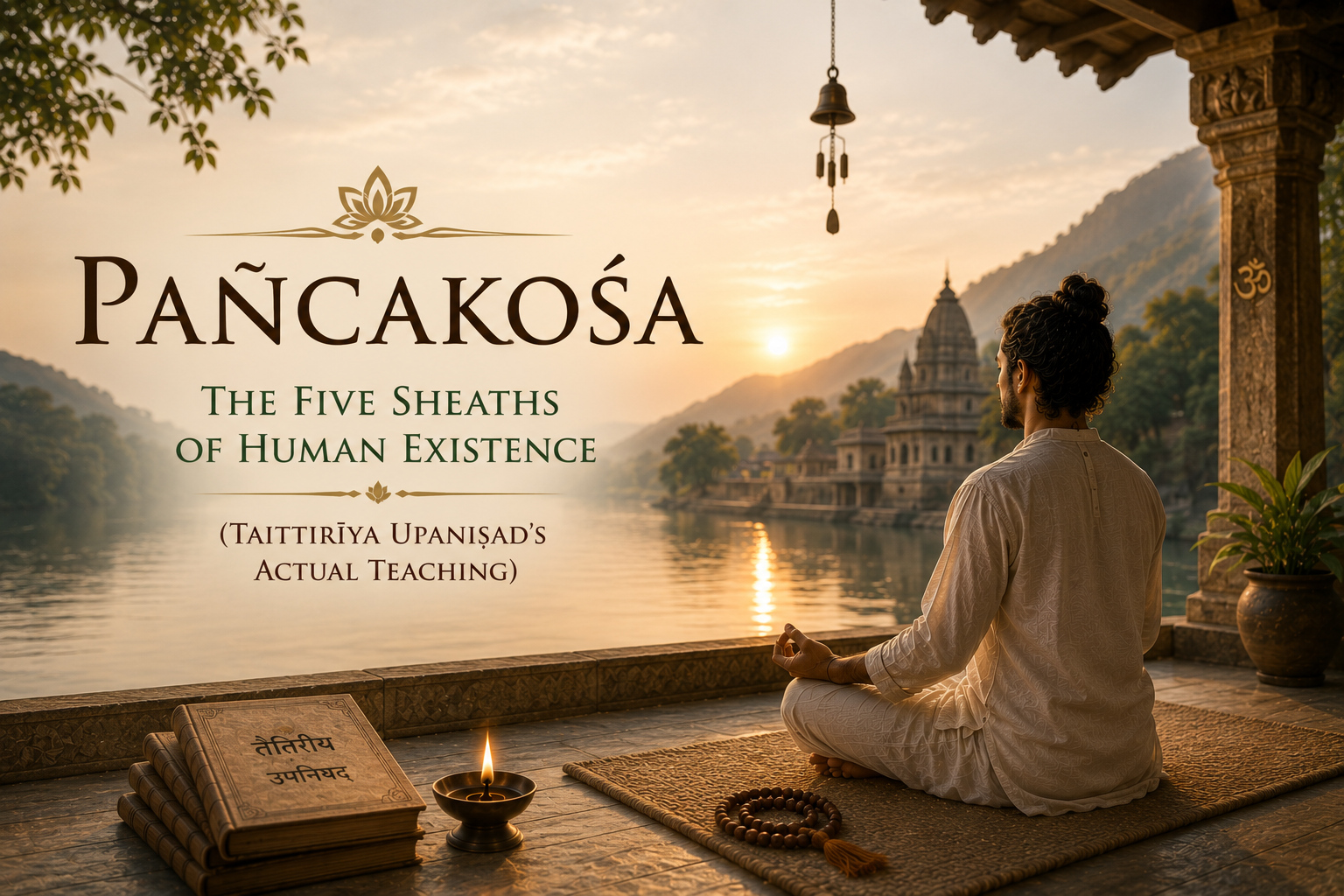
Pañcakośa — The Five Sheaths of Human Existence
Introduction
The Pañcakośa framework is a foundational Vedāntic model for understanding the human person. It proposes that a human being is not merely a physical body, but that our consciousness is layered through five sheaths (kośas). A commonly used modern teaching image compares this to Russian Matryoshka dolls, nested one inside another — though it's worth noting this comparison is a useful pedagogical device, not the Upaniṣad's own imagery. The kośas are described specifically in the Taittirīya Upaniṣad, in its second chapter, the Brahmānanda Vallī.
The Meaning of the Word
- Pañca = five
- Kośa = sheath, covering, or layer
Together: the five coverings or five levels of human existence.
1. Annamaya Kośa (The Food Sheath)
This is the outermost and grossest sheath — our physical body, formed from and sustained by food (anna). It includes the five sense organs, the five organs of action, and the five gross elements (earth, water, fire, air, space). It is subject to the laws of birth, growth, change, decay, and death. Yoga postures, proper diet, fasting, and purification practices keep this sheath healthy and clean.

2. Prāṇamaya Kośa (The Vital-Energy Sheath)
This is the sheath of energy — home to prāṇa (vital force), breath, and the nāḍīs (energy channels). Breath is the gross expression of prāṇa. All the body's biological processes — respiration, circulation, the flow of life-energy — operate through this sheath. Prāṇāyāma, āsana, meditation, sunlight, sāttvic food, and a balanced lifestyle strengthen it.
3. Manomaya Kośa (The Mental Sheath)
This is the sheath of mind, thought, emotion, and conditioning (saṃskāra). Our desires, likes and dislikes, pleasure and pain, mental reactions, and emotional experiences arise at this level. Yogic philosophy generally describes the mind as restless, constantly moving from one object to another. Yoga, prāṇāyāma, meditation, and sense-restraint practices are traditionally used to purify this sheath.

4. Vijñānamaya Kośa (The Wisdom Sheath)
This is the sheath of intellect and discernment. Here, discriminative knowledge develops — the capacity to judge right from wrong, not just accumulate ordinary information. Traditionally, this sheath is described as the faculty through which one moves from ordinary self-concern toward more expansive, discerning awareness. It is developed through meditation, self-study (svādhyāya), self-reflection, service, and study of yogic and Vedāntic philosophy.
5. Ānandamaya Kośa (The Bliss Sheath)
This is the subtlest and most interior sheath — the level of joy, peace, and self-realization. Popular yoga writing often describes this kośa as identical with moksha, mukti, or Patañjali's samādhi. It's worth being precise here: classical Advaita Vedānta, following Śaṅkara's commentary, treats the ānandamaya kośa as still a kośa — a covering — not the Self (Ātman) itself. It is the subtlest of the five sheaths, closest to the causal body, but the Upaniṣad's own method of inquiry (neti neti, "not this, not this") points to a Self that remains even after this sheath is set aside. So while ānandamaya kośa represents profound peace and joy, in the Upaniṣad's own logic, it is not yet the final destination — it is the last veil before it. And since samādhi is a term from Patañjali's Yoga Sūtra — a different text and system — using it interchangeably with this kośa is a loose, cross-tradition borrowing worth naming as such, rather than treating the two as technically identical.

Pañcakośa and the Three Bodies
In Vedāntic philosophy, the pañcakośa framework is correlated with the doctrine of the three bodies (tri-śarīra — gross, subtle, and causal):
- Gross body (sthūla śarīra) → Annamaya Kośa
- Subtle body (sūkṣma śarīra) → Prāṇamaya + Manomaya + Vijñānamaya Kośa
- Causal body (kāraṇa śarīra) → Ānandamaya Kośa
The pañcakośa model can be understood as a more detailed elaboration of this three-body framework.
Means of Purifying the Kośas
- Yoga āsana
- Prāṇāyāma
- Meditation
- Sāttvic, balanced diet
- Fasting and purification practices
- Self-study (svādhyāya)
- Self-reflection
- Selfless service
- Right conduct and a yogic lifestyle
Through these practices, the practitioner moves progressively from the outer, gross level toward the innermost sheath.
My Practical Reflection
(This section is personal contemplation, not classical doctrine.) What strikes me most about this model, practically, is how it resists the temptation to treat any single layer — even the blissful ānandamaya kośa — as the finish line. In my own understanding, that refusal to let the seeker settle for bliss itself is actually the most rigorous part of the teaching: even peace and joy, however profound, are still something experienced, and the Upaniṣad keeps pointing past experience itself toward the one who experiences.
Key Points
- The primary source for the Pañcakośa doctrine is the Taittirīya Upaniṣad (Brahmānanda Vallī).
- A human being is composed of five sheaths.
- The traditional progression moves from Annamaya Kośa toward Ānandamaya Kośa.
- Each kośa can be purified and developed through yogic practice.
- Ānandamaya Kośa is still a kośa (covering), not the Ātman itself — the Self is understood to be beyond even this sheath, per classical Advaita Vedānta.
- The final aim is not to cling to any kośa, but to transcend all five and realize one's true nature.