Pādāṅguṣṭhāsana (Big Toe Pose): Classical Sources, Anatomy, Alignment & Evidence-Based Guide
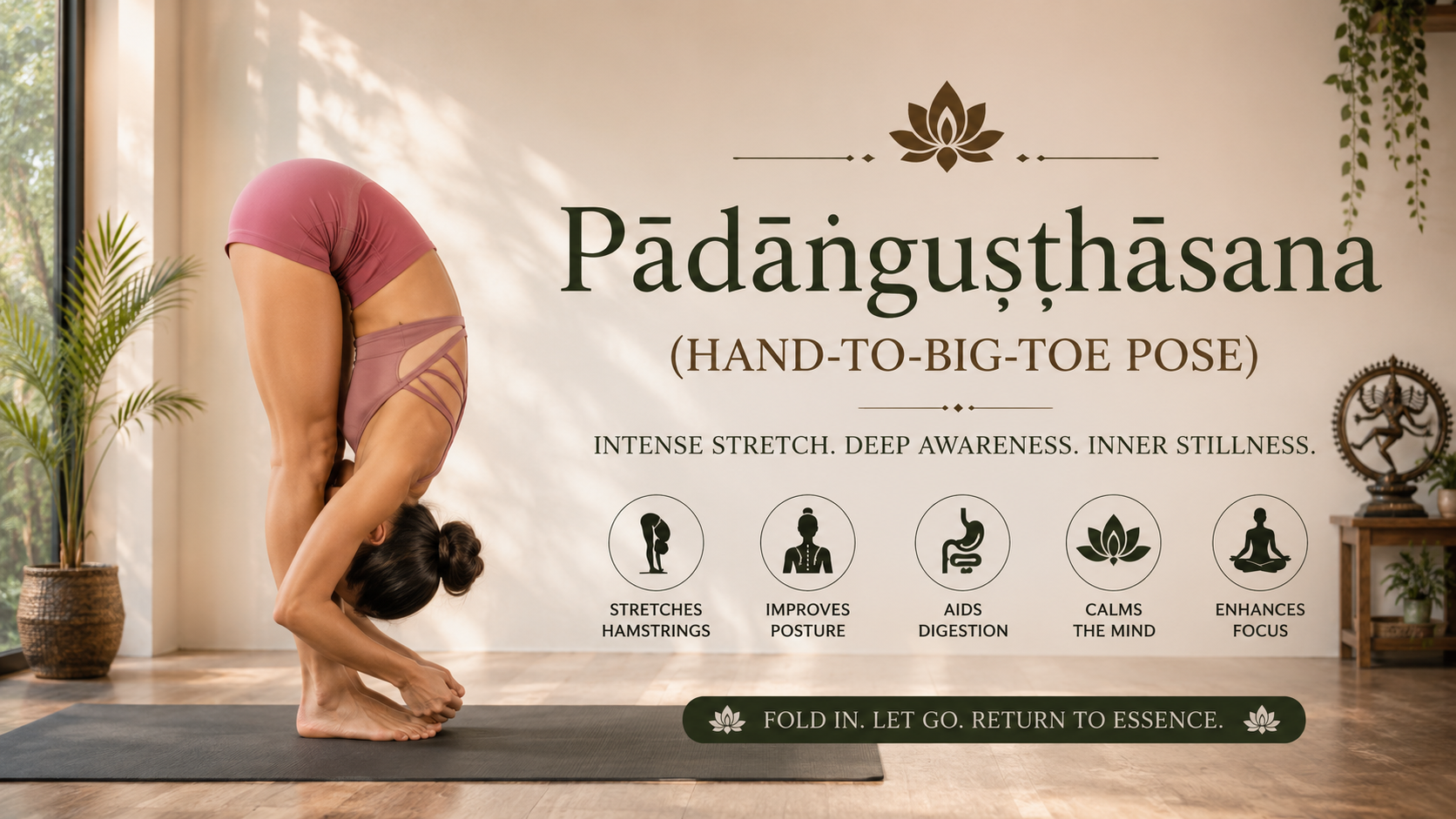
Pādāṅguṣṭhāsana (Big Toe Pose): The Complete Reference Guide
Editorial note, stated once: throughout this article, traditional yogic and Āyurvedic claims (chakra, prāṇa, dosha associations) are presented as traditional belief, not scientific fact, unless a specific evidence source is cited alongside them.
Name & Meaning
- Sanskrit: पादाङ्गुष्ठासन (Pādāṅguṣṭhāsana)
- IAST Transliteration: Pādāṅguṣṭhāsana
- English: Big Toe Pose / Standing Forward Bend with Toe Lock
- Etymology: Pāda (foot) + Aṅguṣṭha (big toe) + Āsana (posture / seat). "The posture where the big toes are held by the fingers during a standing forward fold."
Introduction
- Pādāṅguṣṭhāsana is a foundational standing forward bend posture that lengthens the entire posterior kinetic chain—from the plantar fascia and calves to the hamstrings, gluteals, and spinal erectors.
- In Ashtanga Vinyasa Yoga, Pādāṅguṣṭhāsana serves as the first dedicated standing forward fold immediately following Sūryanamaskāra, paired directly with Pādahastāsana.
- Unlike many modern standing postures, variations of Pādāṅguṣṭhāsana carry authentic classical roots, appearing in medieval Haṭha Yoga literature such as the 17th-century Gheraṇḍa Saṃhitā (though classically described in a seated balance context, whereas modern postural yoga practices it as a standing forward fold).
- Serves as an essential diagnostic posture for evaluating hamstring flexibility, anterior pelvic tilt capacity, and lumbar spinal health.
Benefits
- Physical: Deeply lengthens hamstrings (biceps femoris, semitendinosus, semimembranosus), calves (gastrocnemius, soleus), and spinal erectors; strengthens quadriceps (through reciprocal inhibition of hamstrings); decompresses intervertebral discs.
- Mental: The inversion and forward bend action calms the central nervous system, promoting mental stillness and introspection (pratyāhāra).
- Emotional: Surrendering into a forward fold helps release habitual tension held in the lower back and shoulders during times of stress.
- Digestive & Abdominal: Forward compression of the abdominal cavity gently massages visceral organs, stimulating peristalsis and abdominal circulation.
- Traditional/Spiritual: Believed in traditional Haṭha Yoga to awaken Manipūra (solar plexus) and Svadhiṣṭhāna (sacral) chakras, while redirecting Apāna Vāyu upward—traditional belief, not a scientific claim.
How to Practice Pādāṅguṣṭhāsana: Step-by-Step
| Step | Action | Breath | Teacher Cue |
|---|---|---|---|
| 1 | Stand in Tāḍāsana with feet hip-width apart, outer edges parallel. Place hands on hips. | Natural breath | "Root down evenly through both feet before folding." |
| 2 | Inhale, lift chest, broaden collarbones, and elongate the spine upward. | Inhale deeply | "Grow tall through the crown of your head." |
| 3 | Exhale, hinge forward directly from the hip joints (not the waist), keeping the spine flat and chest long. | Exhale to fold | "Fold from your deep hip creases like a closing book." |
| 4 | Catch the big toes with index finger, middle finger, and thumb (toe lock). Press toes firmly against fingers. | Inhale to look up | "Hook your big toes firmly, straighten arms, and flatten your back." |
| 5 | Exhale, bend elbows out to the sides, draw crown of head toward floor, and deepen forward fold. Hold for 5 to 8 deep breaths. | Steady, deep breathing | "Let your neck hang loose and shift weight slightly forward into your toe mounds." |
| 6 | Inhale, straighten arms and flatten spine (head up). Exhale, bring hands to hips. Inhale, rise up with a flat back to standing. | Inhale to rise | "Engage your core and press through heels to stand smoothly." |
Common Mistakes & Corrections
- Rounding lumbar spine to force toe reach: Bending from mid-back instead of hinging at hip flexors puts immense pressure on intervertebral discs → Correction: Micro-bend knees or use a strap so the spine remains long and flat.
- Hyperextending knees (locking joints backward): Placing joint load on hamstring tendons and knee capsule → Correction: Engage quadriceps actively to pull kneecaps up; maintain an invisible micro-bend in knees.
- Sitting weight heavily back in heels: Hips drift behind ankle line, reducing hamstring stretch efficacy and throwing off balance → Correction: Shift weight forward so hips stack directly over ankles.
- Scrunching shoulders toward ears: Tensing upper trapezius while pulling on big toes → Correction: Draw shoulder blades away from ears toward hips, opening collarbones.
Contraindications & Precautions
- Acute Lumbar Disc Herniation or Sciatica: Deep forward flexion increases intradiscal pressure and can aggravate nerve root compression; practice with soft knee bends or avoid standing folds under guidance.
- Hamstring Avulsion or Tear (Hamstring Tendinopathy): Aggressive forward folding can exacerbate proximal hamstring tendon strain near ischial tuberosities.
- Uncontrolled High Blood Pressure / Glaucoma: Inverting the head below heart level increases intracranial and intraocular pressure; keep head above or parallel to heart.
- Late Pregnancy: Abdominal compression restricts space; take a wide stance and use blocks instead of holding big toes.
Sequencing: Preparatory, Follow-up & Variations
- Preparatory Poses: Tāḍāsana (establishes alignment base), Adho Mukha Śvānāsana (warms calves and hamstrings), Supta Pādāṅguṣṭhāsana (reclined hamstring prep).
- Placement in Sequence: Beginning of standing sequence; immediately following Sūryanamaskāra (e.g., in Ashtanga Primary Series).
- Follow-up Poses: Pādahastāsana (Hand-under-Foot Pose), Utthita Trikoṇāsana, Prasārita Pādottānāsana (Wide-Legged Forward Bend).
- Variations: Strap-assisted Pādāṅguṣṭhāsana, Knee-Bent Pādāṅguṣṭhāsana, Reclined Pādāṅguṣṭhāsana (Supta Pādāṅguṣṭhāsana).
In more detail: Pādāṅguṣṭhāsana acts as a key gateway posture for hamstring and spinal preparation. Positioned right after Sun Salutations, it systematically assesses and opens the posterior chain before introducing asymmetrical standing postures like Trikoṇāsana or balance postures like Utthita Hasta Pādāṅguṣṭhāsana. Pairing Pādāṅguṣṭhāsana immediately with Pādahastāsana creates a progressive intensification—moving from a big-toe grip to stepping full palms beneath the feet.
Modifications
- Beginners: Bend knees generously so fingers easily catch big toes without rounding lower back; prioritize flat spine over straight legs.
- Tight Hamstrings: Loop a yoga strap under the foot arches and hold strap handles with straight arms; keep back extended.
- Seniors: Place hands on blocks placed outside ankles or rest hands on a chair seat instead of reaching for toes.
- Pregnancy: Step feet wider than hip-width apart to accommodate the belly; place hands on blocks or chair seat.
Historical Background & Classical References
- Classical Source in Gheraṇḍa Saṃhitā: A posture named Pādāṅguṣṭhāsana is documented in the 17th-century text Gheraṇḍa Saṃhitā, Chapter 2, Verse 32:
अङ्गुष्ठाभ्यां वष्टभ्य धरां गुल्फौ च खे गतौ।
Note: Classical texts like the Gheraṇḍa Saṃhitā described Pādāṅguṣṭhāsana as a toe-balancing seated posture, whereas modern yoga lineages adapted the name to mean a standing forward fold holding the big toes.
तत्रोपरि न्यसेद्गुदं पादाङ्गुष्ठासनं भवेत्॥ ३२ ॥
Aṅguṣṭhābhyām avaṣṭabhya dharāṁ gulphau ca khe gataiḥ |
Tatropari nyased gudaṁ pādāṅguṣṭhāsanaṁ bhavet || 2.32 ||
"Sustaining the body on the big toes, with heels elevated in the air, and placing the anus on the heels—that is Pādāṅguṣṭhāsana." - Modern Evolution: The standing forward-fold variation was popularized in the 20th century by T. Krishnamacharya, B.K.S. Iyengar (Light on Yoga, 1966), and K. Pattabhi Jois in the Ashtanga Vinyasa Primary Series.
Alignment Principles (Iyengar Method)
- Base & Feet: Feet hip-width apart, parallel to each other. Big toe lock (index and middle fingers hooked firmly between big toe and second toe).
- Legs: Quadriceps actively pulled up; knees soft (micro-bent) if hamstrings are tight; weight centered over toe mounds.
- Pelvis: Pelvis tilted anteriorly (tailbone pointing up) to maximize hamstring lengthening from ischial tuberosities.
- Spine & Neck: Spine lengthened continuously from sacrum to crown; neck completely relaxed, head hanging naturally toward floor.
Anatomy & Biomechanics
- Primary Stretched Muscles: Biceps femoris, semitendinosus, semimembranosus (hamstrings); gastrocnemius, soleus (calves); erector spinae, multifidus (spinal extensors); thoracolumbar fascia.
- Primary Strengthening Muscles: Quadriceps femoris (rectus femoris, vasti muscles through reciprocal inhibition), intrinsic foot flexors, anterior abdominal wall.
- Joint Mechanics: Bilateral hip flexion (hinging at femoral acetabular joint), knee extension, ankle dorsiflexion, spinal flexion (distributed across thoracic and lumbar vertebrae).
- Biomechanics & Reciprocal Inhibition: Contracting quadriceps sends a neurological signal to relax hamstrings, allowing deeper, safer lengthening without muscle guarding.
Nervous System & Breathing Effects
- Parasympathetic Activation: Forward bends combined with subtle inversion stimulate the baroreceptors and vagus nerve, lowering heart rate and promoting parasympathetic dominance.
- Breathing Mechanics: Abdominal compression restricts forward abdominal expansion, encouraging lateral intercostal and posterior thoracic diaphragmatic breathing.
Yogic & Āyurvedic Perspective
- Dosha Impact: Pacifies Pitta (cooling head and calming heat) and Vāta (grounding energy when legs remain steady). Can elevate Kapha if practiced sluggishly without quadriceps engagement—traditional belief.
- Prāṇa Dynamics: Directs Apāna Vāyu downward through feet while drawing excess mental heat (Pitta) out of the upper head center.
Therapeutic Applications
| Condition | Mechanism | Research / Precaution |
|---|---|---|
| Hamstring Tightness / Posterior Chain Shortening | Passive and active lengthening of hamstrings combined with reciprocal inhibition from quadriceps | Supported by physical therapy hamstring stretch literature. Precaution: Micro-bend knees if tendon pain occurs at sit-bones. |
| Mild Stress & Mental Fatigue | Inversion and parasympathetic activation reduce cortisol levels and systemic tension | General yoga forward bend research supports stress reduction. Precaution: Avoid if high blood pressure is unmanaged. |
| Sluggish Digestion | Intra-abdominal pressure massage stimulates visceral organ perfusion | Traditional yogic belief; plausible mechanical massage effect. |
Yoga is never a replacement for medical treatment; serious or persistent conditions require a qualified healthcare professional.
Teaching Cues & Hands-On Adjustments
- Verbal Cues: "Inhale, lengthen your spine and look up; exhale, fold deeply from your hip creases." / "Shift weight slightly into your toes so your hips stay over your ankles." / "Pull your kneecaps up with active thighs."
- Hands-on Adjustment (Safe execution with consent):
- Stand behind student; place hands gently on student's hip crests (sacrum area), guiding hips slightly forward and upward to assist anterior pelvic tilt.
- Place hand lightly on upper back between shoulder blades to cue broad collarbones and relaxed neck.
Myth vs. Fact
| Myth | Fact |
|---|---|
| You must keep your legs perfectly straight even if your back rounds heavily. | Bending knees to maintain a flat lumbar spine is far safer for intervertebral discs than forcing legs straight. |
| The standing Big Toe Pose in Ashtanga is identical to classical ancient text descriptions. | The Gheraṇḍa Saṃhitā (2.32) describes Pādāṅguṣṭhāsana as a toe-squat seat, whereas modern yoga adapted it into a standing forward fold. |
| You should pull as hard as possible with your arms to pull your forehead to knees. | Forward folding comes from pelvic tilting and gravity; forcing arm pulling can strain shoulder and neck muscles. |
Conclusion
Pādāṅguṣṭhāsana (Big Toe Pose) is a fundamental standing forward bend that beautifully illustrates the balance between active engagement and passive surrender. By contracting the quadriceps and hinging at the hips, practitioners safely unlock hamstring length and decompress the spine. Whether practiced in an Ashtanga vinyasa sequence or as a restorative forward fold with props, Pādāṅguṣṭhāsana remains a vital posture for physical flexibility and mental calm.
Quick Facts
| Category | Standing forward fold / inversion |
| Difficulty Level | Beginner to Intermediate |
| Primary Muscles Stretched | Hamstrings, Calves, Erector Spinae, Gastrocnemius |
| Primary Muscles Strengthened | Quadriceps Femoris, Intrinsic Foot Flexors |
| Classical Source? | Yes (Gheraṇḍa Saṃhitā 2.32 described as toe-squat; modern version standing fold) |
| Traditional Chakra (Belief) | Manipūra (Solar Plexus) & Svadhiṣṭhāna (Sacral) |
Frequently Asked Questions
What does Pādāṅguṣṭhāsana mean?
Pāda (foot) + Aṅguṣṭha (big toe) = Big Toe Pose, where you hold your big toes while folding forward.
What if I cannot reach my big toes without rounding my back?
Bend your knees as much as needed until your fingers easily hook your big toes, or loop a yoga strap under your foot arches.
Why shouldn't I round my lower back in forward bends?
Rounding the lumbar spine while flexing forward places heavy compressive loads on the anterior intervertebral discs, increasing risk of herniation.
Is Pādāṅguṣṭhāsana mentioned in ancient yoga texts?
Yes, in the 17th-century Gheraṇḍa Saṃhitā (2.32), though described as a seated toe-balance squat rather than the modern standing forward fold.
Where should my body weight be positioned?
Shift weight slightly forward toward your toe mounds so your hips stack directly over your ankle joints.
How long should I hold Pādāṅguṣṭhāsana?
Hold for 5 to 8 deep, smooth breaths (roughly 30 to 60 seconds).
What is the difference between Pādāṅguṣṭhāsana and Pādahastāsana?
Pādāṅguṣṭhāsana holds the big toes with two fingers; Pādahastāsana slips the entire palms under the soles of the feet.
Can I practice Big Toe Pose during pregnancy?
Yes, but keep feet wide apart to make space for the abdomen, and avoid deep compression.
References
1. Classical Yoga Texts: Gheraṇḍa Saṃhitā, Chapter 2, Verse 32 (17th century).
2. Modern Yoga Institutions: Iyengar, B.K.S. (1966). Light on Yoga. Schocken Books, pp. 84-85. Jois, K. Pattabhi (2002). Yoga Mala. North Point Press. Bihar School of Yoga (Asana Pranayama Mudra Bandha).
3. Peer-Reviewed Scientific Research:
- Sherman, K. J., et al. (2011). A randomized trial comparing yoga, stretching, and a self-care book for chronic low back pain. Archives of Internal Medicine, 171(22), 2019-2026.
- Ni, M., et al. (2014). Comparative muscle activation patterns during yoga postures in elderly adults. BMC Complementary and Alternative Medicine, 14, 401.
This article is for educational purposes and does not replace individualized medical or physical therapy advice. Consult a qualified healthcare provider before beginning any new practice, especially with a pre-existing health condition.