Pādahastāsana (Hand-under-Foot Balance): Complete Anatomy, Alignment & Traditional Guide
The Definitive Guide to Pādahastāsana (Traditional Balance Variation): Classical Roots, Biomechanics, and Clinical Applications
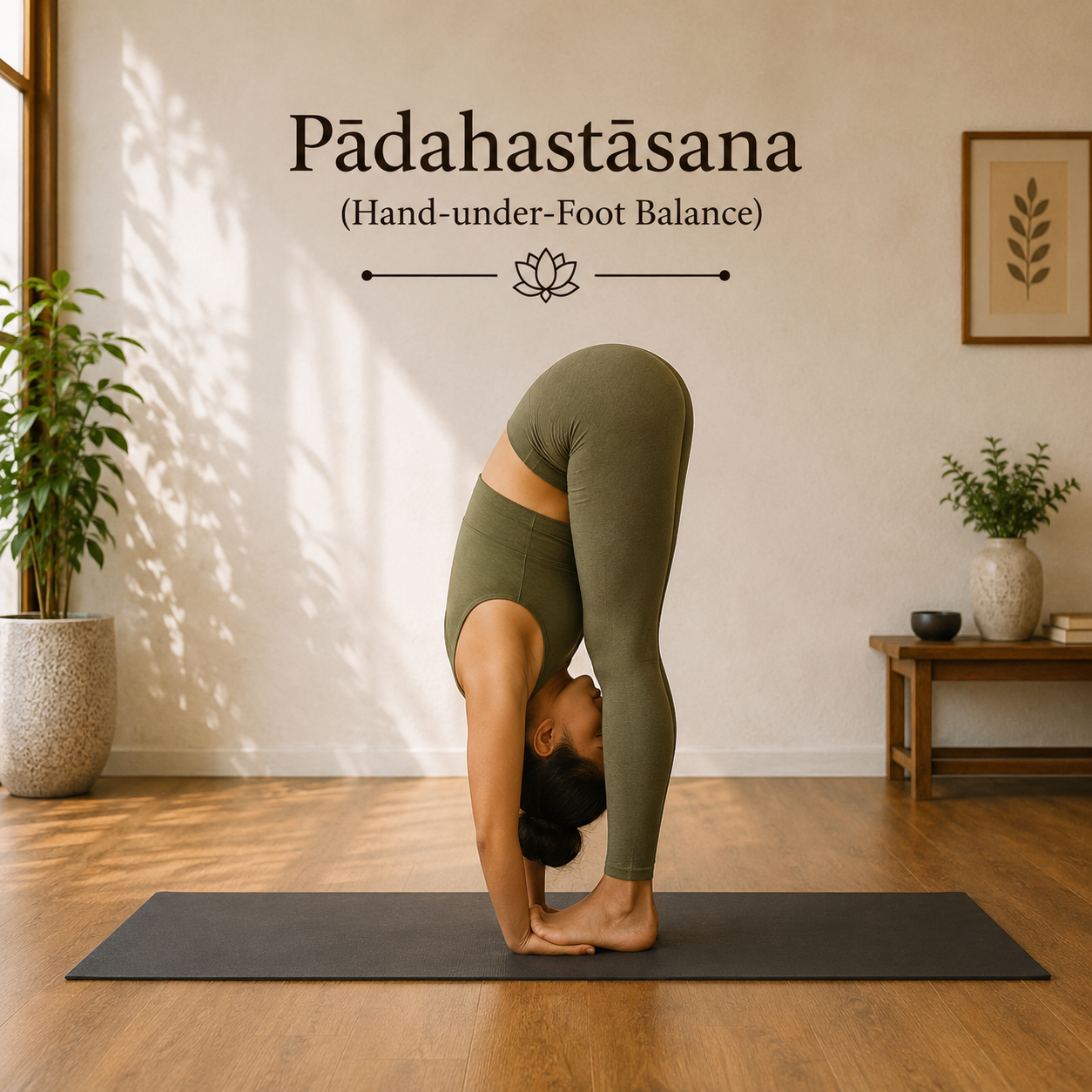
Pādahastāsana, classically translated as the Hand-under-Foot Pose, is often approached in modern classes as a standard, passive hamstrings stretch. However, its traditional lineage variation functions as an intense, closed-loop vertical balance. By stepping the balls of the feet fully onto the palms of the hands and moving the center of mass forward, the practitioner creates a unique mechanical lever. This configuration demands total posterior chain lengthening, deep core hollowing, explosive forearm wrist flexor grounding, and high-level vestibular stabilization. This comprehensive manual synthesizes traditional Hatha frameworks with modern biomechanical precision, providing a definitive reference for yoga teachers, therapists, and practitioners.
1. Comprehensive Benefits of Traditional Pādahastāsana
Physical & Structural Benefits
- Total Posterior Chain Decompression: Provides an intense, progressive eccentric stretch across the entire posterior kinetic chain, including the hamstrings, gluteals, gastrocnemius, and the deep erector spinae group.
- Decompression of the Lumbar Spine: Shifting the center of gravity forward while bound to the hands allows gravity to gently open the intervertebral spaces, encouraging hydrostatic fluid exchange.
- Wrist Joint Counter-Flexion & Therapy: Placing the feet completely onto the palms applies a beneficial deep compression that stretches the carpal tunnel space, acting as an exceptional counter-stretch to modern desk typing and advanced arm balances.
- Deep Core Layer Activation: To maintain balance without tipping forward, the practitioner must maximally contract the transversus abdominis and rectus abdominis, generating internal pelvic stability.
Mental & Emotional Benefits
- Recalibrating Vestibular Balance: Inverting the gaze while shifting the body mass over an uncommon base of support trains present-moment cognitive coordination and deep proprioceptive confidence.
- Soothing Nervous System Stress: The localized chin-to-chest positioning stimulates baroreceptors, triggering a calming parasympathetic vagal response that reduces sympathetic arousal.
Spiritual & Subtle Energy Benefits
- Activation of Mūlādhāra and Svādhiṣṭhāna Chakras: Traditional yogic subtle anatomy asserts that grounding the hands flat beneath the soles loops subtle root energies back into the pelvic basin, encouraging grounding and emotional vitality. Traditional yogic belief; scientific evidence is limited.
- Harmonization of Apāna Vāyu: Symmetrical forward inversion targets the lower abdominal boundaries, regulating the downward elimination winds and drawing them inward to kindle the central axis. Traditional yogic belief; scientific evidence is limited.
2. Step-by-Step Practice Guide
To experience the full biomechanical benefits of this traditional balance variation while safeguarding your lower back and hamstring attachments, execute using these precise progressive stages:
-
The Standing Inversion Entry (The Foundation)
- Action: Stand tall in Tādāsana with feet hip-width apart. Inhale deeply, growing long through the sides of your waist. Exhale smoothly, and hinge at your hip joints to fold forward into a partial forward bend, softening your knees slightly to protect your lower back structures.
- Breathing: Exhale completely throughout the duration of the descent, scooping the lower abdominal wall inward and up.
- Alignment: Ensure the feet remain perfectly parallel like train tracks, with your kneecaps tracking in line with your second toes.
- Common Mistake: Rounding deeply from the lower lumbar column instead of hinging directly from the deep pelvic hip sockets.
- Correction: Bend your knees as much as needed to drape your belly completely flat over your thighs, keeping the lower spine long.
- Teacher Cue: "Hinge from your hip creases, lengthening your spine toward the floor like a waterfall cascading down."
-
The Hand-under-Foot Bind (The Connection Phase)
- Action: Lift the front ball of your right foot and slide your right hand underneath, palm facing up, until your toes touch your right wrist crease. Repeat the exact step with your left hand beneath your left foot. Squeeze your toes down gently into the heels of your hands.
- Breathing: Inhale slowly, lifting your chest slightly into a neutral flat-back shape to expand your lungs.
- Alignment: The soles of your feet must step fully onto your palms, covering your fingers entirely, with the big toe mounds pressing into the bases of your thumbs.
- Common Mistake: Only sliding the fingers beneath the toes, which drops the mechanical efficiency of the lever and strains the fingers.
- Correction: Step forward boldly until your wrist creases are deeply pinned beneath your front toe pads.
- Teacher Cue: "Walk your feet all the way onto your hands until your toes massage your wrist joints."
-
The Forward Weight Shift (The Balanced Expression)
- Action: Inhale, look slightly forward, and begin to straighten your legs while keeping your palms pinned. Exhale deeply, pull your elbows wide out to the sides, and shift your entire body weight forward into the balls of your feet. Let your head hang down completely neutral, drawing your forehead toward your shins.
- Breathing: Maintain continuous, steady diaphragmatic breathing. The front torso is compressed; expand the back and sides of your ribs with each inhale. Do not hold your breath.
- Alignment: Keep your hips stacked directly over your ankles; do not let your seat slide backward behind your heels.
- Common Mistake: Sitting your hips backward into a passive hang, which removes the core engagement and over-strains hamstring attachments.
- Correction: Lean forward purposefully past your comfort zone, pressing down through your toes until the heels of your feet feel incredibly light.
- Teacher Cue: "Shift your body mass forward onto your hands, stacking your hips straight above your heels like an upright beam."
-
The Mindful Release and Exit
- Action: Soften your knees, slide your hands out from beneath your soles, and place your fingers lightly on your hips. Engage your deep core wall layers, look down at the floor, and with a long, straight spine, slowly roll your torso back up to an upright standing stance.
- Breathing: Inhale slowly and fully throughout the entire duration of your ascent, matching the movement to the breath.
- Alignment: Keep your head rising as the absolute last piece to prevent sudden lightheadedness or drop in local blood pressure. Pause in Tādāsana.
- Common Mistake: Rolling up quickly with a rounded spine and loose core, which shocks the lumbar stabilizers.
- Correction: Rise with a completely neutral spine, driving down through your feet and leading upward with your chest.
- Teacher Cue: "Brace your core, press into your feet, and rise up with a flat back, unfurling like a flower."
3. Common Alignment Mistakes & Technical Corrections
Avoiding technical compensation patterns is essential to prevent chronic joint compression over time:
| Identified Mistake | Anatomical Consequence | Biomechanical Correction |
|---|---|---|
| Hips Sinking Backward (Passive Hang) | Shifts the center of gravity behind the support base, overloading hamstring tendons and flattening the lumbar arch. | Actively shift your weight forward into the toes, aligning the hip points vertically over the ankle bones. |
| Elbows Collapsing Inward | Pinches the neck joints, crowding the cervical column and compressing the subacromial space. | Flaring the elbows wide out to the sides, drawing the shoulder blades down the back away from your ears. |
| Hyperextending the Knees | Torques the posterior knee capsule ligaments, straining the joints and bypassing gluteal lengthening. | Keep a micro-bend inside the knees, activating the quadriceps firmly to support a safe, muscular stretch. |
| Cranking the Neck (Looking Up) | Pinches the cervical vertebrae joints, creating tension in the suboccipital and upper trapezius muscles. | Release your head completely toward the earth, keeping the back of the neck long, relaxed, and neutral. |
Figure 1: Biomechanical closed-loop lever map showing the body weight shifted forward to stack the hips vertically directly over the ankle base.
4. Contraindications & Precautions
While highly therapeutic when modified correctly, traditional Pādahastāsana should be altered or avoided under the following physiological conditions:
- Acute Lumbar Disc Herniation with Radiculopathy: Deep forward flexion increases pressure on the front vertebral discs, which can push the disc nucleus further backward and aggravate sciatica.
- Unmanaged High Blood Pressure or Glaucoma: Static inversion moves fluid lines upward, increasing ocular and cranial pressures; strictly contraindicated for active conditions.
- Severe Hamstring Tendon Tears or High Tendonitis: The deep eccentric loading required to extend the legs while bound can aggravate micro-tears near the sitting bone attachments.
- Late Second and Third Trimester Pregnancy: Deep forward compression completely restricts space for the abdomen and is contraindicated; choose wide standing variations or wall stretches instead.
- Severe Vertigo or Vestibular Disorders: Shifting weight forward upside down can cause sudden dizziness or loss of balance stability; practice with wall support.
5. Intelligent Sequencing Protocols
Sequencing Summary Matrix
- Preparatory Asanas: Tādāsana (Mountain Pose), Marjaryasana-Bitilasana (Cat-Cow), Uttānāsana (Standing Forward Fold), Pādāṅguṣṭhāsana (Big Toe Hold).
- Follow-up Counter Poses: Anjaneyāsana (Low Lunge - opens front hip flexors), Utkaṭāsana (Chair Pose), gentle back extensions or Ardha Anuvittāsana.
- Key Progressions & Variations: Paschimottānāsana (Seated variant), Utthita Hasta Pādāṅguṣṭhāsana (standing single leg balance).
- Structural Integration: Positioned near the end of the standing warm-up block, serving as the deep closing forward bend before transitioning down onto the mat.
Comprehensive Sequencing Context
An effective yoga sequence must prepare target structural tissues before subjecting them to deep mechanical loads. Pādahastāsana requires initial mobilization of the spinal column via gentle movements like Cat-Cow to warm up the joints, along with lengthening the hamstrings via standard forward folds. Placing this traditional balance variation at the peak of the standing forward bending block builds directly upon the baseline flexibility established in earlier holds. Following execution, structural harmony must be restored by transitioning into extension counter-poses, most notably low lunges or a gentle standing backbend to release the working core and hip flexors. This systematic approach allows the active spinal extensors and posterior leg chains to release safely, preventing protective muscle spasms across the lumbar region.
6. Strategic Modifications for Special Populations
Yoga should adapt to the unique architectural needs of the individual body. Use these specialized modifications to keep the practice accessible and therapeutic:
-
For Beginners with Tight Hamstrings or Limited Range:
- Bend your knees as deeply as needed to slide your hands completely under your feet. Keeping your knees bent allows you to experience the wrist decompression and forward weight shift safely without over-straining tight leg tendons.
-
For Seniors or Individuals with Minor Balance Anxiety:
- Practice with your buttocks resting lightly flat against a solid wall. Standing with the wall backing stabilizes your center of gravity mechanically, removing any fear of falling forward while you train the hand bind.
-
For Pregnant Practitioners (Alternative Approach):
- Deep abdominal compression is unavailable. Modify by practicing **Wide-Legged Standing Forward Fold (Prasārita Pādottānāsana)** with your hands supported on firm blocks, building leg flexibility while keeping the belly completely safe.
-
For Individuals with Carpal Tunnel Syndrome or Wrist Inflammation:
- Avoid sliding the hands beneath the feet. Instead, practice standard **Uttānāsana with hands on blocks**, focusing entirely on the leg lengthening without putting full compression over the wrist creasing paths.
-
For Pediatric/Children Classes:
- Focus on short, dynamic holds paired with imaginative play ("stepping on your hands like a balanced gorilla") to protect their developing growth plates from sustained static loading.
7. Historical Background & Classical Scriptural References
Pādahastāsana stands out as a traditional, authentic posture documented across centuries of Hatha Yoga lineages, widely recognized for its deep purifying and calming effects.
Ancient Lineage Traditions
The name is derived from the Sanskrit words *Pāda* (meaning foot), *Hasta* (meaning hand), and *Āsana* (meaning posture). While early medieval manuals focused primary attention on seated meditative seats, subsequent expansions and traditional commentary from the 19th-century systems integrated standing forward loops under the family of total spine conditioners, praising their ability to kindle metabolic fire (Agni), stimulate gastric channels, and clear sluggishness from the posterior kinetic lines.
Modern Institutional Refinements
The precise technical balance standard taught globally today—including the strict hip-over-ankle vertical stacking mechanism—was heavily refined and formalized by master systems, prominently featured within the Ashtanga Vinyasa Primary Series and showcased by B.K.S. Iyengar in his landmark 1966 manual Light on Yoga, establishing it as a master benchmark for elite hamstring flexibility and core hollowing safety.
8. Biomechanical and Anatomical Analysis
Primary Movers and Muscle Actions
- Posterior Chain Extensors (Antagonists Lengthened): The hamstrings (biceps femoris, semitendinosus, semimembranosus), erector spinae, gluteus maximus, and gastrocnemius experience maximum eccentric lengthening under joint tension.
- Anterior Core wall (Agonists): The rectus abdominis and transversus abdominis contract concentrically to scoop the belly and pull the torso deeply downward.
- Upper Extremity Anchor Girdle: The biceps brachii and brachioradialis contract to bend the elbows wide, while the lower trapezius depresses the shoulder blades to free the neck.
Biomechanics and Force Architecture
- The Closed-Loop Lever System: Stepping onto the palms creates a locked structural ring. The downward force of the toes pressing into the wrist creases generates an equal and opposite upward ground reaction force, allowing the arms to pull the torso deeper into flexion without compressing the lower back.
- The Forward Weight Counterbalance: Because the body naturally wants to sit back into the heels to avoid stretching tight hamstrings, the practitioner must actively lean forward. Shifting the center of mass past the ankles relocates gravity directly over the toe tripod, maximizing the length along the back thighs.
- Neutral Lumbar Stabilization: Strongly engaging the deep abdominal vacuum provides an internal support anchor that protects the lumbar spine from over-flexing, spreading the fold evenly across the hip sockets.
9. Systemic Physiological Effects
- Nervous System: Deep chest flexion combined with inversion stimulates the carotid baroreceptors. This activation tones the vagus nerve, slowing down the heart rate and shifting the body into a relaxed parasympathetic state.
- Respiratory System: The physical compression of the front torso restricts belly breathing, forcing you to breathe deeply into your back ribs and side lungs, which builds primary breathing muscle endurance.
- Cardiovascular System: Symmetrical forward inversion utilizes gravity to assist passive venous blood return from the lower extremities, supporting overall healthy vascular circulation.
- Digestive System: Squeezing the abdominal muscle wall inward applies a gentle mechanical massage to the internal organs, stimulating peristalsis and helping clear sluggishness.
10. Clinical Research & Therapeutic Applications
Modern physical therapy and sports biomechanics literature provide reliable evidence supporting the use of progressive forward stretching and posterior chain lengthening within rehabilitation programs:
- Management of Postural Hyperkyphosis: Clinical trials evaluating functional flexibility training verify that structured forward flexions combined with shoulder retraction significantly enhance back mobility, reversing rounding caused by modern computer-bound desk habits.
- Alleviation of Postural Fatigue: Peer-reviewed studies confirm that targeted stretching of the posterior leg chain and back extensors relieves muscular stiffness, lowering chronic markers of fatigue held across the structural frame.
- Disclaimer: The therapeutic applications discussed here are meant for educational purposes and to support overall wellness. They are not a replacement for professional medical diagnosis, targeted advice, or customized clinical treatment plans. Always consult a qualified healthcare provider or physical therapist when dealing with acute spinal or joint injuries.
11. Teaching Methodology: Cues and Adjustments
Verbal & Imagery Cues
- "Imagine your hips are balanced on an upright wall; lean forward until your heels feel completely light like feathers."
- "Press your big toe mounds firmly into the heels of your hands, massaging your wrist joints with your weight."
- "Flare your elbows wide out to the sides to widen your upper back, pulling your ears completely free from your shoulders."
Safe, Non-Invasive Hands-On Adjustments
- Sacrum and Pelvic Alignment Support: Standing behind the practitioner folding forward, the teacher can place their hands gently flat on the student's outer hips or sacrum base, applying a subtle forward and upward tracking vector. This steady guide helps the student align and stack their hips vertically over their ankles, deepening the stretch safely without risking balance loss.
- Safety Note: Never push, pull, or force a student's torso lower down toward their legs in Pādahastāsana. The lower back and hamstring attachments are highly vulnerable to tearing if forced abruptly; adjustments must focus entirely on stabilizing the pelvic base and checking knee tracking, letting the student manage their own depth safely.
12. Myth vs. Fact Analysis
- Myth: Your legs must be perfectly straight and your forehead touching your shins for Hand-under-Foot Pose to be considered correct or beneficial.
- Fact: Forcing straight legs before your back muscles are long enough will cause your lower spine to round painfully, pinching the discs. Bending your knees as much as needed to keep your spine long completely activates the wrist decompression and stretches the leg lines safely.
- Myth: Pādahastāsana is exactly the same posture as standard standing forward fold (Uttānāsana).
- Fact: Biomechanically, they are distinct shapes. Uttānāsana allows the arms to rest loosely on the floor or ankles in an open lever. Pādahastāsana requires you to step your feet flat onto your palms, creating a closed-loop tension system where your toe press directly drives the arm leverage to deepen the fold.
Quick Reference Facts Table
| Sanskrit Name | Pādahastāsana (पादहस्तासन) - Traditional Balance Variation |
| English Name | Hand-under-Foot Pose / Standing Forward Fold Balance |
| Difficulty Level | Intermediate (Progressive balance architecture) |
| Primary Anatomical Focus | Hamstrings, Erector Spinae, Transversus Abdominis, Wrist Flexors |
| Primary Joint Actions | Hip Flexion, Knee Extension, Wrist Counter-Flexion, Full Spinal Flexion |
| Traditional Chakra Influence | Mūlādhāra (Root) & Svādhiṣṭhāna (Sacral) Chakras |
| Ayurvedic Constitution Impact | Reduces excess Kapha and Vata; builds deep mental grounding to calm busy minds |
Frequently Asked Questions (FAQ)
Q1: What is the main structural difference between Uttānāsana (Standing Forward Bend) and Pādahastāsana?
A: In Uttānāsana, your hands rest loosely on the floor, blocks, or your ankles in an open-ended loop. In Pādahastāsana, you slide your palms completely underneath the soles of your feet, creating a locked structural ring where your feet anchor the arm lever to actively pull your torso deeper into the fold.
Q2: Why does my lower back ache or pinch when I try to straighten my legs in this pose?
A: A pinching sensation means your hamstrings are too tight, forcing your lower back spine to round excessively to make up for the lack of hip mobility. To protect your discs, lower your hips slightly by keeping your knees bent, focusing on keeping your lower spine straight and long.
Q3: Which way should my elbows point when I am pulling my torso downward?
A: Your elbows should flare completely wide out to the sides away from your body. Bending your elbows wide activates your upper back stabilizers (rhomboids and middle trapezius), which pulls your shoulder blades away from your ears and keeps your neck free from tension.
Q4: Can I practice Hand-under-Foot Pose if I am currently dealing with an active sciatica flare-up?
A: No. Deep inverted forward flexions increase pressure on the front of your spinal discs, which can push the disc nucleus backward and further compress sensitive nerve roots. Avoid the posture during acute flare-ups and choose gentle supine leg stretches instead.
Q5: How long should an intermediate student focus on holding the traditional balance variation?
A: Intermediate students should focus on quality holds of 3 to 5 deep breath cycles (around 15 to 25 seconds), prioritizing parallel feet, stacked hips directly over ankles, and smooth, lateral thoracic breathing.
Q6: Why do my hips always want to slide backward behind my heels when I fold?
A: Your hips slide back automatically because your body is trying to escape the intense stretch along the back of your thighs. To correct this, consciously lean forward, shifting your weight into the balls of your feet until your heels feel incredibly light against the mat.
Q7: Is it normal for my hands to feel heavy or pinned beneath my toes?
A: Yes, completely normal. Shifting your weight forward means the balls of your feet compress the heels of your hands. This deep compression provides a highly beneficial counter-stretch for your wrist joints, releasing tension built up from typing or arm balances.
Q8: Can practicing Pādahastāsana help improve core muscle conditioning?
A: Yes, beautifully. Shifting your weight forward past your ankles upside down requires your deep abdominal core layers (transversus abdominis) to contract powerfully to stabilize your frame, directly boosting functional trunk endurance over time.
Q9: How far underneath my feet should I slide my hands during the setup?
A: You should slide your hands all the way underneath until your front toe pads press firmly against your wrist creases. Sliding your hands completely under locks the biomechanical loop securely, providing the correct leverage for your arms.
Q10: Is it safe to practice this traditional balance variation during pregnancy?
A: No. The deep forward fold fully compresses the abdominal wall, restricting space for the uterus. Pregnant practitioners should avoid full belly flexions and choose wide standing forward folds or legs-up-the-wall tracks instead.
Q11: Why do my shoulders bunch up toward my ears when I pull down?
A: Shrugging happens when you use excessive upper arm force without engaging your lower back stabilizers. To fix this, actively pull your shoulder blades down your back toward your waist, widening your collarbones to keep your neck long.
Q12: Should my head look forward at my feet or hang completely down?
A: Your head should hang completely down toward the earth, with the back of your neck long, soft, and relaxed. Cranking your neck up to look forward pinches your cervical vertebrae joints, causing unnecessary muscle tension.
Q13: How does this posture help runners, cyclists, or active field athletes?
A: It provides an exceptional, deep eccentric stretch for the entire posterior chain (hamstrings and calves), which directly restores healthy muscle length, improves hip tracking flexibility, and significantly lowers the risk of hamstring pull injuries.
Q14: Why does my breathing feel short or limited while holding the fold?
A: Squeezing your chest against your thighs naturally compresses your abdominal wall, making belly breathing unavailable. Focus on expanding your breath sideways into your side ribs and back chest instead to keep your breathing smooth.
Q15: What is the best counter-pose to practice right after releasing Pādahastāsana?
A: Always transition immediately into an open Low Lunge (Anjaneyāsana) or a gentle standing backbend (Ardha Anuvittāsana) to allow your working core, hip flexors, and back muscles to open, release tension, and realign safely.
Refine your technique and deepen your personal practice under expert guidance.
Connect with Iti Iti Yogashram