Niyama: The Second Limb of Ashtanga Yoga
Introduction
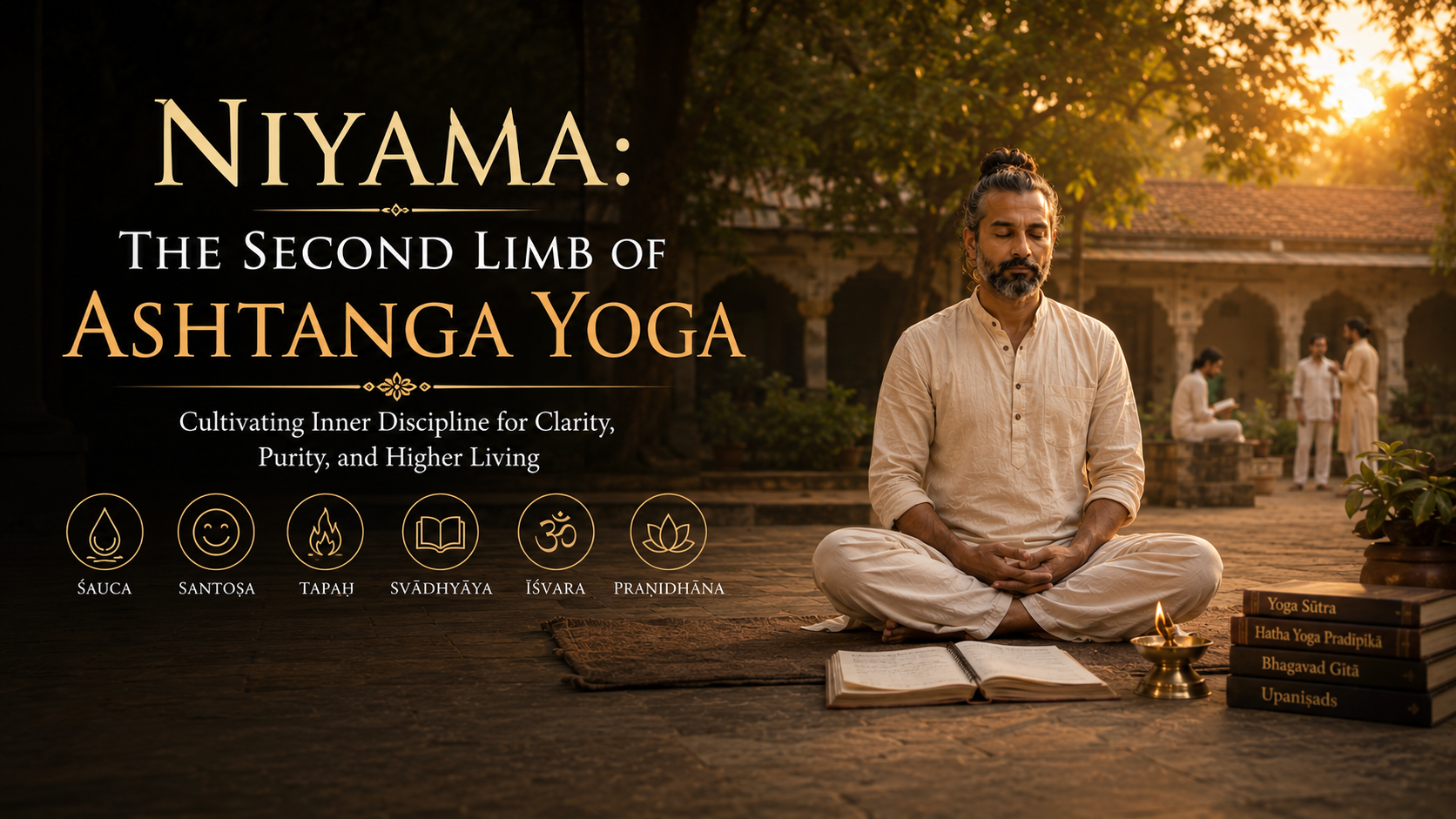
Niyama is the second limb of Ashtanga Yoga. Where Yama teaches us right conduct toward society and the outer world, Niyama teaches us to live a disciplined and self-aware inner life. It is often called personal ethics, personal observance, or self-discipline.
Maharṣi Patañjali lists five principles of Niyama (Yoga Sūtra 2.32):
- Śauca (cleanliness/purity)
- Santoṣa (contentment)
- Tapas (disciplined effort)
- Svādhyāya (sacred study)
- Īśvara Praṇidhāna (surrender to the Divine)

1. Śauca — Purity and Cleanliness
Śauca means more than outward cleanliness alone — it includes both external (Bāhya Śauca) and internal (Antara Śauca) purity.
External Śauca
- Cleanliness of the body
- Clean clothing and surroundings
- Cleanliness of one's living and working space
Internal Śauca
- Purity of mind
- Letting go of negative thoughts
- Mental and spiritual purification through Yoga, Prāṇāyāma, and meditation
The purpose of Śauca is to bring the body, mind, and spirit into a state of purity and balance.
2. Santoṣa — Contentment and Inner Joy
Santoṣa means finding contentment in what is available, while continuing to make sincere effort toward growth in life.
People often assume they will feel happy —
- once they get a particular job.
- once they own a house or a vehicle.
- once they acquire wealth, status, or a relationship.
But this kind of happiness tends to be temporary.
According to Yoga, real joy does not arise from external possessions, but from inner peace.
Through regular practice of Yoga, meditation, and Prāṇāyāma, a person begins to experience a more lasting sense of Santoṣa and contentment.

3. Tapas — Disciplined Effort and Self-Restraint
Tapas means willingly accepting difficulty while remaining steady on the path of self-development.
It is not simply about enduring hardship. It includes:
- Maintaining discipline
- Continuing practice even in difficult circumstances
- Rising above comfort-seeking
- Sustained effort toward self-development
If learning a posture takes time, or a practice requires ongoing, patient repetition, that sustained effort itself is Tapas.
Tapas gives a person patience, resolve, and inner strength.

4. Svādhyāya — Sacred Study and Self-Study
Svādhyāya = Sva + Adhyāya
Meaning, literally, the study of the Self.
It is worth being precise here, since "self-study" is often loosely equated with modern introspection alone. Classically — including in Vyāsa's commentary on the Yoga Sūtras — Svādhyāya centres specifically on two closely linked practices:
(a) Recitation and Study of Sacred Texts
- Recitation (Japa) of the sacred syllable Auṃ and other mantras
- Study of Yoga philosophy
- Study of the Vedas and Upanishads
- Study of the Bhagavad Gītā
- Study of other Mokṣa-Śāstra — scriptures whose focus is liberation of the soul
(b) Self-Reflection Arising From This Study
- What am I thinking?
- How is my speech?
- How are my actions?
- How do I react to situations?
Modern teaching often extends Svādhyāya to include general introspection and self-inquiry independent of scriptural study — a valuable and widely used extension — but it is worth knowing that its classical core, as described by Patañjali (2.44) and Vyāsa, is specifically mantra recitation and the study of liberating scripture, from which self-reflection naturally follows.
Svādhyāya is impartial observation of oneself, not the passing of judgment on oneself. It increases self-awareness and moves a practitioner toward their true nature.
5. Īśvara Praṇidhāna — Complete Surrender
Īśvara Praṇidhāna = Īśvara + Praṇidhāna
- Īśvara — Supreme Consciousness, the Supreme Being
- Praṇidhāna — complete surrender
Meaning: dedicating one's life, actions, and their outcomes to the Supreme Being.
This means:
- Holding trust in life.
- Releasing egotism.
- Regarding oneself as part of the universe.
- Accepting every circumstance while still performing one's best action.
Surrender does not mean passivity. It means giving complete effort, and then accepting the result that follows.
Kriyā Yoga
According to Maharṣi Patañjali (Yoga Sūtra 2.1), the last three limbs of Niyama —
- Tapas
- Svādhyāya
- Īśvara Praṇidhāna
together constitute Kriyā Yoga — described by Patañjali as the practical, preliminary form of Yoga that weakens the mental afflictions (Kleśas) and prepares the ground for Samādhi.
A commonly used teaching correlation links each of these three to one of the broader paths of Yoga:
| Niyama | Associated Path of Yoga |
|---|---|
| Tapas | Karma Yoga |
| Svādhyāya | Jñāna Yoga |
| Īśvara Praṇidhāna | Bhakti Yoga |
It is worth noting that this three-way correlation is a popular teaching device, useful for illustrating how Kriyā Yoga integrates action, knowledge, and devotion — but it is not a mapping stated explicitly in the Yoga Sūtras themselves. Patañjali defines Kriyā Yoga's three components and their purpose (Yoga Sūtra 2.1–2.2); the alignment with Karma, Jñāna, and Bhakti Yoga is a later interpretive bridge, not the Sūtra's own wording.
The Importance of Niyama
Niyama shapes a person's inner character.
Its regular practice brings about:
- Purification of body and mind.
- The development of contentment and mental peace.
- Increased self-discipline.
- Growing self-awareness.
- Deepening faith in and surrender to the Divine.
- Progress toward the higher stages of Yoga.
Key Points
- Niyama is the second limb of Ashtanga Yoga.
- It concerns a practitioner's personal discipline and self-development.
- The five principles of Niyama are: Śauca, Santoṣa, Tapas, Svādhyāya, and Īśvara Praṇidhāna.
- Śauca is both external and internal purity.
- Santoṣa is the practice of lasting inner contentment.
- Tapas is sustained, disciplined effort through difficulty.
- Svādhyāya classically centres on the recitation of sacred mantras and the study of liberating scripture, alongside self-reflection.
- Īśvara Praṇidhāna is complete surrender and trust in the Supreme Being.
- Tapas, Svādhyāya, and Īśvara Praṇidhāna together form Kriyā Yoga.
- The practice of Niyama makes a practitioner pure, balanced, and spiritually mature.
Editorial Notes: Corrections and Clarifications
-
Svādhyāya's classical meaning needed sharpening. The original draft framed Svādhyāya almost entirely as "study of scripture" plus general "self-introspection," without mentioning its classical anchor: recitation (Japa) of Auṃ and other sacred mantras, alongside study of Mokṣa-Śāstra. Vyāsa's commentary on Yoga Sūtra 2.1 and Patañjali's own 2.44 both centre Svādhyāya on this mantra-and-scripture practice specifically. Modern introspection-focused teaching is a valid and common extension, but this piece now makes clear which part is the classical core and which is later extension.
-
The Tapas–Karma Yoga / Svādhyāya–Jñāna Yoga / Īśvara Praṇidhāna–Bhakti Yoga correlation has been flagged as a teaching device, not a mapping Patañjali states explicitly in the Sūtras themselves — the Sūtras define Kriyā Yoga and its purpose, but this three-way correspondence to the broader Yoga paths is a later interpretive layer.
-
A note on scientific context (per your standing request to check facts against both scripture and science): the practice of Santoṣa (contentment) overlaps with what positive psychology research studies as "hedonic adaptation" — the well-documented finding that happiness from acquiring new possessions or circumstances tends to fade over time, while gratitude and acceptance-based practices are associated with more stable wellbeing. This supports the general thrust of the Santoṣa teaching, though it describes a psychological pattern, not a scientific validation of the deeper spiritual claim that lasting joy arises specifically from union with the Self.
Conclusion
Niyama takes the ethical foundation laid by Yama and turns it inward — toward purity, contentment, disciplined effort, sacred study, and surrender to the Divine. Together with Yama, it prepares the ground on which Āsana, Prāṇāyāma, and the deeper internal limbs of Ashtanga Yoga can be practised with a stable, purified mind.
Want to go deeper into authentic Yoga practice with Iti Iti Yogashram?
Get in Touch