The Nine Antarāyas: Understanding the Obstacles on the Path of Yoga
Introduction
Why does a sincere Yoga practitioner sometimes struggle to continue on the path?
The difficulty is not always a lack of knowledge.
A practitioner may understand the importance of Abhyāsa and still become irregular. One may begin with enthusiasm but gradually lose mental energy. Doubt may arise. Negligence may enter practice. Sensory involvement may repeatedly draw Citta outward. Even after attaining a certain degree of steadiness, the practitioner may fail to remain established in it.
Patañjali examines these difficulties with remarkable precision.
In the Samādhi Pāda of the Yoga Sūtras, he identifies nine Antarāyas—impediments or obstacles associated with the distraction of Citta.
He states:
व्याधिस्त्यानसंशयप्रमादालस्याविरतिभ्रान्तिदर्शनालब्धभूमिकत्वानवस्थितत्वानि चित्तविक्षेपास्तेऽन्तरायाः॥१.३०॥
Vyādhi-styāna-saṁśaya-pramādālasyāvirati-bhrānti-darśanālabdha-bhūmikatvānavasthitatvāni citta-vikṣepās te 'ntarāyāḥ
These are not simply nine bad habits.
Patañjali describes them as Citta-vikṣepāḥ—conditions associated with the scattering, distraction, or disturbance of Citta—and calls them Antarāyas, obstacles.
Understanding them is important because a practitioner cannot intelligently respond to an obstacle that has not been clearly recognised.
What Does Antarāya Mean?
The Sanskrit word Antarāya carries the sense of an impediment, obstacle, or interruption.
Within Yoga Sūtra 1.30, the term has a specific Yogic context.
Patañjali is discussing the conditions that disturb the movement of Citta towards Yogic steadiness and Samādhi.

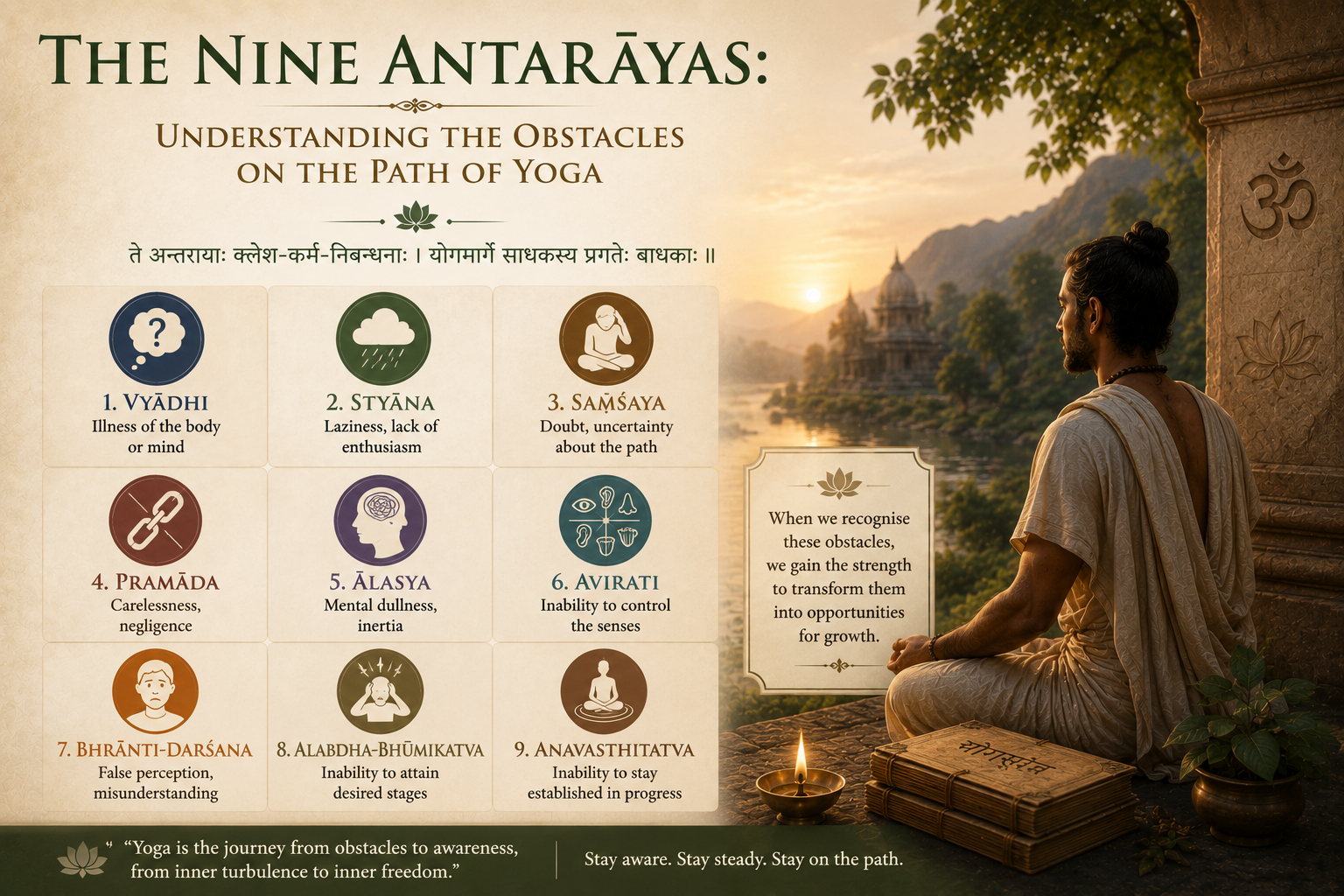
The nine Antarāyas are:
- Vyādhi — Disease or illness
- Styāna — Mental stagnation or languor
- Saṁśaya — Doubt
- Pramāda — Negligence or carelessness
- Ālasya — Laziness or inertia
- Avirati — Inability to withdraw from sensory involvement
- Bhrānti-darśana — Mistaken view or false cognition
- Alabdha-bhūmikatva — Failure to attain a stage or ground
- Anavasthitatva — Failure to remain established in an attained stage
Let us examine each term carefully.
1. Vyādhi: Disease or Illness
The first Antarāya is Vyādhi.
Vyādhi means disease, illness, or bodily disorder.
It should not simply be translated as "physical weakness."
A person may be physically weak without suffering from a specific disease, while disease may exist even in someone who appears physically strong.
The classical commentarial tradition understands illness as a disturbance affecting the body's normal functioning.
Why is Vyādhi an obstacle in Yoga?
Because illness may disturb the continuity and capacity of practice.
Pain may repeatedly draw attention.
Physical discomfort may make sitting difficult.
Fatigue associated with illness may interfere with sustained application.
The body may require treatment, recovery, or modification of practice.
A Practical Contemplation
As a Yoga teacher, I consider an important question to be:
"Is the practitioner failing in discipline, or is the body genuinely asking for appropriate care?"
These are not the same situation.
A teacher who interprets every interruption as laziness may ignore genuine illness.
At the same time, a practitioner may sometimes use minor discomfort as a permanent justification for abandoning all practice.
Discernment is necessary.
Vyādhi reminds us that the condition of the body can become directly relevant to the continuity of Sādhana.
2. Styāna: Mental Stagnation or Languor
The second obstacle is Styāna.
Styāna is often loosely translated as "mental weakness" or "negative thinking."
These translations are inadequate.
The term suggests mental stagnation, languor, dullness, or an incapacity of the mind to engage actively.
Vyāsa's Yoga Bhāṣya explains Styāna in terms of the incapacity or unfitness of Citta for activity.
The practitioner may know that practice is necessary.
Time may be available.
The body may even be capable.
Yet Citta does not seem to engage.
There is a kind of mental non-movement.
Styāna Is Not Simply Sadness
A sad person may still practise with great discipline.
A person experiencing Styāna may not necessarily report sadness.
Therefore, Styāna should not automatically be equated with depression, negativity, or emotional suffering.
These modern psychological categories should not be casually imposed on a classical Sanskrit term.
My Practical Observation
In teaching, I sometimes meet students who say:
"I want to practise, but mentally I cannot begin."
Before calling this laziness, it is worth examining the condition more carefully.
Is there bodily inertia?
Is there doubt?
Is there dejection?
Or is Citta unable to engage with the practice?
The distinction between Styāna and Ālasya becomes important.
3. Saṁśaya: Doubt
The third Antarāya is Saṁśaya—doubt or uncertainty.
Doubt divides the direction of Citta.
The practitioner is unable to arrive at certainty.
"Is this path correct or not?"
"Is this practice effective or ineffective?"
"Am I understanding the teaching correctly?"
In practical teaching, doubt may concern oneself, the method, the teacher, or even the possibility of the Yogic goal.
However, this should be presented as a practical classification rather than a literal threefold division made by Patañjali in Yoga Sūtra 1.30.
The sūtra itself simply names Saṁśaya.
Is All Doubt an Obstacle?
This requires discernment.
Intelligent questioning is not the same as paralysing doubt.
Critical examination can protect a practitioner from false teachers, unsupported claims, and incorrect methods.
The problem begins when uncertainty repeatedly prevents sustained engagement.
A practitioner begins a method.
Doubt arises.
The method is abandoned.
Another practice begins.
Again, doubt arises.
Again, the practice is abandoned.
Eventually, the practitioner becomes highly informed about many systems but established in none.
Saṁśaya then functions as an Antarāya.
4. Pramāda: Negligence or Carelessness
The fourth obstacle is Pramāda.
Pramāda is negligence, carelessness, heedlessness, or failure to maintain proper attentiveness.
It should not simply be defined as:
"Knowing the correct thing but not doing it."
That definition is too broad and may overlap with Ālasya.
Pramāda has a stronger sense of heedlessness or failure to apply appropriate care and attention.
A practitioner may receive clear instruction but practise carelessly.
Important details may be ignored.
Discipline may become casual.
One may stop examining one's own errors.
A Practical Example
Suppose a practitioner has been repeatedly instructed not to force the breath during a particular practice.
Yet the person continues to strain because intensity feels more impressive.
This is not necessarily Ālasya.
The practitioner is actively doing something.
The problem is carelessness in relation to correct practice.
This provides a practical way of understanding Pramāda.
5. Ālasya: Laziness or Inertia
The fifth Antarāya is Ālasya.
Ālasya means laziness, sloth, or inertia.
The Yoga Bhāṣya associates it with heaviness of body and Citta that produces a lack of inclination towards activity.
This is different from Styāna.
In Styāna, the emphasis is on the incapacity or stagnation of Citta.
In Ālasya, heaviness and inertia inhibit engagement in activity.
Rest Is Not Ālasya
A Yoga practitioner must not turn the concept of Ālasya into an argument against necessary rest.
Sleep deprivation is not Tapas.
Ignoring recovery is not discipline.
A body recovering from illness may require rest.
A practitioner experiencing genuine exhaustion may need modification.
The Yogic question is not:
"Did I rest today?"
The more useful question is:
"Has avoidable inertia become a repeated force that interrupts appropriate practice?"
This distinction protects Yoga from becoming a culture of unnecessary self-punishment.
6. Avirati: Inability to Withdraw from Sensory Involvement
The sixth Antarāya is Avirati.
It is often translated as attachment to sense pleasures or overindulgence.
The term is related to the absence of Virati—cessation, withdrawal, or dispassion from involvement.
Avirati therefore points towards the inability to disengage from sensory objects and worldly involvement.
The issue is not that food, music, relationships, or ordinary life are automatically enemies of Yoga.
The deeper problem is lack of freedom in relation to them.
A Modern Practical Contemplation
A practitioner decides to meditate for twenty minutes.
The phone vibrates.
Attention immediately moves towards it.
A notification appears.
Then another video.
Then another message.
Thirty minutes disappear.
Patañjali did not write about smartphones.
Therefore, this is not the literal meaning of Yoga Sūtra 1.30.
But the modern example can help us examine Avirati.
The central question is:
"Can I withdraw attention when withdrawal is required?"
If sensory engagement repeatedly dominates the direction of Citta, Avirati becomes highly relevant to practice.
7. Bhrānti-Darśana: Mistaken View or False Cognition
The seventh obstacle is Bhrānti-darśana.
This term should not be reduced merely to "seeing lights during meditation."
Bhrānti means error, mistake, or delusion.
Darśana, in this compound, concerns seeing or understanding.
Bhrānti-darśana therefore refers to a mistaken view, false cognition, or erroneous understanding.
A practitioner may take what is not the path to be the path.
An incorrect understanding may be accepted as correct.
A limited experience may be interpreted through an erroneous philosophical framework.
Experiences in Meditation
Lights, sounds, bodily sensations, unusual imagery, or other subjective experiences may occur during practice.
The mere occurrence of such an experience is not automatically Bhrānti-darśana.
The problem lies in mistaken cognition or interpretation.
For example, a practitioner may experience a temporary visual phenomenon and immediately declare:
"I have attained Samādhi."
The visual experience itself and the interpretation of that experience are not identical.
The interpretation may be mistaken.
Why This Antarāya Is Particularly Important
Among serious practitioners, incorrect understanding can sometimes become more dangerous than lack of information.
A person who knows that they do not understand may continue learning.
A person convinced of a false view may stop examining it.
Bhrānti-darśana therefore demands Viveka—discernment.
8. Alabdha-Bhūmikatva: Failure to Attain a Stage of Practice
The eighth obstacle is Alabdha-bhūmikatva.
This term is frequently misunderstood.
It does not simply mean:
"Feeling that I have made no progress."
The term is more specific.
Alabdha means not obtained or not attained.
Bhūmi means a ground, level, stage, or state.
Alabdha-bhūmikatva therefore refers to the failure or inability to attain a particular stage or ground of Yogic practice.
The practitioner's concern about lack of progress may be a psychological response to this difficulty, but the feeling itself is not the literal definition of the Sanskrit term.
A Practical Contemplation
A practitioner may practise sincerely but remain unable to establish the required degree of steadiness for a further stage.
At this point, frustration may arise.
Comparison may begin.
Doubt may follow.
This demonstrates how one Antarāya may become practically associated with another.
However, we should distinguish the obstacle itself from the emotional response that may accompany it.
Alabdha-bhūmikatva is the non-attainment of the stage.
"I feel disappointed because I have not progressed" is a possible response to that condition.
The two should not be confused.
9. Anavasthitatva: Instability in an Attained Stage
The ninth Antarāya is Anavasthitatva.
If Alabdha-bhūmikatva concerns failure to attain a stage, Anavasthitatva concerns failure to remain established after a stage has been attained.
This distinction is fundamental.
In the first case, the practitioner has not reached the ground.
In the second, the ground has been reached, but stability in it is not maintained.
A Practical Example
A practitioner may experience a period of genuine steadiness in meditation.
Practice becomes subtle.
Attention becomes more stable.
Then continuity weakens.
The practitioner is unable to remain established in the attained condition.
This is closer to the meaning of Anavasthitatva.
It should not simply be described as:
"My balance breaks when circumstances change."
That may be a useful modern reflection, but the classical term is specifically concerned with instability in an attained stage of practice.
The Danger of Chasing a Previous Experience
In practical teaching, I have observed another pattern.
A practitioner has one powerful experience and then spends months trying to reproduce it.
Every meditation is compared with the previous experience.
"That day my meditation was deeper."
"Why am I not reaching the same state?"
This is my practical observation as a Yoga teacher, not Patañjali's literal definition of Anavasthitatva.
However, attachment to a previous experience may itself complicate the practitioner's relationship with continuity and stability.
Yoga requires practice in the present—not endless psychological comparison with yesterday's meditation.
Are the Nine Antarāyas Connected?
Yoga Sūtra 1.30 lists nine Antarāyas, but in practical experience they need not always appear in complete isolation.
Illness may interrupt practice.
Interrupted practice may contribute to doubt.
Doubt may weaken sustained application.
Negligence may allow irregularity to develop.
Sensory involvement may repeatedly scatter attention.
Failure to attain a stage may be followed by dejection, which Patañjali discusses in the next sūtra as one of the accompaniments of Vikṣepa.
However, we should be precise.
Yoga Sūtra 1.30 itself does not provide a formal causal diagram stating that one specific Antarāya always produces another.
The relationship between them may be explored practically, but it should not be presented as a rigid sequence established by the sūtra.
What Happens When Vikṣepa Is Present?
Patañjali continues immediately in Yoga Sūtra 1.31:
दुःखदौर्मनस्याङ्गमेजयत्वश्वासप्रश्वासा विक्षेपसहभुवः॥१.३१॥
Duḥkha-daurmanasyāṅgamejayatva-śvāsa-praśvāsā vikṣepa-sahabhuvaḥ
Pain or suffering, dejection, bodily trembling, and disturbance in the movement of inhalation and exhalation are described as accompaniments of Vikṣepa.
This textual sequence is important.
Yoga Sūtra 1.30 identifies the Antarāyas.
Yoga Sūtra 1.31 describes the conditions accompanying Vikṣepa.
Patañjali then states in Yoga Sūtra 1.32:
तत्प्रतिषेधार्थमेकतत्त्वाभ्यासः॥१.३२॥
Tat-pratiṣedhārtham eka-tattvābhyāsaḥ
For counteracting these, there is Eka-Tattva-Abhyāsa—practice concerned with one principle.
Therefore, Patañjali does not merely present a list of problems. The discussion moves from obstacles to their accompaniments and then towards a principle of counteraction.
My Practical Understanding as a Yoga Teacher
As a Yoga teacher, I find the nine Antarāyas valuable because they force us to become more precise about why practice is being disturbed.
A student may simply say:
"I am not regular in Yoga."
But that statement tells us very little.
Why is the practice irregular?
Is illness interfering?
Is Citta mentally stagnant?
Has doubt entered the practice?
Has carelessness replaced attentiveness?
Has inertia become dominant?
Is sensory involvement repeatedly pulling attention outward?
Has an incorrect understanding entered the practice?
Is the practitioner unable to attain a required stage?
Or has a previously attained degree of steadiness become unstable?
The solution should not be identical in every case because the obstacle is not identical.
This is my practical contemplation as a teacher.
Patañjali lists the Antarāyas. The application of this framework to individual students requires observation, discernment, and responsible teaching.

A Practical Framework for Self-Observation
When practice becomes disturbed, a practitioner may ask:
Vyādhi: Is illness genuinely affecting my capacity to practise?
Styāna: Is Citta unable to engage actively with the practice?
Saṁśaya: Is unresolved doubt repeatedly dividing my direction?
Pramāda: Have I become careless or heedless in practice?
Ālasya: Has avoidable inertia become dominant?
Avirati: Am I unable to withdraw from sensory involvement when required?
Bhrānti-darśana: Am I interpreting the path, teaching, or my experiences incorrectly?
Alabdha-bhūmikatva: Am I unable to attain the required stage of practice?
Anavasthitatva: Have I attained a degree of steadiness but failed to remain established in it?
These questions are practical contemplations inspired by Yoga Sūtra 1.30.
They are not direct quotations from Patañjali.
Their purpose is to help the practitioner examine practice with greater precision.
Key Points
- Yoga Sūtra 1.30 identifies nine Antarāyas associated with Citta-vikṣepa.
- Vyādhi means disease or illness and should not simply be reduced to weakness.
- Styāna refers to mental stagnation, languor, or incapacity of Citta to engage in activity.
- Saṁśaya means doubt; the popular division into doubt about self, method, and teacher is a practical classification, not Patañjali's literal threefold scheme.
- Pramāda concerns negligence, carelessness, or heedlessness.
- Ālasya refers to laziness or inertia and should be distinguished from necessary rest.
- Avirati concerns inability to withdraw from sensory involvement.
- Bhrānti-darśana means mistaken view or false cognition and is broader than unusual meditation experiences.
- Alabdha-bhūmikatva is failure to attain a stage or ground of practice, not merely the feeling that progress has not occurred.
- Anavasthitatva is failure to remain established in an attained stage.
- The Antarāyas may interact in practical experience, but Yoga Sūtra 1.30 does not present a fixed causal chain between them.
- Yoga Sūtras 1.30–1.32 form an important sequence: obstacles, accompaniments of Vikṣepa, and a principle of counteraction.
Conclusion
The nine Antarāyas of Yoga Sūtra 1.30 reveal the precision of Patañjali's examination of the Yogic path.
The practitioner may be obstructed by disease.
Citta may become stagnant.
Doubt may divide direction.
Negligence may weaken attentiveness.
Inertia may prevent engagement.
Sensory involvement may repeatedly draw Citta outward.
Mistaken understanding may distort the path.
A stage of practice may remain unattained.
Or, after attaining a certain ground, the practitioner may fail to remain established in it.
These are not merely nine negative personality traits.
They are Antarāyas—obstacles associated with Citta-vikṣepa.
For me, as a Yoga teacher, the practical importance of this sūtra lies in precision.
When a practitioner says:
"My practice is not progressing,"
the responsible response is not always:
"Practise harder."
First, we must understand the obstacle.
Different obstacles require different forms of discernment.
The recognition of an Antarāya is not itself the completion of Yoga.
But clear recognition can prevent us from fighting the wrong problem.
Before asking how to overcome an obstacle, learn to recognise which obstacle is actually present.
That is where intelligent Sādhana begins.