Naṭarājāsana (Lord of the Dance Pose): Complete Anatomy, Alignment & History Guide
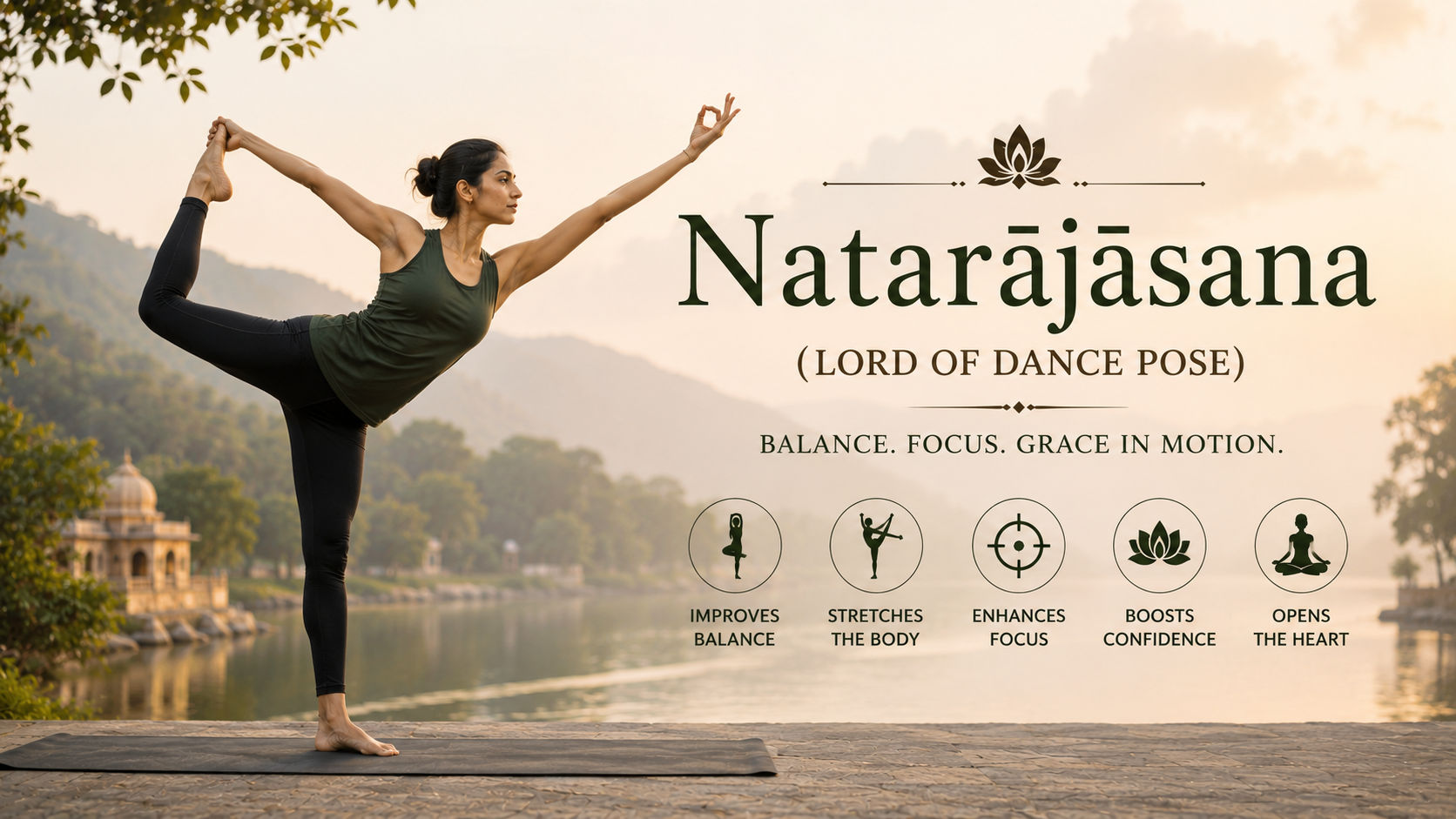
Naṭarājāsana (Lord of the Dance Pose): The Complete Reference Guide

Editorial note, stated once: throughout this article, traditional/symbolic associations (Nataraja iconography, chakra references) are presented as traditional or symbolic, not scientific fact, unless a specific evidence source is cited alongside them.
Name & Meaning
- Sanskrit: नटराजासन (Naṭarājāsana)
- English: Lord of the Dance Pose, Dancer Pose
- Etymology: Naṭa (dancer) + Rāja (king/lord) + Āsana (posture) — "Naṭarāja" is an epithet of Śiva in his form as the cosmic dancer
Introduction
- A standing, balancing, back-bending posture: one leg supports the body while the other is lifted, bent, and held behind the body, often with a deep backbend and one or both arms reaching overhead or back
- Widely used in intermediate-to-advanced yoga classes as a demonstration of combined balance, flexibility, and strength
- Frequently associated with grace and flexibility in yoga marketing and imagery, given its visually striking shape
- Directly inspired by the iconography of Śiva Naṭarāja, the "Dancing King," rather than by an older yoga-specific tradition — see Historical Background below for what this actually means for the pose's authenticity
How to Practice Naṭarājāsana: Step-by-Step
| Step | Action | Breath | Cue |
|---|---|---|---|
| 1 | Begin in Tāḍāsana; shift weight fully onto the standing (e.g. right) leg | Natural breath | "Root the standing leg before anything else moves." |
| 2 | Bend the left knee, reach the left hand back, and take hold of the inner left foot or ankle | Exhale to settle the grip | "Find the grip before you lift the leg." |
| 3 | Begin kicking the foot back into the hand while hinging the torso forward, keeping the standing leg's hip level | Inhale to lengthen, exhale to deepen gradually | "Kick back into the hand, don't just lift the leg." |
| 4 | Extend the free arm forward, opening the chest; keep the raised hip square rather than letting it rotate open | Steady, even breath | "Reach the front hand forward as the back leg reaches back — opposing lines." |
| 5 | Hold with a steady gaze on a fixed point; release with control | Natural breath through the hold | "Let the eyes anchor what the body is negotiating." |
Benefits
- Physical: strengthens the standing-leg quadriceps, glutes, and ankle stabilizers; stretches hip flexors, quadriceps, chest, and shoulders of the lifted-leg side; builds significant core and spinal stability to support the backbend under a balance load
- Mental: the combined demand of balance, flexibility, and backbend depth requires sustained concentration — losing mental focus typically ends the pose immediately
- Emotional: general yoga practice (not specific to this pose) is linked in several reviews to reduced perceived stress over time — moderate evidence level
- Traditional/symbolic: traditionally connected to the symbolism of Śiva's Naṭarāja form — the cosmic dance representing creation, preservation, and destruction — a traditional/symbolic association rather than a scientific claim
Common Mistakes & Corrections
- Hip rotating open toward the lifted-leg side → correction: actively draw the raised hip forward, keep both hip points facing the same direction
- Collapsing the standing knee (losing quadriceps engagement under load) → correction: keep the standing knee actively engaged, not locked or buckling
- Dropping into the backbend from the lower back alone → correction: lift and lengthen through the whole spine before deepening, distributing the backbend rather than concentrating it in the lumbar spine
Contraindications & Precautions
- Low back injury or disc issues — the backbend load is significant
- Shoulder injury (given the overhead/behind-the-back arm position)
- Significant balance or vestibular impairment
- Recent hip, knee, or ankle injury
- High or uncontrolled blood pressure — practice with caution and medical guidance given the inverted-adjacent head position some variations involve
Sequencing: Preparatory, Follow-up & Variations
- Preparatory poses: Vṛkṣāsana (for single-leg balance), Uṣṭrāsana or Bhujaṅgāsana (for backbend readiness), quadriceps/hip-flexor stretches
- Placement in sequence: typically placed mid-to-late in a standing sequence, after the body is thoroughly warmed up and backbend-prepared — not an early or beginner-sequence pose
- Follow-up poses: a gentle forward fold or counter-twist to release the spine after the backbend, such as Uttānāsana
- Variations: holding the ankle instead of the foot (reduces backbend depth), using a strap around the foot for practitioners who can't yet reach it directly, both hands reaching back in the deepest expressions, or practicing near a wall for balance support while building the backbend
In more detail: Naṭarājāsana asks the body to solve two hard problems — a single-leg balance and a deep backbend under load — at the same time, which is precisely why it's sequenced late rather than early. Attempting it before the hip flexors and quadriceps of the lifted leg have some flexibility, and before the spine has been warmed through gentler backbends, tends to concentrate the bend into the lower back rather than distributing it, which is the mechanism behind most of the common mistakes above. The strap variation isn't a "lesser" version reserved for beginners in any lasting sense — many practitioners with shorter arms, tighter shoulders, or simply less flexible hips use the strap indefinitely as their working expression of the pose, and this is a legitimate long-term modification rather than a stepping stone that must eventually be abandoned.
Modifications
- Beginners: hold the ankle instead of the foot; use a strap looped around the foot; practice near a wall for balance support
- Limited shoulder mobility: keep the reaching arm's elbow slightly bent rather than forcing a straight-arm reach
- Back sensitivity: reduce backbend depth significantly, prioritizing balance and leg strength over depth of the bend
- Pregnancy: generally avoided, particularly in later trimesters, given the balance demand and abdominal/backbend pressure — confirm with your own clinician
- Seniors or balance-limited practitioners: practice near a wall; consider omitting the deep backbend and focusing on the standing-leg strength and lifted-leg stretch components separately
Historical Background & Classical References
- Naṭarājāsana does not appear in any medieval Haṭha Yoga text — this is confirmed by yoga historian Elliott Goldberg's research, and the pose is absent from the Haṭha Yoga Pradīpikā, Gheraṇḍa Saṃhitā, and Śiva Saṃhitā alike
- It is also not mentioned by any pre-20th-century traveler's account of Indian yoga practice, nor found in older artistic depictions specifically of yoga postures
- The pose was most likely introduced into modern yoga by Krishnamacharya in the early 20th century, and was subsequently popularized — indeed made something of a signature pose — by his student B.K.S. Iyengar
- What the pose does genuinely draw on is much older: the iconography of Naṭarāja, Śiva as the cosmic dancer, depicted in bronze sculptures from the Chola dynasty (roughly 10th century onward) and in Bharatanāṭyam dance postures shown on the gopuram (temple tower) of the Nataraja Temple at Chidambaram, where roughly twenty different classical dance āsanas are depicted
- So the honest account is: the visual and symbolic inspiration is genuinely ancient (Chola-era sculpture, classical dance iconography), while the pose as a piece of yoga āsana practice is a 20th-century synthesis — a meaningfully different claim than saying the āsana itself is ancient
Alignment Principles (Iyengar Method)
- Standing leg fully engaged and vertical, avoiding a locked or buckling knee
- Raised hip drawn forward and squared, resisting the pull toward external rotation
- Backbend distributed through the whole spine rather than concentrated at the lower back
- Given Iyengar's association with this pose, precision in hip-squaring and even spinal extension is particularly emphasized in his teaching lineage
Anatomy & Biomechanics
- Primary movers (standing leg): quadriceps, gluteus medius/minimus, erector spinae
- Primary movers (lifted leg): quadriceps and hip flexors (stretched under active engagement), gluteals (working to extend the hip against resistance)
- Stretched muscle groups: quadriceps and hip flexors of the lifted leg, anterior shoulder and chest (reaching arm), abdominal wall (backbend)
- Stabilizers: deep core musculature supporting the spine through the backbend, standing-leg ankle and foot stabilizers
- Joint actions: standing-leg hip and knee near-neutral with active engagement; lifted-leg hip in extension; lifted-leg knee in flexion; thoracic and lumbar spine in extension (backbend); shoulder in flexion/external rotation for the reaching arm
- Biomechanics: this pose combines a narrow single-leg base of support (as in Vṛkṣāsana) with a significant postural load shift from the backbend and the kicking-back leg — the center of gravity moves further from the base than in most standing balances, which is the core reason this is sequenced as a more advanced posture
Nervous System & Breathing Effects
- Combines the proprioceptive/vestibular demand of single-leg balance with the additional coordination challenge of an active backbend, making this a substantially more complex nervous-system task than a simple standing balance
- Requires sustained motor cortex engagement across multiple simultaneous demands (balance, active stretch, backbend control)
- Breath is typically kept steady and even; breath-holding tends to destabilize the pose given the number of systems already being coordinated
Yogic Perspective
- Traditionally connected to the symbolism of Naṭarāja's cosmic dance (Ānanda Tāṇḍava, the "dance of bliss"), representing the cycle of creation, preservation, and destruction
- The pose is sometimes described as embodying the union of opposites — grounding and expansion, stability and movement, effort and grace — a traditional/symbolic interpretation rather than a scriptural claim, given the pose's absence from classical texts
Therapeutic Applications
| Condition | Mechanism | Precaution |
|---|---|---|
| Tight hip flexors/quadriceps (e.g. from prolonged sitting) | Active stretch of the lifted leg's hip flexors and quadriceps | Only appropriate once basic single-leg balance and backbend readiness are established |
| Weak standing-leg stabilizers | Single-leg strength and balance training under additional load | Not a starting-point balance pose — build from Vṛkṣāsana first |
| General postural/spinal mobility goals | Active spinal extension distributed across the whole spine | Avoid with any existing low-back pathology; medical guidance recommended |
Yoga is never a replacement for medical treatment; serious or persistent conditions require a qualified healthcare professional.
Teaching Notes
- Cue: "Reach the front hand forward as the back leg reaches back — you're the space between two opposing lines, not a static shape."
- Hands-on adjustment (with consent, within scope): light touch at the raised hip to cue it drawing forward and square; light support at the standing-leg hip to cue level pelvis
Myth vs. Fact
| Myth | Fact |
|---|---|
| Naṭarājāsana is an ancient āsana described in classical yoga texts | It does not appear in any medieval Haṭha Yoga text — it was introduced into yoga practice in the early 20th century, though it draws on genuinely ancient Naṭarāja iconography |
| A strap is only for beginners who haven't progressed yet | It's a legitimate, potentially permanent modification for practitioners with shorter arms, tighter shoulders, or less hip flexibility |
| Depth of backbend is the main measure of doing the pose "correctly" | Even hip-squaring and spinal distribution matter more for safety and quality than raw depth |
Conclusion
Naṭarājāsana is a useful case study in how modern yoga actually developed: the pose itself is a 20th-century synthesis, most likely originating with Krishnamacharya, while its visual and symbolic language reaches back centuries further into Naṭarāja iconography and Bharatanāṭyam dance. Neither fact diminishes the pose — but conflating "the symbolism is ancient" with "the āsana is ancient" is exactly the kind of imprecision this series tries to avoid. Practiced with attention to hip-squaring and spinal distribution rather than raw depth, it remains one of the more complete single postures for combining balance, strength, and flexibility work.
Quick Facts
| Category | Standing balance, backbend |
| Difficulty | Intermediate–Advanced |
| Duration | 15–30 seconds per side |
| Traditional/symbolic association | Śiva Naṭarāja, the cosmic dance (Ānanda Tāṇḍava) |
| Primary Muscles | Quadriceps, gluteus medius/minimus, erector spinae, hip flexors (stretched) |
| Contraindications | Low back injury, shoulder injury, significant balance impairment |
Frequently Asked Questions
Is Naṭarājāsana an ancient pose?
No — it doesn't appear in any medieval Haṭha Yoga text; it was introduced in the early 20th century, though its symbolism draws on much older Naṭarāja iconography. See Historical Background above.
Is it okay to use a strap?
Yes — it's a legitimate modification, not a temporary crutch to be abandoned.
Why does my lower back hurt in this pose?
Usually from concentrating the backbend in the lumbar spine instead of distributing it — see Common Mistakes.
Do I need to be very flexible to attempt this pose?
Some hip and shoulder flexibility helps, but the strap and ankle-hold variations make it accessible earlier than the full expression suggests.
Is it safe during pregnancy?
Generally avoided, particularly later in pregnancy, given the balance and abdominal demands — confirm with your own clinician.
What poses should I be comfortable with before trying this one?
Solid single-leg balance (e.g. Vṛkṣāsana) and some backbend readiness (e.g. Bhujaṅgāsana, Uṣṭrāsana) are reasonable prerequisites.
References
1. Classical Yoga Texts: None directly — Naṭarājāsana is absent from the Haṭha Yoga Pradīpikā, Gheraṇḍa Saṃhitā, and Śiva Saṃhitā, as discussed in Historical Background above. This absence is stated explicitly rather than an artificial citation being supplied.
2. Modern Yoga Institutions: Iyengar, B.K.S. Light on Yoga, Schocken Books (source of the pose's popularization and alignment approach). Goldberg, Elliott (2016). The Path of Modern Yoga: The History of an Embodied Spiritual Practice. Inner Traditions, pp. 223, 395–398 (historical sourcing for the pose's 20th-century origin).
3. Peer-Reviewed Scientific Research: No Naṭarājāsana-specific peer-reviewed research was identified through available sources. General yoga-and-flexibility/balance research applies at the category level only, as noted throughout this article, and is not cited here as pose-specific.
Where no pose-specific classical or scientific source exists, that absence is stated plainly, consistent with this series' editorial standard — rather than an artificial citation being invented to fill the category.
This article is for educational purposes and does not replace individualized medical or physical therapy advice. Consult a qualified healthcare provider before beginning any new practice, especially with a pre-existing health condition.