Mukta Padmāsana (Free Lotus Pose): Classical Sources, Anatomy, Alignment & Evidence-Based Guide
Mukta Padmāsana (Free Lotus Pose): The Complete Reference Guide
Editorial note, stated once: throughout this article, traditional yogic and Āyurvedic claims (chakra, prāṇa, dosha associations) are presented as traditional belief, not scientific fact, unless a specific evidence source is cited alongside them.
Name & Meaning
- Sanskrit: मुक्त पद्मासन (Mukta Padmāsana)
- IAST Transliteration: Mukta Padmāsana
- English: Free Lotus Pose / Unbound Lotus Pose
- Etymology: Mukta (free, unbound, liberated) + Padma (lotus flower) + Āsana (posture / seat). "The Lotus Pose where the hands and arms remain free and unbound, allowing effortless meditation and pranayama."
Introduction
- Mukta Padmāsana is an ancient classical seated posture explicitly documented in medieval Haṭha Yoga literature, serving as a peaceful, unbound variation of the iconic Lotus Pose.
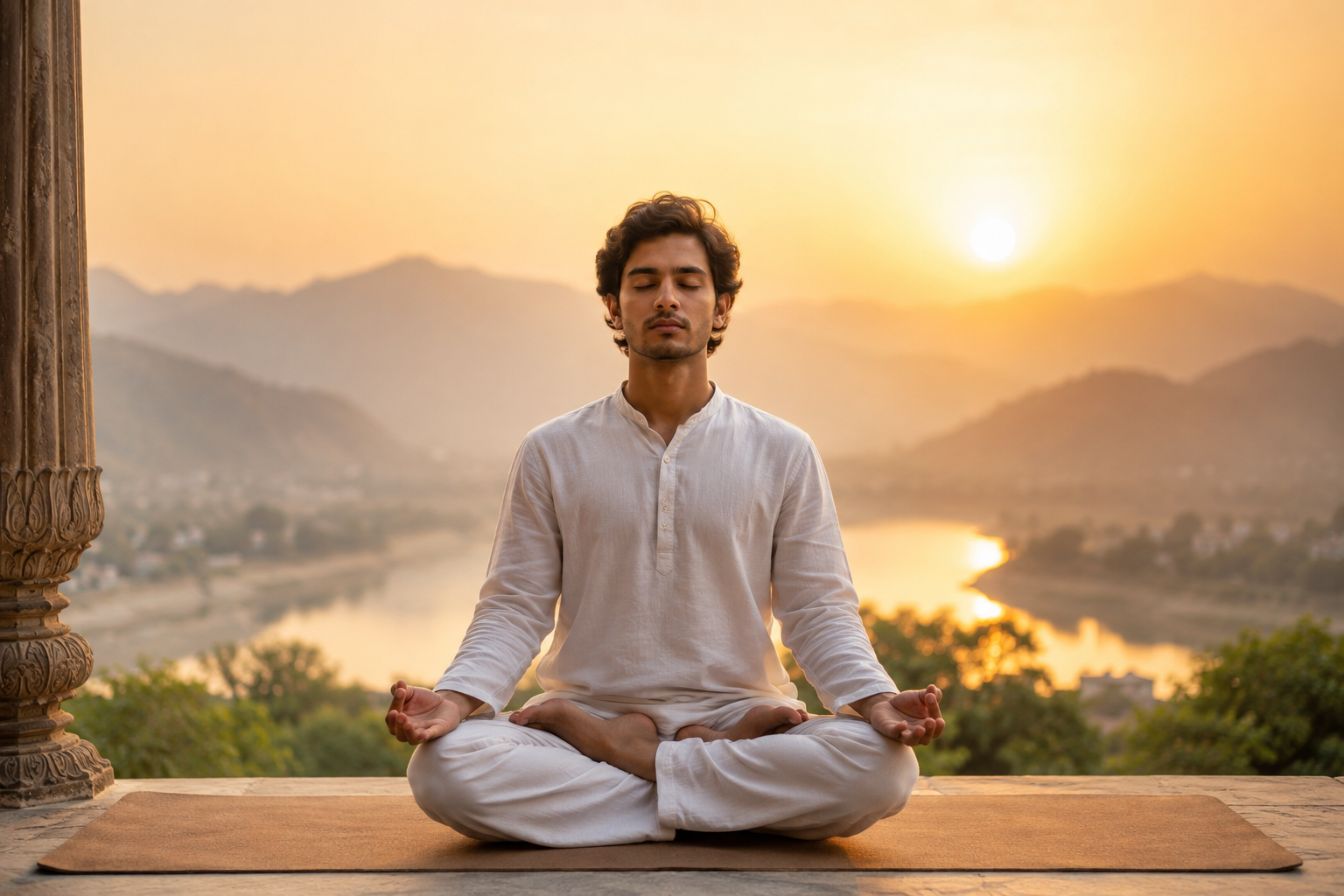
- Characterized by placing feet in Lotus position ( soles turned upward on opposite hip creases) while keeping arms and hands completely unbound—resting freely on the knees in Jñāna Mudrā, Chin Mudrā, or relaxed open in the lap.
- Documented directly in the 17th-century Gheraṇḍa Saṃhitā (Chapter 2, Verse 10) as one of the essential seated physical postures for meditation, mudra, and bandha practices.
- Offers all the structural and energetic benefits of classical Padmāsana while eliminating arm strain or binding pressure, making it an ideal long-hold seat for Prāṇāyāma and Dhyāna (meditation).
Benefits
- Physical: Lengthens hip external rotators, piriformis, and adductors; stretches ankle ligaments; stabilizes the pelvic floor and maintains vertical lumbar alignment.
- Symmetrical Stability: Locks lower limbs into a self-supporting geometric frame that anchors both knees to the floor, dramatically reducing postural sway during static holds.
- Mental & Neurological: Anchoring the hips and knees reduces somatic nervous system feedback, helping signal parasympathetic dominance and facilitating mental quietude (pratyāhāra).
- Traditional/Spiritual: Classically believed to awaken Kuṇḍalinī Śakti, balance Apāna Vāyu with Prāṇa Vāyu at the navel center, and stimulate the Anāhata (heart) and Sahasrāra (crown) chakras—traditional belief, not a scientific claim.
How to Practice Mukta Padmāsana: Step-by-Step
| Step | Action | Breath | Teacher Cue |
|---|---|---|---|
| 1 | Sit in Daṇḍāsana (Staff Pose) on a firm mat with legs extended straight forward and spine fully erect. | Natural breath | "Sit high on your sit-bones and grow tall through the crown." |
| 2 | Bend right knee, draw heel in, and externally rotate the right hip fully before drawing the right foot high onto the left hip crease. | Exhale to bend knee | "Rotate from your hip socket, keeping the knee fully flexed and safe." |
| 3 | Bend left knee, externally rotate left hip, and draw the left foot across onto the right hip crease with soles facing upward. | Exhale to cross leg | "Draw the second foot high onto the hip crease without forcing." |
| 4 | Allow both knees to anchor heavily toward the floor, forming a grounded triangular base. | Inhale to settle base | "Feel both knees rest evenly onto the earth." |
| 5 | Keep hands completely free and unbound. Rest wrists gently on knees in Jñāna Mudrā or Chin Mudrā with arms extended softly. | Inhale to open chest | "Rest your hands softly on your knees, feeling free and unbound." |
| 6 | Lengthen spine, broaden chest, and lower chin slightly (Jālaṁdhara orientation). Hold for meditation duration. Carefully uncross legs and switch lead. | Slow, subtle, quiet breathing | "Rest in motionless, open awareness." |
Common Mistakes & Corrections
- Forcing knee joints downward: Twisting knees when femoral hip external rotation is incomplete strains knee ligaments → Correction: Practice Ardha Padmāsana (Half Lotus) or Baddha Koṇāsana until hip mobility increases; never force knees down manually.
- Sickling the ankle joint: Allowing the foot to sickle outward strains lateral ankle tendons → Correction: Keep ankles active and unsickled, drawing feet high onto opposite hip creases.
- Slouching lower back (posterior pelvic tilt): Rounding lumbar vertebrae causes rapid spinal fatigue → Correction: Elevate hips on a firm cushion or folded blanket to maintain neutral lumbar lordosis.
- Practicing only one leg leading: Always placing the right leg first causes structural pelvic asymmetry → Correction: Alternate leading legs regularly for balanced hip flexibility.
Contraindications & Precautions
- Acute or Chronic Knee Pathology / Meniscus Tear: Flexing knees under rotation causes medial meniscus compression; strictly contraindicated until cleared by orthopedics.
- Acute Ankle Sprain or Ligament Laxity: Deep inversion under tension strains lateral ankle ligaments.
- Sciatica / Acute Piriformis Strain: Static external rotation can compress the sciatic nerve; elevate hips or switch to Sukhāsana.
- Tight Hips in Beginners: Forcing Lotus placement without hip preparation is a leading cause of yoga knee strain.
Sequencing: Preparatory, Follow-up & Variations
- Preparatory Poses: Baddha Koṇāsana (Bound Angle), Agnistambhāsana (Fire Log Pose), Janu Śīrṣāsana, Ardha Padmāsana (Half Lotus).
- Placement in Sequence: Peak meditative seated posture, positioned at the end of practice when hip sockets are thoroughly warm.
- Follow-up Poses: Daṇḍāsana (Staff Pose to extend knees), Paschimottānāsana (Seated Forward Bend), Matsyāsana (Fish Pose).
- Variations: Padmāsana (classical), Baddha Padmāsana (bound lotus), Ardha Padmāsana (half lotus), Tolāsana (scale pose).
In more detail: Mukta Padmāsana occupies an ideal place in meditation sequencing. By maintaining the foot structure of classical Padmāsana while leaving the arms free, it allows practitioners to execute various mudras and pranayama techniques without shoulder fatigue. Preparing hips with Baddha Koṇāsana opens femoral sockets, ensuring safe leg crossing. Following long static holds with knee extensions in Daṇḍāsana restores joint fluid circulation.
Modifications
- Beginners / Tight Hips: Practice Ardha Padmāsana (Half Lotus) with one foot on the opposite hip crease and the other underneath.
- Floating Knees: Support floating knees with yoga blocks or folded blankets to eliminate joint strain.
- Lumbar Slouching: Sit on the front edge of a firm zafu meditation cushion or folded yoga blanket (2–4 inches high).
- Seniors / Joint Sensitivity: Sit upright in a sturdy chair with feet grounded flat on the floor.
Historical Background & Classical References
- Explicit Description in Gheraṇḍa Saṃhitā: The 17th-century Haṭha text Gheraṇḍa Saṃhitā, Chapter 2, Verse 10, explicitly defines Mukta Padmāsana:
सव्योरुपरि दक्षां च दक्षिणोपरि वामकम्।
मुक्तापद्मासनं त्वेतदङ्गमर्दननाशनम्॥ १० ॥
Savyorupari dakṣāṁ ca dakṣiṇopari vāmakam |
Muktāpadmāsanaṁ tvetadaṅgamardananāśanam || 2.10 ||
"Placing the right foot on the left thigh and the left foot on the right thigh, keeping the hands free and unbound—this is Mukta Padmāsana, which destroys bodily fatigue and pain." - Classical Function: Medieval sources highlight Mukta Padmāsana as an essential posture for relieving bodily stiffness (aṅgamardana) and facilitating long, uninterrupted meditation.
Alignment Principles (Iyengar Method)
- Femoral Socket Dominance: Rotation originates entirely from hip sockets, keeping knee joints fully flexed and safe.
- Unbound Arm Freedom: Arms rest softly on knees or lap without tension, allowing shoulder heads to drop back.
- Base Tripod: Both knees anchored evenly to the floor, forming a firm triangular base with the sacrum.
- Vertical Column: Spine fully extended, chest broad and lifted, shoulders relaxed, chin slightly lowered toward sternum.
Anatomy & Biomechanics
- Primary Stretched Muscles: Piriformis, obturator externus/internus, gemelli, quadratus femoris, gluteus medius/minimus, sartorius.
- Primary Strengthening/Stabilizing Muscles: Deep spinal multifidus, erector spinae, transversus abdominis, pelvic floor musculature.
- Joint Mechanics: Deep femoral head external rotation, abduction, and flexion at the hip socket; full knee flexion; ankle inversion and plantarflexion.
- Knee Joint Mechanics: Complete knee flexion closes the joint gap, requiring all rotation to occur safely at the hip socket. Keeping arms free prevents secondary upper body tension from transferring into the spine.
Nervous System & Breathing Effects
- Parasympathetic Induction: Grounded, symmetrical immobility decreases somatic nervous system feedback, favoring parasympathetic dominance.
- Respiratory Clarity: Erect posture removes abdominal compression, allowing unimpeded diaphragmatic movement during Prāṇāyāma.
Yogic & Āyurvedic Perspective
- Dosha Impact: Strongly pacifies Vāta (grounds mental restlessness and physical fatigue) and neutralizes Kapha and Pitta—traditional belief.
- Prāṇa Dynamics: Directs Apāna Vāyu upward to unite with Prāṇa Vāyu at the navel center (Samāna Vāyu), promoting energetic balance.
Therapeutic Applications
| Condition | Mechanism | Research / Precaution |
|---|---|---|
| Bodily Fatigue & Postural Strain | Locks pelvis into anterior tilt, promoting natural lumbar lordosis and reducing muscular fatigue | Supported by classical scripture (Gheraṇḍa Saṃhitā 2.10) and spinal principles. Precaution: Use cushion if hips are tight. |
| Mental Restlessness & Stress | Symmetrical tripod stance calms somatosensory arousal, favoring sustained mental focus | Supported by meditation research. Precaution: Do not force knees down. |
Yoga is never a replacement for medical treatment; serious or persistent conditions require a qualified healthcare professional.
Teaching Cues & Hands-On Adjustments
- Verbal Cues: "Rotate your thigh outward from the hip socket before drawing your foot up." / "Rest your hands softly on your knees, leaving your arms completely free." / "Feel your knees rest firmly into the earth."
- Hands-on Adjustment (Safe execution with consent):
- Stand behind student; place hands gently on student's outer thighs, encouraging subtle hip external rotation without pushing knees downward.
- Place hand lightly at upper back to encourage chest lift and axial extension.
Myth vs. Fact
| Myth | Fact |
|---|---|
| Mukta Padmāsana is just a modern informal variation of Lotus Pose. | Mukta Padmāsana is explicitly documented in the 17th-century classical text Gheraṇḍa Saṃhitā (2.10). |
| You must bind your hands behind your back in all classical Lotus variations. | Mukta Padmāsana specifically leaves hands free on knees, allowing relaxed long holds for meditation and pranayama. |
| Knee pain in Lotus variations is normal discomfort to push through. | Knee pain indicates meniscus compression; immediately back off to Half Lotus or Easy Pose. |
Conclusion
Mukta Padmāsana (Free Lotus Pose) bridges classical Haṭha Yoga heritage with comfortable meditative stillness. By combining the symmetrical pelvic lock of Lotus Pose with the freedom of unbound arms, Mukta Padmāsana relieves physical fatigue, stabilizes the spine, and creates ideal conditions for Prāṇāyāma and meditation.
Quick Facts
| Category | Seated meditation posture / classical seat |
| Difficulty Level | Advanced |
| Primary Muscles Stretched | Piriformis, Gluteus Medius, Adductor Longus, Ankle Flexors |
| Primary Muscles Strengthened | Erector Spinae, Multifidus, Transversus Abdominis |
| Classical Source? | Yes (Gheraṇḍa Saṃhitā 2.10) |
| Traditional Chakra (Belief) | Anāhata (Heart) & Sahasrāra (Crown) |
| Dosha Impact (Belief) | Strongly Pacifies Vāta |
Frequently Asked Questions
What does Mukta Padmāsana mean?
Mukta (free/unbound) + Padma (lotus) + Āsana (seat) = Free Lotus Pose or Unbound Lotus Pose.
Is Mukta Padmāsana described in ancient scriptures?
Yes, it is explicitly detailed in the 17th-century Gheraṇḍa Saṃhitā (Chapter 2, Verse 10).
How does Mukta Padmāsana differ from classical Padmāsana?
Mukta Padmāsana specifically emphasizes leaving the arms and hands free and unbound on the knees, whereas some classical texts describe holding feet or big toes.
What should I do if my knees float off the floor in Mukta Padmāsana?
Support floating knees with yoga blocks or folded blankets, or elevate your hips on a firm meditation cushion.
Can I practice Prāṇāyāma in Mukta Padmāsana?
Yes! Leaving the hands free makes Mukta Padmāsana an excellent classical seat for Prāṇāyāma and Mudrā practice.
How long should I hold Mukta Padmāsana?
Hold for 5 to 20 minutes during meditation or Prāṇāyāma, keeping breath smooth and spine erect.
References
1. Classical Yoga Texts: Gheraṇḍa Saṃhitā, Chapter 2, Verse 10 (17th century).
2. Modern Yoga Institutions: Bihar School of Yoga (Asana Pranayama Mudra Bandha). Iyengar, B.K.S. (1966). Light on Yoga. Schocken Books. Kaivalyadhama publications.
3. Peer-Reviewed Scientific Research:
- Sherman, K. J., et al. (2011). A randomized trial comparing yoga, stretching, and a self-care book for chronic low back pain. Archives of Internal Medicine, 171(22), 2019-2026.
- Ni, M., et al. (2014). Comparative muscle activation patterns during yoga postures in elderly adults. BMC Complementary and Alternative Medicine, 14, 401.
This article is for educational purposes and does not replace individualized medical or physical therapy advice. Consult a qualified healthcare provider before beginning any new practice, especially with a pre-existing health condition.