Maharishi Patanjali: The Compiler of the Yoga Sutras
Introduction
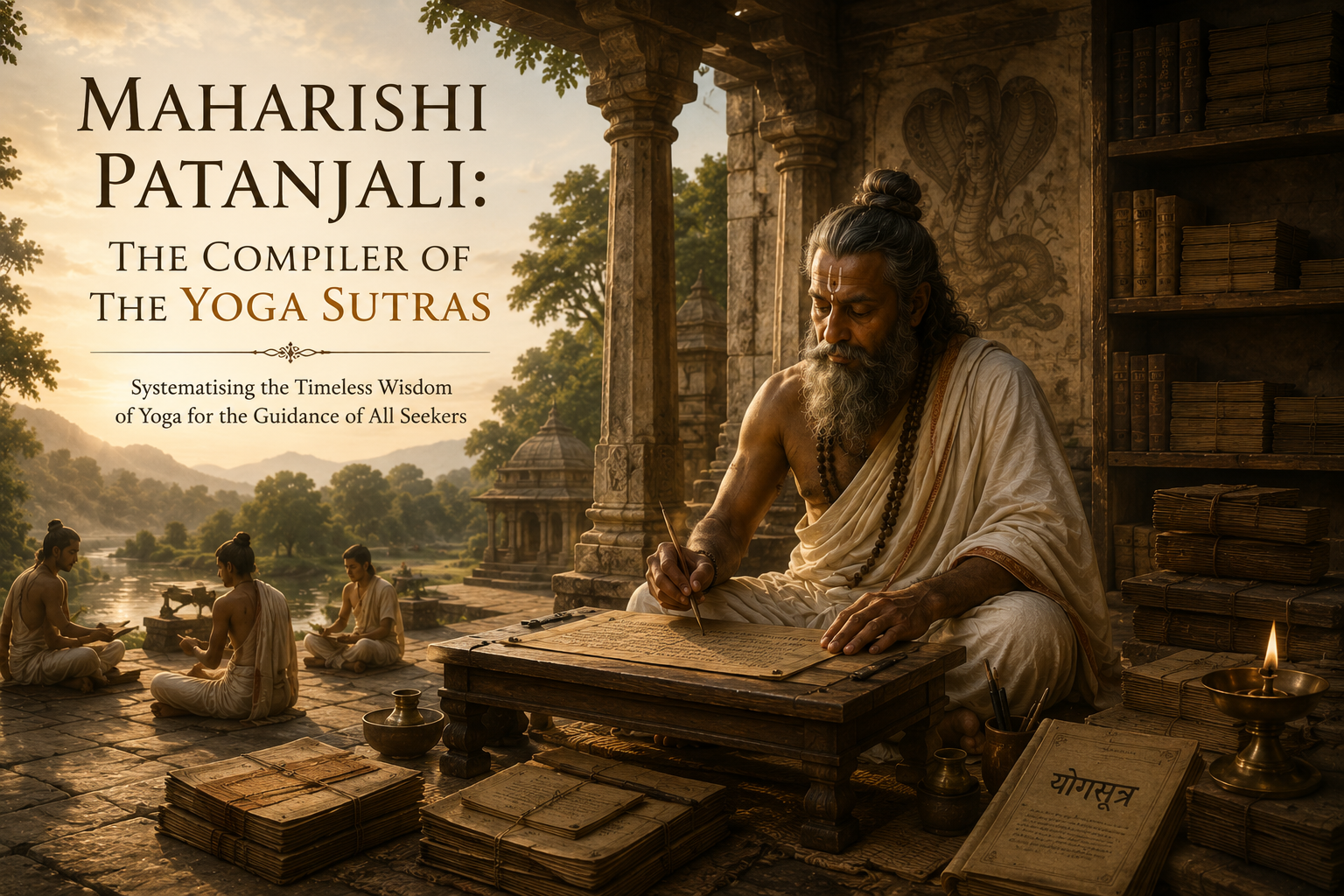
Maharṣi Patañjali is regarded as one of the great sages of the Indian Yoga tradition. He is credited as the author and compiler of the Patañjali Yoga Sūtras, in which he gave ancient Yogic knowledge a systematic form, condensed into terse aphorisms (sūtras). Because of this, the Yoga Sūtras remain, to this day, the most authoritative classical text on Yoga recognised across the world.

An Introduction to Maharṣi Patañjali
Scholars date Patañjali's likely period of activity across a genuinely wide range — most commonly cited as somewhere between the 2nd century BCE and the 4th–5th century CE. There is real disagreement among scholars on this point, so no single, fixed date can be confidently stated.
Contribution to Yoga
Maharṣi Patañjali's greatest contribution is the Patañjali Yoga Sūtras, in which he compiled the entirety of existing Yogic knowledge into a systematic set of aphorisms. Yogic knowledge already existed before him, but he gave it a simple, sequential, and rigorously structured form. For this reason, the Yoga Sūtras are regarded as the principal reference text for Yoga teachers worldwide.

Other Attributed Works
Tradition holds that Maharṣi Patañjali was not only a master of Yoga but a scholar across several fields. He is traditionally credited with:
- Compiling the philosophy of Yoga.
- Writing the Mahābhāṣya, a celebrated commentary on Pāṇini's Aṣṭādhyāyī, the foundational text of Sanskrit grammar.
- Contributing to knowledge related to Āyurveda/medicine (through a work traditionally called the Carakapratisaṃskṛta, a revision of the Charaka Saṃhitā).
- Composing and interpreting texts in Sanskrit and other languages.
In this way, tradition regards his contribution as spanning three fields: Yoga, grammar, and medicine.
The Incarnation of Ādi Śeṣa
According to traditional belief, Maharṣi Patañjali is regarded as an incarnation of Ādi Śeṣa — the divine serpent upon whom Lord Viṣṇu reclines in Yoga-nidrā. This belief reflects the spiritual reverence in which Maharṣi Patañjali is held.
The Patañjali Vandanā (Invocation)
In many traditions, Maharṣi Patañjali is remembered before beginning Yoga practice or teaching. A well-known verse is recited for this purpose:
योगेन चित्तस्य पदेन वाचां मलं शरीरस्य च वैद्यकेन। योऽपाकरोत्तमं प्रवरं मुनीनां पतञ्जलिं प्राञ्जलिरानतोऽस्मि॥
This verse is a way of expressing reverence, gratitude, and respect toward Maharṣi Patañjali.
A Message for Yoga Teachers
Every Yoga teacher should regard themselves not as the owner of this knowledge, but as its medium — a vessel through which it passes. Yogic knowledge has been received through the Guru tradition, and so it is every Yoga teacher's responsibility to carry it forward with purity, authenticity, and respect. Yoga should always be taught in the same spirit in which Maharṣi Patañjali established its foundational form.
Key Points
- Maharṣi Patañjali is traditionally regarded as the author and compiler of the Patañjali Yoga Sūtras.
- His period of activity is disputed among scholars, with estimates ranging broadly from the 2nd century BCE to the 4th–5th century CE.
- He gave the ancient, pre-existing knowledge of Yoga a systematic and structured form.
- The Yoga Sūtras remain the principal reference text of Yoga worldwide.
- Tradition also credits him with the Mahābhāṣya (a commentary on Pāṇini's Sanskrit grammar) and a work related to Āyurvedic medicine.
- According to traditional belief, he is regarded as an incarnation of Ādi Śeṣa.
- Reciting the Patañjali Vandanā before Yoga practice is a mark of respect for the Guru tradition.
- Every Yoga teacher's duty is to carry Yoga forward with authenticity, humility, and tradition intact.
Editorial Notes: Corrections and Clarifications
-
The dating in the original draft was incorrect. The draft stated Patañjali's period as "2nd to 4th century BCE" (दूसरी से चौथी शताब्दी ईसा पूर्व) — entirely within the BCE era. This does not match the scholarly consensus. The widely cited scholarly range spans from the 2nd century BCE through the 4th or 5th century CE — that is, crossing from BCE into the Common Era, not confined to BCE alone. This has been corrected above.
-
The identification of Patañjali the yogi with Patañjali the grammarian (and with the author of the medical text) is a traditional belief, not a settled historical fact — and this distinction is important enough to state plainly. The original draft presented all three attributions (Yoga Sūtras, Mahābhāṣya, and the medical text) as the work of a single person without qualification. In reality:
- The Mahābhāṣya (grammar commentary) is dated by most scholars to around the 2nd century BCE.
- The Yoga Sūtras are more commonly dated to the early centuries CE by many modern scholars — a gap of a few centuries from the Mahābhāṣya.
- The medical text attributed to "Patañjali" is dated by some sources centuries later still.
Because of this timing gap, most modern scholars consider these to be different historical figures who share the name "Patañjali" — while a long-standing traditional view holds that a single polymath-sage authored all three. Both positions are presented here so the reader can hold this nuance rather than treating the single-author tradition as an uncontested fact. This mirrors a similar caution worth applying to "Vyāsa" as a title used by more than one author.

Conclusion
Maharṣi Patañjali holds a position of unmatched reverence in the Yoga tradition — not as the originator of Yoga, but as the sage who gave its scattered, ancient knowledge a systematic, rigorous, and enduring form. Whether one holds the traditional view of a single polymath-sage or the modern scholarly view of several figures sharing his name, his contribution through the Yoga Sūtras remains the foundation on which the whole of classical Yoga rests — a legacy every Yoga teacher inherits, and is responsible for carrying forward with integrity.