Garuḍāsana (Eagle Pose): The Complete Reference Guide
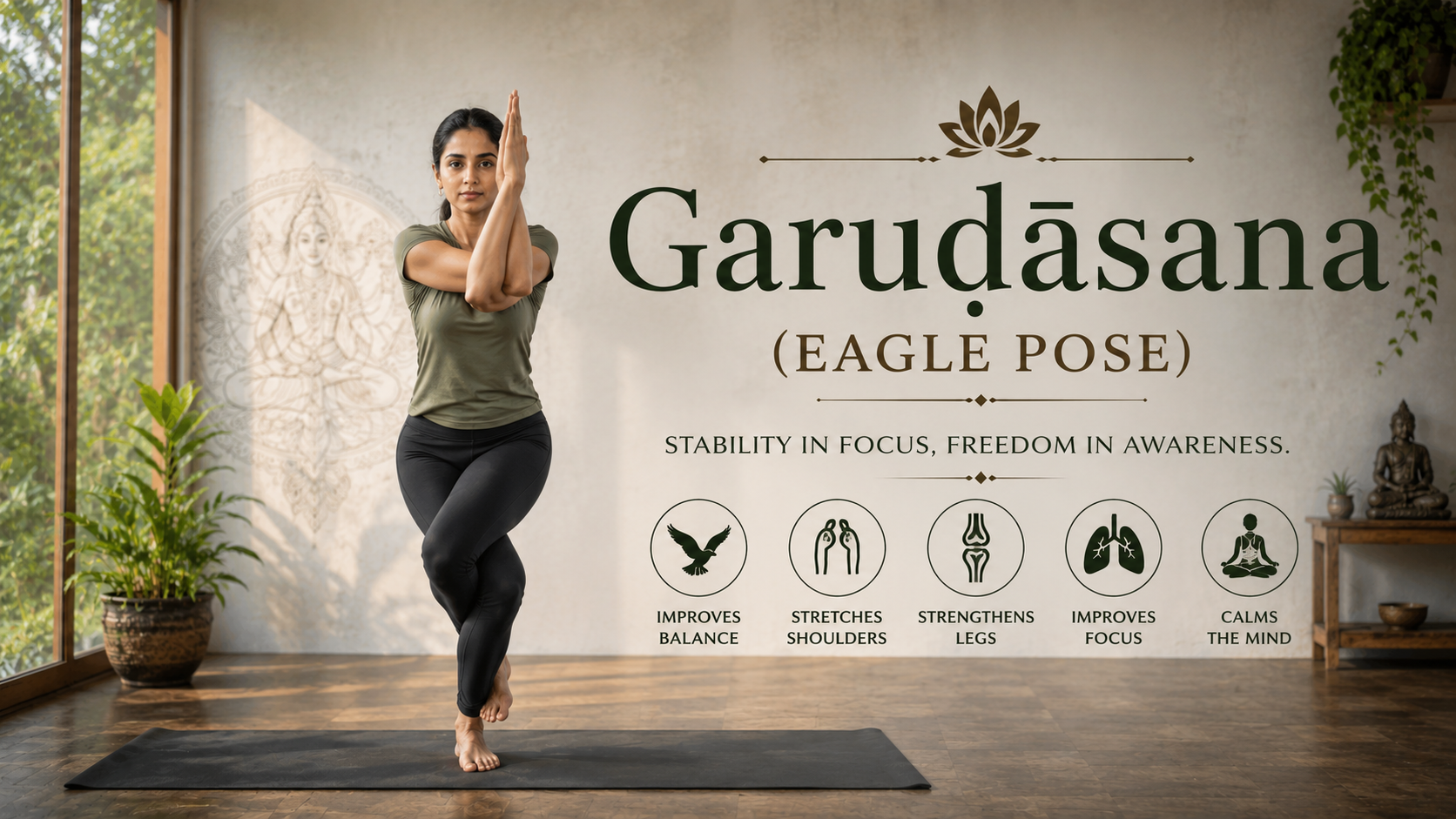
Garuḍāsana (Eagle Pose): The Complete Reference Guide
Editorial note, stated once: throughout this article, traditional/symbolic associations (Garuda mythology, dosha references) are presented as traditional or symbolic, not scientific fact, unless a specific evidence source is cited alongside them.
Name & Meaning
- Sanskrit: गरुडासन (Garuḍāsana)
- English: Eagle Pose
- Etymology: Garuḍa (mythic king of birds, rendered conventionally as "eagle," though some scholars trace the root closer to "devourer") + Āsana (posture)
Introduction
- Garudasana is a rarer case than a simple "modern invention" — the Sanskrit name genuinely appears in classical Hatha Yoga texts, but attached to a different physical shape, in more than one text
- A standing balance pose combining a full arm wrap and a full leg wrap around the body's midline, distinguishing it from open-limbed balances like Vṛkṣāsana
- Widely taught in Hatha and Vinyasa sequencing as a combined hip-mobility, shoulder-mobility, and balance pose
- The gap between the ancient-sounding name and the comparatively recent standing, fully-wrapped form is directly documented in classical sources rather than merely asserted — see Historical Background below
How to Practice Garudasana: Step-by-Step
| Step | Action | Breath | Cue |
|---|---|---|---|
| 1 | Begin in Tāḍāsana; soften both knees slightly, as if sitting into a shallow chair | Natural breath | "Sit down half an inch before you wrap anything." |
| 2 | Shift onto the standing leg; cross the other thigh over it and hook the top foot behind the standing calf (or rest crossed toes on the floor if the hook is out of range) | Inhale to lift the leg, exhale to settle the wrap | "Cross only as far as your hip points stay level." |
| 3 | Extend both arms forward, cross one over the other, bend the elbows and bring palms toward each other (or backs of hands together) | Exhale as the arms wrap | "Lift the elbows before you try to close the hands." |
| 4 | Fix a steady gaze (dṛṣṭi) at eye level; lengthen the crown upward without losing the knee bend | Slow, even nasal breathing — avoid breath-holding | "One steady point, one steady breath." |
| 5 | Hold 20–45 seconds; root through the whole standing foot, not just the toes | Continue even breathing | "Root through the whole foot, not just the toes." |
| 6 | Unwind arms first, then legs, back to Tāḍāsana; repeat on the second side | Exhale to release | "Both sides, every time — even a partial shape counts." |
Benefits
- Physical: strengthens the standing leg's quadriceps, glutes, and ankle stabilizers isometrically; stretches the outer hip, posterior shoulder, and upper back through the arm and leg wraps
- Balance training: as a single-leg pose, it contributes to the kind of balance-challenging practice that general yoga research has linked to modest improvements in balance and mobility in older adults (Youkhana et al., 2016, systematic review and meta-analysis, Age and Ageing) — this research covers general yoga-based exercise, not Garudasana in isolation, and should be read at that level
- Mental: the combined arm-and-leg wrap while balancing demands sustained, single-pointed attention — losing focus typically breaks the balance, making this a fairly direct concentration trainer
- Emotional: general yoga practice (not specific to this pose) is linked in several reviews to reduced perceived stress over time — moderate evidence level
- Traditional/symbolic: traditionally connected to Garuḍa, the mythic king of birds and vahana of Viṣṇu, associated with focus and the capacity to rise above obstacles — a traditional/symbolic association rather than a scientific claim
Common Mistakes & Corrections
- Hip hiking or rotating during the leg wrap → correction: only cross as far as the hips can stay level and square
- Chest collapsing and upper back over-rounding to force the palms together → correction: prioritize spinal length; use the back-of-hands variation instead
- Clawing the standing foot's toes to try to hold balance → correction: spread the toes, root through the whole foot tripod
Contraindications & Precautions
- Recent or unstable knee injury — the standing leg holds a semi-squatted, rotated position under load
- Shoulder injury or active rotator cuff irritation — the arm wrap requires end-range horizontal adduction and internal rotation
- Significant balance or vestibular impairment — this is a narrow-base, single-leg pose
- Ankle instability or recent sprain
- Later pregnancy — shifting center of gravity and ligament laxity make the leg wrap less reliable (see Modifications)
Sequencing: Preparatory, Follow-up & Variations
- Preparatory poses: Tāḍāsana, Vṛkṣāsana, Utkaṭāsana, Gomukhāsana arms (rehearses the shoulder wrap seated, before balance is added)
- Placement in sequence: typically mid-to-late in a standing series, once the hips and shoulders are already warmed
- Follow-up poses: Tāḍāsana or Uttānāsana to release the hips and reset the spine
- Variations: arms-only Eagle (no leg wrap), toe-down leg variation, seated (chair) Eagle Pose
In more detail: Garudasana asks the hips and shoulders to do their hardest work at the same moment the standing leg is managing the entire single-leg balance, which is why most teaching lineages sequence it after — not before — poses like Utkaṭāsana and seated Gomukhāsana arms have already opened those same joints. Teaching the arm wrap and leg wrap as two separate skills before combining them is common and practical: rehearsing "Eagle arms" seated for several sessions, then the leg wrap alone against a wall, before asking the body to do both while balancing. The toe-down leg variation and the back-of-hands arm variation are not merely stepping stones toward some "full" version — for many bodies with less hip or shoulder range, they are the pose's legitimate long-term expression, with no requirement to eventually force the deeper hook or full palm contact.
Modifications
- Beginners: practice near a wall; use the toe-down leg variation; bring backs of hands together instead of forcing full palm contact
- Seniors: practice the seated (chair) version, crossing one leg over the other at the knee or ankle; hold a wall or counter for the standing version
- Pregnancy: favor the arms-only version as pregnancy progresses; if practicing the leg wrap early on with no balance concerns, always stay near a wall — confirm with your own clinician
- Reduced hip/shoulder flexibility: toe-down leg variation; widen the standing stance slightly for a larger base
- Children: frame it as a balance game with short holds; toe-down leg variation as the default
Historical Background & Classical References
- The 17th–18th-century Gheraṇḍa Saṃhitā describes an asana named Garudasana at verse 2.37 — but it is a kneeling posture, not a standing balance: both thighs and knees press toward the ground, with the hands resting on top of the knees, structurally closer to a Vīrāsana variant (paraphrased from the classical description; a fully verified word-for-word Devanāgarī rendering of this short verse was not obtainable through available sources, so it is presented here as a paraphrase rather than a direct quotation)
- A different Garudasana appears in the 19th-century Śrītattvanidhi, verse 39: a one-legged standing balance where the ankle of one foot sits at the base of the opposite thigh and the hands come together — closer to Vṛkṣāsana than to the modern wrapped pose, though it does share the standing single-leg element
- The modern standing pose most practitioners recognize — full arm wrap, full leg wrap — is codified in B.K.S. Iyengar's Light on Yoga (1979 English ed., pp. 97–98), making it a 20th-century systematization rather than a direct continuation of either classical description
- Garuḍa appears throughout Hindu itihāsa and Purāṇic literature as the king of birds and vāhana of Viṣṇu, traditionally associated with opposition to serpents (nāgas) — the mythological backdrop for the name, distinct from the asana's own textual history
- So the honest account is: the name is genuinely classical and appears twice in the pre-modern textual record — but neither classical appearance matches the shape practiced in a studio today, which is a meaningfully different situation from either "purely ancient" or "purely modern"
Alignment Principles (Iyengar Method)
- Pelvis kept level and squared, resisting the wrapped-leg side's tendency to hike or rotate forward
- Standing knee tracks over the standing foot's toes, avoiding inward (valgus) collapse
- Spine kept long; upper-back rounding is corrected by prioritizing length over closing the hand gap
- Shoulder blades spread wide across the back rather than pinching toward the ears — emphasized in Iyengar's teaching as preparation for arm balances and inversions
Anatomy & Biomechanics
- Primary movers (standing leg): quadriceps, gluteus maximus/medius, ankle stabilizers (peroneals, tibialis posterior, intrinsic foot muscles)
- Primary movers (wrapped leg): hip adductors and internal rotators bring the thigh across; the outer hip complex (gluteus medius/minimus, piriformis, TFL/IT band) is stretched in the opposite of its usual action
- Shoulder girdle: serratus anterior and pectoralis major contract to protract and adduct the arms; posterior deltoid, infraspinatus, teres minor, rhomboids, and mid/lower trapezius are placed on stretch
- Stabilizers: deep core and hip stabilizers provide low-level co-contraction to keep the pelvis level against the wrap's rotational bias
- Joint actions: standing-leg hip/knee held near-neutral with active engagement; wrapped-leg hip in adduction and internal rotation with knee flexion; shoulder in horizontal adduction and flexion with scapular protraction
- Biomechanics: wrapping the limbs across the body's midline brings mass closer to the vertical axis, which can make single-leg balance somewhat more manageable than an open-limbed balance like Vṛkṣāsana for some practitioners — but the same wrap creates a strong rotational pull on the pelvis, so gluteus medius and the deep core have to work continuously to keep it level (a mechanism shared with other single-leg standing yoga poses studied in Wang et al., 2013, BMC Complementary and Alternative Medicine, on the biomechanical demands of standing yoga poses in older adults)
Nervous System & Breathing Effects
- Single-leg balance combined with a complex limb wrap is a stronger proprioceptive and attentional demand than simple double-leg standing, given the narrowed base of support and the added coordination task
- Requires sustained motor-cortex engagement for continuous micro-correction across two joint chains at once (hips and shoulders)
- Breath is typically kept even and unforced; breath-holding tends to destabilize the pose rather than help sustain it
Yogic & Āyurvedic Perspective
- Within classical Haṭha Yoga generally, āsana is framed as a tool for steadiness (sthira) and ease (sukha) supporting prāṇāyāma and meditation (Patañjali, Yoga Sūtra II.46); neither classical Garudasana description carries extensive individual commentary on subtle-body effects, so none is invented here
- Symbolically, Garuḍa's mythological role as Viṣṇu's mount and adversary of serpents is often used by modern teachers as a frame for focus and rising above obstacles — a traditional/symbolic association, not a scriptural claim tied to this specific asana
- Āyurveda: some contemporary teachers describe the pose's contained, single-point-focus quality as pacifying for excess Vāta — a modern interpretive framing, not a claim found in classical Āyurvedic source texts
Therapeutic Applications
| Condition | Mechanism | Research / Precaution |
|---|---|---|
| Fall risk / balance decline (general) | Single-leg proprioceptive and vestibular training | General yoga-and-balance research (Youkhana et al., 2016) supports category-level benefit; not Garudasana-specific. Wall or seated variation recommended for at-risk individuals. |
| Tight outer hips / posterior shoulders | Adduction/internal rotation stretch (hip); horizontal adduction stretch (shoulder) | Mechanistically plausible from basic joint mechanics; no dedicated trials isolating this pose |
| Knee osteoarthritis | N/A — pose is not recommended for this population | The standing leg's semi-squatted, rotated load is not one of the low knee-adduction-moment postures used in yoga-for-knee-OA trials; favor seated/toe-down variations or avoid, per a treating clinician's guidance |
Yoga is never a replacement for medical treatment; serious or persistent conditions require a qualified healthcare professional.
Teaching Notes
- Cue: "Cross the legs only as far as your hip points stay level — depth is never the goal here, steadiness is."
- Hands-on adjustment (with consent, within scope): light touch at the sacrum to cue a level pelvis; a brief guiding touch at the top of the shoulders (not pulling) to cue widening rather than hunching. Avoid adjusting the wrapped leg itself — it's already at end range under load.
Myth vs. Fact
| Myth | Fact |
|---|---|
| Garudasana is an ancient standing balance pose practiced unchanged for centuries | The name is classical and appears twice in pre-modern texts — but attached to a kneeling pose (Gheraṇḍa Saṃhitā) and a simpler standing pose (Śrītattvanidhi). The fully wrapped standing version is Iyengar's 20th-century codification. |
| You need full palm contact and a full foot hook for the pose to "count" | The toe-down and back-of-hands variations are legitimate long-term expressions of the pose, not merely beginner stepping stones |
| Garudasana "detoxifies" the organs by wringing out toxins | No scientific evidence supports this; detoxification is handled by the liver and kidneys regardless of asana practice |
Conclusion
Garudasana is a useful case study in how much nuance a single asana name can hide: it isn't a modern invention wearing a Sanskrit label, but it also isn't the unbroken ancient lineage most class descriptions imply — it's a name with two separate, genuine classical appearances, neither of which is the pose taught today. Practiced with attention to a level pelvis and a wide, unhunched upper back rather than raw depth, it remains one of the more efficient single postures for training hip mobility, shoulder mobility, and balance all at once.
Quick Facts
| Category | Standing balance |
| Difficulty | Intermediate |
| Duration | 20–45 seconds per side |
| Traditional/symbolic association | Garuḍa, king of birds, vāhana of Viṣṇu |
| Dosha (traditional) | Pacifying for Vāta (modern interpretive framing) |
| Primary Muscles | Standing-leg quadriceps/glutes/ankle stabilizers; outer hip and posterior shoulder (stretched) |
| Contraindications | Acute knee/shoulder injury, significant balance impairment, later pregnancy (leg-wrap version) |
Frequently Asked Questions
Is the modern Eagle Pose the same as the one in ancient texts?
No — the Gheraṇḍa Saṃhitā's Garudasana is a kneeling pose, and even the Śrītattvanidhi's version doesn't include the full arm-and-leg wrap. The modern shape comes from Iyengar's 1979 Light on Yoga.
Why can't I get my palms together?
Usually shoulder and upper-back mobility, not arm length. The back-of-hands variation is a fully valid long-term option.
Is it normal to be much more stable on one side?
Yes — side-to-side differences in ankle proprioception and hip/shoulder mobility are common and not something to urgently "fix."
Can Garudasana help with knee pain?
Generally not recommended for painful or arthritic knees — see Therapeutic Applications above for lower-load alternatives.
Is it safe during pregnancy?
The arms-only version is generally fine through most of pregnancy; the leg wrap becomes less advisable as balance and ligament laxity change — confirm with your own clinician.
What poses should I do before attempting this one?
Tāḍāsana, Vṛkṣāsana, and Utkaṭāsana for standing-leg stability; seated Gomukhāsana arms to rehearse the shoulder wrap separately.
How long should I hold it?
Commonly 20–45 seconds per side; there's no classical or clinical source establishing an optimal hold time — this reflects teaching convention, not a tested parameter.
References
1. Classical Yoga Texts: Gheraṇḍa Saṃhitā, Chapter 2, Verse 37 (17th–18th century). Śrītattvanidhi, Verse 39 (19th century).
2. Modern Yoga Institutions: Iyengar, B.K.S. Light on Yoga, Schocken Books, 1979, pp. 97–98. Yoga Journal (teaching/alignment cross-reference).
3. Peer-Reviewed Scientific Research: No Garudasana-specific peer-reviewed research was identified through available sources. Youkhana, S., Dean, C.M., Wolff, M., Sherrington, C., & Tiedemann, A. (2016). Yoga-based exercise improves balance and mobility in people aged 60 and over: a systematic review and meta-analysis. Age and Ageing, 45(1), 21–29. Wang, M.-Y., et al. (2013). The biomechanical demands of standing yoga poses in seniors (YESS). BMC Complementary and Alternative Medicine, 13, 8. Both are cited at the category level (general standing/balance yoga poses), not as Garudasana-specific findings.
Consistent with this series' editorial standard, the absence of a Garudasana-specific peer-reviewed study is stated plainly above rather than filled with a citation that doesn't actually study this pose.
This article is for educational purposes and does not replace individualized medical or physical therapy advice. Consult a qualified healthcare provider before beginning any new practice, especially with a pre-existing health condition.