Ekapādāsana (One-Legged Pose): Classical Sources, Anatomy, Alignment & Evidence-Based Guide
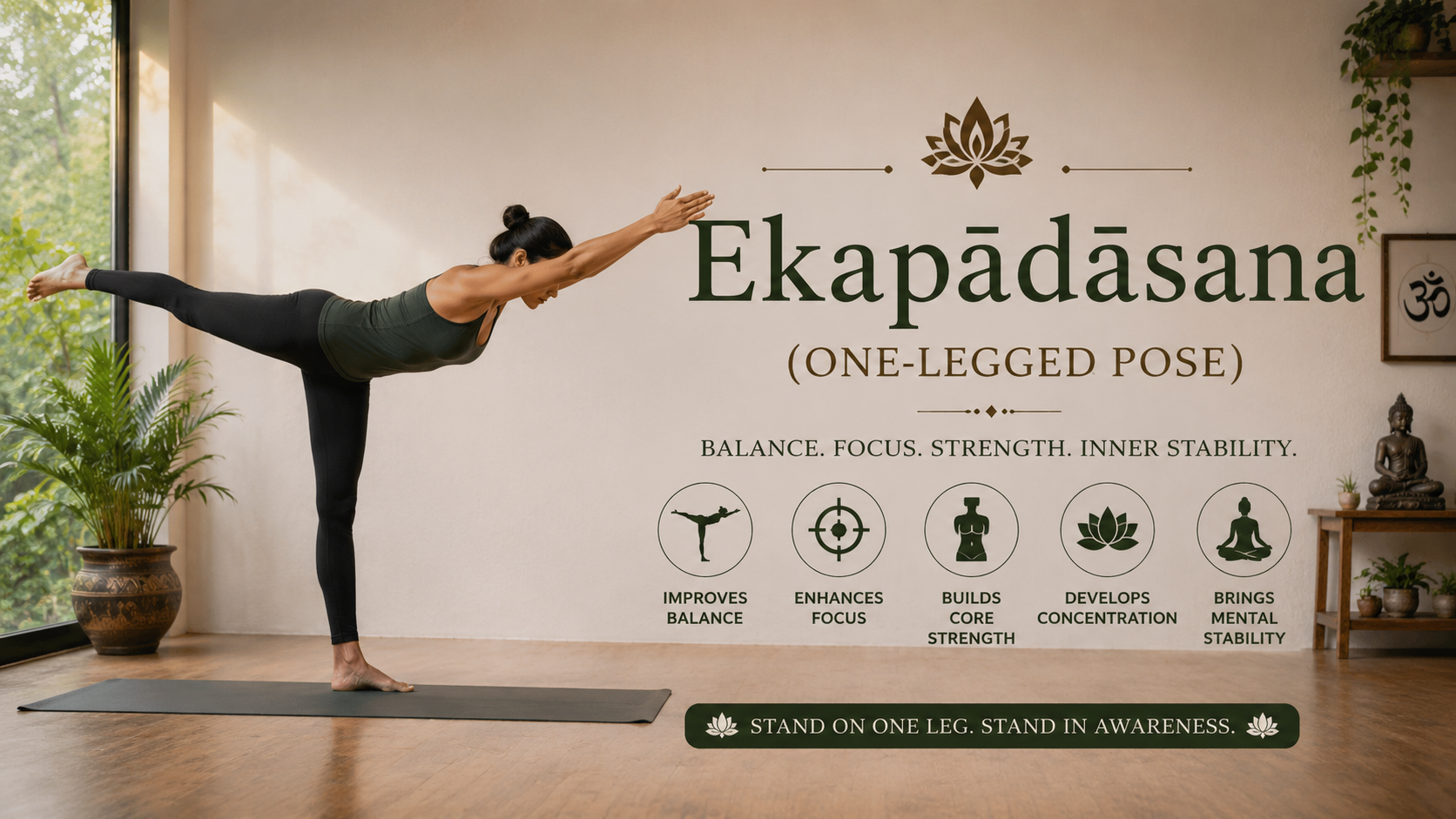
Ekapādāsana (One-Legged Pose): The Complete Reference Guide
Editorial note, stated once: throughout this article, traditional yogic and Āyurvedic claims (chakra, prāṇa, dosha associations) are presented as traditional belief, not scientific fact, unless a specific evidence source is cited alongside them.
Name & Meaning
- Sanskrit: एकपादासन (Ekapādāsana)
- IAST Transliteration: Ekapādāsana
- English: One-Legged Pose / Single-Leg Balance Pose
- Etymology: Eka (one) + Pāda (foot / leg) + Āsana (posture / seat). "The posture of standing steadily on a single leg."
Introduction
- Ekapādāsana is a foundational single-leg standing balance posture that demands precise weight transfer, intrinsic foot engagement, pelvic leveling, and focused concentration (dṛṣṭi).
- Unlike many standing balance postures developed purely in 20th-century lineages, Ekapādāsana holds an authentic classical lineage, appearing explicitly in the 17th-century Gheraṇḍa Saṃhitā.
- In modern postural practice, Ekapādāsana serves both as a discrete balance posture (standing upright on one leg with arms extended overhead or in Añjali Mudrā) and as a gateway framework for more complex asymmetrical balances like Virabhadrasana III and Tulādaṇḍāsana.
- Functions as an excellent clinical assessment tool for single-leg proprioception, ankle stabilization, and gluteus medius strength.
Benefits
- Physical: Strengthens ankle flexors/extensors, intrinsic foot muscles, quadriceps, gluteus medius, and core abdominal stabilizers; improves lateral pelvic alignment.
- Mental: Sustaining single-leg stability requires unyielding present-moment attention, sharpening neural concentration (dhāraṇā) and visual focal control.
- Emotional: Teaches poise, equanimity, and nervous system control when processing physical instability or wobbling.
- Fall Prevention & Proprioception: Single-leg loading activates joint mechanoreceptors in the ankle and hip, enhancing somatosensory awareness—a key component in fall prevention for older adults (Keay et al., 2018).
- Traditional/Spiritual: Believed in traditional Haṭha Yoga to harmonize Prāṇa Vāyu and Apāna Vāyu, channeling grounding earth energy through the standing foot up to the Sahasrāra (crown) chakra—traditional belief, not a scientific claim.
How to Practice Ekapādāsana: Step-by-Step
| Step | Action | Breath | Teacher Cue |
|---|---|---|---|
| 1 | Begin in Tāḍāsana (Mountain Pose). Distribute weight evenly across all four corners of both feet. | Natural breath | "Root down firmly through both feet to build a strong foundation." |
| 2 | Shift weight completely into the left foot. Fix your gaze (dṛṣṭi) on a non-moving point at eye level. | Exhale to settle weight | "Anchor your eyes on a single still point before lifting the leg." |
| 3 | Inhale, lift the right foot off the floor, drawing the right knee up toward hip height or extending the leg clean and parallel. | Inhale to lift | "Lift from your lower core without letting your right hip hike upward." |
| 4 | Bring palms together at heart center in Añjali Mudrā or reach both arms overhead parallel to each other. | Inhale to extend arms | "Lengthen through the sides of your waist as your branches reach upward." |
| 5 | Engage left quadriceps to stabilize the standing knee (keeping a micro-bend). Hold for 5 to 8 steady breaths. | Steady, deep breathing | "Press through your standing heel while lengthening up through the crown of your head." |
| 6 | Exhale to slowly lower the right foot and arms back to Tāḍāsana. Repeat on the opposite side. | Exhale to release | "Lower down with the same mindfulness and control you used to enter." |
Common Mistakes & Corrections
- Pelvic dropping or hiking (Trendelenburg sign): Weakness in the standing leg's gluteus medius causes the non-standing hip to drop or hike up → Correction: Actively press down through the standing heel and engage the outer hip stabilizer to keep hip points level.
- Hyperextending the standing knee: Trapping joint load in the knee capsule rather than using muscular engagement → Correction: Keep a soft micro-bend in the standing knee, lifting the kneecap with active quadriceps.
- Gripping or clawing toes of the standing foot: Over-activating foot flexors out of anxiety, destabilizing the arch tripod → Correction: Lift and spread all five toes, then root down evenly through the big toe mound, pinky toe mound, and center heel.
- Floating eyes (unfocused gaze): Looking around rapidly destabilizes vestibular processing → Correction: Fix eyes softly on a single still target on the floor or wall.
Contraindications & Precautions
- Severe Vertigo, Labyrinthitis, or Vestibular Disorders: Single-leg balance increases risk of fall; practice touching a wall or chair for safety.
- Acute Ankle, Knee, or Hip Injuries: High single-leg load can strain healing ligaments or tendons; delay practice until cleared by a physical therapist.
- Uncontrolled High Blood Pressure: Extended overhead arm holding can raise systemic vascular resistance; keep hands in Añjali Mudrā at chest center.
- Late Pregnancy: Shifting center of gravity destabilizes balance; use wall support throughout.
Sequencing: Preparatory, Follow-up & Variations
- Preparatory Poses: Tāḍāsana (standing baseline), Ankle circles & toe lifts (prepares joint mechanoreceptors), Vṛkṣāsana (Tree Pose).
- Placement in Sequence: Early-to-middle standing series posture, after warming up joints but before complex balances or peak poses.
- Follow-up Poses: Garuḍāsana (Eagle Pose), Virabhadrasana III (Warrior III), Utthita Hasta Pādāṅguṣṭhāsana.
- Variations: Wall-supported Ekapādāsana, Hands-at-Heart Ekapādāsana, Extended-Leg Ekapādāsana, Eyes-closed Ekapādāsana (advanced).
In more detail: Ekapādāsana serves as an ideal baseline balance posture. Because its base of support is narrowed to a single foot while the torso remains upright, it provides a clean, uncomplicated stimulus for the nervous system and ankle stabilizers. Practicing Ekapādāsana early in a standing sequence warms up the gluteus medius and intrinsic foot muscles, laying a stable neuromuscular foundation for asymmetrical balance challenges like Virabhadrasana III or Naṭarājāsana.
Modifications
- Beginners: Keep the lifted leg's big toe lightly touching the floor (kickstand modification); practice near a wall.
- Seniors: Hold the back of a sturdy chair or place one hand on a wall; keep holds shorter (5 to 10 seconds).
- Pregnancy: Stand close to a wall for immediate balance protection; keep feet hip-width when entering and exiting.
- Weak Ankles / Flat Feet: Practice on a firm, non-squishy surface or directly on hardwood floor rather than a thick yoga mat.
Historical Background & Classical References
- Classical Text Source in Gheraṇḍa Saṃhitā: Ekapādāsana is directly described in the 17th-century Haṭha text Gheraṇḍa Saṃhitā, Chapter 2, Verse 30:
चरणं सव्यमूरौ तु संस्थाप्य जनुदुपरि।
तिष्ठेदृजुशरीरश्चैवेकपादासनं भवेत्॥ ३० ॥
Caraṇaṁ savyamūrau tu saṁsthāpya janudupari |
Tiṣṭhedṛjuśarīraścaivekapādāsanaṁ bhavet || 2.30 ||
"Placing one foot upon the opposite thigh and standing with an upright body—this is known as Ekapādāsana." - Textual Significance: This classical verse establishes Ekapādāsana as one of the authentic standing balance postures documented in medieval Haṭha Yoga, sharing textual heritage alongside Vṛkṣāsana and Utkaṭāsana.
Alignment Principles (Iyengar Method)
- Foot Tripod: Equal pressure distributed across the three major weight-bearing points of the standing foot: base of big toe, base of pinky toe, center heel.
- Pelvis Integrity: Both hip points (ASIS) remain level and squared forward, preventing pelvic tilting or dropping.
- Spinal Axis: Vertical crown-to-pelvis alignment; avoid leaning sideways to compensate for leg weight.
- Shoulder & Arm Extension: Scapulae drawn broad and down the back; arms reaching overhead cleanly inline with ears without compressing the neck.
Anatomy & Biomechanics
- Primary Strengthening Muscles: Gluteus medius and minimus (standing side pelvic stabilizer), Quadriceps femoris (standing leg kneecap elevation), Tibialis anterior, Peroneus longus/brevis (ankle fine-tuning), Transversus abdominis.
- Primary Stretched Muscles: Hip adductors of lifted leg, intrinsic foot plantar fascia.
- Joint Mechanics: Standing hip in neutral extension with isometric abductor contraction; standing knee in extended position (with micro-bend); standing ankle in dynamic stabilization; spine in axial extension.
- Biomechanics & Trendelenburg Prevention: When standing on one leg, gravity pulls the ungrounded side of the pelvis downward. The ipsilateral gluteus medius must contract strongly to keep the pelvis level, preventing hip drop (Trendelenburg pattern).
Nervous System & Breathing Effects
- Somatosensory & Proprioceptive Stimulation: Narrowing base of support significantly increases proprioceptive feedback loops sent through ankle stretch receptors and vestibular systems to the cerebellum.
- Autonomic Balance: Staying calm while wobbling trains parasympathetic modulation under mild physiological challenge.
Yogic & Āyurvedic Perspective
- Dosha Impact: Highly effective for pacifying excess Vāta by developing single-point physical grounding and mental focus. Helps balance Kapha through active leg engagement—traditional belief.
- Prāṇa Dynamics: Channels Apāna Vāyu downward into the earth while drawing Prāṇa Vāyu upward through the vertical spine.
Therapeutic Applications
| Condition | Mechanism | Research / Precaution |
|---|---|---|
| Fall Prevention (Older Adults) | Single-leg proprioceptive and ankle stabilizer neuromuscular training | Supported by fall prevention studies (Keay et al., 2018, Pilot & Feasibility Studies). Precaution: Always use wall or chair support for safety. |
| Gluteus Medius Weakness / Ankle Instability | Closed kinetic chain isometric loading strengthens outer hip abductors and ankle stabilizers | Established physical therapy biomechanical principle. Precaution: Keep pelvis level. |
Yoga is never a replacement for medical treatment; serious or persistent conditions require a qualified healthcare professional.
Teaching Cues & Hands-On Adjustments
- Verbal Cues: "Press down into your standing heel to lift up out of your hip." / "Keep your gaze as steady as your standing foot." / "Spread your standing toes wide like roots."
- Hands-on Adjustment (Safe execution with consent):
- Stand behind student; place hands gently on student's hip points to guide pelvic leveling.
- Place hand lightly at upper back to cue vertical lengthening through the crown of the head.
Myth vs. Fact
| Myth | Fact |
|---|---|
| Wobbling in Ekapādāsana means you are failing at the pose. | Micro-wobbling is the nervous system and ankle stabilizers actively adjusting and building neuromuscular strength. |
| Ekapādāsana is a modern 20th-century exercise creation. | Ekapādāsana is documented in the 17th-century classical text Gheraṇḍa Saṃhitā (2.30). |
| You must practice without wall support for it to be effective. | Wall support allows practitioners to safely strengthen hip stabilizers without risking falls or anxiety. |
Conclusion
Ekapādāsana (One-Legged Pose) bridges classical Haṭha Yoga heritage with modern balance mechanics. By narrowing the base of support to a single foot, it strengthens ankle stabilizers, corrects gluteus medius weakness, and sharpens mental focus. Practiced with attention to pelvic leveling and steady breathing, Ekapādāsana stands as a cornerstone posture for lifelong balance and joint health.
Quick Facts
| Category | Standing single-leg balance / posture |
| Difficulty Level | Beginner to Intermediate |
| Primary Muscles Strengthened | Gluteus Medius, Quadriceps, Ankle Stabilizers, Transversus Abdominis |
| Classical Source? | Yes (Gheraṇḍa Saṃhitā 2.30) |
| Traditional Chakra (Belief) | Mūlādhāra (Root) to Sahasrāra (Crown) |
| Dosha Impact (Belief) | Pacifies Vāta & Kapha |
Frequently Asked Questions
What does Ekapādāsana mean in Sanskrit?
Eka (one) + Pāda (leg/foot) = One-Legged Pose.
Is Ekapādāsana mentioned in ancient classical yoga texts?
Yes, Ekapādāsana is directly described in the 17th-century Gheraṇḍa Saṃhitā (Chapter 2, Verse 30).
Is wobbling normal when practicing Ekapādāsana?
Yes, wobbling is a natural sign that your ankle stabilizers and nervous system are actively making micro-adjustments to build balance.
How can I improve my balance in this pose?
Focus your eyes on a single unmoving point (dṛṣṭi), root down through all four corners of your standing foot, and practice near a wall.
What is the difference between Ekapādāsana and Vṛkṣāsana (Tree Pose)?
In Vṛkṣāsana, the lifted foot rests against the inner thigh or calf of the standing leg with the hip rotated externally. Ekapādāsana focuses on standing straight on one leg with hips squared forward.
Can seniors practice Ekapādāsana?
Yes, with wall or chair support. Single-leg standing exercises are widely used in senior fall-prevention programs.
References
1. Classical Yoga Texts: Gheraṇḍa Saṃhitā, Chapter 2, Verse 30 (17th century).
2. Modern Yoga Institutions: Iyengar, B.K.S. (1966). Light on Yoga. Schocken Books. Bihar School of Yoga (Asana Pranayama Mudra Bandha).
3. Peer-Reviewed Scientific Research:
- Keay, L., Praveen, D., Salam, A., et al. (2018). A mixed methods evaluation of yoga as a fall prevention strategy for older people in India. Pilot and Feasibility Studies, 4(1), 74.
- Ni, M., et al. (2014). Comparative muscle activation patterns during yoga postures in elderly adults. BMC Complementary and Alternative Medicine, 14, 401.
This article is for educational purposes and does not replace individualized medical or physical therapy advice. Consult a qualified healthcare provider before beginning any new practice, especially with a pre-existing health condition.