Dhāraṇā: The Sixth Limb of Aṣṭāṅga Yoga (Patañjali's Concentration Practice vs. Trāṭaka)
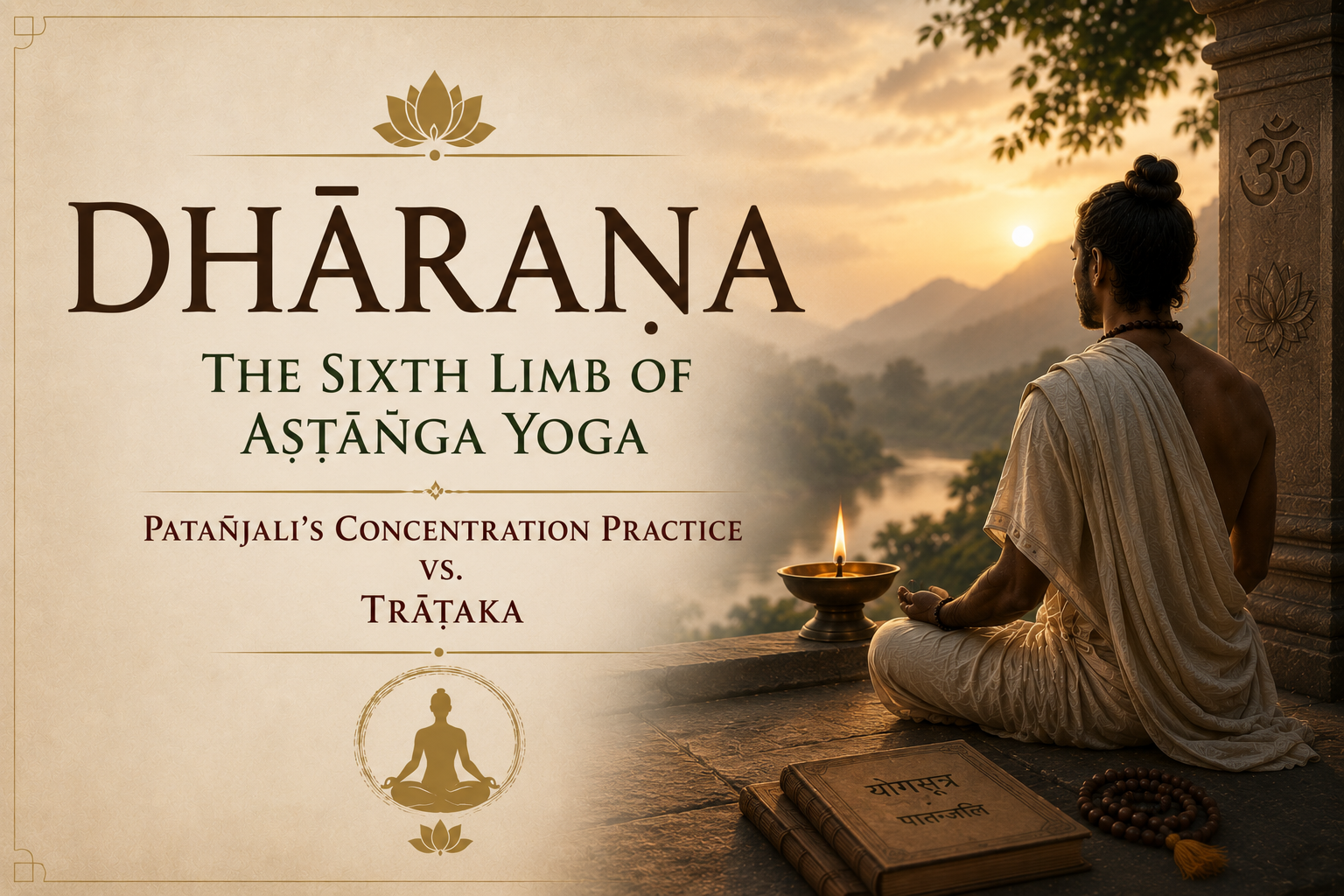
Dhāraṇā — The Sixth Limb of Aṣṭāṅga Yoga

Introduction
Dhāraṇā is the sixth limb (aṅga) of Patañjali's eightfold yoga. It means fixing the mind on a single point, object, sound, thought, or symbol. It is the stage immediately preceding dhyāna (meditation), in which the practitioner uses conscious, repeated effort to keep returning the mind to the same object of focus.
The Meaning of the Word
In Sanskrit, dhāraṇā carries the sense of:
- Holding, or bearing
- Concentrating
- Fixing the mind steadily on one subject
Patañjali defines it precisely in YS 3.1: deśa-bandhaḥ cittasya dhāraṇā — dhāraṇā is the binding of the mind (citta) to a place, or a single point. It is the state in which wandering is checked and attention is deliberately anchored to a chosen target.
The Purpose of Dhāraṇā
The primary aims of dhāraṇā are to:
- Reduce the restlessness (cañcalatā) of the mind
- Develop sustained concentration
- Prepare the mind for dhyāna
- Turn the practitioner's attention inward
Dhāraṇā requires active effort — the practitioner consciously and repeatedly brings the mind back to the same object each time it wanders.

Means of Practicing Dhāraṇā
Dhāraṇā can be approached through several supports (ālambana):
- Concentration on a mantra
- Focus on a sound (such as Oṃ)
- Contemplation of a symbol or deity
- Mental visualization
- Trāṭaka (steady, unblinking gaze on a flame or fixed point)
- Fixing the mind on a specific point in or around the body
Each of these gives the mind a single direction rather than allowing it to scatter.
A note on sources: Patañjali does give explicit scriptural grounding for mantra practice — YS 1.27–28 names praṇava (the syllable Oṃ) as the expression (vācaka) of Īśvara, prescribing its repetition (japa) and contemplation of meaning (bhāvana) as a method of stilling the mind. Trāṭaka, however, is not found in the Yoga Sūtra — it belongs to the later Haṭha Yoga tradition, where the Haṭhapradīpikā classifies it as one of the six ṣaṭkarmas (cleansing practices). It's widely adopted as a dhāraṇā technique today, but it's worth knowing this is a later technical addition rather than Patañjali's own prescription.
Dhāraṇā and Trāṭaka
Trāṭaka is one of the most well-known practices associated with dhāraṇā. In this practice, the practitioner:
- Gazes steadily at a flame or a fixed point without blinking
- Holds both the gaze and the mind on that same point
- Develops concentration and mental steadiness through sustained repetition

The Relationship Between Dhāraṇā and Dhyāna
Dhāraṇā is not dhyāna — it is the preparation for it.
Patañjali defines dhyāna in the very next sūtra, YS 3.2: tatra pratyaya-eka-tānatā dhyānam — dhyāna is the unbroken, continuous flow of that same single cognition toward the object.
The progression, as Vyāsa's Yoga Bhāṣya elaborates on these two sūtras, can be understood as:
- Dhāraṇā → holding the mind on one point through conscious effort, with the mind still occasionally wandering and being brought back
- Dhyāna → that same concentration flowing continuously, effortlessly, without interruption
Through sustained practice, dhāraṇā gradually matures into dhyāna — this qualitative shift from effortful to effortless attention is where Vyāsa's commentary is especially clarifying, since Patañjali's own sūtras state it far more tersely.
Benefits of Dhāraṇā
- Increased concentration
- Reduced mental restlessness
- Improved memory and attentional capacity
- Greater mental steadiness
- Mental readiness for dhyāna
- Development of inward awareness
(These are traditionally described benefits of sustained practice; as with any concentration training, individual experience and pace will vary.)
My Practical Reflection
(This section is personal contemplation, not classical doctrine.) What I find most useful about dhāraṇā, practically, is how honestly it exposes the mind's habits — you notice exactly how often and in what ways attention drifts. I've come to see the "failures" of dhāraṇā (the mind wandering, again and again) not as a problem to eliminate but as the actual material of the practice — each return to the point of focus is the practice, not a departure from it.
Key Points
- Dhāraṇā is the sixth limb of Aṣṭāṅga Yoga.
- It means fixing the mind on one object (YS 3.1: deśa-bandhaḥ cittasya dhāraṇā).
- Dhāraṇā requires conscious effort.
- Mantra (with explicit sūtra grounding — YS 1.27–28), sound, symbol, trāṭaka, and visualization are its major supports.
- Trāṭaka is a Haṭha Yoga technique, not one named in the Yoga Sūtra itself.
- Dhāraṇā is preparation for dhyāna (YS 3.2), not dhyāna itself.
- Regular practice develops concentration, mental steadiness, and inward awareness.