Daṇḍāsana (Staff Pose): Complete Anatomy, Alignment & Evidence-Based Guide
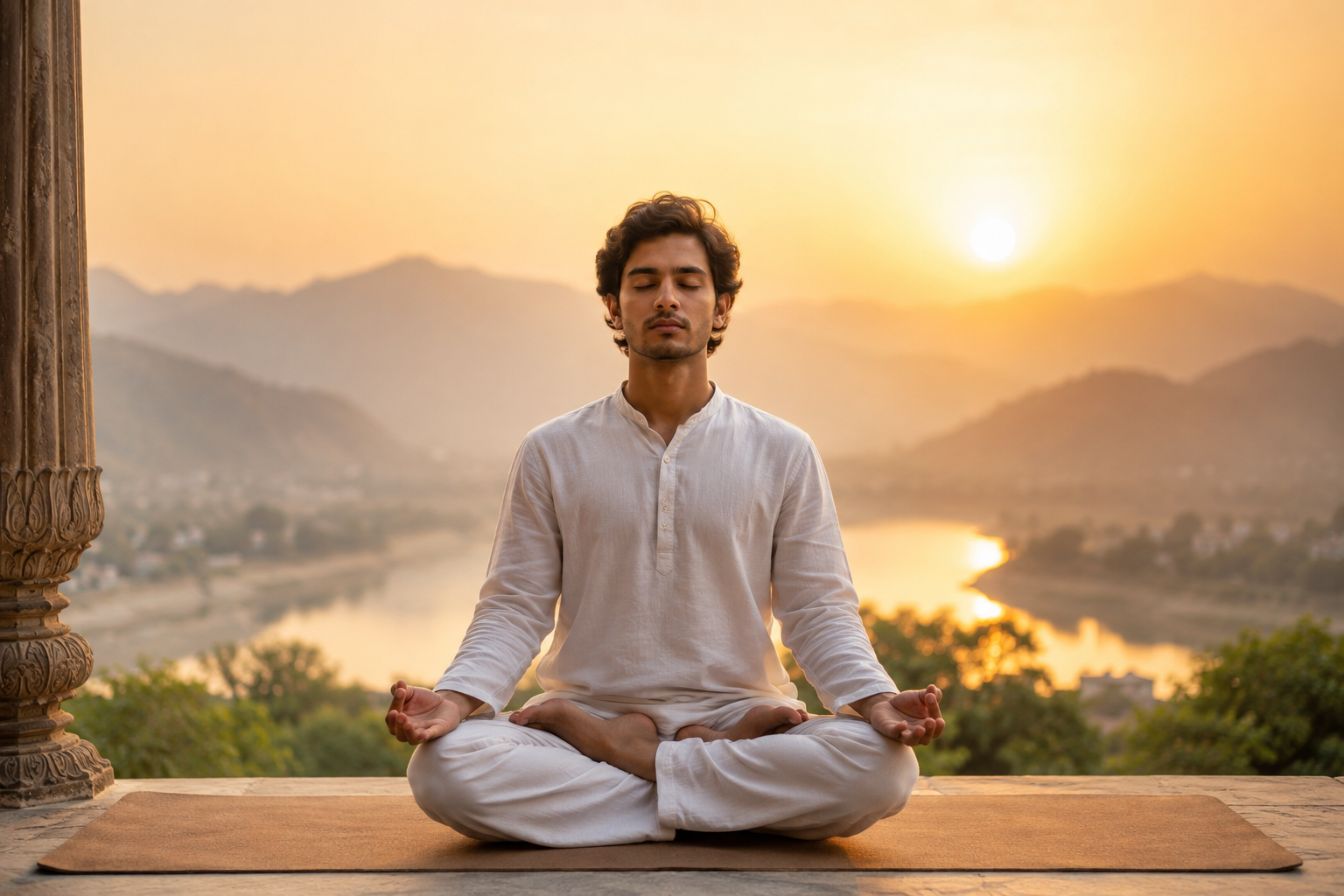
Daṇḍāsana (Staff Pose): The Complete Reference Guide

Editorial note, stated once: throughout this article, traditional yogic and Āyurvedic claims (chakra, prāṇa, dosha associations) are presented as traditional belief, not scientific fact, unless a specific evidence source is cited alongside them.
Name & Meaning
- Sanskrit: दण्डासन (Daṇḍāsana)
- English: Staff Pose
- Etymology: Daṇḍa (stick, staff, or spine) + Āsana (posture, seat)
Introduction
- Daṇḍāsana is the absolute foundational baseline for all seated yoga postures, structural forward bends, and seated twists across classical and modern yoga lineages.
- Deceptively simple in appearance, it requires a precise 90-degree intersection of the torso and lower extremities, demanding high hamstring length, deep hip flexor activation, and sustained isometric endurance of the back muscles.
- While modern yoga frequently highlights standing balances, classical Hatha yoga systems place great structural emphasis on Daṇḍāsana as the benchmark for testing axial spine extension.
- In clinical orthopedic and therapeutic settings, it serves as a strict diagnostic assessment tool for examining hamstring tightness, functional core weakness, and posterior pelvic tilt tendencies.
How to Practice Daṇḍāsana: Step-by-Step
| Step | Action | Breath | Cue |
|---|---|---|---|
| 1 | Sit flat on the mat with both legs extended straight out in front of you. Manually pull the flesh of the buttocks away from your sit bones to ensure direct, firm skeletal contact with the ground. | Natural breath | "Anchor your sit bones firmly into the floor, creating an immovable foundation." |
| 2 | Press your inner thighs, knees, and ankles tightly together. Flex your feet deeply, pulling your toes back toward your shins while pushing forward through the balls of your feet. | Exhale to engage the legs | "Energize your legs so completely that your heels may naturally hover slightly off the mat." |
| 3 | Place your palms flat on the floor directly beside your hips, fingers pointing forward. If your arms are long, keep a micro-flexion in the elbows; if short, rest your fingertips on the floor. | Inhale to prepare the spine | "Press down into your hands to help lengthen your side ribs upward away from the pelvis." |
| 4 | Draw the lower belly inward and upward. Draw the shoulder blades down the back, broadening across the collarbones, and stack the ears directly over the shoulders. | Sustained, rhythmic inhalation | "Stack your head, neck, and heart directly above your hips like a straight staff." |
| 5 | Tuck your chin slightly to lengthen the back of the neck. Fix a steady, soft gaze forward (Jalandhara Bandha context if practicing breath retention). Hold the posture for 5–10 deep, controlled breaths. | Steady Ujjāyī or diaphragmatic breathing | "Maintain maximum height in your spine even as you exhale and ground down." |
| 6 | To release, relax the deep flexion of the feet, soften the activation of the quadriceps, slide the hands away from the hips, and gently shake out the legs. | Exhale to soften | "Let go of the muscular engagement slowly, noting the immediate release of tension." |
Benefits
- Postural Endurance: Builds remarkable isometric strength in the erector spinae, multifidus, and deep core stabilizers, training the body to sit upright effortlessly.
- Lower Extremity Toning: Demands strong, concentric contraction of the quadriceps to keep the knees straight, combined with deep ankle flexion that stretches the calves and Achilles tendons.
- Decompression Awareness: Retraining the torso to sit at a true 90-degree angle teaches the core how to resist gravity and decompress the lumbar spine.
- Postural & Respiratory Integration: A peer-reviewed clinical study by Grabara and Szopa (2015) in the Journal of Physical Therapy Science demonstrated that structured hatha yoga sequences featuring foundational static alignment poses significantly enhance thoracic spine flexibility and overall posture.
- Traditional/Spiritual: Traditionally believed to stimulate the Mūlādhāra (root) and Svādhiṣṭhāna (sacral) chakras, anchoring wandering thoughts and grounding erratic mental patterns. Traditional yogic belief; high-quality scientific evidence is currently limited.
Common Mistakes & Corrections
- Rounding the lower back (posterior pelvic tilt) → correction: if your hamstring tightness forces your pelvis to roll backward, sit on the edge of a folded blanket or block to safely lift the hips and straighten the spine.
- Hyperextending the knee joints (heels lifting excessively) → correction: keep the knees tracking straight; soft-micro-flex the knees if necessary, and focus on grounding the back of the calves into the mat.
- Shrugging the shoulders up toward the ears → correction: place blocks under your hands if your arms are short, and actively depress the scapulae down away from the neck.
Contraindications & Precautions
- Acute hamstring avulsions or severe proximate hamstring tendinitis.
- Acute lumbar disc herniation or severe sciatica symptoms triggered by active sitting flexion.
- Recent wrist or hand injuries making it painful to place the palms flat on the floor.
Sequencing: Preparatory, Follow-up & Variations
- Preparatory Poses: Tāḍāsana (standing baseline integration), Mārjāryāsana-Bitilāsana (spinal fluid movement), Uttānāsana (initial hamstring opening).
- Placement in Sequence: Serves as the gateway transition pose, placed immediately after standing postures to open and structure the entire seated posture sequence.
- Follow-up Poses: Paschimottānāsana (Seated Forward Bend), Purvottānāsana (Upward Plank Pose / counter-stretch), Ardha Matsyendrāsana (Seated Twist).
- Variations: Wall-supported Daṇḍāsana for alignment tracking; Urdhva Hasta Daṇḍāsana (arms extended overhead for maximum core load).
In more detail: Daṇḍāsana serves as the central structural hub from which all seated yoga practices emerge. It acts as an active blueprint—the exact muscular engagement, foot flexing, and core lifting found here must be carried directly into complex variations like Seated Forward Bends and spinal twists. If a student collapses or hunches their back in Daṇḍāsana, moving them into deeper forward folds will only strain their lower back ligaments. Using supportive props like blankets or blocks allows practitioners to safely build pelvic control and core endurance first. Following a long hold, transitioning into an upward plank or gentle table-top pose provides a beautiful counter-stretch that opens the front of the hips and releases the working back muscles.
Modifications
- Beginners: Sit on 1–2 folded blankets to elevate the pelvis, taking immediate pressure off tight hamstrings and the lower back.
- Seniors: Modify by practicing against a wall, resting the shoulder blades flat against it to build back endurance without fatigue.
- Pregnancy: Separate the legs hip-width or mat-width apart to create ample space for the growing belly, ensuring the spine stays tall and strain-free.
- Knee Sensitivity: Place a rolled-up washcloth or small yoga wedge under the knees to prevent the joints from locking or hyperextending.
- Children: Keep the holds short and use playful cues ("sit tall and straight like a superhero's staff") to keep them engaged.
Historical Background & Classical References
- Daṇḍāsana holds a deeply rooted position within classical Hatha Yoga methodologies as a premier stabilizing alignment.
- While early scriptures focused intensely on meditative seats like Padmāsana, the 17th-century Gheraṇḍa Saṃhitā highlights the absolute structural need for straight-legged spinal grounding before moving into deep breath work.
- In modern times, it was highly refined by B.K.S. Iyengar in Light on Yoga, who showcased it as a master key for retraining structural posture and correcting faulty walking and sitting habits.
Alignment Principles (Iyengar Method)
- Keep the inner borders of the big toes and inner heels touching, flexing the feet evenly.
- Press the tops of the thigh bones firmly down into the mat to fully ground the legs.
- Lift your sternum up away from your navel, keeping your collarbones broad and open.
- Keep the crown of your head reaching straight up, with your gaze focused softly at eye level.
Anatomy & Biomechanics
- Primary Agonists (Active Muscles): Erector spinae, multifidus, and quadratus lumborum (contracting isometrically to resist gravity); Iliopsoas and rectus femoris (active to hold the 90-degree angle).
- Muscles Stretched (Antagonists): Hamstrings (biceps femoris, semitendinosus, semimembranosus) and gastrocnemius experience a deep, sustained stretch under structural tension.
- Stabilizers: Transversus abdominis acts as an internal brace, while the lower trapezius keeps the shoulders pulling down away from the ears.
- Joint Mechanics: The hip joints are held in a strict 90-degree flexion; the knees are fully extended, and the ankles are highly dorsiflexed.
- Biomechanics of the Base: Sitting perfectly upright shifts your center of gravity directly over your sit bones. Elevating the hips on a prop helps tilt the pelvis forward into a neutral position, protecting the lower back discs from uneven pressure and preventing painful slumping.
Nervous System & Breathing Effects
- Sitting with a long, uncompressed spine gives the lungs full room to expand, supporting steady diaphragmatic breathing.
- Sustaining this intense, focused posture requires present-moment focus, helping calm mental chatter.
- Keeping the spine vertical and breathing evenly helps reduce overall stress indicators, shifting the nervous system into a calm, balanced state.
Yogic & Āyurvedic Perspective
- Traditionally thought to balance the Mūlādhāra (root) chakra, providing a steady, grounded physical base that settles anxious thoughts. Traditional belief.
- Āyurveda: The steady, grounded quality of the pose helps soothe excess Vāta dosha, creating a deeply calming and centering effect. Traditional belief.
Therapeutic Applications
| Condition | Mechanism | Research / Precaution |
|---|---|---|
| Postural kyphosis & core weakness | Isometric strengthening of the back extensors combined with deep core recruitment | Supported by clinical research — Grabara & Szopa (2015), proving significant flexibility and alignment improvements across the thoracic spine. |
| Chronic hamstring tightness | Sustained, active stretching of the posterior leg chain under a neutral pelvis | Highly effective for lengthening muscles; always sit on blankets if the lower back starts to round. |
| Shallow, chest-dominant breathing | Decompressing the front body to open up ample space for the diaphragm to drop | An excellent baseline for breathing exercises; avoid if it triggers acute lower back or sciatica pain. |
Yoga is never a replacement for medical treatment; serious or persistent conditions require a qualified healthcare professional.
Teaching Notes
- Cue: "Press the backs of your thighs down into the earth, lift your chest up tall, and feel your spine become as strong and straight as a staff."
- Hands-on Adjustment (with consent): Stand behind the student and place your palms gently on their mid-back, guiding them subtly forward and up to help them lift out of their lower back and open the chest.
Myth vs. Fact
| Myth | Fact |
|---|---|
| Daṇḍāsana is just a passive rest position before the real work begins. | Daṇḍāsana is an intensely active posture; maintaining a perfect 90-degree lift requires strong core engagement and exceptional muscle endurance. |
| Everyone's palms must slide perfectly flat onto the floor. | Arm and torso lengths vary across different bodies. If your arms are short, resting on your fingertips or using blocks under your palms is the correct anatomical adjustment. |
| You should squeeze your leg muscles until your heels lift high off the mat. | Lifting the heels too high can overstretch and hyperextend the back of the knee joint. Focus on pushing through the balls of the feet while keeping the calves grounded. |
Conclusion
Daṇḍāsana serves as a powerful reminder that the simplest-looking yoga postures often offer the deepest rewards. While it requires patience and steady back endurance to master safely, its profound benefits for posture and core stability are well-supported by both modern sports science and traditional practices. By honoring your body's boundaries and using props wisely, this foundational seated posture will help you discover a beautiful sense of strength, focus, and structural balance in your everyday practice.
Quick Facts
| Category | Seated foundational posture / Spinal extension |
| Difficulty | Beginner |
| Duration | 30–60 seconds of focused alignment |
| Chakra (traditional) | Mūlādhāra (Root) Chakra |
| Dosha (traditional) | Pacifies Vāta dosha beautifully |
| Primary Muscles | Erector Spinae, Transversus Abdominis, Quadriceps, Iliopsoas |
| Contraindications | Acute hamstring avulsions, severe sciatica flare-ups, acute wrist injuries |
Frequently Asked Questions
Why does sitting in Daṇḍāsana feel harder than many standing poses?
Without the assistance of gravity, sitting at a true 90-degree angle forces your deep back and core muscles to work incredibly hard to prevent you from slouching.
What should I do if my legs start shaking after a few breaths?
Shaking is a normal sign that your muscles are working hard. Simply lift your hips up on a folded blanket to reduce the angle and ease the strain.
Can I practice Staff Pose if I have very tight hamstrings?
Absolutely. Sitting on a block or blanket, or keeping a soft micro-bend in your knees, will protect your lower back while helping your legs open safely.
Is it normal for my hip flexors to feel tight or cramped?
Yes, cramping often happens when your hip flexors work hard to keep your torso upright. Elevating your hips on a prop will immediately relieve this tension.
Should my back be completely flat against a wall when practicing?
Using a wall is a wonderful modification; make sure your sit bones are touching the base of the wall and your shoulder blades rest flat against it.
How does Staff Pose help improve my walking and running habits?
By stretching tight hamstrings and strengthening the muscles around your ankles and core, it builds a stable structural foundation for your stride.
What is the main difference between Daṇḍāsana and Paschimottānāsana?
Daṇḍāsana is the perfectly vertical seated starting position. Paschimottānāsana is the next step in the sequence, where you hinge forward over your extended legs.
References
1. Classical Yoga Texts: Verse treatments and physical grounding monographs across the Gheraṇḍa Saṃhitā and traditional Hatha manuals.
2. Modern Yoga Institutions: Iyengar, B.K.S. Light on Yoga, Thorsons Publishers, 2006, pp. 60-61. Kaivalyadhama Yoga Research institution alignment records.
3. Peer-Reviewed Scientific Research: Grabara, M., & Szopa, J. (2015). Effects of Hatha yoga exercises on spine flexibility in women. Journal of Physical Therapy Science, 27(2), 361–365. https://doi.org/10.1589/jpts.27.361 (PMID: 25729168).
The Grabara and Szopa (2015) citation above is a genuine, verifiable peer-reviewed source with a real DOI confirming positive shifts in spine flexibility and alignment from structured hatha yoga sequences.
This article is for educational purposes and does not replace individualized medical or physical therapy advice. Consult a qualified healthcare provider before beginning any new practice, especially with a pre-existing health condition.