Crescent Lunge (High Lunge / Utthita Aśvacālanāsana): Classical Sources, Anatomy, Alignment & Evidence-Based Guide
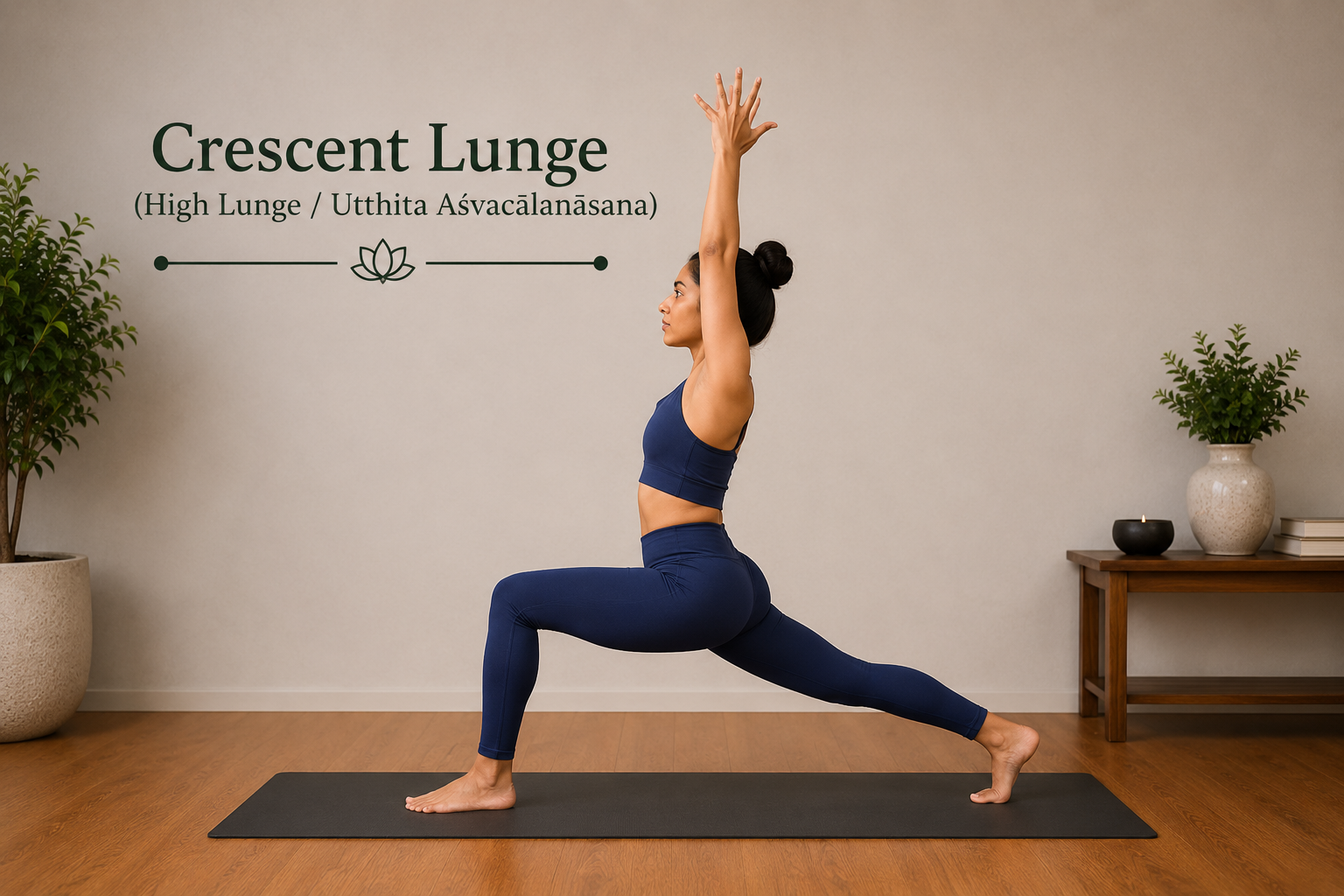
Crescent Lunge (High Lunge / Utthita Aśvacālanāsana): The Complete Reference Guide
Editorial note, stated once: throughout this article, traditional yogic and Āyurvedic claims (chakra, prāṇa, dosha associations) are presented as traditional belief, not scientific fact, unless a specific evidence source is cited alongside them.
Name & Meaning
- Sanskrit: उत्थित अश्वचालानासन (Utthita Aśvacālanāsana) / उच्च चन्द्रासन (Ucca Candrāsana)
- IAST Transliteration: Utthita Aśvacālanāsana / Crescent Lunge
- English: Crescent Lunge / High Lunge / Extended Equestrian Pose
- Etymology: Utthita (extended) + Aśva (horse) + Cālana (moving / riding) + Āsana (posture / seat). "The extended dynamic lunge capturing the poised energy, strength, and alert readiness of a rider mounted on a horse."
Introduction
- Crescent Lunge (High Lunge) is a powerhouse standing posture in modern Vinyasa and Haṭha Yoga, combining lower-body strength, hip opening, core stability, and balance.
- Characterized by stepping one foot forward into a deep lunge with the front knee bent at a 90-degree angle, keeping the rear leg strong and straight with the heel lifted high over the ball of the foot, squaring the pelvis forward, and reaching the arms overhead.
- Extensively integrated into Vinyasa flows, Sun Salutations (Surya Namaskar variations), and athletic conditioning programs.
- Functions as an outstanding clinical diagnostic for evaluating lower extremity strength, ankle plantarflexion stability, hip flexor flexibility, and core balance control.
Benefits
- Quadriceps, Glute & Calf Strengthening: Intensely builds muscular endurance in the front quadriceps, gluteus maximus, hamstrings, and rear calf complex (gastrocnemius/soleus).
- Hip Flexor & Psoas Elongation: Stretches the iliopsoas and rectus femoris of the extended rear leg while stabilizing the pelvis.
- Core Stability & Balance Control: Recruits transverse abdominis, obliques, and spinal stabilizers to maintain upright equilibrium on a split stance.
- Thoracic Expansion & Posture: Reaching arms overhead broadens the chest wall, opens pectorals, and counteracts rounded posture.
- Traditional/Spiritual: Believed to stimulate Manipūra (solar plexus) and Anāhata (heart) chakras, generate fiery inner vitality (Tapas), and ground mental focus—traditional belief, not a scientific claim.
How to Practice Crescent Lunge: Step-by-Step
| Step | Action | Breath | Teacher Cue |
|---|---|---|---|
| 1 | Begin standing in Samasthitiḥ at the front of the mat. Step your left foot back 3.5 to 4 feet into a wide stance, keeping your back heel lifted high. | Exhale to step back | "Step your left foot back, keeping your back heel stacked high over your toes." |
| 2 | Bend your front right knee until your right thigh is parallel to the floor, stacking your right knee directly over your right ankle at a 90-degree angle. | Exhale to bend front knee | "Bend your front knee to 90 degrees, tracking it directly over your ankle." |
| 3 | Keep your back left leg strong and straight, pressing your left heel backward toward an imaginary wall while lifting the back of your left thigh toward the ceiling. | Inhale to engage back leg | "Energize your back leg, pressing your heel back and lifting your back thigh skyward." |
| 4 | Steer your pelvis forward so your hips are squared to the front. Lengthen your tailbone down, pull your lower belly inward, and inhale both arms overhead. | Inhale arms overhead | "Draw your lower belly in, lengthen your tailbone, and sweep your arms to the sky." |
| 5 | Soften your shoulders away from your ears, lift your chest into a gentle upper back extension, and fix your gaze straight ahead. Hold for 5–8 steady breaths. | Steady, expansive diaphragmatic breath | "Soften your shoulders, lift your heart, and find steady balance." |
| 6 | To exit, exhale hands down to frame your front foot, press off your back foot, and step forward to Samasthitiḥ. Repeat on the left side. | Exhale to step forward | "Plant your hands, step forward to the front of your mat, and switch sides." |
Common Mistakes & Corrections
- Front knee drifting forward past the ankle: Pushing the front knee past 90 degrees strains the patellar tendon → Correction: Widen your stance and stack your front knee directly over your ankle.
- Back knee bending or slumping: Allowing the rear leg to go soft removes support from the hip flexors → Correction: Press your back heel up high and lift the back thigh firmly toward the ceiling.
- Hyper-arching the lower back (lumbar dumping): Failing to engage the core causes the lower back to collapse → Correction: Lengthen your tailbone down toward the floor and draw your lower ribs inward.
- Narrow tightrope foot placement: Placing feet on a single straight line compromises balance → Correction: Step your feet hip-width apart laterally (on railroad tracks) for stability.
Contraindications & Precautions
- Acute Knee Injury or Patellar Tendonitis: Deep 90-degree lunging under load can aggravate knee pain; keep lunge shallower.
- Severe Ankle Instability or Plantar Fasciitis: Balancing on the ball of the rear foot can strain unstable ankles.
- High Blood Pressure or Cardiac Conditions: Reaching arms overhead increases vascular load; keep hands on hips or at heart center.
Sequencing: Preparatory, Follow-up & Variations
- Preparatory Poses: Anjaneyāsana (Low Lunge), Vīrabhadrāsana I (Warrior I), Uttānāsana, Downward-Facing Dog.
- Placement in Sequence: Standing lunge sequence peak, utilized extensively in Vinyasa transitions and Sun Salutation variations.
- Follow-up Poses: Vīrabhadrāsana II (Warrior II), Parivṛtta Aṣṭāṅcālanāsana (Revolved Lunge), Uttānāsana, Śavāsana.
- Variations:
- Hands at Heart Center (Anjali Mudra): Modified upper body position for shoulder tension or balance focus.
- Revolved Crescent Lunge (Parivṛtta Crescent Lunge): Twisting torso toward front leg with elbows hooked.
- Block-Supported High Lunge: Resting fingertips on yoga blocks beside front foot.
Modifications
- Hands at Heart Center: Bring palms together at chest level if overhead arm extension causes shoulder strain or compromises balance.
- Shorter Stance Length: Reduce the distance between your front and back feet to make balancing easier and relieve calf tension.
- Lower Back Knee to Mat (Low Lunge): If fatigue sets in, drop your back knee down to the floor into Anjaneyāsana.
Historical Background & Classical References
- Modern Vinyasa Evolution: While classical texts feature various kneeling lunges, Crescent Lunge (High Lunge) was formalized in 20th-century Vinyasa yoga and modern physical culture as a primary strength-building standing posture.
- Energetic Symbolism: Represents the fiery, dynamic sun energy (Sūrya) and the cultivation of inner heat and resilience.
Alignment Principles (Iyengar Method)
- Vertical Front Shin: Front knee stacks directly above ankle forming a 90-degree angle.
- Elevated Rear Heel: Back heel lifts high over toes with back leg locked straight and strong.
- Integrated Core: Lower ribs knit inward while tailbone drops downward to protect lumbar spine.
Anatomy & Biomechanics
- Primary Stretched Muscles: Iliopsoas, Rectus Femoris, Pectineus, Pectoralis Major, Latissimus Dorsi.
- Primary Active/Strengthening Muscles: Quadriceps Femoris (front leg), Gluteus Maximus, Gastrocnemius/Soleus (rear leg), Transverse Abdominis, Deltoids.
- Joint Mechanics: Front hip flexion (90°) and knee flexion (90°); rear hip extension, neutral abduction; rear ankle plantarflexion; thoracic spinal extension.
- Closed-Chain Kinetic Stability: The split stance creates an unstable base requiring simultaneous stabilization from the front quadriceps and rear calf muscles. Core engagement prevents anterior pelvic tilt and shields lumbar facet joints from excessive compression.
Nervous System & Breathing Effects
- Sympathetic Invigoration: Full-body muscular engagement stimulates sympathetic alertness, boosting energy and circulation.
- Intercostal Expansion: Overhead arm reaches expand the ribcage, encouraging deep, rhythmic tidal breathing.
Yogic & Āyurvedic Perspective
- Dosha Impact: Stimulates Pitta (builds internal heat and determination) and grounds erratic Vāta—traditional belief.
- Prāṇa Dynamics: Awakens Manipūra Chakra (solar plexus) and circulates Prāṇa Vāyu throughout the upper body.
Therapeutic Applications
| Condition | Mechanism | Research / Precaution |
|---|---|---|
| Lower Body Weakness & Sedentary Atrophy | Loaded split-stance weight-bearing builds functional quadriceps and gluteal strength | Supported by exercise physiology studies. Precaution: Step feet hip-width apart. |
| Tight Hip Flexors & Rounded Posture | Rear leg extension stretches iliopsoas while overhead reach opens chest | Supported by postural physical therapy protocols. Precaution: Keep lower belly engaged. |
Yoga is never a replacement for medical treatment; serious or persistent conditions require a qualified healthcare professional.
Teaching Cues & Hands-On Adjustments
- Verbal Cues: "Stack your front knee directly over your ankle and press your back heel up high." / "Draw your lower belly in and sweep your arms to the sky." / "Energize your back leg straight and strong."
- Hands-on Adjustment (Safe execution with consent):
- Stand beside student; place one hand gently on their lower back/sacrum to guide tailbone downward and prevent lower back arching.
- Place flat hand against their upper back to help them lift their chest into thoracic extension.
Myth vs. Fact
| Myth | Fact |
|---|---|
| Crescent Lunge is just a transition pose, so alignment does not matter much. | High Lunge is a demanding strength posture; proper alignment protects your knees and lumbar spine from injury. |
| Your back leg should be slightly bent to help you bounce into the stretch. | The back leg must be kept strong and straight with the heel lifted high to maximize stability and muscle activation. |
Conclusion
Crescent Lunge (High Lunge) is a dynamic, invigorating posture that builds lower body resilience, strengthens the core, and opens the chest. By keeping the front knee stacked, the back leg strong and straight, and the core engaged, practitioners cultivate fiery warrior energy and steady balance.
Quick Facts
| Category | Standing high lunge / Strengthening pose |
| Difficulty Level | Intermediate |
| Primary Muscles Stretched | Iliopsoas, Rectus Femoris, Pectoralis Major, Latissimus Dorsi |
| Primary Muscles Active | Quadriceps Femoris, Gluteus Maximus, Gastrocnemius/Soleus, Transverse Abdominis |
| Classical Source? | Yes (Modern classical vinyasa formalization) |
| Traditional Chakra (Belief) | Manipūra (Solar Plexus) & Anāhata (Heart) |
| Dosha Impact (Belief) | Ignites Pitta & grounds Vāta |
Frequently Asked Questions
What is the difference between Crescent Lunge and Warrior I?
In Crescent Lunge, the back heel remains lifted high over the toes and the hips square forward easily. In Warrior I, the back foot steps down flat and turns out at a 45-degree angle.
Why do I feel unstable when practicing High Lunge?
Instability usually happens when your feet are placed in a single narrow line like a tightrope. Step your feet hip-width apart laterally (on railroad tracks) to create a wide, stable base.
How can I protect my lower back in Crescent Lunge?
Draw your lower belly inward and lengthen your tailbone straight down toward the floor to neutralize your pelvis and prevent lower back arching.
How long should I hold Crescent Lunge?
Hold for 5 to 8 steady breaths (about 20 to 40 seconds) on each side.
References
1. Modern Vinyasa & Hatha Manuals: Contemporary sequencing and biomechanics literature.
2. Peer-Reviewed Scientific Research:
- Sherman, K. J., et al. (2011). A randomized trial comparing yoga, stretching, and a self-care book for chronic low back pain. Archives of Internal Medicine, 171(22), 2019-2026.
- Ni, M., et al. (2014). Comparative muscle activation patterns during yoga postures in elderly adults. BMC Complementary and Alternative Medicine, 14, 401.
This article is for educational purposes and does not replace individualized medical or physical therapy advice. Consult a qualified healthcare provider before beginning any new practice.