Chitta Prasādanam: Four Yogic Attitudes for Clarity and Serenity of Citta

Chitta Prasādanam: Four Yogic Attitudes for Clarity and Serenity of Citta
Introduction
Why can another person's happiness disturb us?
Why does the suffering of another person sometimes awaken compassion, while at other times it produces indifference, judgement, or emotional overwhelm?
Why are we occasionally uncomfortable in the presence of genuine virtue?
And why can another person's misconduct continue to occupy Citta long after the external event has ended?
Human relationships continually become objects of cognition.
Another person's happiness, suffering, conduct, success, failure, or behaviour may give rise to different Vṛttis within Citta.
In the Samādhi Pāda of Patañjali's Yoga Sūtras, a remarkably practical discipline is presented for cultivating a clearer and more serene condition of Citta.
Patañjali states:
मैत्रीकरुणामुदितोपेक्षाणां सुखदुःखपुण्यापुण्यविषयाणां भावनातश्चित्तप्रसादनम्॥१.३३॥
Maitrī-karuṇā-muditopekṣāṇāṁ sukha-duḥkha-puṇyāpuṇya-viṣayāṇāṁ bhāvanātaś citta-prasādanam.
The sūtra presents four cultivated attitudes:
- Maitrī — Friendliness or goodwill
- Karuṇā — Compassion
- Muditā — Gladness or appreciative joy
- Upekṣā — Equanimity or impartial regard
These are cultivated respectively in relation to:
- Sukha — Happiness or ease
- Duḥkha — Suffering or pain
- Puṇya — Virtue or merit
- Apuṇya — Non-virtue or demerit
Through the cultivation of these attitudes, Patañjali points towards Citta-Prasādanam—the clarification, serenity, and tranquillisation of Citta.
This is not merely a lesson in social etiquette.
Nor is it simply a formula for becoming a “nice person.”
The sūtra concerns the condition of the practitioner's own Citta and the cultivation of dispositions that counter disturbances arising in relation to particular objects and conditions.
To understand the teaching carefully, we must distinguish the structure of the original sūtra, the classical commentarial interpretation, and its practical application in contemporary life.
Yoga Sūtra 1.33
मैत्रीकरुणामुदितोपेक्षाणां सुखदुःखपुण्यापुण्यविषयाणां भावनातश्चित्तप्रसादनम्॥१.३३॥
Maitrī-karuṇā-muditopekṣāṇāṁ sukha-duḥkha-puṇyāpuṇya-viṣayāṇāṁ bhāvanātaś citta-prasādanam.
Word-by-Word Meaning
Maitrī (मैत्री) — Friendliness, goodwill, benevolent disposition
Karuṇā (करुणा) — Compassion
Muditā (मुदिता) — Gladness, joy, delight
Upekṣā (उपेक्षा) — Equanimity, impartiality, or a disposition of non-reactive regard; the precise English rendering requires contextual care
Sukha (सुख) — Happiness, ease, or a pleasant condition
Duḥkha (दुःख) — Suffering, pain, or distress
Puṇya (पुण्य) — Virtue, merit, or meritorious conduct
Apuṇya (अपुण्य) — Non-virtue, demerit, or unmeritorious conduct
Viṣayāṇām (विषयाणाम्) — With regard to these objects, fields, or conditions
Bhāvanātaḥ (भावनातः) — Through cultivation, development, or sustained bringing into being
Citta (चित्त) — The inner cognitive apparatus within the Pātañjala philosophical framework
Prasādanam (प्रसादनम्) — Clarification, serenity, tranquillisation, or making clear and calm
Concise Translation
“Through the cultivation of friendliness towards happiness, compassion towards suffering, gladness towards virtue, and equanimity towards non-virtue, Citta becomes clear and serene.”
English translations vary.
Some translators use joy, delight, indifference, disregard, impartiality, or equanimity for particular terms.
No English rendering should automatically be assumed to exhaust the Sanskrit concept.
However, the grammatical and conceptual structure of the sūtra clearly presents four attitudes cultivated in relation to four corresponding objects or conditions.
The Structure of Yoga Sūtra 1.33

The fourfold correspondence is central to the sūtra:
| Condition or Viṣaya | Cultivated Attitude |
|---|---|
| Sukha — Happiness | Maitrī — Friendliness |
| Duḥkha — Suffering | Karuṇā — Compassion |
| Puṇya — Virtue | Muditā — Gladness |
| Apuṇya — Non-virtue | Upekṣā — Equanimity |
This structure should be preserved when teaching the sūtra.
Patañjali does not simply provide four attractive virtues and ask the practitioner to cultivate all of them indiscriminately in every situation.
Each Bhāvanā is presented in relation to a corresponding Viṣaya.
Maitrī in relation to Sukha.
Karuṇā in relation to Duḥkha.
Muditā in relation to Puṇya.
Upekṣā in relation to Apuṇya.
The sūtra is therefore both ethical in implication and psychologically precise in its practical structure.
Does Patañjali Divide Humanity into Four Types of People?
A popular explanation of Yoga Sūtra 1.33 says:
“There are four types of people in the world: happy people, unhappy people, good people, and bad people.”
This can function as a simple teaching device.
However, it should not automatically be presented as a literal translation of the Sanskrit.
The sūtra speaks of:
- Sukha — Happiness
- Duḥkha — Suffering
- Puṇya — Virtue or merit
- Apuṇya — Non-virtue or demerit
These are the Viṣayas—the objects or conditions in relation to which the four attitudes are cultivated.
Classical commentarial explanations often discuss persons characterised by happiness, suffering, virtue, or non-virtue because, in practical life, these conditions are encountered through living beings and their conduct.
Yet this should not be converted too rigidly into four permanent human identities.
A person who experiences Sukha today may encounter Duḥkha tomorrow.
A person may act virtuously in one situation and engage in non-virtuous conduct in another.
Therefore, a more careful practical formulation is:
When happiness is encountered, cultivate Maitrī.
When suffering is encountered, cultivate Karuṇā.
When virtue is encountered, cultivate Muditā.
When non-virtue is encountered, cultivate Upekṣā.
The teaching directs attention towards the quality of the disposition cultivated in Citta.
What Is Citta-Prasādanam?
The expression Citta-Prasādanam deserves careful attention.
It is sometimes loosely explained as:
“Keeping the mind happy.”
This is inadequate.
The semantic range of Prasādana is connected with making clear, calming, soothing, tranquillising, or bringing into a serene condition.
Therefore, Citta-Prasādanam should not be reduced to maintaining a pleasant emotional mood.
A person may appear cheerful while Citta remains agitated by envy, resentment, hostility, or confusion.
Similarly, Yogic serenity does not require artificial smiling or denial of Duḥkha.
Within Yoga Sūtra 1.33, the concern is a clearer, calmer, and less disturbed condition of Citta.
This is philosophically important because the sūtra occurs within a section concerned with obstacles, disturbance, and methods supporting the steadiness of Citta.
The four Bhāvanās are not ornamental moral virtues added to Yoga.
They perform a Yogic function in relation to Citta.
Yoga Sūtra 1.33 in the Context of Samādhi Pāda
Yoga Sūtra 1.33 should not be isolated from the sūtras surrounding it.
In Yoga Sūtra 1.30, Patañjali identifies the Antarāyas—obstacles or impediments associated with Citta-Vikṣepa.
These include:
- Vyādhi — Illness
- Styāna — Mental stagnation or languor
- Saṁśaya — Doubt
- Pramāda — Carelessness or heedlessness
- Ālasya — Laziness
- Avirati — Lack of dispassion or inability to withdraw from sensory involvement
- Bhrānti-Darśana — False or mistaken perception
- Alabdha-Bhūmikatva — Failure to attain a stage
- Anavasthitatva — Instability in maintaining an attained state
Yoga Sūtra 1.31 describes accompanying disturbances:
- Duḥkha — Suffering
- Daurmanasya — Mental distress or dejection
- Aṅgamejayatva — Trembling or instability of the body
- Śvāsa-Praśvāsa — Disturbance associated with inhalation and exhalation
Yoga Sūtra 1.32 then directs the practitioner towards Eka-Tattva-Abhyāsa—the practice of one principle or one object—as a means of counteracting these obstacles.
Yoga Sūtra 1.33 continues the discussion by presenting the cultivation of Maitrī, Karuṇā, Muditā, and Upekṣā for Citta-Prasādanam.
The following sūtras present additional means connected with the clarification and stabilisation of Citta.
The textual sequence matters.
Yoga Sūtra 1.33 is not random advice on interpersonal relationships.
It belongs to Patañjali's wider practical concern with Citta, Vikṣepa, and the cultivation of conditions supportive of Yogic steadiness.
Yoga Sūtra 1.33 in Vyāsa's Commentary
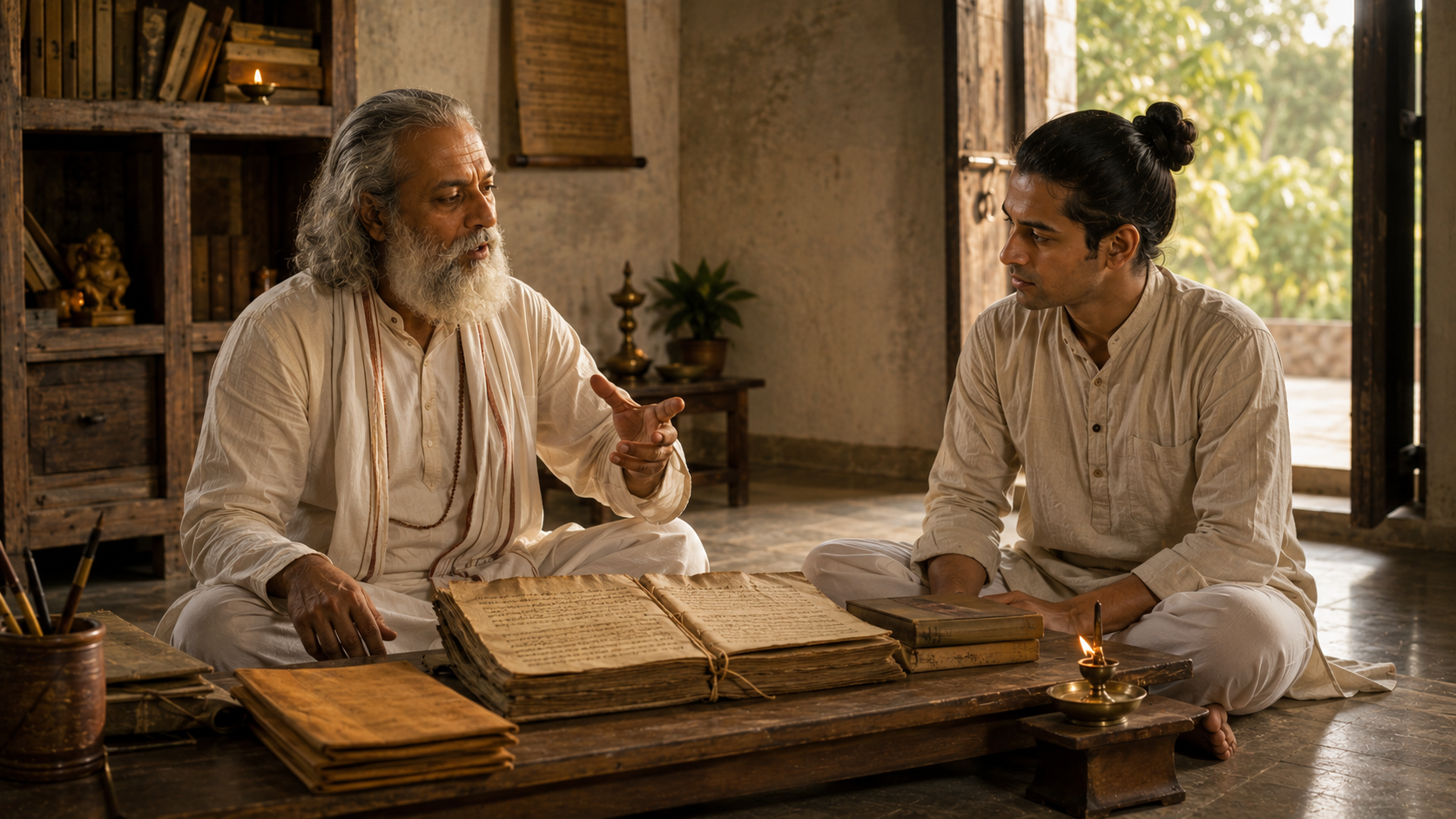
The Yoga Bhāṣya attributed to Vyāsa provides an important classical interpretive layer for understanding this sūtra.
Vyāsa connects the four attitudes with disturbances that may arise in Citta when particular human conditions are encountered.
In relation to the happiness of others, hostility or envy may arise.
In relation to suffering, compassion is cultivated.
In relation to the virtuous, gladness is cultivated.
In relation to the non-virtuous, equanimity or impartiality is maintained.
The significance of this commentarial framework is practical.
The happiness, suffering, virtue, or non-virtue of another person becomes an occasion in which the condition of our own Citta may be disturbed.
The cultivated attitude functions as a counter-direction.
Maitrī opposes the disturbance associated with hostility towards happiness.
Karuṇā establishes a compassionate relation to suffering.
Muditā prevents virtue from becoming an object of envy or resentment.
Upekṣā prevents non-virtue from continually contaminating Citta through reactive involvement.
This commentarial layer helps us understand why the result of the four Bhāvanās is described as Citta-Prasādanam.
The teaching is not simply:
“Be friendly, compassionate, happy, and indifferent because these are good manners.”
The concern is the purification and clarification of Citta for the Yogic path.
1. Maitrī: Friendliness Towards Sukha
The first cultivated attitude is Maitrī.
Maitrī may be understood as friendliness, goodwill, or a benevolent disposition.
Patañjali connects Maitrī with Sukha—happiness, ease, or a pleasant condition.
Why Can Another Person's Happiness Disturb Citta?
Suppose someone becomes successful.
Their work receives recognition.
Their business grows.
Their students appreciate them.
Their family appears happy.
What happens within Citta?
Sometimes friendliness arises naturally.
At other times, comparison begins:
“Why did they succeed before me?”
“They are not as capable as people think.”
“Perhaps their success is not genuine.”
The external condition is another person's happiness or favourable circumstance.
Yet Citta develops envy, suspicion, hostility, or resentment.
The other person's Sukha may not have directly harmed us.
But our reaction to that Sukha disturbs our own Citta.
Maitrī as a Yogic Bhāvanā
Patañjali gives Maitrī as the cultivated disposition in relation to Sukha.
This does not mean becoming emotionally intimate with every happy or successful person.
Nor does Maitrī require artificial excitement.
The practical discipline is the cultivation of non-hostile goodwill towards happiness.
We may ask:
“Can I encounter another person's happiness without immediately turning it into a threat to my own identity?”
This question is my practical contemplation inspired by the sūtra.
It is not Patañjali's literal wording.
When hostility towards another's Sukha is weakened through Maitrī, one source of disturbance in Citta is also weakened.
2. Karuṇā: Compassion Towards Duḥkha
The second cultivated attitude is Karuṇā—compassion.
Patañjali connects Karuṇā with Duḥkha—suffering, pain, or distress.
When suffering is encountered, the cultivated response is compassion.
Karuṇā Is Not Merely a Feeling of Pity
Karuṇā should not be reduced to the casual statement:
“I feel sorry for you.”
Compassion involves a disposition towards suffering that is different from cruelty, enjoyment of another's pain, or cold indifference.
In practical life, Karuṇā may inform listening, support, protection, teaching, practical assistance, or simply the refusal to increase another person's suffering.
However, we should maintain textual precision.
Modern Yoga teachers sometimes say:
“Pity makes a person weak, but compassion gives solutions.”
This may function as a modern teaching distinction.
But Patañjali does not state this psychological formula in Yoga Sūtra 1.33.
If such an idea is used, it should be identified as a practical interpretation rather than the literal teaching of the sūtra.
Does Compassion Require Emotional Overwhelm?
Another misunderstanding is to equate Karuṇā with complete emotional absorption into another person's suffering.
Someone is anxious, and we reproduce the anxiety within ourselves.
Someone is grieving, and we assume that we must become equally destabilised to demonstrate care.
The sūtra itself does not define compassion as emotional contagion.
From a practical Yogic perspective, a clearer and steadier Citta may sometimes allow compassionate action to become more effective.
This should not be used as an excuse for emotional coldness.
But Karuṇā and psychological collapse are not identical.
A practitioner may remain sensitive to suffering while cultivating sufficient steadiness to respond appropriately.
3. Muditā: Gladness Towards Puṇya
The third cultivated attitude is Muditā.
Muditā carries the sense of gladness, joy, or delight.
Patañjali connects Muditā with Puṇya—virtue, merit, or meritorious conduct.
This is a subtle discipline.
Human beings often notice wrongdoing very quickly.
Someone makes a mistake, and the event becomes a topic of discussion.
Someone behaves badly, and the story is remembered.
Someone fails, and the failure spreads through conversation.
But when a person acts with integrity, discipline, generosity, or genuine service, the response may be strangely silent.
Sometimes virtue itself disturbs Citta.
The mind begins searching for a hidden motive:
“They are only doing this for publicity.”
“Nobody is genuinely that sincere.”
“There must be some personal benefit.”
Discernment remains necessary.
Not every public display of virtue is genuine.
But habitual cynicism is not identical with Viveka.
The Practice of Muditā
Muditā is cultivated in relation to Puṇya.
When genuine virtue is encountered, can we appreciate it?
When someone serves sincerely, can gladness arise?
When a practitioner develops discipline, can we appreciate that discipline without immediately entering comparison?
When another teacher works responsibly, can we recognise the quality of the work?
Muditā is not flattery.
It is not blind admiration.
It is not the suspension of critical intelligence.
It is the cultivation of gladness in relation to virtue rather than allowing Puṇya to become another object of envy, hostility, or habitual suspicion.
Muditā and the Habit of Constant Criticism
A Citta trained only to detect faults may gradually become incapable of recognising excellence even when excellence is present.
This does not mean that Yoga requires naïveté.
It means that constant criticism can itself become a conditioning pattern.
Muditā introduces another disposition.
The practitioner learns to recognise what is genuinely worthy of gladness.
4. Upekṣā: Equanimity Towards Apuṇya
The fourth attitude is perhaps the most easily misunderstood.
Patañjali gives Upekṣā in relation to Apuṇya—non-virtue or unmeritorious conduct.
English translations include equanimity, impartiality, disregard, and sometimes indifference.
Each English word carries its own connotations.
Therefore, caution is necessary.
Upekṣā Does Not Simply Mean “Ignore Bad People”
A common simplified teaching says:
“Ignore bad people.”
This is inadequate.
First, the sūtra does not rigidly classify certain human beings as permanently “bad people.”
Second, Upekṣā concerns the cultivated disposition of Citta in relation to Apuṇya.
Vyāsa's commentarial framework helps clarify the Yogic concern: involvement with non-virtue can generate disturbance and impurity in one's own Citta.
The practitioner therefore cultivates Upekṣā.
Upekṣā and Moral Passivity
We must also avoid importing an opposite error.
Upekṣā should not automatically be used to construct a universal ethical rule that harmful conduct must never be challenged.
Yoga Sūtra 1.33 is specifically discussing a Bhāvanā conducive to Citta-Prasādanam.
It is not a complete legal, political, or institutional theory of responding to every form of wrongdoing.
Therefore, the sūtra alone should not be used to claim either:
“Always ignore wrongdoing,”
or
“Patañjali explicitly instructs us to confront wrongdoing through particular modern social procedures.”
Both claims go beyond the text.
A Practical Contemplation on Upekṣā
In ordinary life, we can nevertheless contemplate the principle carefully.
Another person's misconduct may require discernment.
Sometimes distance is appropriate.
Sometimes a teaching relationship requires correction.
Sometimes a practical response is necessary according to one's role and circumstances.
But after recognising what must be done, another question remains:
“Must the wrongdoing continue to occupy Citta without end?”
We may replay the event.
We may construct imaginary arguments.
We may repeatedly intensify anger.
The external act may have ended, but Citta continues producing Vṛttis around it.
From my practical contemplation as a Yoga teacher, Upekṣā invites us to examine this reactive continuation.
Recognise what has occurred.
Use discernment.
Fulfil the responsibility appropriate to the situation.
Do not unnecessarily cultivate endless reactive involvement in Citta.
This is a modern practical contemplation inspired by the principle.
It is not a literal translation of Upekṣā or a direct quotation from Patañjali or Vyāsa.
The Four Attitudes Are Practices of Bhāvanā
One of the most important words in Yoga Sūtra 1.33 is Bhāvanātaḥ.
The sūtra does not merely list four emotional states.
It speaks of Bhāvanā—cultivation or development.
This changes the practical significance of the teaching.
Maitrī may not arise automatically when another person is happy.
Karuṇā may not arise automatically when suffering is encountered.
Muditā may be difficult when comparison is strong.
Upekṣā may be difficult when anger repeatedly pulls Citta into reactive engagement.
The fact that a particular attitude does not arise spontaneously does not make the teaching irrelevant.
That may be precisely where Bhāvanā becomes necessary.
- If envy appears in relation to Sukha, Maitrī is cultivated.
- If coldness or hostility appears in relation to Duḥkha, Karuṇā is cultivated.
- If resentment appears in relation to Puṇya, Muditā is cultivated.
- If reactive entanglement appears in relation to Apuṇya, Upekṣā is cultivated.
Yoga is not merely the passive observation of every existing conditioning pattern.
Within the Pātañjala discipline, particular dispositions and practices are intentionally cultivated because they support the Yogic path.
Are Maitrī, Karuṇā, Muditā, and Upekṣā Personality Traits?
Not in the limited sense of fixed personality categories.
A person may say:
“I am naturally friendly.”
“I am simply not compassionate.”
“I cannot feel glad for successful or virtuous people. That is my nature.”
Yoga Sūtra 1.33 does not need to be reduced to a personality test.
The term Bhāvanātaḥ points towards cultivation.
A disposition can be developed.
A habitual response can be examined.
A different orientation of Citta can be repeatedly strengthened.
This requires practice.
Maitrī may initially feel difficult in the presence of envy.
Karuṇā may feel difficult when judgement dominates.
Muditā may feel difficult when comparison is habitual.
Upekṣā may feel difficult when anger demands continued mental involvement.
The difficulty does not invalidate the practice.
The difficulty may reveal the very conditioning in relation to which cultivation is required.
The Four Attitudes Are About the Condition of Our Own Citta

Yoga Sūtra 1.33 is often presented as a guide for dealing with other people.
This is useful, but incomplete.
The result named in the sūtra is:
Citta-Prasādanam.
The clarification and serenity of Citta.
Consider the four situations.
Another person is happy.
What arises in my Citta?
Someone is suffering.
What arises in my Citta?
Virtuous conduct is encountered.
What arises in my Citta?
Non-virtuous conduct is encountered.
What arises in my Citta?
The external condition becomes a Viṣaya in relation to which a particular Bhāvanā is cultivated.
The teaching therefore turns attention back towards the practitioner's own Citta.
This does not mean becoming self-absorbed or indifferent to others.
It means recognising that our habitual responses to others also condition our own inner instrument.
Another person's Sukha may become envy in my Citta.
Another person's Duḥkha may become cruelty or indifference in my Citta.
Another person's Puṇya may become resentment in my Citta.
Another person's Apuṇya may become obsessive hatred in my Citta.
The four Bhāvanās provide a different orientation:
Maitrī.
Karuṇā.
Muditā.
Upekṣā.
The result is not control over other people.
The result described is Citta-Prasādanam.
A Practical Contemplation for Daily Life
When Citta becomes disturbed in relation to another person or condition, Yoga Sūtra 1.33 can become a framework for self-examination.
When Encountering Sukha
“Am I meeting this happiness with Maitrī, or has comparison and envy entered Citta?”
When Encountering Duḥkha
“Can I cultivate Karuṇā without becoming cruel, dismissive, or unnecessarily destabilised?”
When Encountering Puṇya
“Can I recognise and feel glad in relation to genuine virtue?”
When Encountering Apuṇya
“What is the appropriate response, and am I continuing to feed reactive involvement beyond what the situation requires?”
These questions are practical contemplations inspired by Yoga Sūtra 1.33.
They are not direct quotations from Patañjali.
Nor should the practitioner become obsessed with mechanically classifying every social interaction.
The purpose is to become more aware of how habitual reactions condition Citta.
What Citta-Prasādanam Does Not Mean
Citta-Prasādanam does not mean that a Yoga practitioner must remain emotionally cheerful every hour of the day.
It does not mean suppressing grief.
It does not mean pretending that suffering is pleasant.
It does not mean tolerating abuse.
It does not mean praising every successful person.
It does not mean assuming that every apparently virtuous action is genuine.
It does not mean ignoring all harmful conduct.
And it does not mean displaying a spiritual smile while Citta remains internally consumed by resentment.
The sūtra presents a discipline of Bhāvanā—cultivation.
The practitioner examines and gradually refines the dispositions through which Citta relates to Sukha, Duḥkha, Puṇya, and Apuṇya.
The result described is Citta-Prasādanam.
Not social performance.
Not emotional pretence.
Clarity and serenity of Citta.
Key Points
- Yoga Sūtra 1.33 presents Maitrī, Karuṇā, Muditā, and Upekṣā as four cultivated attitudes.
- Maitrī is cultivated in relation to Sukha—happiness or ease.
- Karuṇā is cultivated in relation to Duḥkha—suffering or distress.
- Muditā is cultivated in relation to Puṇya—virtue or merit.
- Upekṣā is cultivated in relation to Apuṇya—non-virtue or demerit.
- The fourfold correspondence between the attitudes and their Viṣayas is central to the structure of the sūtra.
- Patañjali does not necessarily divide humanity into four permanently fixed types of people.
- Citta-Prasādanam should not be reduced to “keeping the mind happy.”
- Prasādanam carries senses associated with clarification, serenity, calming, and tranquillisation.
- Yoga Sūtra 1.33 occurs within a wider textual discussion concerning Antarāyas, Citta-Vikṣepa, and methods supporting the steadiness of Citta.
- Vyāsa's commentary helps clarify the relation of these Bhāvanās to disturbances arising in response to happiness, suffering, virtue, and non-virtue.
- Maitrī can counter hostility or envy in relation to another's happiness.
- Karuṇā is cultivated in relation to suffering but should not automatically be equated with emotional collapse.
- Muditā is gladness in relation to virtue and should not be confused with blind admiration.
- Upekṣā should not simply be translated as “ignore bad people.”
- Yoga Sūtra 1.33 should not be treated as a complete political, legal, or institutional theory of responding to wrongdoing.
- Bhāvanātaḥ points towards cultivation; the four attitudes are not merely fixed personality traits.
- Practical modern applications should be clearly distinguished from the literal statements of Patañjali and classical commentary.
- The primary Yogic result named in the sūtra is Citta-Prasādanam—the clarification and serenity of Citta.
Conclusion
Yoga Sūtra 1.33 presents a profound teaching concerning the relationship between the conditions we encounter and the dispositions cultivated within Citta.
We encounter happiness.
We encounter suffering.
We encounter virtue.
We encounter non-virtue.
The world does not organise itself according to our psychological comfort.
People will experience Sukha.
People will experience Duḥkha.
We will encounter Puṇya.
We will encounter Apuṇya.
Patañjali does not begin by promising control over every person or circumstance.
The sūtra directs attention towards Bhāvanā—the cultivation of particular dispositions within Citta.
Maitrī towards Sukha.
Karuṇā towards Duḥkha.
Muditā towards Puṇya.
Upekṣā towards Apuṇya.
The purpose is not artificial goodness.
The purpose is not spiritual politeness.
The purpose is not to construct a socially attractive personality.
The result described by Patañjali is:
Citta-Prasādanam.
The clarification and serenity of Citta.
As a Yoga teacher, I find this sūtra especially practical because many disturbances of Citta do not arise only from external events.
They are also shaped by the dispositions through which Citta relates to what it encounters.
Another person's happiness becomes comparison.
Another person's suffering becomes judgement or destabilisation.
Another person's virtue becomes envy or habitual suspicion.
Another person's non-virtuous conduct becomes an endless internal argument.
Yoga Sūtra 1.33 presents a discipline of cultivation.
Friendliness.
Compassion.
Gladness.
Equanimity.
The external world may continue to present Sukha, Duḥkha, Puṇya, and Apuṇya.
The Yogic question is:
“What are we repeatedly cultivating within Citta in response?”
This is where the teaching of Citta-Prasādanam moves from philosophical study into the living discipline of Yoga.