Brahmāsana (Pose of Brahma): Classical Sources, Anatomy, Alignment & Evidence-Based Guide
Brahmāsana (Pose of Brahma): The Complete Reference Guide
Editorial note, stated once: throughout this article, traditional yogic and Āyurvedic claims (chakra, prāṇa, dosha associations) are presented as traditional belief, not scientific fact, unless a specific evidence source is cited alongside them.
Name & Meaning
- Sanskrit: ब्रह्मासन (Brahmāsana)
- IAST Transliteration: Brahmāsana
- English: Pose of Brahma / Creator's Posture
- Etymology: Brahma (the Hindu deity of creation and cosmic intelligence, or Supreme Spirit) + Āsana (posture / seat). "The sacred seat representing creative poise, mental stability, and cosmic awareness."
Introduction
- Brahmāsana is an ancient classical seated meditation posture explicitly documented in medieval Haṭha Yoga literature, dedicated to Brahma—the creator aspect of the divine trinity.
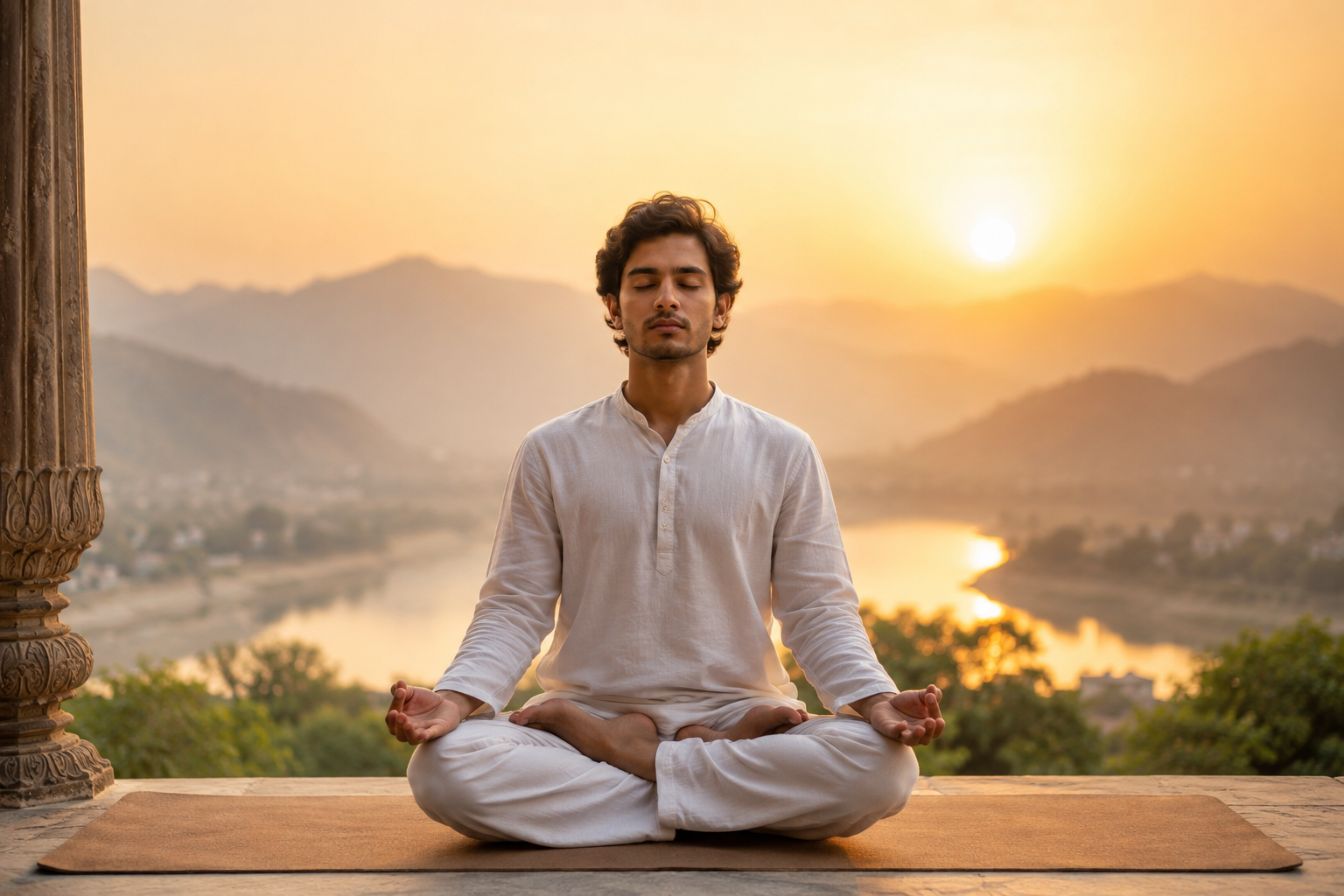
- Characterized by crossing the ankles in a stable, symmetrical seat with knees resting grounded on the floor, while the spine ascends cleanly in a vertical axis and hands rest in a sacred mudrā or open upon the knees.
- Documented directly in the 17th-century Gheraṇḍa Saṃhitā (Chapter 2, Verse 12) as one of the 32 essential physical postures for worldly practitioners.
- Provides an exceptionally stable, balanced, and quiet seat for Prāṇāyāma, Brahmamudrā head movements, and deep meditation (Dhyāna), eliminating unnecessary joint strain in the knees while fostering optimal spinal alignment.
Benefits
- Physical: Lengthens hip external rotators and groin flexors; supports natural lumbar lordosis when hips are elevated or knees grounded; stabilizes pelvic floor muscles.
- Postural & Ergonomic: Establishes a broad, solid triangular base (sit-bones and both knees touching the floor) that minimizes postural sway and muscular fatigue during long static holds.
- Mental & Neurological: Anchoring the hips and knees lowers somatic nervous system arousal, signaling parasympathetic dominance and facilitating mental quietude (pratyāhāra).
- Traditional/Spiritual: Classically believed to awaken Brahma Nāḍī (the central spiritual channel within Suṣumnā), stimulate the Anāhata (heart) and Sahasrāra (crown) chakras, and cultivate creative mental clarity—traditional belief, not a scientific claim.
How to Practice Brahmāsana: Step-by-Step
| Step | Action | Breath | Teacher Cue |
|---|---|---|---|
| 1 | Sit in Daṇḍāsana (Staff Pose) on a firm mat with legs extended straight forward and spine fully erect. | Natural breath | "Sit tall on your sit-bones and grow long through your crown." |
| 2 | Bend both knees and cross legs at the ankles, bringing feet beneath opposite thighs or shins in a stable, comfortable cross-legged seat. | Exhale to cross legs | "Cross your shins snugly, allowing both knees to descend toward the floor." |
| 3 | Adjust sit-bones so weight is distributed evenly across both sides of the pelvis. | Inhale to settle base | "Feel your sit-bones anchor deeply into your mat." |
| 4 | Rest hands softly on knees in Jñāna Mudrā, Chin Mudrā, or folded in the lap in Brahma Mudrā (right palm over left palm resting at navel). | Inhale to lift sternum | "Rest your hands softly and open your chest wide." |
| 5 | Lengthen spine upward, broaden collarbones, draw shoulders back and down, and lower chin slightly toward chest. | Inhale to extend spine | "Feel your central channel ascend like a column of light." |
| 6 | Gaze softly at nose tip (Nāsāgra) or eyebrow center (Bhrūmadhya). Hold for desired meditation duration. Alternate cross of legs periodically. | Slow, deep, quiet breathing | "Rest in quiet, creative stillness." |
Common Mistakes & Corrections
- Slouching lower back (posterior pelvic tilt): Rolling back on sacrum flattens natural lumbar curvature and causes rapid back fatigue → Correction: Elevate hips on a firm cushion/folded blanket until pelvis tilts forward and knees touch the floor.
- Floating knees: Tight hip external rotators suspend knees high, straining groin muscles → Correction: Place yoga blocks or folded towels under floating knees to provide a stable base.
- Asymmetrical weight distribution: Tilting more weight onto one sit-bone → Correction: Adjust seating position so sit-bones bear equal weight.
- Hunched shoulders: Slouching chest forward → Correction: Broaden collarbones and roll shoulder heads back and down.
Contraindications & Precautions
- Acute Knee Injury / Ligament Strain: Flexing knees in external rotation places stress on knee joint capsule; avoid until cleared by physical therapy.
- Severe Sciatica / Piriformis Strain: Static external rotation can aggravate sciatic nerve compression; elevate hips high on a cushion or use a chair.
- Sacroiliac (SI) Joint Dysfunction: Unbalanced leg folding can torque SI ligaments; ensure equal weight distribution across sit-bones.
- Ankle Strain or Recent Ligament Injury: Support ankles with soft padding under feet.
Sequencing: Preparatory, Follow-up & Variations
- Preparatory Poses: Baddha Koṇāsana (Bound Angle), Janu Śīrṣāsana, Sukhāsana (Easy Pose baseline).
- Placement in Sequence: Main meditative seated posture at the end of physical asana practice for Prāṇāyāma and meditation.
- Follow-up Poses: Daṇḍāsana (Staff Pose to extend knees), Paschimottānāsana (Seated Forward Bend).
- Variations: Sukhāsana, Siddhāsana, Padmāsana, Swastikāsana.
In more detail: Brahmāsana serves as an ideal classical meditation seat for practitioners who require a stable, grounded posture without the intense knee joint demands of Padmāsana. Preparing the hips with Baddha Koṇāsana opens the femoral sockets, allowing knees to rest flat on the floor. Following long static holds with knee extensions in Daṇḍāsana restores joint fluid circulation.
Modifications
- Beginners / Tight Hips: Sit on the front edge of a firm zafu meditation cushion or folded blanket (2–4 inches high) to elevate pelvis.
- Floating Knees: Support floating knees with yoga blocks or folded towels to relieve groin tension.
- Ankle Sensitivity: Place a soft blanket beneath ankles to cushion bones against hard floors.
- Seniors / Limited Mobility: Practice seated in a sturdy chair with spine upright and feet grounded flat on floor.
Historical Background & Classical References
- Explicit Description in Gheraṇḍa Saṃhitā: The 17th-century classical Haṭha text Gheraṇḍa Saṃhitā, Chapter 2, Verse 12, explicitly defines Brahmāsana:
पादयुग्मं विपरीतमङ्गुष्ठौ करयुग्मकम्।
ऋजुकायो नियम्यैवं ब्रह्मासनमितीरितम्॥ १२ ॥
Pādayugmaṁ viparītamaṅguṣṭhau karayugmakam |
Ṛjukāyo niyamyaivaṁ brahmāsanamitīritam || 2.12 ||
"Crossing both legs, holding the toes with hands, and keeping the body straight and restrained—this is known as Brahmāsana." - Classical Function: Medieval manuals highlight Brahmāsana as a posture of spiritual restraint and creative focus, providing a stable foundation for Brahmamudrā and mental absorption.
Alignment Principles (Iyengar Method)
- Grounding Tripod Base: Both knees and sit-bones firmly anchored to floor/cushion, forming an unyielding triangular base.
- Pelvic Neutrality: Sacrum erect, preserving natural inward lumbar lordotic curve without backward collapse.
- Axial Column: Crown of head aligned directly over spinal axis; chest broadened, shoulder blades drawing gently down back.
- Balanced Leg Cross: Legs crossed symmetrically at ankles/shins to maintain equal pelvic height on both sides.
Anatomy & Biomechanics
- Primary Stretched Muscles: Piriformis, obturator internus/externus, gemelli, sartorius, adductor longus/brevis.
- Primary Strengthening/Stabilizing Muscles: Deep spinal multifidus, erector spinae, transversus abdominis, pelvic floor musculature (levator ani).
- Joint Mechanics: Bilateral hip flexion, abduction, and external rotation; bilateral knee flexion; ankle plantarflexion.
- Pelvic Biomechanics: Elevating hips on a cushion allows the pelvis to tilt anteriorly, preserving natural lumbar lordosis and reducing spinal extensor fatigue.
Nervous System & Breathing Effects
- Parasympathetic Induction: Unmoving, grounded posture reduces somatic nervous system input, favoring parasympathetic dominance.
- Respiratory Clarity: Vertical spinal column removes abdominal compression, optimizing diaphragmatic excursion during Prāṇāyāma.
Yogic & Āyurvedic Perspective
- Dosha Impact: Strongly pacifies Vāta (calms mental agitation and physical restlessness) and balances Pitta and Kapha—traditional belief.
- Prāṇa Dynamics: Channels Apāna Vāyu upward to unite with Prāṇa Vāyu at the navel center, promoting energy equilibrium.
Therapeutic Applications
| Condition | Mechanism | Research / Precaution |
|---|---|---|
| Mental Stress & Anxiety | Static unyielding posture calms central nervous system arousal and favors parasympathetic tone | Supported by parasympathetic meditation research. Precaution: Elevate hips if knees float. |
| Postural Slouching / Lower Back Fatigue | Isometric engagement of spinal extensors maintains natural lumbar lordosis | Supported by spinal biomechanical principles. Precaution: Use cushion to prevent pelvic roll. |
Yoga is never a replacement for medical treatment; serious or persistent conditions require a qualified healthcare professional.
Teaching Cues & Hands-On Adjustments
- Verbal Cues: "Cross your shins comfortably and anchor both knees to the earth." / "Sit high on a cushion so your pelvis tilts naturally forward." / "Align head, neck, and spine in one straight line."
- Hands-on Adjustment (Safe execution with consent):
- Stand behind student; place hands gently on shoulders, guiding them down and back while cuing crown lift.
- Place hand lightly at sacrum to guide pelvis into subtle anterior tilt if lumbar spine is rounding.
Myth vs. Fact
| Myth | Fact |
|---|---|
| Brahmāsana is just a modern name for Easy Pose. | Brahmāsana is explicitly documented in the 17th-century Gheraṇḍa Saṃhitā (2.12) as a distinct classical meditation seat. |
| You must be able to sit in Lotus Pose to practice classical meditation. | Classical texts like the Gheraṇḍa Saṃhitā outline postures like Brahmāsana specifically to provide stable, accessible meditation seats. |
| Sitting on a cushion invalidates classical Brahmāsana. | Elevating hips on a cushion allows proper pelvic tilting, preventing lumbar strain and enabling comfortable long meditation holds. |
Conclusion
Brahmāsana (Pose of Brahma) stands as a timeless classical meditation posture of Haṭha Yoga literature. By providing a stable, accessible triangular base and promoting upright spinal alignment, Brahmāsana calms the nervous system and creates ideal conditions for Prāṇāyāma and meditation.
Quick Facts
| Category | Seated meditation posture / classical seat |
| Difficulty Level | Beginner to Intermediate |
| Primary Muscles Stretched | Piriformis, Hip Abductors, Adductor Longus, Ankle Flexors |
| Primary Muscles Strengthened | Erector Spinae, Multifidus, Pelvic Floor Musculature |
| Classical Source? | Yes (Gheraṇḍa Saṃhitā 2.12) |
| Traditional Chakra (Belief) | Anāhata (Heart) & Sahasrāra (Crown) |
| Dosha Impact (Belief) | Strongly Pacifies Vāta |
Frequently Asked Questions
What does Brahmāsana mean?
Brahma (creator deity/spirit) + Āsana (seat) = Pose of Brahma or Creator's Posture.
Is Brahmāsana mentioned in classical yoga texts?
Yes, it is explicitly detailed in the 17th-century Gheraṇḍa Saṃhitā (Chapter 2, Verse 12).
How does Brahmāsana differ from Padmāsana (Lotus Pose)?
Brahmāsana involves crossing the legs in a simpler, accessible cross-legged position without placing feet high on opposite hip creases, preventing knee joint strain.
Can beginners practice Brahmāsana for meditation?
Yes! Brahmāsana is an accessible classical posture, making it ideal for beginners establishing a meditation seat.
Why do my knees float off the floor in Brahmāsana?
Floating knees indicate tightness in hip external rotators. Elevate your hips on a firm cushion or support knees with blocks.
How long should I hold Brahmāsana?
Hold for 5 to 20 minutes during Prāṇāyāma or meditation practice, keeping breath smooth and spine erect.
References
1. Classical Yoga Texts: Gheraṇḍa Saṃhitā, Chapter 2, Verse 12 (17th century).
2. Modern Yoga Institutions: Bihar School of Yoga (Asana Pranayama Mudra Bandha). Iyengar, B.K.S. (1966). Light on Yoga. Schocken Books. Kaivalyadhama publications.
3. Peer-Reviewed Scientific Research:
- Sherman, K. J., et al. (2011). A randomized trial comparing yoga, stretching, and a self-care book for chronic low back pain. Archives of Internal Medicine, 171(22), 2019-2026.
- Ni, M., et al. (2014). Comparative muscle activation patterns during yoga postures in elderly adults. BMC Complementary and Alternative Medicine, 14, 401.
This article is for educational purposes and does not replace individualized medical or physical therapy advice. Consult a qualified healthcare provider before beginning any new practice, especially with a pre-existing health condition.