Bhadrāsana (Gracious Pose): The Complete Reference Guide
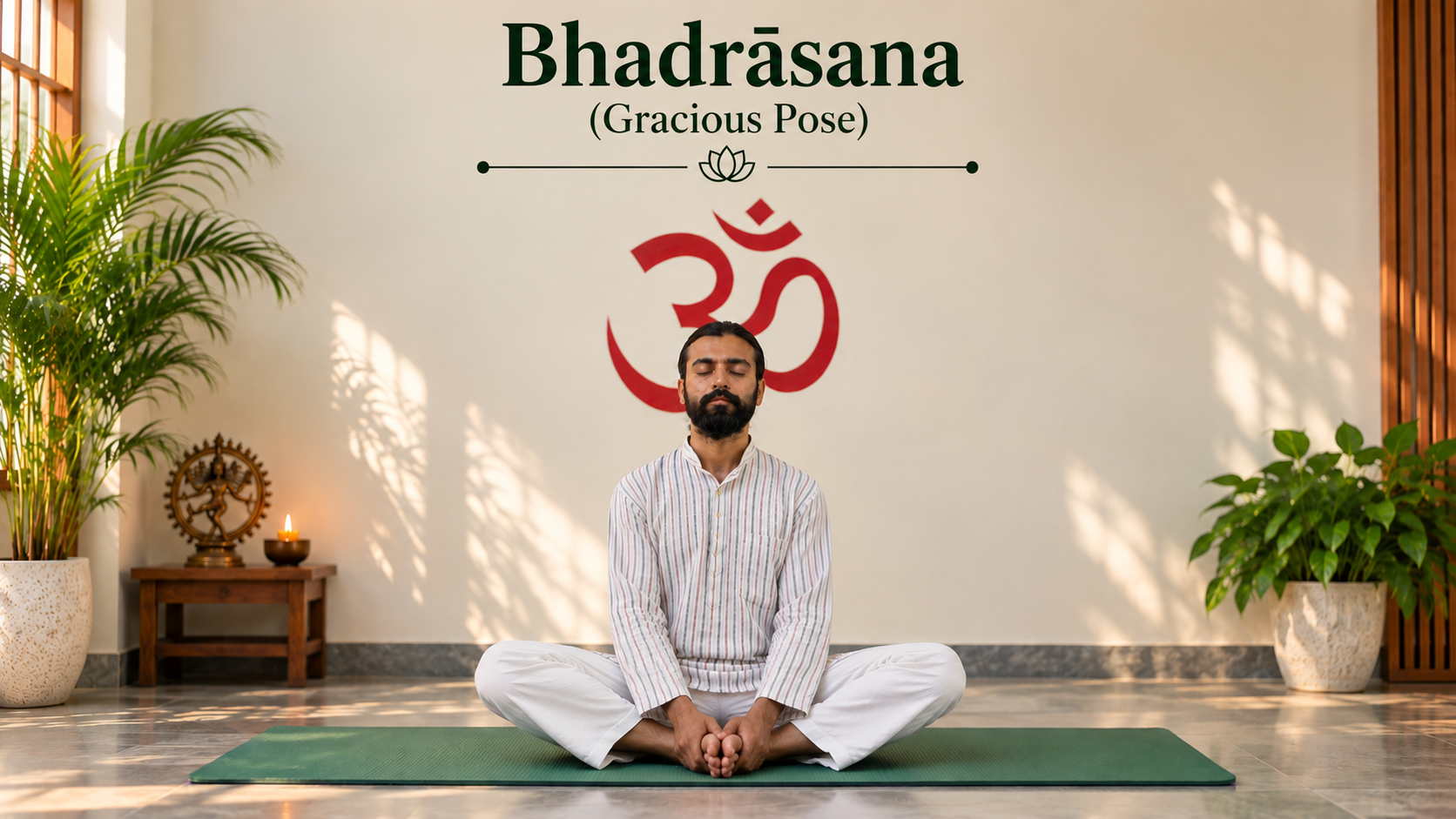
Bhadrāsana (Gracious Pose): The Complete Reference Guide

Editorial note, stated once: throughout this article, traditional yogic and Āyurvedic claims (nāḍī, chakra, doṣa references, disease-destroying claims) are presented as traditional belief, not scientific fact, unless a specific evidence source is cited alongside them.
Name & Meaning
- Sanskrit: भद्रासन (Bhadrāsana)
- English: Gracious Pose, Auspicious Pose, Throne Pose (translations vary)
- Etymology: Bhadra (gracious, auspicious, gentle) + Āsana (posture)
- Alternate classical name: the Haṭha Yoga Pradīpikā states this same posture is also called Gorakṣāsana by accomplished yogis (siddha-yoginaḥ) — though see Historical Background below for an important nuance about this equivalence
Introduction — Two Poses Share One Name
- Bhadrāsana is one of the more genuinely confusing names in the modern yoga vocabulary, because it is used for two different postures depending on the source
- Classical Bhadrāsana (Haṭha Yoga Pradīpikā, Gheraṇḍa Saṃhitā): a seated meditation posture with the heels placed on either side of the perineum, ankles crossed beneath the body, and the sides of the feet held firmly by the hands — one of the texts' short list of principal meditation seats, alongside Siddhāsana, Padmāsana, and Siṃhāsana
- Popular modern "Bhadrāsana": in many contemporary classes and teacher-training materials, the name is used interchangeably with Baddha Koṇāsana (Butterfly/Bound Angle Pose) — soles of the feet together in front of the pelvis, knees dropping open to the sides
- This article covers both, states plainly which claims belong to which version, and does not blend them into a single undifferentiated "Bhadrāsana"
- Unlike Vīrabhadrāsana or Naṭarājāsana, the classical version of this pose has a genuine, directly citable medieval textual source — a point in its favor that this series has flagged as the exception rather than the rule among frequently taught standing/seated postures
How to Practice: Step-by-Step
Classical Bhadrāsana (Haṭha Yoga Pradīpikā / Gheraṇḍa Saṃhitā version)
| Step | Action | Breath | Cue |
|---|---|---|---|
| 1 | Sit on the floor with legs extended (Daṇḍāsana); bend both knees and bring the heels toward the perineum, one heel on each side | Natural breath | "Let the ankles arrive at their own pace — this is not a pose to force." |
| 2 | Cross the ankles beneath the body so the outer edges of both feet rest on the floor; hold the sides of the feet firmly with both hands | Exhale to settle the grip | "Bind the feet, don't just rest the hands on them." |
| 3 | Lengthen the spine upright; soften the shoulders away from the ears | Inhale to lift through the crown | "This is a seat for stillness, not a stretch to chase." |
| 4 | Hold for meditation or prāṇāyāma practice, breathing naturally and steadily | Steady, even breath throughout | "Let the stillness of the ankles support stillness of mind." |
Popular Modern "Bhadrāsana" (Baddha Koṇāsana form)
| Step | Action | Breath | Cue |
|---|---|---|---|
| 1 | Sit in Daṇḍāsana, then bend the knees and bring the soles of the feet together, drawing the heels toward the pelvis as comfortable | Natural breath | "Bring the heels in only as far as your hips allow without strain." |
| 2 | Hold the feet or ankles with the hands; let the knees release toward the floor | Exhale to let the knees soften | "Let gravity lower the knees — don't press them down." |
| 3 | Lengthen the spine upright, sitting bones grounded | Inhale to lift through the spine | "Sit as if you were sitting tall on a throne." |
| 4 | Hold, or fold forward gently from the hips for a deeper variation | Steady breath; exhale to fold if folding | "Fold from the hip crease, not the mid-back." |
Benefits
- Physical (both versions): external rotation and gentle opening of the hip joints; stretch to the inner thighs and groin
- Physical (classical version specifically): the crossed-ankle, heel-at-perineum placement is traditionally described as engaging the pelvic floor region more directly than the simple soles-together variant — a plausible mechanical claim given the heel placement, though no dedicated study measuring this was identified
- Mental: as a seated meditation posture, classical Bhadrāsana is traditionally used to support long, stable sitting for prāṇāyāma and meditation, similarly to Siddhāsana and Padmāsana
- Traditional/textual claim: the Haṭha Yoga Pradīpikā states this āsana is "the destroyer of all diseases" (sarva-vyādhi-vināśanam) — a traditional textual claim from a 15th-century source, not a scientifically verified medical outcome, and presented here as such rather than as established fact
- Emotional: general yoga and seated-meditation practice (not specific to this pose) is linked in several reviews to reduced perceived stress over time — moderate evidence level
Common Mistakes & Corrections
- Rounded, collapsed spine (common when hips are tight and the pelvis tips backward) → correction: sit on a folded blanket or block to elevate the hips above the knees, allowing the spine to lengthen naturally
- Forcing the knees toward the floor → correction: let the knees release gradually with breath; support them with blocks or blankets rather than pressing them down with the elbows or hands
- Feet placed too far forward from the pelvis (reduces the hip-opening effect and shifts the stretch away from the hip joint) → correction: draw the heels closer to the body as comfortable, without forcing
Contraindications & Precautions
- Groin, hip, or knee injury — the deep external hip rotation can aggravate existing joint issues
- Sciatica or significant lower-back pathology — forward folding from this position should be approached cautiously and only with a lengthened spine, not a rounded one
- Classical Bhadrāsana specifically requires considerable ankle flexibility; the Haṭha Yoga Pradīpikā tradition itself notes this posture is intended for accomplished practitioners with prepared, flexible ankles, and several modern teaching sources describe it as unsuitable for beginners or those with tender ankles
- Pregnancy: the soles-together seated form is commonly practiced with support (see Modifications), but any version involving a forward fold should be approached gently and without compressing the abdomen
Sequencing: Preparatory, Follow-up & Variations
- Preparatory poses: gentle hip-opening stretches, Sukhāsana (Easy Pose), Daṇḍāsana
- Placement in sequence: commonly used as a seated meditation or prāṇāyāma seat at the start or end of a practice, or as a hip-opening pose within a seated sequence
- Follow-up poses: Paścimottānāsana or a gentle seated twist to complement the hip-opening effect
- Variations: Supta Bhadrāsana (reclined version, lying back with the soles-together shape); folding forward from the soles-together position for a deeper stretch; using a strap around the feet to assist the bind in the classical version
Because "Bhadrāsana" refers to two different postures depending on source, sequencing intent matters more than usual here. When taught as a meditation seat (the classical form), it belongs at the start of a seated practice, before prāṇāyāma or meditation, in the same category as Siddhāsana or Padmāsana — poses meant to be held steadily rather than used for active stretching. When taught as a hip-opener (the Baddha Koṇāsana-equivalent form), it fits naturally within a seated hip-opening sequence, often before deeper forward folds or seated twists, since opening the hips first tends to make subsequent forward folds more accessible through the hip joint rather than the lower back.
Modifications
- Tight hips (either version): sit on a folded blanket or block to elevate the pelvis above the knees; support the knees with blocks or blankets rather than letting them hang unsupported
- Tender ankles (classical version): this variation is genuinely advanced for the ankle joint; beginners are commonly advised to build toward it gradually or substitute Sukhāsana or the soles-together form instead
- Pregnancy: practice the soles-together form with back support against a wall; avoid deep forward folding; confirm with your own clinician
- Seniors: sit on a chair with feet together and knees apart as a seated adaptation if floor-sitting is uncomfortable
- Groin/inner-thigh tightness: keep the feet further from the pelvis and use support under the knees; do not force the range of motion
Historical Background & Classical References
- Classical Bhadrāsana is genuinely, directly citable — a real exception in this series, where absence-of-classical-source has been the more common finding. It appears in the Haṭha Yoga Pradīpikā, Chapter 1, verses 53–56 (verse numbering varies slightly between editions/commentaries): the heels are placed on either side of the perineum, the feet are held firmly with the hands, and the text states this posture "is the destroyer of all diseases" and names it as one of the āsanas recommended for prolonged, comfortable sitting
- It is also described in the Gheraṇḍa Saṃhitā, Chapter 2, verses 9–10, and is listed among the principal āsanas in the Śiva Saṃhitā, though the Śiva Saṃhitā elaborates in detail on only four postures (Siddhāsana, Padmāsana, Ugrāsana, Svastikāsana) and does not describe Bhadrāsana's technique in the same depth
- The Haṭha Yoga Pradīpikā itself states that accomplished yogis (siddha-yoginaḥ) also call this posture Gorakṣāsana — but modern scholarship (see the Wikipedia entry on Gorakṣāsana) notes that later or parallel tradition sometimes describes a Gorakṣāsana with the heels placed differently (under the body rather than beside the perineum), meaning the "same name, different technique" confusion that affects Bhadrāsana in modern teaching has a real precedent within the classical textual tradition itself, not just in modern usage
- The popular modern "Bhadrāsana" = Baddha Koṇāsana equivalence is a separate matter. Some contemporary teaching sources use "Bhadrāsana" as a name for the soles-together seated posture more commonly known today as Baddha Koṇāsana — this usage appears in modern teaching lineages and popular yoga literature, but it does not match the heel-at-perineum technique the classical Haṭha texts actually describe under that name
- This article treats that popular usage honestly as a widespread modern naming convention, not as the technique the medieval texts are describing, in keeping with this series' standard of not blurring "commonly said" with "textually verified"
Alignment Principles (General Seated-Pose Principles)
- Pelvis level and spine vertical, rather than tipping backward into a rounded lower back
- Sitting bones grounded evenly — using a blanket or block if the hips are tight enough to tip the pelvis backward without one
- Shoulders drawn down and back, away from the ears, rather than hunching to compensate for tight hips
- In the classical version, the bind of the hands around the feet is firm and active, not passive — consistent with the "hold firmly" instruction in the Haṭha Yoga Pradīpikā verse itself
Anatomy & Biomechanics
- Primary joint action: external rotation and flexion at the hip joint (both versions)
- Muscles under stretch: adductor group (inner thigh), and to a lesser degree the hip flexors and piriformis, depending on individual hip anatomy
- Stabilizers: deep core and pelvic floor musculature work to maintain an upright spine against the pull of tight hip structures trying to tip the pelvis backward
- Classical-version specifics: the crossed-ankle placement beneath the body changes the loading pattern at the ankle and forefoot compared with the simple soles-together form, which is the anatomical basis for this version demanding considerably more ankle flexibility
- Biomechanics of the pelvic tilt: when hip external rotation is limited, the pelvis tends to rotate posteriorly to compensate, rounding the lumbar spine — this is the direct mechanical cause of the "collapsed spine" common mistake described above, and is why elevating the hips on a prop (rather than "trying harder" to sit up straight) is the more effective fix
Nervous System & Breathing Effects
- As a stable, non-balancing seated posture, this pose is well-suited to sustained, calm breathing practice, unlike balance-dependent poses where breath-holding can destabilize the posture
- Classical Haṭha Yoga texts pair such steady meditation seats with prāṇāyāma practice, on the traditional premise that physical stillness supports steadiness of breath and mind — a traditional pedagogical principle rather than a claim with dedicated pose-specific research behind it
Yogic & Āyurvedic Perspective
- Within the Haṭha Yoga tradition, Bhadrāsana is grouped with Siddhāsana, Padmāsana, and Siṃhāsana as one of the principal seats for sustained meditation and prāṇāyāma practice
- Some modern teachers connect the pose's inner-thigh opening to Svādhiṣṭhāna (sacral) chakra symbolism — a traditional/symbolic association, not a scriptural claim tied specifically to this pose in the classical texts themselves
- Āyurveda: the grounding, hip-opening quality is sometimes described by contemporary teachers as pacifying for Vāta doṣa — a modern integrative interpretation rather than a documented classical Āyurvedic prescription for this specific āsana
Therapeutic Applications
| Condition | Mechanism | Research / Precaution |
|---|---|---|
| Tight hip external rotators/adductors (e.g. from prolonged sitting) | Passive/active stretch of the adductor group and hip external rotators | Mechanistically well-supported by general stretching literature; no Bhadrāsana-specific outcome trial identified |
| Need for a stable, sustainable meditation seat | Wide base of support and grounded pelvis support long, still sitting | Traditional rationale from Haṭha Yoga texts; general meditation-posture research supports stable seated postures broadly, not this pose specifically |
| Pelvic floor awareness (classical heel-at-perineum version, as sometimes taught) | Heel placement creates direct sensory contact with the perineal region | Plausible mechanism based on anatomical placement; no dedicated research measuring pelvic floor outcomes from this pose was identified |
Yoga is never a replacement for medical treatment; serious or persistent conditions require a qualified healthcare professional.
Teaching Notes
- Cue: "Let your hips open like a book — the depth will come with breath, not with force."
- Hands-on adjustment (with consent, within scope): a light touch at the sacrum to cue a lengthened, non-tucked spine; light support at the outer knees only to indicate direction, never to press them down
Myth vs. Fact
| Myth | Fact |
|---|---|
| Bhadrāsana is just another name for Baddha Koṇāsana (Butterfly Pose) | Only in modern popular usage. The classical Haṭha Yoga Pradīpikā and Gheraṇḍa Saṃhitā describe a different technique — heels beside the perineum with crossed ankles, not simple soles-together |
| This pose has no real classical textual basis, like many commonly taught "traditional-sounding" poses | Unlike several other poses covered in this series, classical Bhadrāsana genuinely does appear in the Haṭha Yoga Pradīpikā and Gheraṇḍa Saṃhitā, with a directly citable verse describing its technique |
| Pressing the knees down with the hands or elbows helps "open" the hips faster | Forcing external rotation this way risks strain at the knee and groin; supported, gradual release with props is the safer approach |
Conclusion
Bhadrāsana is an unusually instructive case in this series precisely because it runs in the opposite direction from poses like Vīrabhadrāsana or Naṭarājāsana: here, the classical textual source is genuine and directly citable, while it's the modern popular usage — treating the name as interchangeable with Baddha Koṇāsana — that departs from what the medieval texts actually describe. Neither version is "wrong" to practice; the point is simply to know which one you're doing, and why, rather than assuming a single continuous "ancient" technique where the historical record shows something more layered.
Quick Facts
| Category | Seated meditation posture / hip-opener (two distinct versions) |
| Difficulty | Beginner (soles-together form) – Advanced (classical heel-at-perineum form, due to ankle demand) |
| Duration | 1–10+ minutes as a meditation seat; shorter holds as a hip-opening stretch |
| Classical textual basis | Genuine — Haṭha Yoga Pradīpikā 1.53–56; Gheraṇḍa Saṃhitā 2.9–10 |
| Primary structures affected | Hip external rotators, adductors, ankle joint (classical version) |
| Contraindications | Groin/hip/knee injury, sciatica, limited ankle flexibility (classical version) |
Frequently Asked Questions
Is Bhadrāsana the same as Butterfly Pose?
Only in modern popular usage. The classical technique described in the Haṭha Yoga Pradīpikā and Gheraṇḍa Saṃhitā places the heels beside the perineum with crossed ankles — different from the simple soles-together Baddha Koṇāsana form many classes call by this name.
Is this pose really from an ancient text?
Yes — genuinely, unlike several other poses covered in this series. It appears in the Haṭha Yoga Pradīpikā (Chapter 1) and the Gheraṇḍa Saṃhitā (Chapter 2).
Why do my knees hurt in this pose?
Usually from forcing the knees toward the floor rather than letting them release gradually; use blocks or blankets for support instead.
Can beginners do the classical version?
It genuinely demands significant ankle flexibility; most modern teaching sources suggest building toward it gradually or using the soles-together form as a starting point instead.
Is it safe during pregnancy?
The soles-together seated form is commonly practiced with back support; avoid deep forward folding and confirm with your own clinician.
Does this pose really destroy all diseases, as the Haṭha Yoga Pradīpikā says?
That's the text's own traditional claim from the 15th century, not a scientifically verified medical outcome — presented here as traditional belief, not established fact.
What's a good pose to do before this one?
Gentle hip-opening stretches or a simple cross-legged seat (Sukhāsana) to warm up the hips.
References
1. Classical Yoga Texts: Svātmārāma. Haṭha Yoga Pradīpikā, Chapter 1, verses 53–56 (verse numbering varies by edition). English translation consulted via Internet Sacred Text Archive, https://sacred-texts.com/hin/hyp/hyp03.htm. Gheraṇḍa, Gheraṇḍa Saṃhitā, Chapter 2, verses 9–10 (as referenced in Mallinson, J. (2004). The Gheranda Samhita: The Original Sanskrit and an English Translation. YogaVidya.com). Śiva Saṃhitā (asana listed among principal postures; technique not elaborated in that text).
2. Modern Yoga Institutions: Wikipedia contributors. Gorakshasana. Retrieved from https://en.wikipedia.org/wiki/Gorakshasana (discussing the Bhadrāsana/Gorakṣāsana naming relationship and technique variation across texts). Yoga Journal and various contemporary teaching sources (cross-referenced for the modern Baddha Koṇāsana-equivalent usage of "Bhadrāsana").
3. Peer-Reviewed Scientific Research: No dedicated peer-reviewed study isolating Bhadrāsana's physiological effects (pelvic floor engagement, disease outcomes, or hip-mobility change) was identified through available sources. General hip-mobility and stretching research applies at the category level only, as noted throughout this article, and is not cited here as pose-specific.
Where no pose-specific scientific source exists, that absence is stated plainly, consistent with this series' editorial standard — rather than an artificial citation being invented to fill the category. The classical textual citations above, by contrast, are genuine and directly verifiable.
This article is for educational purposes and does not replace individualized medical or physical therapy advice. Consult a qualified healthcare provider before beginning any new practice, especially with a pre-existing health condition.