Atha Yogānuśāsanam: Understanding the First Yoga Sutra of Patanjali
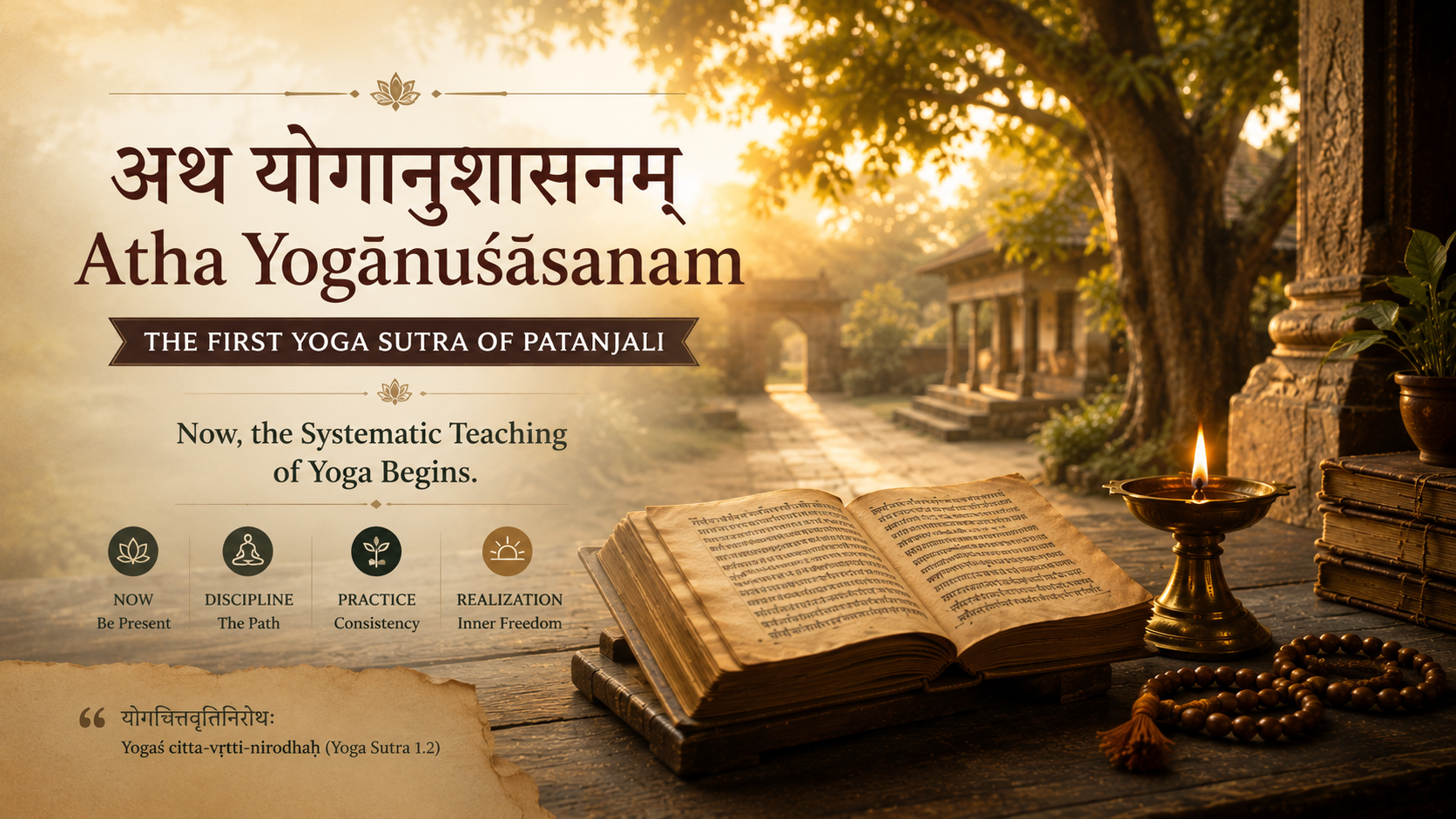
Atha Yogānuśāsanam: Understanding the First Yoga Sutra of Patanjali
Introduction
The Yoga Sūtras of Patañjali are among the foundational texts of classical Yoga philosophy. In a remarkably concise collection of aphorisms, Patañjali presents a systematic path concerned with the mind, practice, meditative absorption, discernment, and ultimately Kaivalya—liberation.
The text is traditionally divided into four chapters, or Pādas: Samādhi Pāda, Sādhana Pāda, Vibhūti Pāda, and Kaivalya Pāda. Depending on the textual tradition and method of counting, the Yoga Sūtras are said to contain 195 or 196 sūtras.
The entire teaching opens with an extraordinarily brief statement:
अथ योगानुशासनम्॥१॥
Atha Yogānuśāsanam
This is Yoga Sūtra 1.1.
Although the sūtra contains only three words, it establishes the opening context for the entire discipline of Yoga.
It announces that now, the systematic teaching or discipline of Yoga begins.
The First Yoga Sutra
अथ योगानुशासनम्॥१॥
Atha Yogānuśāsanam
Word-by-Word Meaning
- Atha (अथ) – Now; now then; an auspicious beginning or commencement
- Yoga (योग) – Yoga; the discipline and state explained through the Yoga Sūtras
- Anuśāsanam (अनुशासनम्) – Instruction, systematic teaching, discipline, or authoritative exposition
Meaning
“Now, the systematic teaching of Yoga begins.”
The sūtra is simple in language but profound in implication.
Patañjali does not begin with a long philosophical argument. He begins with Atha—Now.
The Significance of “Atha”
The first word of the Yoga Sūtras is Atha.

It is commonly translated as “now” or “now then.”
In the traditional commentarial understanding, atha marks the commencement of the subject being taught. It announces the beginning of the exposition of Yoga.
However, for a practitioner, the word can also carry a powerful contemplative significance.
Now.
Not yesterday.
Not tomorrow.
Not after life becomes perfect.
The practice begins now.
The human mind frequently moves between memories of the past and expectations or anxieties about the future.
We remember what happened.
We imagine what may happen.
Meanwhile, the present experience often passes without complete awareness.
From a practical Yogic perspective, the word Atha can remind the practitioner to return to the immediacy of the present.
If the mind has wandered, become distracted, or become entangled in thought, awareness can return.
Now, begin again.
This is one of the most practical ways in which a modern practitioner can contemplate the opening word of the Yoga Sūtras.
What Does “Yoga” Mean Here?
The Sanskrit word Yoga has been interpreted in many ways across Indian philosophical and spiritual traditions.
It is often translated as union, and the Sanskrit verbal root yuj is associated with joining, yoking, or harnessing.
However, we must be careful when interpreting Patañjali.
To say that Yoga Sūtra 1.1 specifically defines Yoga as “the union of individual consciousness with universal consciousness” would be philosophically imprecise.
Patañjali's technical explanation of Yoga follows immediately in the next sūtra:
योगश्चित्तवृत्तिनिरोधः॥२॥
Yogaś citta-vṛtti-nirodhaḥ
Therefore, the meaning of Yoga in the Pātañjala system must be understood in relation to the regulation or stilling of the activities of Citta, the development of meditative absorption, discriminative knowledge, and the movement towards Kaivalya.
Yoga is certainly not limited to physical postures.
Āsana is only one component within the broader Yogic discipline described by Patañjali.
The Yoga Sūtras are deeply concerned with the transformation of the mind and the recognition of the distinction between Puruṣa and Prakṛti.
Therefore, in this context, Yoga should be understood as a systematic discipline of inner transformation and liberation .
Understanding “Anuśāsanam”

The word Anuśāsanam is central to this sūtra.
It may be understood as systematic instruction, disciplined teaching, or an authoritative exposition that follows an established tradition.
This is important.
Patañjali is not presenting Yoga as a collection of random techniques.
Yoga is a discipline.
There is a method.
There is practice.
There is observation.
There is refinement.
There is continuity.
Modern life often encourages us to search for immediate results.
We want a quick meditation.
A quick transformation.
A quick solution to stress.
A quick spiritual experience.
But the Yogic path described by Patañjali demands something different.
It demands Abhyāsa—sustained practice.
It demands commitment.
It demands the willingness to observe the mind repeatedly.
Therefore, Anuśāsanam reminds us that Yoga cannot be reduced to occasional inspiration.
Yoga requires disciplined engagement with the path.
Rules and Self-Discipline Are Not the Same
External rules can be imposed upon us.
A school may have rules.
An organisation may have rules.
A teacher may establish rules for a class.
But genuine self-discipline develops internally.
No one can permanently force another person to live a Yogic life.
A teacher may guide.
A Guru may show the path.
A scripture may provide knowledge.
But the practitioner must practise.
The practitioner must return to the discipline again and again.
This is why self-discipline is so important in Yoga.
It means developing the ability to continue a meaningful practice even when temporary excitement disappears.
You may not feel motivated every day.
The mind may become distracted.
The body may feel lazy.
Life may become busy.
Anuśāsanam reminds us that a genuine path cannot depend entirely on changing moods.
Discipline creates continuity.
And continuity allows practice to deepen.
From Effort to Effortlessness
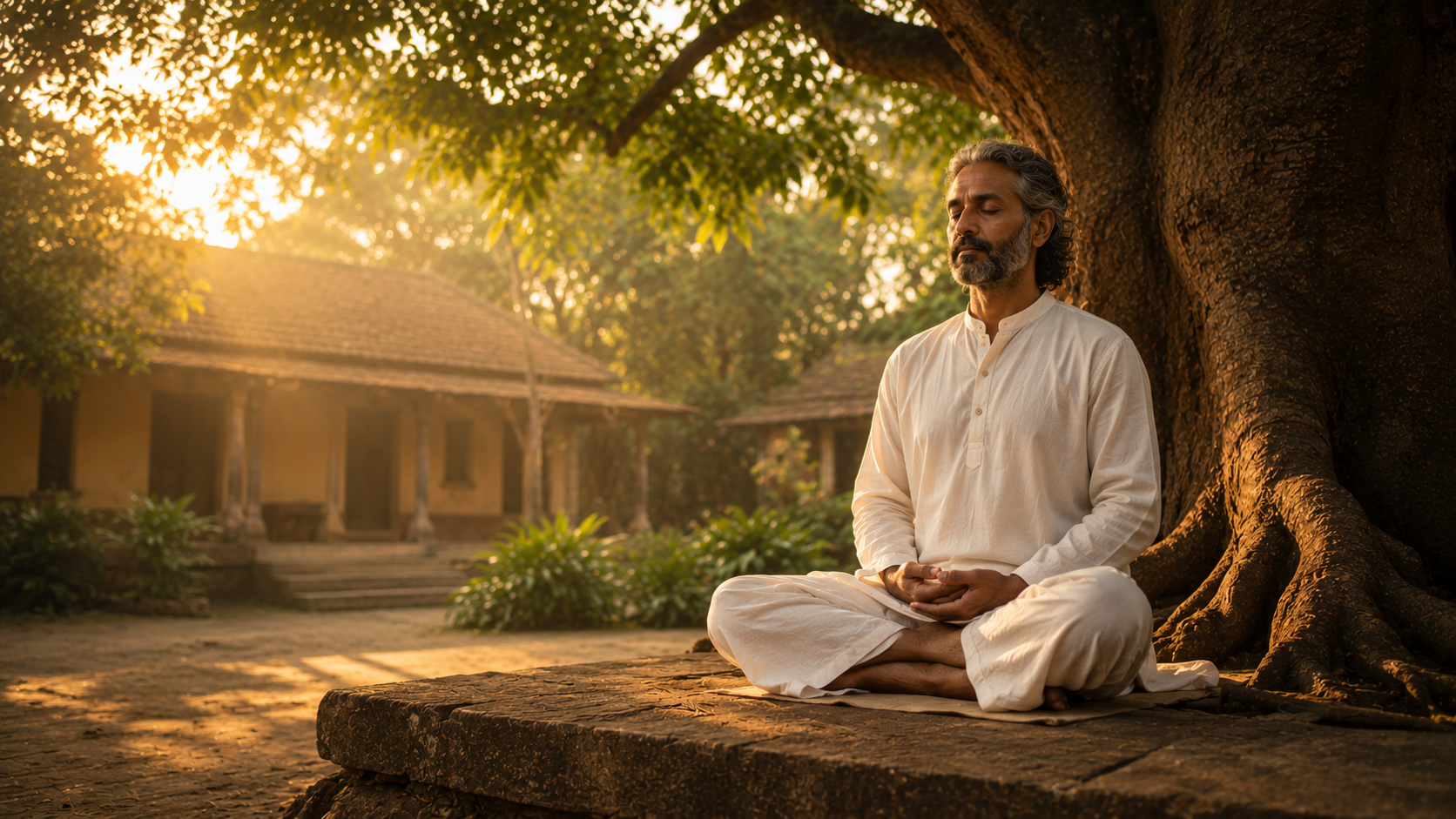
In the beginning, Yogic practice often requires conscious effort.
We make an effort to wake up at the appropriate time.
We make an effort to sit for practice.
We make an effort to observe the mind.
We make an effort to maintain awareness.
We make an effort to return when attention wanders.
This effort is natural.
A beginner should not expect every aspect of Yoga to feel effortless immediately.
However, with sustained practice, something begins to change.
What initially required constant effort can gradually become more natural.
The body becomes familiar with practice.
Attention becomes more refined.
Awareness becomes more accessible.
The practitioner develops a different relationship with the mind.
This does not mean that all effort permanently disappears.
Rather, disciplined practice can reduce unnecessary struggle.
A useful way to understand this process is:
First, discipline supports practice.
Then, practice creates familiarity.
With maturity, greater ease may emerge.
Yoga is not about forcing the body or violently controlling the mind.
The deeper path is one of refinement.
Yoga Begins in the Present
One of the most practical contemplations arising from Atha Yogānuśāsanam is that Yoga always begins in the present.
Perhaps you stopped practising for several months.
Atha—now. Begin.
Perhaps the mind wandered during meditation.
Atha—now. Return.
Perhaps yesterday was filled with confusion.
Atha—now. Become aware.
The present moment is where practice is possible.
We cannot practise yesterday.
We cannot directly practise tomorrow.
Action, awareness, and discipline can only be cultivated in the experience available to us now.
This is why the opening word of the Yoga Sūtras can be so powerful for a practitioner.
It continually brings us back to the beginning.
The Message of Yoga Sutra 1.1
Atha Yogānuśāsanam announces the beginning of the teaching of Yoga.
But for the practitioner, it can also become a personal reminder.
Yoga is not merely something to read about.
It is not simply a philosophical subject to collect information about.
Yoga must enter practice.
Practice requires continuity.
Continuity requires discipline.
And discipline must be lived in the present.
The first sūtra therefore prepares us for everything that follows.
Before studying the movements of Citta, Abhyāsa, Vairāgya, Samādhi, Kriyā Yoga, Aṣṭāṅga Yoga, or Kaivalya, the seeker must first become available to the teaching.
Now, the discipline of Yoga begins.
Key Points
- Atha Yogānuśāsanam is the first sūtra of Patañjali's Yoga Sūtras.
- The Yoga Sūtras are traditionally divided into four Pādas.
- Different textual traditions count 195 or 196 sūtras.
- Atha literally marks “now” or the commencement of the teaching.
- For a practitioner, Atha can also serve as a reminder to return to the present.
- Anuśāsanam refers to systematic instruction, discipline, or an established teaching.
- Yoga in Patañjali's system should not be reduced simply to physical postures.
- The exact technical understanding of Yoga becomes clearer through the subsequent sūtras, especially Yoga Sūtra 1.2.
- Genuine Yogic discipline requires continuity and sustained practice.
- External rules and internal self-discipline are not identical.
- Practice may initially require conscious effort, but sustained discipline can cultivate greater familiarity and ease.
- Yoga can always begin again in the present moment.
Conclusion
Atha Yogānuśāsanam is a remarkably concise opening to one of the most influential texts of Yoga philosophy.
With the word Atha, the teaching begins.
With Yoga, the subject is established.
With Anuśāsanam, we are reminded that this path involves systematic instruction and disciplined engagement.
The first sūtra does not ask us to become perfect before beginning.
It announces the beginning.
Now.
The mind may have wandered.
Practice may have stopped.
Life may have become complicated.
But the possibility of awareness and disciplined practice exists in the present.
Atha—Now.
Now, the discipline of Yoga begins.