Ashtanga Yoga: The Eightfold Path of Yoga
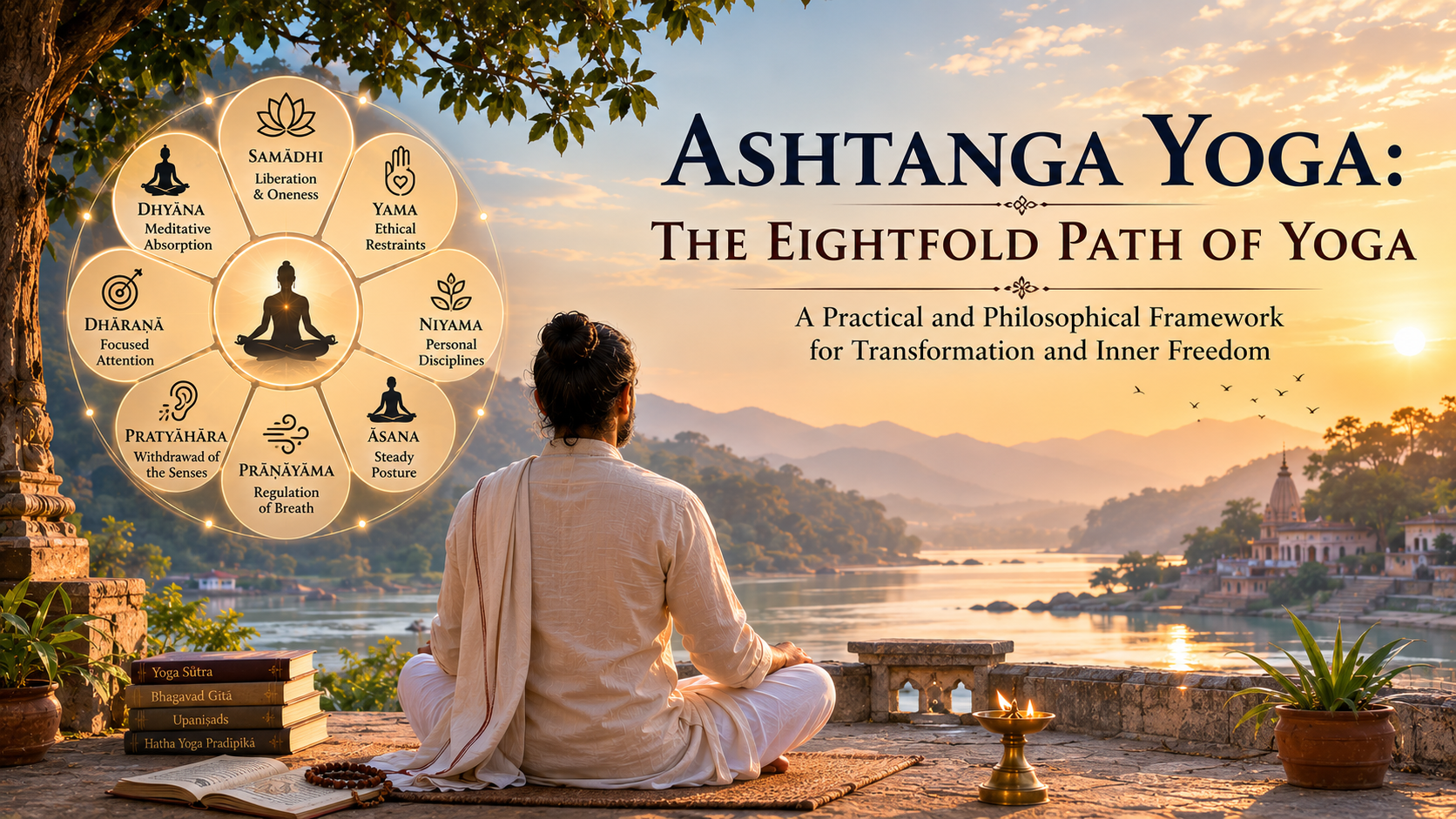
Introduction
Ashtanga Yoga is the most important system of practice set forth by Maharṣi Patañjali. Although the term is also used today as the name of a specific style of Yoga (Ashtanga Vinyasa Yoga, popularised in the 20th century), the Ashtanga Yoga described in Patañjali's Yoga Sūtras is not a fixed sequence of postures at all — it is a complete scientific and spiritual philosophy for living. This eightfold system forms the central structure of the Yoga Sūtras and is often referred to as Rāja Yoga, or the Eightfold Path of Yoga.
The Meaning of Ashtanga Yoga
Ashtanga is formed from two words:
- Ashta = eight
- Anga = limb, or step
So Ashtanga Yoga means the practice in which Yoga's eight limbs are laid out.
Not Just a Style — A Complete Philosophy
Ashtanga Yoga should not be confused with, or reduced to, any particular sequence of āsanas (such as the modern "Primary" or "Secondary Series" associated with the Ashtanga Vinyasa style).
Patañjali's Ashtanga Yoga is:
- The foundation of the entire philosophy of Yoga.
- A framework that brings balance to a practitioner's inner and outer life.
- A means of deepening Sādhana (spiritual practice).
- A path toward mental, spiritual, and ethical development.
The Purpose of Ashtanga Yoga
The aim of Ashtanga Yoga is not physical health alone. Its purpose extends to:
- Inner peace
- Mental balance
- Self-discipline
- Intuition
- Self-realisation

Mastery Over the Inner Kingdom
A helpful teaching metaphor compares Ashtanga Yoga to the rule of a king over his kingdom.
Just as a king governs his territory, a practitioner must learn to govern their own:
- Mind
- Senses
- Thoughts
- Emotions
When this inner kingdom becomes well-ordered, outer life tends to find its own balance as well. (This is a widely used teaching metaphor rather than a phrase drawn directly from the Yoga Sūtras themselves — it is a helpful way of conveying the Sūtras' emphasis on self-governance, not a literal textual reference.)
The Eight Limbs of Ashtanga Yoga
Maharṣi Patañjali describes the eight limbs of Yoga as follows (Yoga Sūtra 2.29):
- Yama — social/ethical restraints
- Niyama — personal observances
- Āsana — a steady and comfortable posture
- Prāṇāyāma — regulation of the breath
- Pratyāhāra — withdrawal of the senses
- Dhāraṇā — concentration
- Dhyāna — sustained meditation
- Samādhi — Self-realisation, absorption
The Classical Division: Bahiranga and Antaranga
The Yoga Sūtras themselves group these eight limbs into two categories, and this classification is worth knowing precisely:
- Bahiraṅga Yoga (external limbs): Yama, Niyama, Āsana, Prāṇāyāma, and Pratyāhāra — the first five limbs, which prepare the body, senses, and energy for deeper practice.
- Antaraṅga Yoga (internal limbs): Dhāraṇā, Dhyāna, and Samādhi — the last three limbs, which work directly with the mind.
Together, these final three internal limbs are given a specific name in the Yoga Sūtras: Saṃyama — and Patañjali states that mastery of Saṃyama gives rise to Prajñā (direct insight).

All Limbs Are Interconnected
An important teaching point is that the eight limbs of Ashtanga Yoga should not be viewed as entirely separate or as a strictly linear staircase to be climbed one step at a time and then abandoned.
The limbs:
- Complement one another.
- Develop together, in an overlapping way, even while following a broadly external-to-internal progression.
- Are often compared, in teaching, to a string of connected pearls — each bead distinct, yet part of a single unified thread.
So Yoga Sādhana is not merely the mechanical completion of sequential stages, but the coordinated practice of all the limbs together, even as Bahiraṅga practice does lay a necessary foundation for Antaraṅga practice.
The Special Importance of Yama and Niyama
The first two limbs of Ashtanga Yoga —
- Yama
- Niyama
are considered its most essential foundation.
Each of these contains five specific components:
- The five Yamas (Yoga Sūtra 2.30): Ahiṃsā (non-violence), Satya (truthfulness), Asteya (non-stealing), Brahmacharya (right use of vital energy), and Aparigraha (non-possessiveness).
- The five Niyamas (Yoga Sūtra 2.32): Śauca (cleanliness), Santoṣa (contentment), Tapas (disciplined effort), Svādhyāya (self-study), and Īśvara-Praṇidhāna (surrender to the divine).
A closer study of each of these ten components will follow separately.
Key Points
- Ashtanga Yoga is the foundational structure of Maharṣi Patañjali's Yoga philosophy.
- It is also referred to as Rāja Yoga and the Eightfold Path of Yoga — though "Rāja Yoga" as a name became widely attached to this system somewhat later in the tradition, notably through its popularisation by teachers like Swami Vivekananda.
- Ashtanga Yoga is not merely a style of āsana practice — it is a complete life philosophy.
- Its purpose is mental, ethical, spiritual, and physical development.
- A practitioner is encouraged to first gain mastery over their own inner "kingdom" — mind, senses, thoughts, and emotions.
- The eight limbs are: Yama, Niyama, Āsana, Prāṇāyāma, Pratyāhāra, Dhāraṇā, Dhyāna, and Samādhi.
- The Yoga Sūtras themselves classify the first five limbs as Bahiraṅga (external) and the last three as Antaraṅga (internal) — together called Saṃyama.
- All eight limbs are interconnected and best practised in a coordinated way.
- Yama and Niyama form the foundation of Ashtanga Yoga, each containing five specific components.
- The ultimate aim of Ashtanga Yoga is Self-realisation and Samādhi.
Editorial Notes: Corrections and Clarifications
-
"Ashtanga Yoga" and "Rāja Yoga" — a note on the equivalence. The original draft treated these as simply interchangeable names for the same system. This is a common and reasonable teaching equivalence, but it is worth knowing that "Rāja Yoga" as a specific label for Patañjali's eightfold system became especially widespread through later popularisation — most notably by Swami Vivekananda in the modern era — rather than being a term used by Patañjali himself in the Yoga Sūtras.
-
The classical Bahiraṅga/Antaraṅga/Saṃyama classification was missing from the original draft and has been added, since it is the Yoga Sūtras' own internal grouping of the eight limbs (Yama through Pratyāhāra as external practice; Dhāraṇā, Dhyāna, and Samādhi together as Saṃyama, the internal practice) — a more precise structure than simply saying the limbs are "like a string of pearls."
-
On the "inner kingdom" metaphor: this is a widely used and valuable teaching device, but it has been explicitly flagged as a metaphor rather than a direct quotation from the Yoga Sūtras, to avoid the impression that "Inner Kingdom" is Patañjali's own terminology.
-
A note on scientific context (since accuracy was requested against both scripture and science): several components of Ashtanga Yoga have some corroborating modern research — for instance, regulated breathing practices (Prāṇāyāma) have been associated in physiological studies with changes in autonomic nervous system activity, and sustained attention practices (Dhāraṇā, Dhyāna) overlap substantially with what contemporary research calls focused-attention meditation, which has documented effects on attentional control. These findings are relevant and worth noting, but they describe measurable physiological and cognitive correlates — they do not constitute scientific validation of the Sūtras' further spiritual claims (such as Samādhi as a state of ultimate liberation), which remain claims of a different, non-empirical kind.

Conclusion
Ashtanga Yoga is Patañjali's blueprint for a disciplined, balanced, and ultimately liberated life — not a sequence of postures, but a coordinated path spanning ethical conduct, physical steadiness, breath, sense-withdrawal, and the deep inner work of concentration, meditation, and absorption. Understanding its classical Bahiraṅga–Antaraṅga structure, and being clear about what is textual fact versus useful teaching metaphor, allows this eightfold path to be taught with the precision it deserves.