Asana: The Third Limb of Ashtanga Yoga
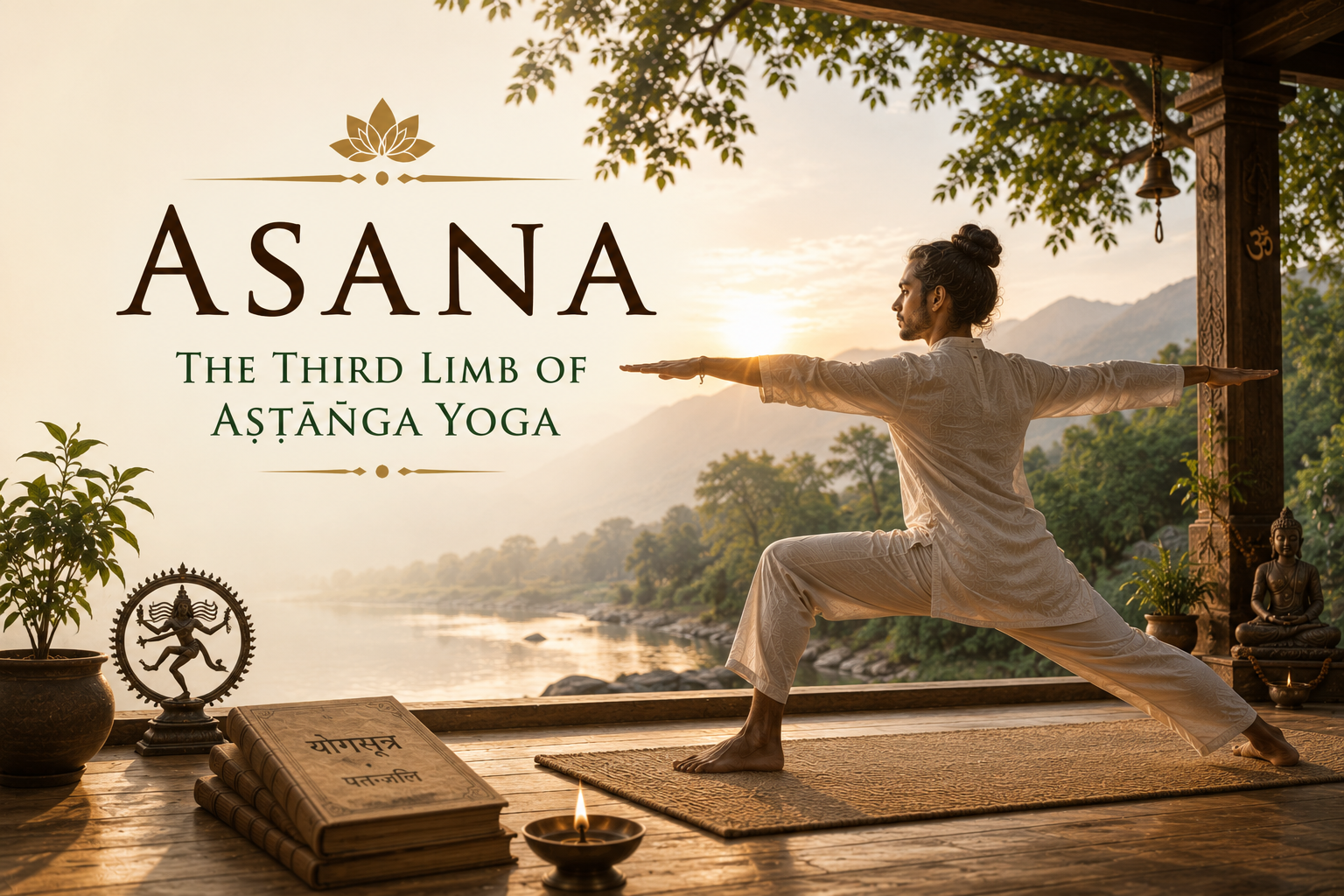
Introduction
Āsana is the third limb of Ashtanga Yoga. Today, most people equate Yoga almost entirely with Āsana, when in truth Āsana is only a small part of the complete system. Of Maharṣi Patañjali's roughly 195–196 Yoga Sūtras (the exact count varies slightly across published editions), only three sūtras deal directly with Āsana. This alone makes clear that Yoga is not merely the practice of physical postures — it is a complete philosophy for living.

The Meaning of Āsana
In Sanskrit, Āsana means a steady and comfortable posture or way of sitting.
Maharṣi Patañjali defines Āsana in this sūtra:
"Sthira-sukham-āsanam." (Yoga Sūtra 2.46)
Meaning: the posture that is steady (Sthira) and comfortable (Sukha) is true Āsana.
But this is only the first of the three Āsana sūtras. The remaining two complete the picture, and are worth including in full:
"Prayatna-śaithilya-ananta-samāpattibhyām." (Yoga Sūtra 2.47) Perfection in the posture comes through the relaxation of effort, together with absorption on the infinite (Ananta).
"Tato dvandva-anabhighātaḥ." (Yoga Sūtra 2.48) Thereafter, one is no longer disturbed by the pairs of opposites (heat and cold, pleasure and pain, and so on).
Together, these three sūtras describe not just what a posture should feel like, but how it is perfected and what it ultimately yields.
The Core Principles of Āsana
1. Sthira (Steadiness)
- The body remains stable and balanced.
- There is no unnecessary trembling or instability.
- Appropriate control over the body is maintained.
2. Sukha (Ease)
- The posture holds comfort and ease.
- There is no tension in either body or mind.
- The breath remains natural and calm.
3. From Effort Toward Effortlessness
Entering a posture initially requires effort, but once established in the posture, the body and mind should become fully at ease. This is precisely what Yoga Sūtra 2.47 describes — perfection of the posture through the "relaxation of effort" (Prayatna-śaithilya).
If a posture involves excessive struggle, tension, or pain, it is not considered an ideal Āsana from a Yogic point of view.
A note on "Ananta" in Sūtra 2.47: this word is usually translated simply as "the infinite," and the sūtra is often read as absorbing the mind in that boundlessness. It is worth knowing that Vyāsa's classical commentary offers a more specific reading: Ananta is also the name of the great serpent (also called Śeṣa) upon whom Lord Viṣṇu reclines — a being of legendary steadiness. Read this way, Sūtra 2.47 suggests that perfect posture comes from a steadiness as vast and unwavering as that of Ananta himself, in addition to the more general reading of "meditating on the infinite." Both readings are part of the classical commentarial tradition and are worth knowing.
4. Steadiness of Breath
The sign of a correct posture is:
- The breath remains long and calm.
- The flow of breath stays smooth.
- There is harmony between body and breath.
5. The Unity of Mind and Body
Āsana is not merely physical exercise.
When body, breath, and mind function together, the practitioner becomes established in the present moment, and mental duality begins to lessen — which is precisely the fruit Patañjali describes in Sūtra 2.48: freedom from being disturbed by the pairs of opposites.

The Real Purpose of Āsana
The purpose of Āsana is not simply:
- performing difficult postures,
- increasing flexibility,
- or capturing an attractive photograph.
Rather, its purpose is to:
- Bring stability to the body.
- Calm the mind.
- Prepare the body for meditation.
- Guide the practitioner toward inner balance.
Āsana and Modern Confusion
Today, social media often treats difficult and visually striking postures as the very symbol of Yoga.
According to Yoga philosophy —
- standing on one's head,
- taking the legs behind the head,
- or performing difficult postures generally
are not proof of Yoga's completeness.
If the mind remains disturbed, the practice of difficult postures alone is not what is meant by Yoga.
The Yogic View of Āsana
In Yoga, what matters is not:
- how difficult a posture you can perform,
but rather:
- Is your body steady?
- Is your mind calm?
- Is your breath at ease?
- Are you fully present in that moment?
The Benefits of Āsana
- Stability and balance develop in the body.
- Muscular strength and flexibility increase.
- The quality of breath improves.
- The mind becomes calm and focused.
- The body is prepared for meditation and Prāṇāyāma.
- Harmony is established between body, mind, and breath.
Key Points
- Āsana is the third limb of Ashtanga Yoga.
- Yoga is not limited to Āsana alone.
- Only three sūtras (2.46–2.48) in Patañjali's Yoga Sūtras deal with Āsana directly.
- "Sthira-sukham-āsanam" is the foundational definition of Āsana.
- A correct posture requires steadiness, ease, and calm breath.
- Initial effort in Āsana should give way to effortlessness, as described in Sūtra 2.47.
- Sūtra 2.48 describes the fruit of mastered Āsana: freedom from disturbance by dualities.
- Āsana is a practice of harmony between body, mind, and breath.
- Performing difficult postures is not the goal of Yoga.
- The purpose of Āsana is to prepare the body and mind for meditation.
Editorial Notes: Corrections and Clarifications
-
The original draft quoted only Sūtra 2.46 ("Sthira-sukham-āsanam") despite stating that three sūtras deal with Āsana. Since the article itself emphasises how few sūtras address Āsana, it seemed important to actually include all three — 2.46, 2.47, and 2.48 — so the reader sees the complete classical picture rather than only its most famous line.
-
The meaning of "Ananta" in Sūtra 2.47 has been given its fuller classical context. Popular teaching usually renders it simply as "the infinite." Vyāsa's commentary offers an additional, more specific reading — Ananta as the name of the cosmic serpent Śeṣa, a symbol of ultimate steadiness. Both readings are legitimate parts of the classical tradition and have been included together.
-
The count of "195–196 sūtras" has been left as an approximate range rather than a single fixed number, since different published editions of the Yoga Sūtras count the verses slightly differently depending on how certain sūtras are divided.
-
A note on scientific context (per your standing request to check facts against both scripture and science): the physiological benefits attributed to Āsana here — improved flexibility, muscular strength, and calmer breathing — are reasonably well supported by contemporary exercise-science and yoga-therapy research. The deeper claim that steady Āsana leads to freedom from being disturbed by dualities (Sūtra 2.48) describes a psychological and spiritual state that is harder to test empirically; it should be understood as a classical spiritual claim rather than one with direct scientific confirmation, even though related research on emotional regulation through embodied practice offers some loosely supportive context.

Conclusion
Āsana is not a display of flexibility or difficulty — it is the disciplined cultivation of a steady, comfortable posture from which effort gradually dissolves into ease, breath grows calm, and the mind settles into the present moment. Understood through all three of Patañjali's Āsana sūtras together, rather than the first alone, Āsana reveals itself as a small but essential doorway into the deeper, meditative aims of the entire eightfold path.
Want to go deeper into authentic Yoga practice with Iti Iti Yogashram?
Get in Touch