Ardha Uttānāsana (Half Forward Bend): Classical Sources, Anatomy, Alignment & Evidence-Based Guide
Ardha Uttānāsana (Half Forward Bend): The Complete Reference Guide
Editorial note, stated once: throughout this article, traditional yogic and Āyurvedic claims (chakra, prāṇa, dosha associations) are presented as traditional belief, not scientific fact, unless a specific evidence source is cited alongside them.
Name & Meaning
- Sanskrit: अर्धउत्तानासन (Ardha Uttānāsana)
- IAST Transliteration: Ardha Uttānāsana / Ardha Uttanasana
- English: Half Forward Bend / Halfway Lift / Flat Back Pose
- Etymology: Ardha (half) + Ut (intense) + Tāna (stretch / extension) + Āsana (posture / seat). "The half-extended posture bridging standing folds, where the spine stretches flat and parallel to the floor."
Introduction
- Ardha Uttānāsana is an essential transitional and strengthening posture in Haṭha and Vinyasa Yoga, bridging deep standing forward folds with upright extensions.
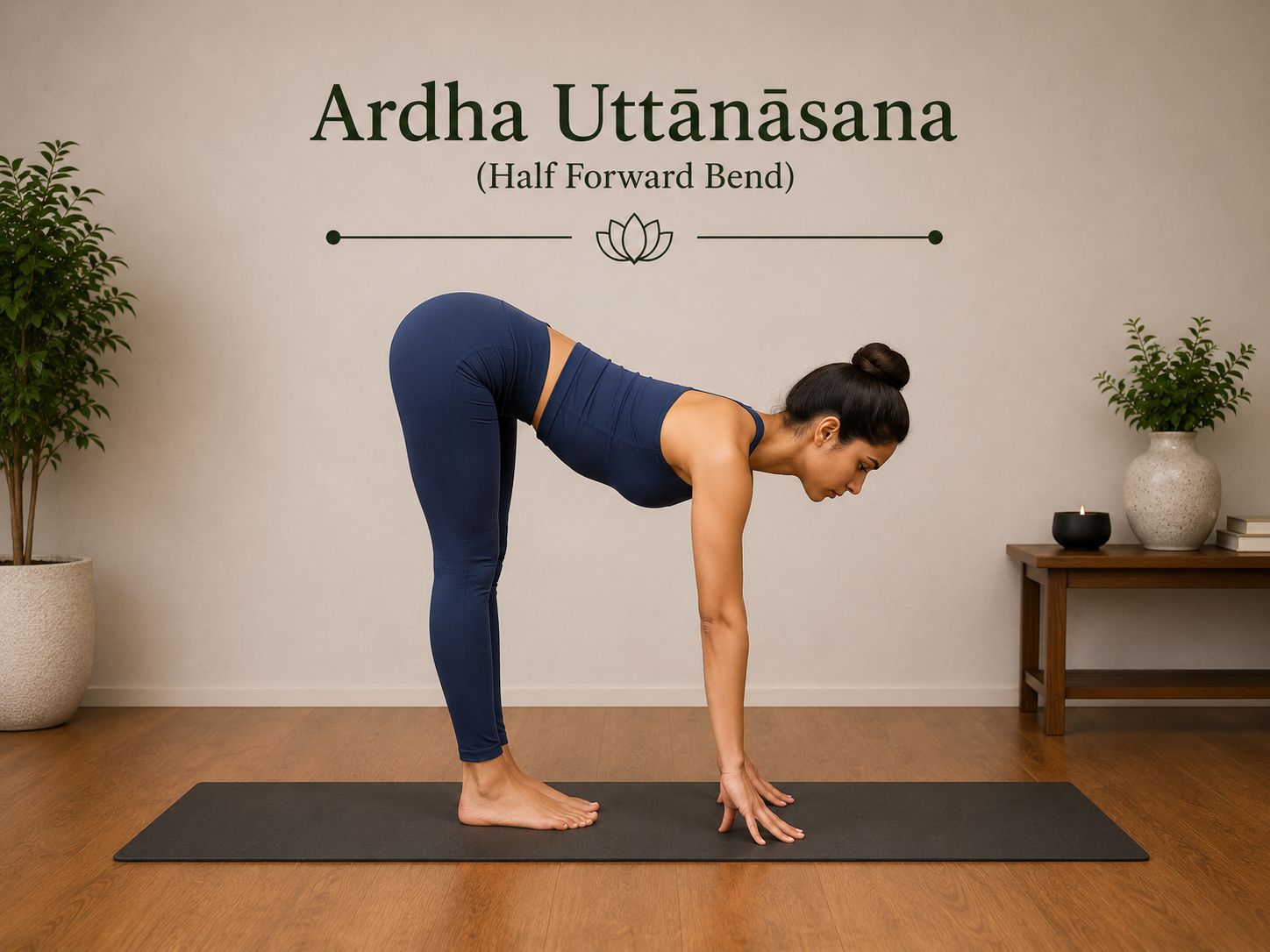
- Characterized by lifting the torso halfway up from Uttānāsana, extending the spine into a long, flat line parallel to the floor, placing fingertips on the mat or palms resting flat against the shins, and drawing the gaze forward.
- Widely integrated into the Ashtanga Vinyasa Yoga system as the mandatory halfway-lift transition in Surya Namaskar A & B, and detailed extensively in the Iyengar method.
- Functions as an outstanding clinical diagnostic for evaluating spinal extension strength, thoracic mobility, hamstring-pelvic interactions, and proprioceptive body awareness.
Benefits
- Erector Spinae & Back Extensor Strengthening: Intensely engages the erector spinae, multifidus, and rhomboids to build functional endurance along the entire spinal column.
- Thoracic Extension & Postural Correction: Counteracts rounded upper-back slouched postures by broadening collarbones and drawing shoulder blades down the back.
- Spinal Decompression & Length: Axial extension creates negative pressure across intervertebral discs, relieving compression from previous deep folds.
- Proprioceptive Spinal Awareness: Teaches practitioners how to isolate neutral lumbar extension from pelvic tilting.
- Traditional/Spiritual: Believed to stimulate Manipūra (solar plexus) chakra, circulate Prāṇa Vāyu upward, and bring mental clarity—traditional belief, not a scientific claim.
How to Practice Ardha Uttānāsana: Step-by-Step
| Step | Action | Breath | Teacher Cue |
|---|---|---|---|
| 1 | Begin in a full forward fold (Uttānāsana) with feet together or hip-width apart, knees micro-bent if needed. | Exhale fully in fold | "Start from your deepest forward fold, releasing your neck completely." |
| 2 | Inhale, lift your head and chest halfway up. Slide your fingertips onto the floor (or place palms flat against your shins or thighs). | Inhale to lift halfway | "Inhale, lift your chest halfway up and slide your hands to your shins." |
| 3 | Extend your spine forward from tailbone to crown. Draw your shoulder blades toward each other and broaden your collarbones. | Hold breath briefly or sip air | "Draw your shoulders back and lengthen your spine flat like a table." |
| 4 | Engage your core (draw lower belly inward) to support the flat back. Keep your gaze directed softly forward on the floor a few feet ahead. Hold 3–5 breaths. | Steady breath in extension | "Hugs your low belly in to support your long, flat back." |
| 5 | To exit, either exhale to fold back down into Uttānāsana, or inhale to rise all the way up to standing, or exhale to step/jump back into Chaturaṅga. | Exhale to fold or transition | "Exhale to melt back down into your forward fold, or step back to plank." |
Common Mistakes & Corrections
- Remaining hunched with a rounded back: Lifting the head while keeping the mid-back rounded fails to engage spinal extensors → Correction: Place hands higher up on shins or thighs, and focus on drawing shoulder blades together to flatten the back.
- Craning the neck upward too far: Throwing the head back strains cervical vertebrae → Correction: Keep the back of the neck long, aligning the head as a natural extension of the flat spine, gazing at the floor ahead.
- Pressing hands directly onto the knee joints: Pushing against kneecaps hyperextends and damages knee ligaments → Correction: Place hands either on the shins, thighs, or fingertips on yoga blocks on the floor.
- Shifting weight into heels: Leaning backward causes the body to lose balance during transitions → Correction: Distribute weight evenly across the entire sole of the foot.
Contraindications & Precautions
- Acute Lumbar Sprain or Severe Disc Injury: Holding a flat back against gravity can overload injured paraspinal tissues; practice full support with hands on thighs or avoid.
- Severe Vertigo or Low Blood Pressure: Rapid transitions from a full fold to a halfway lift can cause temporary lightheadedness; move slowly and keep gaze steady.
Sequencing: Preparatory, Follow-up & Variations
- Preparatory Poses: Uttānāsana (Full Forward Bend), Bhujaṅgāsana (Cobra), Daṇḍāsana (Staff Pose).
- Placement in Sequence: Used constantly as a transition pose in Surya Namaskar (Sun Salutations) between forward folds and planks/lunges.
- Follow-up Poses: Uttānāsana, Chaturaṅga Daṇḍāsana, Samasthitiḥ.
- Variations:
- Hands on Shins Ardha Uttānāsana: Standard variant providing leverage for a flat back.
- Fingertips on Yoga Blocks: Placing blocks under hands to maintain a flat back when hamstrings are tight.
- Urdhva Mukha Pādāṅguṣṭhāsana: Holding big toes while lifting halfway up.
Modifications
- Hands on Shins or Thighs: Resting hands higher up on the legs gives better leverage to flatten the upper back if hamstrings or back muscles are tight.
- Yoga Blocks Under Hands: Place two yoga blocks on their highest setting beneath your fingertips to maintain a flat back without straining.
- Micro-Bend Knees: Soften the knees slightly to release hamstring pull on the pelvis, making it easier to achieve a flat spine.
Historical Background & Classical References
- Vinyasa Systematization: While classical medieval texts focused primarily on seated meditation seats, Ardha Uttānāsana was formalized into an integral transition pose by T. Krishnamacharya and popularized globally in Ashtanga Vinyasa Yoga and Iyengar Yoga.
- Functional Role: Serves as the crucial spinal reset in Sun Salutations, ensuring the spine is flat and elongated before transitioning into high-plank or jumping back.
Alignment Principles (Iyengar Method)
- Concave Spine Extension: Upper back draws inward slightly (concave lift) to eliminate hunching while lower back remains neutral.
- Scapular Retraction: Shoulder blades draw down and toward each other, opening chest.
- Cervical Neutrality: Neck follows line of spine without dropping or craning.
Anatomy & Biomechanics
- Primary Stretched Muscles: Hamstrings, Gluteus Maximus, Thoracolumbar Fascia (mildly during lift).
- Primary Active/Strengthening Muscles: Erector Spinae, Multifidus, Rhomboids, Middle/Lower Trapezius, Transverse Abdominis, Quadriceps.
- Joint Mechanics: Hip flexion (approx. 45° to 70°); knee extension; spinal extension (thoracic and lumbar); cervical neutral extension.
- Spinal Biomechanics: Lifting the torso against gravity from a forward fold requires eccentric-to-concentric contraction of the erector spinae. Using the hands on shins creates a closed kinetic chain, allowing upper body leverage to assist thoracic extension.
Nervous System & Breathing Effects
- Inspiratory Expansion: The inhalation accompanying the halfway lift expands the thoracic ribcage, stimulating sympathetic alertness for the upcoming Vinyasa transition.
Yogic & Āyurvedic Perspective
- Dosha Impact: Energizes Vāta and sparks Pitta focus through active spinal extension—traditional belief.
- Prāṇa Dynamics: Directs Prāṇa Vāyu upward along the spinal channel, preparing the body for active movement.
Therapeutic Applications
| Condition | Mechanism | Research / Precaution |
|---|---|---|
| Upper Back Slouching & Kyphosis | Strengthens scapular retractors and erector spinae while lengthening chest | Supported by postural physical therapy research. Precaution: Keep collarbones broad. |
Yoga is never a replacement for medical treatment; serious or persistent conditions require a qualified healthcare professional.
Teaching Cues & Hands-On Adjustments
- Verbal Cues: "Inhale, lift your chest halfway and lengthen your spine flat like a tabletop." / "Draw your shoulder blades down your back." / "Rest your hands on your shins and look a few feet ahead on the floor."
- Hands-on Adjustment (Safe execution with consent):
- Stand behind student; place the flat of your hand gently between their shoulder blades, encouraging them to lift their chest and flatten their upper back.
- Place hands on their sacrum to guide a neutral flat spine alignment.
Myth vs. Fact
| Myth | Fact |
|---|---|
| Ardha Uttānāsana is just a lazy way to stand up from a forward fold. | It is an active strengthening posture that requires intense activation of the erector spinae and core muscles to hold a flat back. |
| Your hands must touch the floor in the halfway lift. | Placing hands on shins or thighs provides crucial leverage to keep the spine flat, especially for practitioners with tight hamstrings. |
Conclusion
Ardha Uttānāsana (Half Forward Bend) is a vital transitional posture that builds spinal strength and postural awareness. By lifting halfway with a flat back, engaging the erector spinae, and breathing with intention, practitioners ensure safe, aligned movement through their flow.
Quick Facts
| Category | Standing spinal extension / Transition pose |
| Difficulty Level | Beginner / Foundational |
| Primary Muscles Active | Erector Spinae, Multifidus, Rhomboids, Transverse Abdominis, Quadriceps |
| Classical Source? | Yes (Modern classical formalization in Ashtanga & Vinyasa) |
| Traditional Chakra (Belief) | Manipūra (Solar Plexus) |
| Dosha Impact (Belief) | Energizes Vāta & Pitta |
Frequently Asked Questions
What does Ardha Uttānāsana mean in English?
Ardha (half) + Ut (intense) + Tāna (stretch) + Āsana (pose) = Half Forward Bend or Halfway Lift.
Where should my hands go in Ardha Uttānāsana?
Hands can rest on your shins, thighs, fingertips on the floor, or on yoga blocks. Placing them on your shins is ideal for most practitioners to maintain a flat back.
Why is the halfway lift important in Sun Salutations?
The halfway lift elongates and flattens the spine before moving into high plank or jumping back, protecting your lower back from compressive injury.
How long should I hold Ardha Uttānāsana?
In Vinyasa flow, it is held for 1 breath (an inhale). In alignment-based classes, it can be held for 3 to 5 breaths.
References
1. Modern Classical Yoga Texts: Iyengar, B.K.S. (1966). Light on Yoga. Schocken Books. Jois, K. Pattabhi (2002). Yoga Mala. North Point Press.
2. Peer-Reviewed Scientific Research:
- Sherman, K. J., et al. (2011). A randomized trial comparing yoga, stretching, and a self-care book for chronic low back pain. Archives of Internal Medicine, 171(22), 2019-2026.
- Ni, M., et al. (2014). Comparative muscle activation patterns during yoga postures in elderly adults. BMC Complementary and Alternative Medicine, 14, 401.
This article is for educational purposes and does not replace individualized medical or physical therapy advice. Consult a qualified healthcare provider before beginning any new practice.